Road signs in the United States
In the United States, road signs are, for the most part, standardized by federal regulations, most notably in the Manual on Uniform Traffic Control Devices (MUTCD) and its companion volume the Standard Highway Signs (SHS).
There are no plans for adopting the Vienna Convention on Road Signs and Signals standards. The 1971 MUTCD adopted several Vienna Convention-inspired symbol signs with the intent to transition to symbols in lieu of words as "rapidly as possible",[1][2][3] but U.S. drivers were baffled by symbol signs.[4][5] The language about "rapidly" transitioning to symbols was removed in the 1978 MUTCD.[6] The result was to effectively freeze several measures intended to be temporary until U.S. drivers could learn the relevant symbols' meanings. For example, the "Do Not Enter" word message is not found on the Vienna Convention's equivalent sign. Two symbol signs were eliminated, respectively, in the 2000 and 2003 MUTCDs (thereby requiring use of the previous word message signs): Pavement Ends and Narrow Bridge.[7]
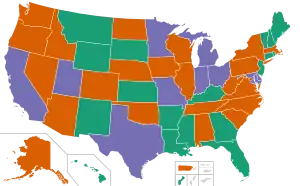
Eighteen states use the manual without alterations; 22 states, the District of Columbia, and Puerto Rico have adopted it in conjunction with a supplemental volume; and ten states have a state version in substantial conformance to the MUTCD.[8] There are localized versions used in large cities such as New York City which use a naming system compatible with the MUTCD and/or state supplement. The MUTCD and SHS establish seven categories of signs for road and highway use, as follows[9] (all signs from national MUTCD, unless noted):
Regulatory signs
Regulatory signs give instructions to motorists, pedestrians, and cyclists. Signs including Stop, Yield, No Turns, No Trucks, No Parking, No Stopping, Minimum Speed, Right Turn Only, Do Not Enter, Weight Limit, and Speed Limit are considered regulatory signs. Some have special shapes, such as the octagon for the Stop sign and the crossbuck for railroad crossings. Some signs can be localized, such as No Parking, and some are found only in state and local jurisdictions, as they are based on state or local laws, such as New York City's "Don't Block the Box" signs. These signs are in the R series of signs in the MUTCD and typically in the R series in most state supplements or state MUTCDs.
R1 series: Stop and yield
The MUTCD's R1 series is for Stop and Yield. As not all situations are covered, several states have their own standards in addition to the MUTCD. The 4-WAY and 3-WAY plaques (R1-3) were deprecated in the 2009 Edition of the MUTCD in favor of the ALL WAY plaque (R1-3P).
- Stop and Yield
 R1-1: Stop
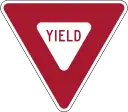 R1-2: Yield
 R1-2aP: To oncoming traffic (plaque)
 R1-3P: All way (plaque)
 R1-5: Yield here to pedestrians
 R1-5a: Yield here to pedestrians
 R1-5b: Stop here for pedestrians
 R1-5c: Stop here for pedestrians
.svg.png.webp) R1-6: In-street pedestrian crossing[lower-alpha 1]
R1-6: In-street pedestrian crossing[lower-alpha 1].svg.png.webp) R1-6a: In-street pedestrian crossing[lower-alpha 1]
R1-6a: In-street pedestrian crossing[lower-alpha 1] R1-6b: In-street school crossing
 R1-6c: In-street school crossing
 R1-7:Wait on stop
 R1-8: Go on slow
 R1-9: Overhead ped crossing[lower-alpha 1]
 R1-9a: Overhead ped crossing[lower-alpha 1]
 R1-10P: Except right turn
R2 series: Speed limit
The MUTCD's R2 series is for speed limit signs. Some state supplements and state MUTCDs place various speed limit signs in other series. As all situations are not covered, several states have their own standards in addition to the MUTCD. Speed limits in the United States are always in miles per hour. Metric speed limit signs in kilometers per hour are authorized but extremely rare, usually seen near the borders with Canada and Mexico, both of which use the metric system.[10] Many states, however, disallow the use of metric signs on state-maintained roads due to MUTCD restrictions,[11] increasing the rarity of such signs.
- Speed Limit Signs
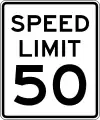 R2-1: Speed limit
 R2-1: Speed limit (metric)
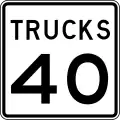 R2-2P: Truck Speed limit
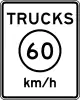 R2-2P: Truck speed limit (metric)
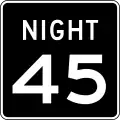 R2-3P: Night speed limit
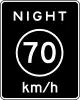 R2-3P: Night speed limit (metric)
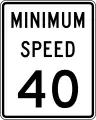 R2-4P: Minimum speed limit
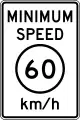 R2-4P: Minimum speed limit (metric)
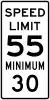 R2-4a: Combined speed limit
 R2-5P: Unless otherwise posted
 $XX fine
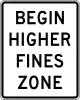 Begin higher/double fines
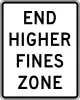 End double/higher fines
R3 series: Lane usage and turns
The MUTCD's R3 series of signs is for lane usage and turn signs. As all situations are not covered, several states have their own standards in addition to the MUTCD.
- Lane Usage and Turns Signs
 No right turn
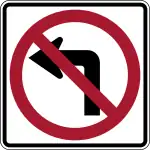 No left turn
 No turns
 No U-turn
 Left turn only
 Right turn only
 Straight ahead only
 Left lane
 Center lane
 Right lane
 Bus lane
 Option sign for left turn or straight
 Option sign for right turn or straight
 Left lane MUST turn left
 Right lane MUST turn right
 Advanced intersection control
 Turn only lanes
 Advanced intersection control
 Concurrent (center) left turn lane (overhead)
 Concurrent (center) Left Turn Lane (ground)
 Reversible lane control
 Center lane control (time)


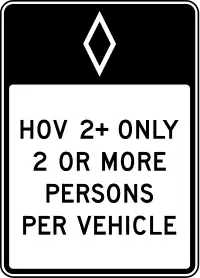 HOV 2+ only 2 or more persons per vehicle
 HOV 2+ only (time)
 HOV 2+ Time (LEFT LANE)
 24HR HOV 2+

 HOV lane ends

 HOV (overhead)
 Overhead
 Overhead
 Overhead
 Bike lane
 No left or U-turn
 No thru movement
 No left turn across tracks
R4 series: Regulation of movement
The MUTCD's R4 series of signs is for the regulation of movement signs. As all situations are not covered, several states have their own standards in addition to the MUTCD.
- Regulation of Movement Signs
 Do not pass
 Pass with care
 Left turn signal
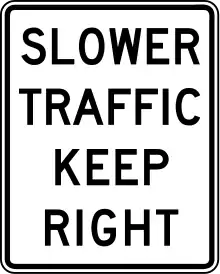 Slower traffic keep right
 Begin right turn lane yield to bikes
 Trucks use right Lane
 Truck lane 500 Feet
 Keep right
 Keep right
 Keep right
 Keep right (median island less than 4 feet wide)
 Keep left
 Keep left
 Keep left
 Keep left (median island less than 4 feet wide)
 Stay in lane
 Runaway vehicles only
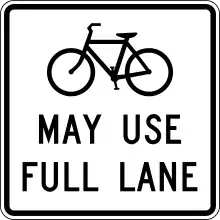 Cyclists may use full lane
 Slow vehicles with 5 or more following vehicles must use turn-out
 Slow vehicles must use turn-out ahead
 Slow vehicles must turn out
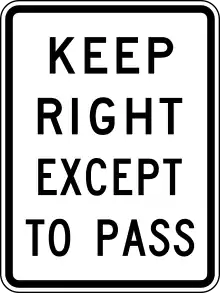 Keep right except to pass
 Do not drive on shoulder
 Do not pass on shoulder
R5 series: Exclusionary
The MUTCD's R5 series of signs is for exclusionary signs. As all situations are not covered, several states have their own standards in addition to the MUTCD. The most common of these signs is the do not enter sign.
- Exclusionary Signs
 Do not enter
 Wrong way
 Bicycles wrong way
 No trucks
 No motorized vehicles
 No commercial vehicles
 No lugged vehicles
 No bicycles
 No nonmotorized traffic
 No motor driven cycles
 No pedestrians bicycles motor driven cycles
 No pedestrians or bicycles
 No pedestrians
 No unauthorized vehicles
R6 series: One way and divided highway
The MUTCD's R6 series of signs is for one way and divided highway signs. As all situations are not covered, several states have their own standards in addition to the MUTCD. The most common of these signs is the One Way sign.
- One Way and Divided Highway
 One way
 One way, alternate
 Divided highway crossing
 Divided highway crossing, T-intersection
 Chevron roundabout directional
R7 series: Parking
The MUTCD allows for three types of parking signs: permissive, No Parking, and No Standing. However, in most states, there is an additional more restrictive one, No Stopping. These signs are found in the R7 series of signs in the MUTCD. As all situations are not covered, several states and local governments have their own standards in addition to the MUTCD. Permissive parking signs allow for parking for either an unlimited or varied amount of time. They are often used in conjunction with parking meters and parking permits. They are specified by the MUTCD to be green on white. Local variations occur with additional information and slightly different designs. No Parking signs indicate that loading or unloading while temporarily stopped is permitted, but the driver must not leave the vicinity of the vehicle.[12] Some No Parking signs display time restrictions, while others are permanent restrictions. There are also temporary versions of the signs, often of similar design to the permanent ones. These signs are specified by the MUTCD to be red on white, although local variations occur. No Standing signs indicate that stopping temporarily to load or unload passengers is allowed, but vehicles cannot be stopped at the location for longer periods of time, even if the driver remains with the vehicle.[12] As with no parking signs, some restrictions displayed on the signs are permanent and some are time based.
- Parking
 No parking
 No parking from 8:30 am to 5:30 pm
 No parking from 8:30 am to 5:30 pm (alternative)
 No Parking; Except Sundays
 No standing any time
 one hour parking time
 Two hours parking time
 No parking; Loading zone
 Parking fee station
 Reserved parking (wheelchair)
 Van accessible
 No parking bus stop
 Parking pay parking
 (Combined) no Parking one hour parking time
 Tow Away Zone
R8 series: Parking and emergency restrictions
The MUTCD's R8 series of signs is for parking restriction and emergency restriction signs. As all situations are not covered, several states have their own standards in addition to the MUTCD.
- Parking and Emergency Restrictions
 No parking on pavement
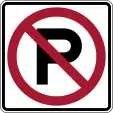 No parking
 Exception of Sundays and holidays
 On tracks plaque
 Except on shoulder plaque
 Loading zone
 No stopping on pavement
 Stop here when flashing
R9 series: Bicycles and pedestrians
The MUTCD's R9 series of signs is for bicycle and pedestrian signs. As all situations are not covered, several states have their own standards in addition to the MUTCD.
- Bicycle and Pedestrian Signs
 Walk on left facing traffic
 Cross only at cross walks
 No pedestrians
 No rollerblading
 No hitch hiking
 Bicycles left pedestrians right
 Sidewalk Closed Use Other Side
 No horseback riding
R10 series: Traffic signal
The MUTCD's R10 series of signs is for traffic signal related signs. As all situations are not covered, several states have their own standards in addition to the MUTCD.
- Traffic Signal Signs
 Crosswalk signal instructions
 Stop here on red
.svg.png.webp) Turning vehicles yield to pedestrians
Turning vehicles yield to pedestrians Left turn yield on green
 Bicycles to request green wait on line
 Left turn yield on flashing yellow arrow, version 1
 Left turn yield on flashing arrow, version 2
R11 series: Road closed
The MUTCD's R11 series of signs is for road closure-related signs. As all situations are not covered, several states have their own standards in addition to the MUTCD.
- Road Closed Signs
 Road closed
 Road closed ahead
 Bridge out ahead
R12 series: Weight limits
The MUTCD's R12 series of signs is for weight limit-related signs. As all situations are not covered, several states have their own standards in addition to the MUTCD.
- Weight Limits Signs
 Weight limit
 Axle weight limit
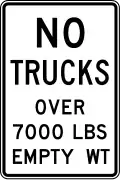 Truck weight limit
 Weight limit with per axle and gross
 Weight limit with truck symbols
R13 series: Weigh stations
The MUTCD's R13 series of signs is for weigh station related signs. As all situations are not covered, several states have their own standards in addition to the MUTCD.
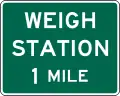 Weigh station sign
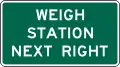 Weigh station next right sign
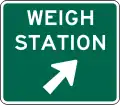 Weigh station sign with right exit arrow
R14 series: Truck routes
The MUTCD's R14 series of signs is for truck route-related signs. As all situations are not covered, several states have their own standards in addition to the MUTCD.
 Truck route sign
 Hazardous material route
 Hazardous material prohibited
 National Network Route
 National Network prohibited
R15 series: Rail and light rail
The MUTCD's R15 series of signs is for rail- and light rail-related signs. As all situations are not covered, several states have their own standards in addition to the MUTCD.
- Rail and Light Rail Signs
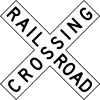 Railroad crossing (crossbuck)
 Three tracks
 This railroad stop is exempt from the horn blowing
 Light rail only in right lane
 Light rail only in left lane
 Light rail only in center lane
 Do not pass stopped trains
 Do not drive on tracks
 Divided highway transit rail crossing
 Look both ways at track
R16 series: Seat belts and headlight use
The MUTCD's R16 series of signs is for seat belt and headlight use-related signs. As all situations are not covered, several states have their own standards in addition to the MUTCD.
- Seat Belts and Headlight Use Signs
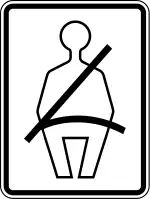 Wear seat belt
 Lights on when raining
 Check headlights
 Turn on headlights
 Fender bender
Warning signs
Warning signs are found in the W series of the national MUTCD. They highlight existing conditions, such as a curve, school, dead end street, or traffic signal. They can also warn of possible danger such as bumps, bicycles, low flying aircraft, or emergency vehicles. They are either yellow or fluorescent yellow in color and, with a few exceptions, are usually diamond-shaped and sometimes have square or rectangular smaller signs or plaques associated with them. Most W series signs can also be found with orange backgrounds for temporary use in situations such as construction zones. Some of the temporary-use signs are for use only in temporary situations.
W1 series: Horizontal alignment
The MUTCD's W1 series of signs is for warning signs relating to horizontal alignment As not all situations are covered, several states have their own standards in addition to the MUTCD.
- Curves and Turns
 Turn
Turn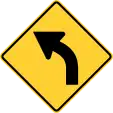 Curve
Curve Curve with minor road
 Reverse turn
 Reverse curve
 Arrow
Arrow Double arrow
 Chevron
 Winding road
 Turn around road
 Truck rollover warning
 270-degree loop
W2 series: Junctions
The MUTCD's W2 series of signs is for warning signs relating to junctions. As not all situations are covered, several states have their own standards in addition to the MUTCD.
- Junctions
 Crossroad junction
 Side road junction
 Slanted side road junction
 T junction
 Y junction
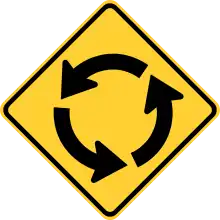 Roundabout
 Offset side roads
 Double side roads
W3 series: Advance traffic control
The MUTCD's W3 series of signs is for warning signs relating to advance traffic controls. As all situations are not covered, several states have their own standards in addition to the MUTCD. The MUTCD provides options for graphic and text signs.
- Advance Traffic Control
 Stop sign ahead
 Yield sign ahead
 Speed limit ahead
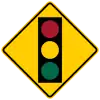 Traffic lights Ahead
 Be prepared to stop
 Speed zone ahead
 Draw bridge ahead
 Ramp meter ahead
 Ramp metered when flashing
W4 series: Lanes and merges
The MUTCD's W4 series of signs is for warning signs relating to lane merges and added lanes, as well as lane endings. As all situations are not covered, several states have their own standards in addition to the MUTCD.
- Lanes and Merges
 Merge ahead
 Right lane ends
 Lane drop ahead
 Added left lane
 Added right lane
 Cross traffic does not stop
 Merge on slip lane
 Added left lane on slip lane
 Added right lane on slip lane
W5 series: Road width restrictions
The MUTCD's W5 series of signs is for warning signs relating to road width restrictions. As all situations are not covered, several states have their own standards in addition to the MUTCD. The MUTCD provides options for graphic and text signs.
- Road Width Restrictions
 Road Narrows
 Narrow Bridge
 One lane bridge
 Path Narrows
 Bikeway narrows
W6 series: Divided highway
The MUTCD's W6 series of signs is for warning signs relating to divided highways. As all situations are not covered, several states have their own standards in addition to the MUTCD. The MUTCD provides options for graphic and text signs.
- Divided Highways
 Divided Highway
 Divided highway ends
 Two-way traffic
W7 series: Hills
The MUTCD's W7 series of signs is for warning signs relating to hills. As all situations are not covered, several states have their own standards in addition to the MUTCD.
- Hills
 Steep grade/hill
 Hill
Hill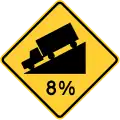 Steep grade/hill percentage
 Use low gear
 Trucks use lower gear
 X% grade ahead
 Next (distance) miles ahead
 X% grade (distance) miles ahead
 Runaway truck ramp ahead
 Runaway truck ramp
 Truck escape ramp
 sand
sand gravel
 paved
paved Hill (bike)
 Hill blocks view
W8 series: Pavement and roadway conditions
The MUTCD's W8 series of signs is for warning signs relating to pavement and roadway conditions. As all situations are not covered, several states have their own standards in addition to the MUTCD.
- Pavement and Roadway Conditions
 Bump
Bump Dip
Dip Pavement ends
 Soft shoulder
 Slippery ahead
 Loose gravel
 Rough road
 Bicycle slippery ahead
 Uneven lanes
 No center line
 Bridge ices before road
 Fallen rocks
 Metal bridge deck
 Road may flood
 Gusty Winds Area
 Fog area
 No shoulder ahead
 Shoulder ends
W9 series: Lane transitions
The MUTCD's W9 series of signs is for warning signs relating to lane transitions. As all situations are not covered, several states have their own standards in addition to the MUTCD.
- Lane Transitions
 Lane ends
 Lane ends merge...
 Center lane closed ahead
W10 series: Crossings
The MUTCD's W10 series of signs is for warning signs relating to crossings. As all situations are not covered, several states have their own standards in addition to the MUTCD.
- Grade crossings
 Crossing ahead
 Crossing on junction ahead
 Skewed crossing ahead
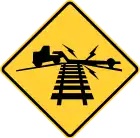 Low ground clearance
 Trains may exceed 80 mph
 No train horn warning
W11 series: Advance warnings
The MUTCD's W11 series of signs is for warning signs relating to advance warnings. As all situations are not covered, several states have their own standards in addition to the MUTCD. The MUTCD allows use of a fluorescent yellow-green background color for signs relating to non-motorized vehicles crossing the road.[13]
- Advanced warnings
 Bicycle
 Pedestrians
 Deer
Deer Cattle
 Farm vehicles
 Snowmobile
 Equestrian
 Emergency vehicle
 Handicapped
 Truck
Truck Golf cart
 Horse-drawn vehicles
 Bicycle and pedestrians
 Bear
Bear Sheep
Sheep Ram
Ram Donkey
 Elk
Elk Moose
Moose Wild horse
W12 series: Obstacles
The MUTCD's W12 series of signs is for warning signs relating to obstacles. As all situations are not covered, several states have their own standards in addition to the MUTCD. Metric low bridge signs in meters are authorized but extremely rare, usually seen near the borders with Canada and Mexico, both of which use the metric system.[10] Many states, however, disallow the use of metric signs on state-maintained roads due to system restrictions, increasing the rarity of such signs.
- Obstacles
 Double arrow obstacle
 Low bridge obstacle
 Low bridge obstacle metric
 Sign displays height of bridge
W13 series: Advisory speeds
The MUTCD's W13 series of signs is for warning signs relating to advisory speeds. As all situations are not covered, several states have their own standards in addition to the MUTCD. Speed limits in the United States are always in miles per hour. Metric advisory speed signs in kilometers per hour are authorized but extremely rare, usually seen near the borders with Canada and Mexico, both of which use the metric system.[10] Many states, however, disallow the use of metric signs on state-maintained roads due to system restrictions, increasing the rarity of such signs.
- Advisory Speeds
 Speed advisory
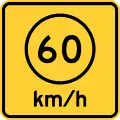 Speed advisory metric
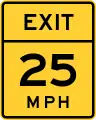 Exit speed advisory
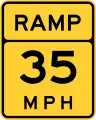 Ramp speed advisory
W14 series: Dead end streets and no passing zones
The MUTCD's W14 series of signs is for warning signs relating to dead-end streets and no-passing zones. As all situations are not covered, several states and local governments have additional signs for other types of situations not covered by the MUTCD.
- Dead End and Limited Access Streets
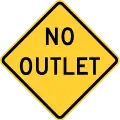 No Outlet
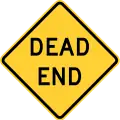 Dead End
 No Passing Zone
W15 series: Playgrounds
The MUTCD's W15 series of signs is for warning signs relating to playgrounds. As all situations are not covered, several states have their own standards in addition to the MUTCD.
- Playgrounds
 Playground[lower-alpha 2]
W16 series: Supplemental plaques
The MUTCD's W16 series of signs is for supplemental plaques for warning signs. As all situations are not covered, several states have their own standards in addition to the MUTCD.
- Supplemental Plaques
 XX feet
 XX feet
 X miles
 X miles
 Next XX feet
 Advance street name
 Advance street name (double arrow)
 Ahead
Ahead Photo enforced
 HOV
HOV Roundabout junction plaque
 When flashing
 New
New Notice
W17 series: Speed humps
The MUTCD's W17 series of signs is for warnings relating to speed humps. As all situations are not covered, several states have their own standards in addition to the MUTCD.
- Speed Humps
 Speed Hump
W18 series: No traffic signs
The MUTCD's W18 series of signs is for warnings relating to no further traffic signs. As all situations are not covered, several states have their own standards in addition to the MUTCD.
- No Traffic Signs
 No Traffic Signs
W19 series: Freeway or expressway end signs
The MUTCD's W19 series of signs is for warning signs relating to the end of a freeway or expressway. As all situations are not covered, several states have their own standards in addition to the MUTCD.
- Freeway or expressway end signs
 Freeway Ends
 Expressway Ends
 Freeway Ends
 Expressway Ends
 All traffic must exit
W20 series: Work zones
The MUTCD's W20 series of signs is for warning signs relating to work zones. These signs are typically orange background ones used for temporary situations. As all situations are not covered, several states have their own standards in addition to the MUTCD.
- Work Zone Signs
 Road Work Next 5 Miles
 End road work
 Work Zone Speed limit
 Road work ahead
 Road Closed Ahead
.svg.png.webp) Road is closed 1000 ft. ahead
Road is closed 1000 ft. ahead Detour
 End Detour
 End(If a road work blocked road)
 Flagger
W21 series: Road work
The MUTCD's W21 series of signs is for warning signs relating to road work. They typically have orange backgrounds and are used for temporary situations. As all situations are not covered, several states have their own standards in addition to the MUTCD
- Road Work Signs
 One lane road ahead
 Be prepared to stop
 Men working
 Fresh oil
 Utility work ahead
W22 series: Blasting zones
The MUTCD's W22 series of signs is for warning signs relating to blasting zones. They typically have orange backgrounds and are used for temporary situations. As all situations are not covered, several states have their own standards in addition to the MUTCD.
- Blasting Zone Signs
 Blasting zone ahead
 Turn off 2-way radios and cell phones
 End blasting zone
W23 series: Slow traffic
The MUTCD's W23 series of signs is for warning signs relating to slow traffic. They typically have orange backgrounds and are used for temporary situations. As all situations are not covered, several states have their own standards in addition to the MUTCD.
- Slow Traffic Signs
 Slow traffic ahead
 New traffic pattern ahead
W24 series: Lane shifts
The MUTCD's W24 series of signs is for warning signs relating to lane shifts, where traffic is diverted slightly toward the left or right of the roadway, but the route is otherwise unchanged. These signs typically have orange background and are used for temporary situations. As all situations are not covered, several states have their own standards in addition to the MUTCD.
- Double Reverse Curve Signs
 Double reverse curve
 Double reverse curve
 Double reverse curve
 All lanes
W25 series: Oncoming traffic has extended green
The MUTCD's W25 series of signs is for signs warning that oncoming traffic has an extended green signal at a traffic light. As all situations are not covered, several states have their own standards in addition to the MUTCD.
- Extended Green Signs
 Extended green
 Possible extended Green
Guide signs
Guide signs include highway route markers (shields), which are reassurance markers, interchange signs, including advance guide and exit signs, and mile markers. Advance guide and exit signs usually feature control cities or other locations to help direct drivers toward their destinations. The position of the exit number plaque indicates right or left exit[15] (and should indicate center lane exit).
Interchange signs
- Interchange Advance Guide Signs
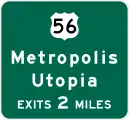 Interchange Guide sign
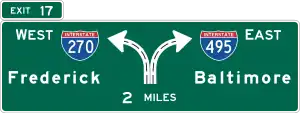 Interchange Guide sign
- Interchange Exit Direction Signs
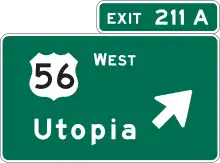 Interchange exit direction
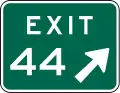 Exit number sign
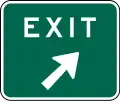 Exit sign
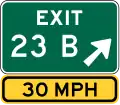 Exit number sign with speed advisory
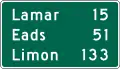 Mileage signs for highway routes
- Service and Rest Area signs
 Specific service signs for food (as shown)
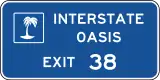 Interstate oasis
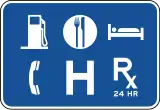 Advanced services sign
Toll signs
Chapter 2F of the MUTCD deals with signs relating to tolls.
- Toll Road Signs
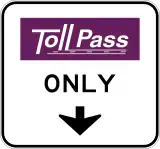 Toll road pass only
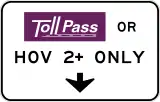 Toll road pass or HOV
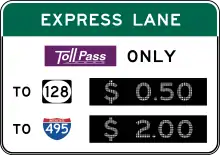 Toll costs at intersections or HOV
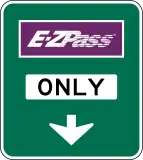 MUTCD Conventional Toll Plaza advance sign
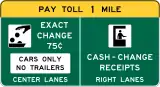 MUTCD Conventional Toll Plaza advance sign
 Pay toll
Motorist services
 Telephone
 Hospital
 Camping
 Trailer camping
 Litter container
 Handicapped accessible
 Gas
Gas Food
Food Lodging
 General information
 Diesel fuel
 Alternative fuel (CNG)
 Electric vehicle charging
 Alternative fuel (E85)
 RV sanitary station
 Ambulance symbol
 Police
 Propane gas
 Truck parking
 Pharmacy
 Telecommunication
 Wireless internet
General information
 Traffic Signal Speed
 State Line
 River
River Airport
 Bus Station
 Train Station
 Library
 Recycling Collection Center
 Light Rail Station
School zone signs
The S series of signs is specially designated by the MUTCD for use around schools. Some states have additional school warning-related signs in the S series, the W series of warning signs, and/or the R series of regulatory signs of the state supplement or state MUTCD. As of 2009 the MUTCD requires school warning signs to have fluorescent yellow-green backgrounds.[16]
- Schools
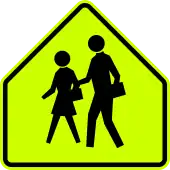 School zone ahead (also used for pedestrian crosswalk near schools) since 1998
.svg.png.webp) School bus stop ahead
School bus stop ahead School bus turn ahead
 Time of Day
 When Children are present
 School plaque
 When lights flashing
 School speed limit ahead
 School Speed zone ahead
 Day(s) of the week
 All year school zone ahead
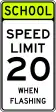 School speed limit when flashing
 End school zone (usually under an R2 speed limit sign)
See also
- Comparison of traffic signs in English-speaking countries
- Glossary of road transport terms
- Road signs in Canada
- Street signs in Chicago – Street name signs
- Street signs in New York City – Street name signs
- Warning sign
Notes
- The legend STATE LAW is optional. A fluorescent yellow-green color may be used instead of yellow for this sign.
- A fluorescent yellow-green background color may be used for this sign.[14]
References
- American Association of State Highway Officials; National Joint Committee on Traffic Control Devices (1971). "Section 2A-13, Symbols". Manual on Uniform Traffic Control Devices for Streets and Highways. Washington, D.C.: U.S. Department of Transportation, Federal Highway Administration. p. 16. Retrieved July 21, 2020.
- "Symbols to Replace Words on U.S. Traffic Signs". The New York Times. May 31, 1970. p. 58.
- Lindsey, Robert (April 23, 1972). "Signs of Progress: Road Symbols Guiding Traffic". The New York Times. p. S22. Retrieved August 19, 2020.
- Hazlett, Bill (March 23, 1972). "Some Confusing: Wordless Traffic Signs Popping Up". Los Angeles Times. p. E1. Available through ProQuest Historical Newspapers.
- Conniff, James C.G. (March 30, 1975). "Danger: Signs ahead". The New York Times. p. 183. Retrieved August 19, 2020.
- American Association of State Highway Officials; National Joint Committee on Traffic Control Devices (1978). "Section 2A-13, Symbols". Manual on Uniform Traffic Control Devices for Streets and Highways. Washington, D.C.: U.S. Department of Transportation, Federal Highway Administration. p. 2A-6.
- American Association of State Highway and Transportation Officials; National Joint Committee on Traffic Control Devices (2003). "Introduction". Manual on Uniform Traffic Control Devices for Streets and Highways. Washington, D.C.: U.S. Department of Transportation, Federal Highway Administration. Retrieved August 26, 2020.
- "MUTCDs & Traffic Control Devices Information by State". Manual on Uniform Traffic Control Devices. Federal Highway Administration. July 14, 2020. Retrieved January 11, 2021.
- Staff. "The Shape—and Color—Give Us a Sign". Federal Highway Administration. Archived from the original on April 1, 2009. Retrieved April 5, 2009.
- Metric signs on roads in the U.S.
- "23 CFR Part 655 National Standards for Traffic Control Devices; the Manual on Uniform Traffic Control Devices for Streets and Highways; Revision; Final Rule" (PDF). Retrieved April 2, 2019.
- Staff (October 2011). "Chapter 7: Parallel Parking". Driver's Manual and Study Guide. New York State Department of Motor Vehicles. Retrieved March 16, 2012.
- "2009 Edition Part 2 Figure 2C-11. Non-Vehicular Warning Signs". Manual on Uniform Traffic Control Devices. United States Department of Transportation. Retrieved June 6, 2012.
- "2009 Edition Part 2 Figure 2C-11. Non-Vehicular Warning Signs". Manual On Uniform Traffic Control Devices. United States Department of Transportation. Retrieved June 6, 2012.
- "MUTCD, Section 2E.28 - Interchange Exit Numbering" (PDF).
- "2009 Edition Chapter 7B. School Signs". Manual on Uniform Traffic Control Devices. The United States Department of Transportation. Retrieved June 6, 2012.
External links
 Media related to Road signs in the United States at Wikimedia Commons