The Blue Lagoon (novel)
The Blue Lagoon is a romance novel written by Henry De Vere Stacpoole and was first published by T. Fisher Unwin in 1908. The Blue Lagoon explores themes of love, innocence, and the conflict between civilization and nature. Stacpoole's vivid descriptions of the island and its natural beauty transport the reader to a world that is both enchanting and haunting.
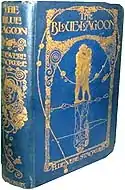 | |
| Author | Henry De Vere Stacpoole |
|---|---|
| Country | Great Britain |
| Language | English |
| Series | Blue Lagoon trilogy |
| Genre | Romance |
| Publisher | T. Fisher Unwin |
Publication date | 1908 |
| Media type | Print (hardcover) |
| Pages | 328 |
| Followed by | The Garden of God |
Plot summary
The story centers on two cousins, Dick and Emmeline Lestrange, who are marooned with a galley cook on an island in the South Pacific following a shipwreck. The galley cook, Paddy Button, assumes responsibility for the children and teaches them how to survive, cautioning them to avoid the "arita" berries, which he calls "the never-wake-up berries".
Two and a half years after the shipwreck, Paddy dies following a drinking binge. The children survive on their resourcefulness and the bounty of their remote paradise. They live in a hut and spend their days fishing, swimming, diving for pearls and exploring the island.
As the years pass, Dick and Emmeline grow into physically mature young adults and begin to fall in love. Ignorant of their human sexuality, they do not understand or know how to express their physical attraction to each other. Eventually, they consummate their relationship. The author, Henry De Vere Stacpoole, describes their sexual encounter as having been "conducted just as the birds conduct their love affairs. An affair absolutely natural, absolutely blameless and without sin. It was a marriage according to nature, without feast or guests".[1]
Dick becomes very attentive toward Emmeline, listening to her stories and bringing her gifts. Over several months they make love often and eventually Emmeline becomes pregnant. The couple does not understand the physical changes happening to Emmeline's body and have no knowledge of childbirth. When the day comes for delivery, Emmeline disappears into the forest and returns with a child. They discover over time that the baby requires a name and they call him "Hannah" because they have only ever known an infant called by that name.
Dick and Emmeline teach Hannah how to swim, fish, throw spears and play in the mud. They survive a violent tropical cyclone and other natural hazards of island life.
Back in San Francisco, Arthur, Dick's father and Emmeline's uncle, believes the two are still alive and is determined to find them, after recognizing a child's tea set belonging to Emmeline which was retrieved by a whaler on an island. Arthur finds a captain willing to take him to the island and they set out.
Meanwhile, Dick, Emmeline and Hannah row their lifeboat to the place where they had once lived with Paddy as children. Emmeline breaks a branch off the deadly arita plant as Dicky cuts bananas on the shore. While in the boat with her son, Emmeline fails to notice that Hannah has tossed one of the oars into the sea. The tide comes in and sweeps the boat into the lagoon, leaving Emmeline and Hannah stranded. As Dicky swims to them, he is pursued by a shark. Emmeline strikes the shark with the remaining oar, earning Dick time to climb into the boat safely.
Although they are not far from shore, the trio cannot get back without the oars and they are unable to retrieve them from the water because of the shark. The boat is then caught in the current and drifts out to sea; all the while Emmeline still grasps the arita branch.
Sometime later, Arthur's ship comes across the lifeboat and finds the three unconscious but still breathing. The arita branch is now bare save for one berry. Arthur asks, "Are they dead?" and the captain replies, "No, sir. They are asleep".[2] The ambiguous ending leaves it uncertain whether or not they can be revived.
Title
The title The Blue Lagoon derives from the Doge of Venice's speech in Lord Byron's Marino Faliero, Act I, Scene II:
I have fought and bled; commanded, aye, and conquered;
Have made and marred peace oft in embassies,
As it might chance to be our country's 'vantage;
Have traversed land and sea in constant duty,
Through almost sixty years, and still for Venice,
My fathers' and my birthplace, whose dear spires,
Rising at distance o'er the blue Lagoon,
It was reward enough for me to view
Once more; but not for any knot of men,
Nor sect, nor faction, did I bleed or sweat!— Lord Byron, Marino Faliero, Doge of Venice, Act I, Scene II, ll. 430–439[3]
Characters
- Emmeline Lestrange: a shipwrecked orphan, the heroine
- Dick Lestrange: Emmeline's cousin, a shipwrecked orphan, the hero
- Paddy Button: the galley cook of the wrecked ship
- Arthur Lestrange: Dick's father and Emmeline's uncle
- Hannah: Dick and Emmeline's son
History
In 1907, Henry De Vere Stacpoole underwent two pivotal experiences that had a profound impact on the course of his life. The first of these was the writing of his now renowned novel, The Blue Lagoon, which has since been hailed as a literary masterpiece and cemented his legacy as a talented author. The second event was his marriage to the love of his life, Margaret Robson. This union not only brought him great personal happiness, but also served as a source of unwavering support and inspiration throughout his career. Together, they formed a partnership that would endure a lifetime, allowing Stacpoole to flourish both creatively and emotionally. These two events, taken together, marked a turning point in his life and set him on a path towards artistic and personal fulfillment.
During a sleepless night, Stacpoole's mind wandered to the concept of a caveman's life. He found himself in awe of the primitive man's ability to appreciate and find wonder in the most basic of things, such as a sunset or thunderstorm. He compared this to the current era, where advanced technology has taken away the mystery and enchantment of these natural occurrences. Modern-day humans have become so consumed with the scientific explanation of things that they have lost the ability to appreciate the beauty and awe-inspiring qualities of nature. By doing so, they have deprived themselves of the simple joys that once filled them with wonder.
Stacpoole, being a seasoned medical practitioner, had encountered innumerable instances of both the beginning and end of life, and as a result, these occurrences no longer possessed any sense of awe or enigma for him. This led him to ponder about the concept of two young children who are forced to grow up on an isolated island with no access to any form of guidance or knowledge. These children would be subject to the natural phenomena of birth, death, and storms, and would have to experience the highs and lows of life without any assistance. Stacpoole found this idea fascinating, and was inspired to explore it further.
The next day, he delved into his work on The Blue Lagoon, putting all his energy and creativity into bringing his characters to life. This process turned out to be incredibly beneficial for him, as he found that he was able to explore the full range of human experience through his writing. Through the innocence and naivety of the two children at the heart of the story, he was able to reconnect with the wonder and complexity of life that he had somehow lost touch with during his time as a doctor. By immersing himself in the world of his own creation, he was able to rediscover the mystery and beauty of existence in a way that was both therapeutic and deeply satisfying.
Comparisons with Alice's Adventures in Wonderland
The author deliberately draws parallels between The Blue Lagoon and the Biblical story of Adam and Eve, highlighting the innocence and naivety of the two young protagonists, Emmeline and Dick. However, it is evident that the author is also influenced by Lewis Carroll's Alice's Adventures in Wonderland. The reference to Wonderland is made when the castaways' approach Palm Tree Island, which is the beginning of an adventure that is full of similarities to Alice's journey. Like Alice, Emmeline is around the same age, and their innocent curiosity leads them to explore their surroundings. Emmeline's tea party on the beach and her former pet's resemblance to the Cheshire Cat are examples of the author's clever allusions to Carroll's work.
The similarities continue with Emmeline's innocent attempt to eat the "never-wake-up berries" and receiving a lecture on poison from Paddy Button, which is reminiscent of Alice's encounter with the "Drink Me" bottle. The "Poetry of Learning" chapter also draws parallels with Alice's conversation with the caterpillar. Paddy's smoking of a pipe and the children teaching him to write his name in the sand echoes the caterpillar smoking a hookah while questioning Alice's identity.
The author also cleverly incorporates other references to wonder, curiosity, and strangeness throughout the novel, honoring Carroll's work. The children lose track of time, similar to the Mad Hatter's tea party, and undergo physical changes, like Alice growing taller and Emmeline becoming plumper. The reference to the baby in "Pig and Pepper" is also made when Hannah sneezes at the sight of Dicky.
Overall, Stacpoole's deliberate use of allusions to Carroll's work in The Blue Lagoon enhances the reader's experience and further highlights the innocence and wonder of the two young protagonists.
Reception
Upon its initial publication, the book rapidly gained popularity among a broad audience, including literary critics and the general public. The critical acclaim was substantial, with one reviewer commending the book's tale of discovering love and experiencing innocent mating, describing it as refreshing as the ozone that had strengthened the characters. Another reviewer went so far as to assert that the label of "romance," frequently used in contemporary works, was genuinely fitting for this novel.
The novel's popularity was evident from the fact that it was reprinted over twenty times in the following twelve years, which is a significant achievement for any literary work. Moreover, it remained popular in various formats since, demonstrating the novel's enduring influence on literature and popular culture.
Adaptations
Stage
- The Blue Lagoon (opened 28 August 1920) produced by Basil Dean. The adaptation was by Norman MacOwan and Charlton Mann.[4]
Films
Six films have been based on this novel:
- The Blue Lagoon (1923), a silent film directed by W. Bowden and Dick Cruickshanks, starring Molly Adair and Arthur Pusey; produced for African Film Productions (lost)
- The Blue Lagoon (1949), directed by Frank Launder, starring Jean Simmons and Donald Houston; currently owned by ITV Studios through The Rank Organisation film library
- The Blue Lagoon (1980), directed by Randal Kleiser, starring Brooke Shields and Christopher Atkins; released by Columbia Pictures
- Pengantin Pantai Biru (1983), an Indonesian adaptation
- Return to the Blue Lagoon (1991), directed by William A. Graham, starring Brian Krause and Milla Jovovich; released by Columbia Pictures
- Blue Lagoon: The Awakening (2012); produced by Sony Pictures Television for Lifetime
See also
References
- Stacpoole, H. de Vere. 1921. The Blue Lagoon. Duffield Publishing. p.229. Accessed October 9, 2021. Book URL.
- "The Blue Lagoon". goodreads.com. Retrieved 23 September 2014.
- Byron, George Gordon (1821). Marino Faliero, Doge of Venice : an historical tragedy, in five acts, with notes ; The prophecy of Dante : a poem. London : John Murray. p. 27. Retrieved 20 March 2023.
- "The Playhouses". The Illustrated London News. Illustrated London News. 157 (4246): 378. 4 September 1920. Retrieved 5 May 2023.
External links
- The Blue Lagoon at Project Gutenberg
 The Blue Lagoon public domain audiobook at LibriVox
- Primordial, and Three Laws & the Golden Rule by Morgan Robertson. These 1898 stories, which first appeared in Harper's monthly, are considered by some fans and scholars to be precursors to The Blue Lagoon. Some editions of The Blue Lagoon include Primordial in the appendix, the editors believing that Stacpoole may have been inspired by it.
- Fans of Edgar Rice Burroughs also acknowledge Robertson's contribution to Stacpoole's work as they study how both stories influenced Burroughs in the creation of Tarzan of the Apes. The Ape-Man, His Kith and Kin by Georges Doddes, published in Erbzine, is a collection of stories and references to stories about shipwrecked, feral children predating the Tarzan novels. The Blue Lagoon and Primordial/ Three Laws & the Golden Rule are reprinted in their entirety.