The Blue Lagoon (1949 film)
The Blue Lagoon is a 1949 British coming-of-age romance and adventure film directed and co-produced by Frank Launder (with Sidney Gilliat) and starring Jean Simmons and Donald Houston. The screenplay was adapted by John Baines, Michael Hogan, and Frank Launder from the 1908 novel The Blue Lagoon by Henry De Vere Stacpoole. The original music score was composed by Clifton Parker and the cinematography was by Geoffrey Unsworth.
| The Blue Lagoon | |
|---|---|
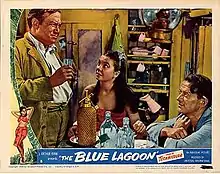 Lobby card | |
| Directed by | Frank Launder |
| Written by | Novel: Henry De Vere Stacpoole Screenplay: John Baines Michael Hogan Frank Launder |
| Produced by | Sidney Gilliat Frank Launder |
| Starring | |
| Cinematography | Geoffrey Unsworth |
| Edited by | Thelma Connell |
| Music by | Clifton Parker |
| Distributed by | General Film Distributors |
Release date | 1 March 1949 |
Running time | 101 minutes |
| Country | United Kingdom |
| Language | English |
| Budget | £311,100[1] |
| Box office | £351,400[2][1] |
The film tells the story of two young children shipwrecked on a tropical island paradise in the South Pacific. Emotional feelings and physical changes arise as they grow to maturity and fall in love. The film has major thematic similarities to the Biblical account about Adam and Eve.
Plot
In 1841, 8-year-old Emmeline Foster and 10-year-old Michael Reynolds, two British children, are the survivors of a shipwreck in the South Pacific. After days afloat, they are marooned on a lush tropical island in the company of kindly old sailor Paddy Button. Eventually, Paddy dies in a drunken binge, leaving Emmeline and Michael alone. They survive solely on their resourcefulness and the bounty of their remote paradise.
Eight years later, in 1849, the now-adult couple live together in the island paradise, fish, and collect "beads" from the shellfish in the surrounding lagoon. One day, a ship arrives carrying Doctor Murdoch and James Carter, two British men, who are intimated to have fled as criminals from civilization. Surprised to find the couple on the island, Doctor Murdoch soon realizes that Michael collects valuable pearls without knowing their true worth. While Murdoch attempts to trick Michael into getting him a bounty of pearls, Carter tries to kidnap Emmeline and escape. Murdoch and Carter kill each other on the boat, and Michael and Emmeline vow to never attempt to leave the island again. They marry, and during a tropical storm, a child, Paddy, is born.
In 1852, Emmeline is reminded of the outside world and wants to leave the island. She fears for their child if Michael and she should die. Michael gives in to her pleading and they pack a small boat and leave the island. Becalmed in mid-ocean, they succumb to exposure. They are found by a British ship, but the film leaves their fate ambiguous, showing only that Paddy remains alive in the small boat.
Cast
- Jean Simmons as Emmeline Foster
- Donald Houston as Michael Reynolds
- Susan Stranks as Emmeline (younger)
- Peter Rudolph Jones as Michael (younger)
- Noel Purcell as Paddy Button
- James Hayter as Dr. Murdock
- Cyril Cusack as James Carter
- Nora Nicholson as Mrs. Stannard
- Maurice Denham as Ship's Captain
- Philip Stainton as Mr. Ansty
- Patrick Barr as Second Mate
- Lyn Evans as Trotter
- Russell Waters as Craggs
- John Boxer as Nick Corbett
- Bill Raymond as Marsden
Production history
The film was an adaptation of a novel whose previous screen adaptation was completed for release in 1923, but it is the earliest-surviving adaptation.
Herbert Wilcox bought the rights to the novel in 1928 from I.W. Schlesinger, and announced it a year later as part of his slate of films in production.[3][4] He planned to film it in multiple-language versions in French and Spanish[5] and in 2-strip Technicolor and a full libretto of native music.[6] The project was abandoned due to the Great Depression, and was not restarted until 1935. After development resumed, Wilcox planned to cast either Joel McCrea or Richard Cromwell as the male lead. It was going to be shot in 3-strip Technicolor in Honolulu.[7] [8] [9]
He did not make the film, though, and sold the rights to Gainsborough Pictures at the recommendation of Frank Launder, who always admired the novel.[10] Gainsborough announced the film in 1938 as part of a slate of 10 films.[11] The stars were to be Michael Redgrave and Margaret Lockwood, who had just appeared in Gainsborough's The Lady Vanishes; Will Fyffe was to co-star.[12][13] Carol Reed was considered to direct.[14][15] In 1939, Gainsborough went into a co-production with 20th Century Fox and Lockwood was going to co-star with Richard Greene, under contract to Fox.[16] Plans to make the film were postponed due to the war.[17]
The project was reactivated after the war and announced in 1946 with Frank Launder attached to direct.[18] Extensive location searches were undertaken before deciding to make the film in Fiji.[19]
Plans to make the film were postponed due to Britain's currency difficulties, but eventually, plans were reactivated.[20]
Censorship
In 1946, Joseph Breen told Universal Studios that they could turn the book into a movie if they made some changes to follow the Hays Code. Breen said the characters couldn't be related, the romance should be between adults, and there couldn't be any sex scenes or birth scenes. He also asked them to take out the parents' suicide. In 1948, Breen approved the script with more changes, like no nudity or suggestive content, and suggested they show the marriage happening right away. Even though there were rules and restrictions, they still made and released the movie.[21]
Casting
Jean Simmons was attached to the project at an early stage, due to her success in Great Expectations (1946).[22]
Donald Houston was selected as the male lead over 5,000 applicants, 100 of whom were screen-tested.[23]
Filming
The film was shot on location in Fiji, Yasawa Islands,[24] and at Pinewood Studios, Iver Heath, Buckinghamshire, England.
In December, a light plane carrying Leslie Gilliat, the producer and brother of Sidney Gilliat, crashed into a river near Suva. Both Gilliat and the pilot escaped unharmed.[25]
Simmons left England in November, spent some time in Australia, and then travelled to Fiji.[26][27] There was uncertainty regarding her entry into Fiji due to her age of 18, and the colonial government of Fiji was discussing the possibility of prohibiting individuals under 19 from entering the country as a preventative measure against the introduction of polio.[28]
Houston and Simmons were almost injured in Fiji when the car they were in overturned.[29]
Most of the filming occurred on the Yasawa Islands, and due to bad weather conditions, the filming process was prolonged for three months.[30]
Reception
Commercial
The Blue Lagoon was the seventh-most popular film at the British box office in 1949.[31][32] According to Kinematograph Weekly, the 'biggest winner' at the box office in 1949 Britain was The Third Man with "runners up" being Johnny Belinda, The Secret Life of Walter Mitty, The Paleface, Scott of the Antarctic, The Blue Lagoon, Maytime in Mayfair, Easter Parade, Red River, and You Can't Sleep Here.[33]
Producer's receipts were £186,500 in the UK and £164,900 overseas.[1]
It made a profit of £40,300.[34] Most of the film's earnings came from abroad.
Critical
According to A. H. Weiler, a reviewer from the New York Times, the film depicted a tranquil Polynesian utopia accurately, but was lacking in excitement. Nonetheless, he acknowledged that the leisurely-paced events were juxtaposed against a picturesque backdrop of Technicolor sunsets, gorgeous beaches, and verdant vegetation. Additionally, he commended the competent performances of the limited cast. Nevertheless, Weiler believed that the movie's most noteworthy feature was its magnificent Technicolor scenery.[35]
In his review for Variety, Myro expressed that the Technicolor cinematography of a stunning South Pacific setting was an appropriate and romantic setting for the movie. However, he found fault with the weak plot and stated that the tale of two children marooned on a South Sea island lacked a cohesive storyline. Although he praised the movie's visual beauty, he criticized the leading actors for not being challenged beyond their physical appearances.[36]
A Harrison's Reports critic gave a mixed review. He praised the film's beautiful visuals but criticized the story's lack of believability and the pace of the movie as being mostly slow.[37]
Mandel Herbstman, a critic for the Motion Picture Daily, however, gave a positive review of the movie. He liked how the film used Technicolor to show both beautiful and violent scenes of nature. Herbstman thought that the movie would appeal to a wide range of viewers and could fit into different types of adventure and romance stories. He also mentioned that the film's tension and violent moments added to its dramatic impact. Herbstman was impressed by Jean Simmons's performance as the main female character, commenting on her physical elegance and innocence. Lastly, he thought that Donald Houston did a good job as the male lead.[38]
Other versions and sequel
- The novel was adapted into a motion picture by a Hollywood studio (Columbia Pictures) for the first time in a version that was released in 1980 starring Brooke Shields and Christopher Atkins. The updated version, directed by Randal Kleiser, included nudity and sexual content, although not as much as the book. According to Kleiser himself, it was the book and not the 1949 film that inspired his version of the story. That version was followed in 1991 by the sequel Return to the Blue Lagoon, starring Milla Jovovich and Brian Krause. Although the sequel bears a strong similarity to the 1980 film, it bears little resemblance to Stacpoole's second novel, The Garden of God. The pearl-greedy traders do not appear in Stacpoole's original novel, but in the third novel, The Gates of Morning, a pair of sailors attack the people of a nearby island for pearls after seeing a woman wearing a double pearl hair ornament, as Emmeline does in the 1949 film.[39]
- A "contemporary remake" of The Blue Lagoon was made for television in 2012. Called Blue Lagoon: The Awakening, it depicts two teenagers Emmaline Robinson (Indiana Evans) and Dean McCullen (Brenton Thwaites) being stranded on a tropical island. The male lead from the 1980 film, Christopher Atkins, appears in this film as one of the teachers on the shipborne field trip where Emma and Dean are lost at sea and end up on an island.
See also
References
- Chapman, J. (2022). The Money Behind the Screen: A History of British Film Finance, 1945-1985. Edinburgh University Press p 354. Income is in terms of producer's share of receipts.
- Fowler, Roy; Haines, Taffy (15 May 1990). "Interview with Sidney Gilliat" (PDF). British Entertainment History Project. p. 111.
- "NEW SOUND FILMS". Daily News. No. 16922. Perth, Western Australia, Australia. 29 July 1929. p. 1. Retrieved 2 May 2023.
- "Famous London Stage Stars in B.D.F.'s 26 Talkies". Everyones. 10 (498): 9. 4 September 1929. Retrieved 15 April 2023.
- "Details of B.D.F.'s Features. Lovers' Farces Prominent". Everyones. 11 (567): 28. 31 December 1930. Retrieved 15 April 2023.
- "B.D.F. Announces Its New Season's Attractions". Everyones. 12 (575): 18. 25 February 1931. Retrieved 15 April 2023.
- "HERBERT WILCOX'S PROGRAMME". The West Australian. Vol. 52, no. #15, 542. Western Australia. 17 April 1936. p. 2. Retrieved 10 October 2017 – via National Library of Australia.
- "BRITISH FILMS". The Sydney Morning Herald. No. #30, 504. 9 October 1935. p. 14. Retrieved 10 October 2017 – via National Library of Australia.
- "Associated Distributors' 25 World Standard Productions". Everyones. 15 (803): 8. 16 October 1935. Retrieved 15 April 2023.
- "FEMININE INTEREST". Warwick Daily News. No. #9124. Queensland, Australia. 1 November 1948. p. 3. Retrieved 19 August 2017 – via National Library of Australia.
- "BRITISH FILM PRODUCTION". The West Australian. Vol. 54, no. #16, 213. Western Australia. 17 June 1938. p. 9. Retrieved 10 October 2017 – via National Library of Australia.
- "Will Fyffe's Next". The West Australian. Vol. 54, no. #16, 255. Western Australia. 5 August 1938. p. 3. Retrieved 10 October 2017 – via National Library of Australia.
- ""The"Blue Lagoon" In Technicolor". The Advocate. Tasmania, Australia. 24 June 1938. p. 9. Retrieved 10 October 2017 – via National Library of Australia.
- Wapshott, Nicholas (1990). The man between: a biography of Carol Reed. London: Chatto & Windus. ISBN 0-7011-3353-8. OCLC 24955116.
- Wapshott, Nicholas (1994). Carol Reed : a biography. New York: Knopf. ISBN 0-679-40288-8. OCLC 29027663.
- "Here's Hot News From All Studios!". The Australian Women's Weekly. Vol. 6, no. #35. 4 February 1939. p. 5 (The Movie World). Retrieved 10 October 2017 – via National Library of Australia.
- "New Plays From English Studios". The Mercury. Vol. CLI, no. #21, 492. Tasmania, Australia. 14 October 1939. p. 5. Retrieved 10 October 2017 – via National Library of Australia.
- "Films". The Sun. No. #11621. Sydney. 24 April 1947. p. 6 (LATE FINAL EXTRA). Retrieved 10 October 2017 – via National Library of Australia.
- "British Film News". The Sydney Morning Herald. No. #34, 204. 7 August 1947. p. 10. Retrieved 10 October 2017 – via National Library of Australia.
- "FILM NEWS AND GOSSIP". Truth. No. #3010. Sydney. 28 September 1947. p. 58. Retrieved 10 October 2017 – via National Library of Australia.
- Slide, Anthony (1998). 'Banned in the USA': British films in the United States and their censorship, 1933-1960. London: I.B. Tauris. pp. 38–39. ISBN 1860642543. Retrieved 15 April 2023.
- "and From". The Mail. Vol. 35, no. #1, 806. Adelaide. 4 January 1947. p. 9 (Sunday Magazine). Retrieved 10 October 2017 – via National Library of Australia.
- "FILM FLASH CABLE". The Sunday Times. Perth. 21 December 1947. p. 12 Supplement: The Sunday Times MAGAZINE. Retrieved 7 July 2012 – via National Library of Australia.
- "Jean Simmons Goes Native", cover story, Illustrated magazine 15, January 1949
- "Film Plane Crashes at Suva". Kalgoorlie Miner. Vol. 53, no. #13, 171. Western Australia. 23 December 1947. p. 5. Retrieved 10 October 2017 – via National Library of Australia.
- "Weather Delays British Film Star in Brisbane". The Sydney Morning Herald. No. #34, 305. 3 December 1947. p. 3. Retrieved 10 October 2017 – via National Library of Australia.
- "Jean Simmons, British Film Star, Here." The Argus. No. #31, 599. Melbourne. 10 December 1947. p. 4 (The Argus Woman's Magazine). Retrieved 10 October 2017 – via National Library of Australia.
- "Paralysis Precautions May Stop Work on Film". The Chronicle. Vol. 90, no. #5, 114. Adelaide. 24 December 1947. p. 5. Retrieved 10 October 2017 – via National Library of Australia.
- "British Star of "Blue Lagoon" In Car Capsize". The Age. No. #28918. Victoria, Australia. 1 January 1948. p. 1. Retrieved 10 October 2017 – via National Library of Australia.
- "DELAY IN FILMING OF "BLUE LAGOON"". Tweed Daily. Vol. XXXV, no. #41. New South Wales, Australia. 17 February 1948. p. 6. Retrieved 10 October 2017 – via National Library of Australia.
- "TOPS AT HOME". The Courier-Mail. Brisbane. 31 December 1949. p. 4. Retrieved 24 April 2012 – via National Library of Australia.
- Thumim, Janet. "The popular cash and culture in the postwar British cinema industry". Screen. Vol. 32, no. 3. p. 258.
- Lant, Antonia (1991). Blackout: reinventing women for wartime British cinema. Princeton University Press. p. 232.
- Gillett, Philip (2003). The British working class in postwar film. Manchester: Manchester University Press. ISBN 0-7190-6257-8. OCLC 50783286.
- The New York Times film reviews (1949-1958). New York: Arno Press. 1968. p. 2363. Retrieved 28 April 2023.
- Myers, Harold (9 March 1949). "The Blue Lagoon". Variety. 173 (13): 20. ISSN 0011-5509. Retrieved 28 April 2023.
- ""The Blue Lagoon" with an all-British cast". Harrison's Reports. New York, Harrison's Reports, Inc. 31 (31): 122. 30 July 1949. Retrieved 28 April 2023.
- "Reviews". Motion Picture Daily. New York: Motion Picture Daily, Inc. 66 (25): 4. 5 August 1949. Retrieved 28 April 2023.
- "'Return to the Blue Lagoon' is for those who liked original". The Baltimore Sun. Retrieved 19 May 2022.
External links
- The Blue Lagoon (1949) at IMDb
- The Blue Lagoon at Rotten Tomatoes
- The Blue Lagoon (1949) at the TCM Movie Database
- The Blue Lagoon (1949) at AllMovie