Princess Kaguya (1935 film)
Princess Kaguya (Japanese: かぐや姫, Hepburn: Kaguya Hime)[lower-alpha 1] is a 1935 Japanese musical drama film directed by Yoshitsugu Tanaka,[4] with cinematography and special effects by Eiji Tsuburaya.[5] Produced by J.O. Studios[6] (later Toho), it is based on the 10th century Japanese literary tale The Tale of the Bamboo Cutter.[7] In the film, Princess Kaguya was raised by a couple who spread rumors that she had ascended a mountain in order to deceive suitors and ran away with her son and the princess.[7] The film was considered lost until the British Film Institute found a 35mm cut in May 2015.[8][9][10][2][11][12]
| Princess Kaguya | |||||
|---|---|---|---|---|---|
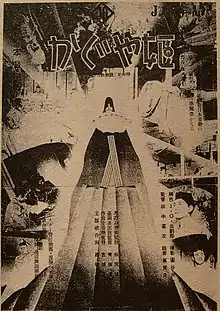 Theatrical release poster | |||||
| Japanese name | |||||
| Kanji | かぐや姫 | ||||
| |||||
| Directed by | Yoshitsugu Tanaka | ||||
| Screenplay by | J.O. Planning Department | ||||
| Based on | The Tale of the Bamboo Cutter[1] | ||||
| Starring |
| ||||
| Cinematography | Eiji Tsuburaya[1][2] | ||||
| Music by | Michio Miyagi[3] | ||||
Production company | |||||
| Distributed by | Towa Shoji Film Club[3] | ||||
Release date | November 21, 1935 (Japan)[3] | ||||
Running time | 75 minutes[3] 33 minutes (shortened version) | ||||
| Country | Japan | ||||
| Language | Japanese | ||||
Cast
- Kazuko Kitazawa as Princess Kaguya[3][7][8]
- Yō Shiomi as Okina[3]
- Hideko Higashi[8][13] as Ōna, Okina's wife[7]
- Ichirō Fujiyama[3][8] as Zomaro[7]
- Dekao Yokoo as the Prime Minister[7]
- Tamaki Tokuyama as Tamaro, the Prime Minister's son
- Kinji Fujiwa as Hosomi, the Prime Minister's son
- Hyō Kitazawa[7]
Production
Special effects
Famed special effects director Eiji Tsuburaya worked on the film's effects,[5] which are regarded as a major advancement in Japanese visual effects.[14] Miniatures and synthetic techniques were used to recreate the town of Kyoto.[1][5][7]
Kenzō Masaoka supervised the miniature effects for the film. He would later recall in Kinema Junpo: "We tried to create our own frame-by-frame shots for the oxcarts, which I think was the first time this [technique] was attempted in Japan. We shot about ten plaster figures of oxen in various stages of movement, and then animated them by replacing these static models frame-by-frame. These plaster figures were the masterpieces of Takefu Asano, and took a period of more than one month to sculpt."[15]
Release
The Japan Association of London organized a screening in 1936 for local subsidiaries, and requested the Embassy of Japan to "prepare a film about Japanese myths and legends."[12] In addition to not having a screening record since its release, the location of the film was also unknown.[9] The British Film Institute (BFI) received information in May 2015 regarding a flammable positive film of the film. A researcher at the National Film Archive investigated the film at the BFI Preservation Center in October of the same year and determined that it was a shortened version of the film.[9] The shortened version of the film was released in Japan on September 4, 2021,[16] after negotiations with the BFI for six years.[9]
See also
Notes
- Also known as Princess of the Moon.[1]
References
- Ryfle 1998, p. 45.
- "円谷英二監督が撮影の映画発見 85年ぶり、秋に一般公開|全国のニュース". 佐賀新聞LiVE (in Japanese). July 7, 2021. Retrieved July 8, 2021.
{{cite web}}: CS1 maint: url-status (link) - "かぐや姫". jmdb.ne.jp. Retrieved 2021-07-04.
- "電通映画社のなりたち~終戦まで". www.kakio24.com. Retrieved 2021-07-04.
- Ragone 2014, p. 193.
- "Collections Search | BFI | British Film Institute". collections-search.bfi.org.uk. Retrieved July 5, 2021.
{{cite web}}: CS1 maint: url-status (link) - allcinema, 映画 かぐや姫 (1935)について 映画データベース - allcinema (in Japanese), retrieved 2021-07-04
- "円谷英二撮影の幻の映画「かぐや姫」イギリスから帰還 フィルムが渡った理由、発掘の経緯は? : 映画ニュース". 映画.com (in Japanese). Retrieved 2021-10-24.
- "円谷英二 生誕120年記念特別イベントレポート。失われた幻の映画『かぐや姫』85年ぶりの奇跡の凱旋上映決定! - SCREEN ONLINE(スクリーンオンライン)". screenonline.jp. Retrieved 2021-09-21.
- "Collections Search | BFI | British Film Institute". collections-search.bfi.org.uk. Retrieved 2021-07-04.
- "円谷英二による幻の映画「かぐや姫」約85年ぶりに上映、生誕120年の展示会で". 映画ナタリー (in Japanese). July 7, 2021. Retrieved July 8, 2021.
{{cite web}}: CS1 maint: url-status (link) - "若き日の円谷英二、幻の映画 1935年「かぐや姫」短縮版、英で発見 東京で9月上映:朝日新聞デジタル". 朝日新聞デジタル (in Japanese). Retrieved 2021-07-16.
- "かぐや姫|一般社団法人日本映画製作者連盟". db.eiren.org. Retrieved 2021-07-04.
- Ragone 2014, p. 27.
- Ragone 2014, pp. 26–27.
- "生誕120年 円谷英二展『かぐや姫』上映会 | 国立映画アーカイブ". www.nfaj.go.jp. Retrieved 2021-10-24.
Sources
- Ragone, August (6 May 2014). Eiji Tsuburaya: Master of Monsters (paperback ed.). Chronicle Books. ISBN 978-1-4521-3539-7.
- Ryfle, Steve (1998). Japan's Favorite Mon-Star: The Unauthorized Biography of the Big G. ECW Press. ISBN 1550223488.
External links
- Princess Kaguya at IMDb
- Princess Kaguya at the official Toho website (archived) (in Japanese)