Eiji Tsuburaya filmography
Eiji Tsuburaya (1901–1970) was a Japanese special effects director and filmmaker who worked on roughly 250 films throughout his five-decade career.[1] Popularly known as the "Father of Tokusatsu" for his techniques in special effects,[2] Tsuburaya started his career in the Japanese film industry as a cinematographer for several successful drama and jidaigeki films in the early 1920s.[3] His directorial debut was the propaganda documentary film Three Thousand Miles Across the Equator, which he filmed in the Pacific Ocean on the Asama for most of 1935. Following the completion of photography on this film, he worked as the cinematographer and had his debut as special effects director on Princess Kaguya (1935). It was one of Japan's first major productions to feature special effects.[4][5] The next year, Tsuburaya made his dramatic directorial debut with the release of Folk Song Collection: Oichi of Torioi Village and had his breakthrough in effects on Arnold Fanck's The Daughter of the Samurai (released 1937).[6]
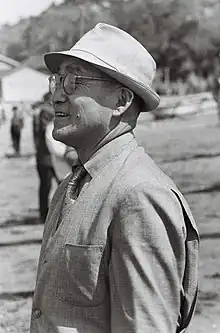
Tsuburaya transitioned from Kyoto to Tokyo in order to form the newly-established company Toho's special effects division in late 1937. Thereafter, in 1938, he was assigned to create effects for The Abe Clan and directed and filmed the unreleased propaganda musical The Song of Major Nanjo; two years later, he directed and shot the documentary motion picture entitled The Imperial Way of Japan and shot the war film Navy Bomber Squadron.[7] In 1942, Tsuburaya directed the effects for the Kajirō Yamamoto-directed war epic The War at Sea from Hawaii to Malaya, which became the highest-grossing Japanese film in history upon its release.[8] His efforts, cited as behind its major critical and commercial success, earned him the Technical Research Award from the Japan Motion Picture Cinematographers Association.[9][10] In 1948, the Supreme Commander for the Allied Powers purged Tsuburaya from employment at Toho.[11][7] He, therefore, created his own independent effects company and worked on films by other major film companies, including Daiei Film's The Invisible Man Appears (1949), which was Japan's first science fiction film. In 1950, Tsuburaya returned to Toho and subsequently worked on their films Escape at Dawn (1950), The Lady of Musashino (1951), The Skin of the South, and The Man Who Came to Port (both 1952), Eagle of the Pacific (1953), and Farewell Rabaul (1954), with the latter four being his first collaborations with director Ishirō Honda.[12]
In 1954, Tsuburaya directed the special effects for Hiroshi Inagaki's jidaigeki epic Samurai I: Musashi Miyamoto and Honda's kaiju film Godzilla. For the latter major critically and commercially successful film, he achieved his first Japan Technical Award for Special Skill and attained international recognition.[13][14] Two years later, he directed the effects for Shirō Toyoda's The Legend of the White Serpent and Honda's Rodan,[15] with Rodan winning him his second Japan Technical Award.[13] In response to recent popular alien invasion science fiction films, Toho assigned Tsuburaya to direct the effects for Honda's big-budget epic The Mysterians (1956) and he won another Japan Technical Award for his work.[16] Three years later, Tsuburaya earned another Japan Technical Award for his effects on the Hiroshi Inagaki's $1 million[17] epic The Three Treasures.[13] Later, he worked on the tremendously successful tokusatsu films: Mothra, The Last War (both 1961), King Kong vs. Godzilla, and Chūshingura: Hana no Maki, Yuki no Maki (both 1962). In 1963, he earned Japan Technical Award for his special effects work on The Lost World of Sinbad;[13] the following year he made the effects for Honda's Mothra vs. Godzilla, often regarded as his best kaiju film.[18] Also that year, he began preproduction on his recently-founded company's first series that aired on Japanese television in 1966 as Ultra Q and created the special effects for Frank Sinatra's war epic None but the Brave.[19] In 1965, his efforts on the war film Retreat From Kiska won him another Japan Technical Award for Special Skill and he gained the same award the following year for the same position in Honda's Invasion of Astro-Monster (also 1965).[13]
Because Ultra Q was a tremendous success during its release, Tsuburaya moved on to develop and supervise a follow-up titled Ultraman.[20] Ultraman was released from 1966 to 1967 and was even more successful than its predecessor. These programs spanned a franchise that is still majorly popular and ongoing today.[19] After working on Honda's influential kaiju film The War of the Gargantuas (1966),[21] he began being credited as the "special effects supervisor" on the Godzilla films and continued receiving this credit until Destroy All Monsters (1968).[22] His final official theatrical film credit, the Seiji Maruyama-directed war epic Battle of the Japan Sea, was released in August 1969 and became the second-highest-grossing Japanese film of 1969;[23] he received a ceremonial title as effects director on Honda's All Monsters Attack later that year. In December of the same year, he completed work on Birth of the Japanese Islands, an audiovisual exhibit for the Expo '70.[24] Although he continued to plan to work on productions such as Space Amoeba, Japan Airplane Guy, and Princess Kaguya, he passed away a day prior to his return to Tokyo in order to begin work for ensuing the year in January 1970.[25][2]
Film
| Year | Title | Credited as | Notes | Ref(s) | |||
|---|---|---|---|---|---|---|---|
| Special effects director |
Cinematographer | Director | Special effects supervisor | ||||
| 1919 | A Tune of Pity | No | Assistant | No | No | [26] | |
| 1920 | Tombs of the Island | No | Assistant | No | No | ||
| 1925 | The Hunchback of Enmei'in Temple | No | Yes | No | No | [27][28] | |
| 1926 | A Page of Madness | No | Assistant | No | No | [29] | |
| 1927 | Children's Swordplay | No | Yes | No | No | [28] | |
| The Bat Copybook | No | Yes | No | No | |||
| Mad Blade Under the Moon | No | Yes | No | No | |||
| Record of the Tragic Swords of the Tenpo Era | No | Yes | No | No | |||
| 1928 | Sayamaro the Thief | No | Yes | No | No | ||
| 1929 | Light and Shadow | No | Yes | No | No | ||
| A Tale of the Occult | No | Yes | No | No | |||
| 1930 | Sanji, the Wild Fox | No | Yes | No | No | ||
| 1931 | A Wolf Howls in the Blizzard | No | Yes | No | No | ||
| 1932 | Fierce Attack at Takadanobaba | No | Yes | No | No | ||
| Ghost Story: The Book of Evening Calm | No | Yes | No | No | |||
| 1933 | Drizzle in Gion | No | Yes | No | No | ||
| 1934 | Astaro Descends Mt. Akagi | No | Yes | No | No | [30] | |
| Fusaemon Araki: Lord of Iga | No | Yes | No | No | |||
| 1935 | The Chorus of a Million | No | Yes | No | No | [31][30] | |
| Princess Kaguya | Yes | Yes | No | No | [32][30] | ||
| 1936 | Three Thousand Miles Across the Equator | No | Yes | Yes | No | Documentary | [33] |
| Folk Song Collection: Oichi of Torioi Village | No | No | Yes | No | [30] | ||
| 1937 | The Daughter of the Samurai | Yes | No | No | No | [34][35] | |
| 1938 | The Abe Clan | Yes | No | No | No | [30] | |
| The Song of Major Nango | No | Yes | Yes | No | Unreleased | ||
| 1940 | The Imperial Way of Japan | No | Yes | Yes | No | ||
| Navy Bomber Squadron | Yes | No | No | No | |||
| The Burning Sky | Yes | No | No | No | [36] | ||
| Son Gokū | Yes | No | No | No | Two-part film | [37][38] | |
| 1941 | Moon Over Shanghai | Yes | No | No | No | [30] | |
| 1942 | Bouquet for the South Pacific | Yes | No | No | No | ||
| Koharu's Play | Yes | No | No | No | [39] | ||
| War Song of the Wings | Yes | No | No | No | [30] | ||
| The War at Sea from Hawaii to Malaya | Yes | No | No | No | [34] | ||
| Ramayana | No | No | No | No | Scripting supervisor | [40][41] | |
| 1943 | The Opium War | Yes | No | No | No | [30] | |
| World of Love: The Story of Windcat Tomi | Yes | No | No | No | [42] | ||
| Marching Music Force | Yes | No | No | No | [43] | ||
| The Story of Heiroku's Dream | Yes | No | No | No | |||
| Watchtower Suicide Squad | Yes | No | No | No | |||
| Military Song of the Morning Mist | Yes | No | No | No | |||
| Man | Yes | No | No | No | [44] | ||
| Toward the Decisive Battle in the Sky | Yes | No | No | No | [30] | ||
| Diary of a Drifting Boy | Yes | No | No | No | [44] | ||
| Hot Wind | Yes | No | No | No | |||
| Forward with the Flag of Independence | Yes | No | No | No | |||
| Naniwabushi Recitation Chushingura | Yes | No | No | No | [45] | ||
| 1944 | Fire on that Flag! | Yes | No | No | No | [45] | |
| Kato's Falcon Fighters Squadron | Yes | No | No | No | [34][46] | ||
| Four Weddings | Yes | No | No | No | [46] | ||
| Bomber Squadron, Move Out | Yes | No | No | No | |||
| 1945 | Until the Day of Victory | Yes | No | No | No | [47] | |
| Three People of the North | Yes | No | No | No | |||
| Five Men from Tokyo | Yes | No | No | No | [46] | ||
| 1946 | The Descendants of Taro Urashima | Yes | No | No | No | ||
| An Enemy of the People | Yes | No | No | No | [47] | ||
| Lord for a Night | Yes | No | No | No | [46] | ||
| 1947 | A Thousand and One Nights with Toho | Yes | No | No | No | ||
| 1948 | A Moonflower in Heaven | Yes | No | No | No | ||
| Gate of Flesh | Yes | No | No | No | |||
| A Woman in a Typhoon Area | Yes | No | No | No | |||
| The Bandit of Moonlight Castle | Yes | No | No | No | |||
| 1949 | The Life of a Woman | Yes | No | No | No | [48] | |
| The Appearance of the White Hood | Yes | No | No | No | |||
| Lady from Hell | Yes | No | No | No | |||
| A Woman's Fight | No | No | No | No | Compositor | ||
| The White-Haired Fiend | Yes | No | No | No | [46] | ||
| Flowers of Raccoon Palace | Yes | No | No | No | |||
| The Rainbow Man | Yes | No | No | No | Uncredited; with Tatsuyuki Yokota |
[49] | |
| The Blue Mountains | Yes | No | No | No | Two-part film | [48] | |
| The Ghost Train | Yes | No | No | No | [46] | ||
| Ginza Kankan Girl | Yes | No | No | No | [48] | ||
| Enoken's Tobisuke Adventure Journey | Yes | No | No | No | |||
| The Invisible Man Appears | Yes | No | No | No | [46] | ||
| Passion Without End | No | No | No | No | Compositor | [48] | |
| Return | Yes | No | No | No | |||
| Life Player | No | No | No | No | Compositor | ||
| Yearning for the Shadows | No | No | No | No | |||
| 1950 | Escape at Dawn | Yes | No | No | No | [48][50] | |
| Till We Meet Again | Yes | No | No | No | [48] | ||
| Listen to the Voices of the Sea | Yes | No | No | No | [46] | ||
| Kojirō Sasaki: Part One | Yes | No | No | No | |||
| 1951 | Beyond Love and Hate | Yes | No | No | No | ||
| Pirate Ship | Yes | No | No | No | |||
| The Lady of Musashino | Yes | No | No | No | |||
| 1952 | The Skin of the South | Yes | No | No | No | ||
| The Woman Who Touched the Legs | Yes | No | No | No | [51] | ||
| The Hill in Bloom | Yes | No | No | No | |||
| The Man Who Came to Port | Yes | No | No | No | |||
| Jirocho Rises in Fame | Yes | No | No | No | |||
| One Thousand Ryo Ship in the Wind and Clouds | Yes | No | No | No | |||
| 1953 | The Tower of Lilies | Yes | No | No | No | [52] | |
| The Sunday That Jumped Out | No | Yes | No | No | With Jun Yasumoto | ||
| Beyond the Clouds | Yes | No | No | No | |||
| Anatahan | Yes | No | No | No | |||
| Girls in the Orchard | Yes | No | No | No | [53] | ||
| What Is Your Name? | Yes | No | No | No | [54] | ||
| Eagle of the Pacific | Yes | No | No | No | [53][55] | ||
| The Lovers | Yes | No | No | No | [53] | ||
| Tiger of the North Sea | Yes | No | No | No | |||
| Hanjiro the Festival | Yes | No | No | No | |||
| Ninjutsu Pass Strike | Yes | No | No | No | |||
| What Is Your Name? Part II | Yes | No | No | No | [54] | ||
| Red-Light Bases | Yes | No | No | No | [53] | ||
| 1954 | Farewell Rabaul | Yes | No | No | No | [56] | |
| What Is Your Name? Part III | Yes | No | No | No | [54] | ||
| Outcome of a Summer Festival at a Nagaya | Yes | No | No | No | [53] | ||
| And Then the Liberty Bell Rang | Yes | No | No | No | |||
| Samurai I: Musashi Miyamoto | Yes | No | No | No | [57][52] | ||
| Godzilla | Yes | No | No | No | [58] | ||
| The Invisible Avenger | Yes | Yes | No | No | [59] | ||
| 1955 | Godzilla Raids Again | Yes | No | No | No | [60] | |
| Half Human | Yes | No | No | No | [61] | ||
| Ginrin | Yes | No | No | No | [57] | ||
| 1956 | Housewives Are Suing | Yes | No | No | No | [62] | |
| Vampire Moth | Yes | No | No | No | |||
| Three Youngmen and a Dream Girl | Yes | No | No | No | |||
| Blue Buds | Yes | No | No | No | |||
| Norihei's College Affair: The Happy Family | Yes | No | No | No | |||
| Fighting Cha Cha Girl | Yes | No | No | No | |||
| The Wicked Boy | Yes | No | No | No | |||
| The Legend of the White Serpent | Yes | No | No | No | [63] | ||
| Modern Desires | Yes | No | No | No | [62] | ||
| Rodan | Yes | No | No | No | [64] | ||
| 1957 | Forgotten Flower Petal | Yes | No | No | No | [62] | |
| Throne of Blood | Yes | No | No | No | [62][65] | ||
| The Paradise Island Story | Yes | No | No | No | [62] | ||
| A Tower with a Mountain and River | Yes | No | No | No | |||
| Story of a Detective's Assistant | Yes | No | No | No | |||
| A Dangerous Hero | Yes | No | No | No | [66] | ||
| The Living Koheiji | Yes | No | No | No | |||
| The Last Escape | Yes | No | No | No | |||
| Regarding Chieko | Yes | No | No | No | |||
| New Suits | Yes | No | No | No | |||
| Schooldays | Yes | No | No | No | |||
| The Mysterians | Yes | No | No | No | [67] | ||
| 1958 | Yagyu Secret Scrolls: Ninjitsu - Part II | Yes | No | No | No | [66] | |
| Three Generations of Company Presidents | Yes | No | No | No | |||
| City of Love | Yes | No | No | No | |||
| Rickshaw Man | Yes | No | No | No | |||
| The H-Man | Yes | No | No | No | [68] | ||
| Varan the Unbelievable | Yes | No | No | No | [69] | ||
| The Hidden Fortress | Yes | No | No | No | [70] | ||
| 1959 | Inao: Story of an Iron Arm | Yes | No | No | No | [71] | |
| Monkey Sun | Yes | No | No | No | Remake of Son Gokū (1940) |
[72] | |
| Submarine I-57 Will Not Surrender | Yes | No | No | No | [73] | ||
| The Three Treasures | Yes | No | No | No | [74] | ||
| Battle in Outer Space | Yes | No | No | No | [75] | ||
| 1960 | The Secret of the Telegian | Yes | No | No | No | [76] | |
| Storm Over the Pacific | Yes | No | No | No | [70] | ||
| The Human Vapor | Yes | No | No | No | [77] | ||
| 1961 | The Story of Osaka Castle | Yes | No | No | No | [70] | |
| Mothra | Yes | No | No | No | [78] | ||
| Blood on the Sea | Yes | No | No | No | [79] | ||
| The Youth and His Amulet | Yes | No | No | No | [70] | ||
| The Last War | Yes | No | No | No | [80] | ||
| 1962 | The Crimson Sky | Yes | No | No | No | [81] | |
| Gorath | Yes | No | No | No | [82] | ||
| The Big Wave | Yes | No | No | No | Completed in 1961 | [83] | |
| King Kong vs. Godzilla | Yes | No | No | No | [84] | ||
| The Great Story of Shim Cheong | Yes | No | No | No | [85] | ||
| Chūshingura: Hana no Maki, Yuki no Maki |
Yes | No | No | No | Uncredited | [86] | |
| 1963 | Attack Squadron! | Yes | No | No | No | [87] | |
| The Love Eterne | Yes | No | No | No | [88][89] | ||
| Legacy of the 500,000 | Yes | No | No | No | [81] | ||
| The Siege of Fort Bismarck | Yes | No | No | No | |||
| Matango | Yes | No | No | No | [90] | ||
| The Lost World of Sinbad | Yes | No | No | No | [91] | ||
| Atragon | Yes | No | No | No | [92] | ||
| 1964 | Whirlwind | Yes | No | No | No | [93] | |
| Mothra vs. Godzilla | Yes | No | No | No | [94] | ||
| The Rabble | Yes | No | No | No | [81] | ||
| Dogora | Yes | No | No | No | [95] | ||
| Ghidorah, the Three-Headed Monster | Yes | No | No | No | [96] | ||
| 1965 | None but the Brave | Yes | No | No | No | [34] | |
| The Retreat from Kiska | Yes | No | No | No | [97] | ||
| Frankenstein vs. Baragon | Yes | No | No | No | [98] | ||
| The Crazy Adventure | Yes | No | No | No | [99] | ||
| Invasion of Astro-Monster | Yes | No | No | No | [100] | ||
| 1966 | The Adventure in Taklamakan | Yes | No | No | No | [101] | |
| Zero Fighter | Yes | No | No | No | |||
| The War of the Gargantuas | Yes | No | No | No | [21] | ||
| Ebirah, Horror of the Deep | No | No | No | Yes | [102] | ||
| 1967 | King Kong Escapes | Yes | No | No | No | [82] | |
| Ultraman: Monster Movie Feature | No | No | No | No | Executive producer | [101] | |
| Son of Godzilla | No | No | No | Yes | [103] | ||
| 1968 | Goodbye, Moscow Hooligans | No | No | No | No | Compositor | [104] |
| The Tigers: The World Is Waiting for Us | No | No | No | No | |||
| Mexican Free-for-All | No | No | No | No | |||
| Young Guy in Rio | No | No | No | No | |||
| The Green Years | No | No | No | No | Optical photography | ||
| Destroy All Monsters | No | No | No | Yes | [105] | ||
| Admiral Yamamoto | Yes | No | No | No | [101] | ||
| 1969 | Samurai Banners | No | No | No | No | Compositor | [106][104] |
| The Crazy Cats' Big Explosion | No | No | No | Yes | [104][101] | ||
| Latitude Zero | Yes | No | No | No | [97] | ||
| Battle of the Japan Sea | Yes | No | No | No | |||
| All Monsters Attack | Ceremonial title[lower-alpha 1] | No | No | No | Also participated in editing |
[107][108] | |
| 1970 | Birth of the Japanese Islands | Yes | No | No | No | Produced in 1969 | [24] |
Television
| Year | Title | Credited as | Notes | Ref(s) | |
|---|---|---|---|---|---|
| Supervisor | Producer | ||||
| 1956 | Ninja Arts of Sanada Castle | Special effects |
No | [109] | |
| 1959–1960 | Mighty Atom | Special effects |
No | Uncredited | [110] |
| 1962 | Japanese Standerds | No | No | Himself; May 15 episode | [85] |
| 1966 | Ultra Q | Yes | Yes | [111] | |
| Modern Leaders | No | No | Himself; episode, "The Father of Ultra Q" | [112] | |
| 1966–1967 | Ultraman | Yes | Yes | Also developer | [20] |
| 1967–1968 | Ultraseven | Yes | Yes | [113] | |
| 1968 | Mighty Jack | Yes | Yes | ||
| Fight! Mighty Jack | Yes | Yes | [114] | ||
| Operation: Mystery! | Yes | Yes | |||
| 1973 | Horror Theater Unbalance | Yes | Yes | Produced in 1969 | [115] |
Notes
- Although Tsuburaya was credited as the special effects director in the film, his credit was merely ceremonial. Its director, Ishirō Honda, also directed the effects with the assistance of Tsuburaya's disciple Teruyoshi Nakano.[24]
References
Citations
- Bolton, Doug (July 7, 2015). "Godzilla creator Eiji Tsuburaya celebrated in Google Doodle". The Independent. Archived from the original on July 14, 2022. Retrieved September 17, 2021.
- "The Founder – Eiji Tsuburaya". Tsuburaya Productions. Archived from the original on February 27, 2023. Retrieved September 17, 2021.
- Ragone 2014, p. 22-23.
- Ryfle 1998, p. 45.
- Ragone 2014, p. 26.
- Ragone 2014, p. 27.
- Matsuda 2001, pp. 14–15.
- Matsuda 2001, pp. 20–21.
- Ryfle & Godziszewski 2017, p. 30.
- Tanaka 1983, p. 541.
- Iwabatake 1994, pp. 52–53.
- Yosensha 2010, pp. 300–303.
- "日本映画技術賞 受賞一覧 – 一般社団法人 日本映画テレビ技術協会". mpte.jp (in Japanese). Motion Picture And Television Engineering Society Of Japan Inc. Archived from the original on March 22, 2023. Retrieved March 22, 2023.
- Ragone 2014, p. 14.
- Ragone 2014, p. 50.
- Ragone 2014, p. 53.
- Motion Picture Herald 1959, p. 32.
- Ragone 2014, p. 78.
- Ryfle & Godziszewski 2017, p. 229.
- Ragone 2007, p. 114.
- Galbraith IV 2008, p. 231.
- Ryfle & Godziszewski 2017, p. 245.
- Nakamura et al. 2014, p. 124.
- Ryfle & Godziszewski 2017, p. 255.
- Ryfle & Godziszewski 2017, p. 260.
- Ragone 2014, p. 21.
- "延命院の傴僂男" [The Hunchback of Enmei'in Temple]. Japanese Movie Database (in Japanese). Archived from the original on March 18, 2016. Retrieved July 14, 2022.
- Ragone 2014, p. 192.
- Ryfle 1998, p. 44.
- Ragone 2014, p. 193.
- Galbraith IV 2008, p. 6.
- Galbraith IV 2008, p. 8.
- Ragone 2014, p. 26, 193.
- Ryfle 1998, p. 46.
- Galbraith IV 2008, p. 12.
- Galbraith IV 2008, p. 42.
- Takeuchi & Yamamoto 2001, p. 345.
- Galbraith IV 2008, p. 43.
- Galbraith IV 2008, p. 52.
- Asano 2019.
- Asano, Eiko (February 18, 2020). "太平洋戦争中の特撮人形劇映画、制作現場の写真見つかる 人形は浅野孟府作" [Special effects puppet movie during the Pacific War, photos of the production site can be found. Puppets made by Mōfu Asano]. Voice of Nara (in Japanese). Archived from the original on February 7, 2023. Retrieved March 8, 2023.
- Galbraith IV 2008, p. 53.
- Galbraith IV 2008, p. 54.
- Galbraith IV 2008, p. 55.
- Galbraith IV 2008, p. 56.
- Ragone 2014, p. 194.
- Matsuda 2001, p. 22.
- Takeuchi & Yamamoto 2001, p. 412.
- Matsuda 2001, p. 24.
- Yosensha 2010, p. 301.
- Takeuchi & Yamamoto 2001, p. 411.
- Ragone 2014, p. 195.
- Takeuchi & Yamamoto 2001, p. 410.
- Ryfle & Godziszewski 2017, p. 135.
- Galbraith IV 2008, p. 96.
- Galbraith IV 2008, p. 99.
- Takeuchi & Yamamoto 2001, p. 91.
- "Godzilla". The Criterion Collection. Archived from the original on April 14, 2022. Retrieved April 14, 2022.
- Galbraith IV 2008, p. 107.
- "Godzilla Raids Again". The Criterion Collection. Archived from the original on July 14, 2022. Retrieved July 14, 2022.
- Galbraith IV 2008, p. 113.
- Takeuchi & Yamamoto 2001, p. 409.
- Galbraith IV 2008, p. 122.
- Kalat 2010, p. 41.
- Watson 2020, p. 93.
- Takeuchi & Yamamoto 2001, p. 408.
- Galbraith IV 2008, p. 140.
- Galbraith IV 2008, p. 146.
- Kalat 2010, p. 46.
- Ragone 2014, p. 196.
- Ryfle & Godziszewski 2017, p. 156.
- Galbraith IV 2008, p. 155.
- Matsuda 1997, p. 96.
- Galbraith IV 2008, p. 161.
- Galbraith IV 2008, p. 162.
- Galbraith IV 2008, p. 168.
- Galbraith IV 2008, p. 176.
- Kalat 2010, p. 51.
- Galbraith IV 2008, p. 184.
- Galbraith IV 2008, p. 186.
- Ragone 2014, p. 197.
- "Eiji Tsuburaya". Turner Classic Movies. Archived from the original on July 14, 2022. Retrieved July 14, 2022.
- "ゴジラの円谷監督が特撮担当、幻の映画を"初上映"" [Director Tsuburaya of Godzilla is in charge of special effects, "premiere" of the fantasy movie]. ZAKZAK (in Japanese). October 24, 2005. Archived from the original on October 28, 2005. Retrieved March 25, 2023.
- "King Kong vs. Godzilla". The Criterion Collection. Archived from the original on July 14, 2022. Retrieved July 14, 2022.
- Takeuchi & Yamamoto 2001, p. 336.
- Galbraith IV 2008, p. 196.
- Galbraith IV 2008, p. 198.
- Nishimoto, Yamada & Yamane 2004, p. 136.
- Qiū 2007, p. 188.
- Galbraith IV 2008, p. 203.
- Galbraith IV 2008, p. 205.
- Galbraith IV 2008, p. 206.
- Galbraith IV 2008, p. 207.
- "Mothra vs. Godzilla". The Criterion Collection. Archived from the original on July 14, 2022. Retrieved July 14, 2022.
- Galbraith IV 2008, p. 212.
- "Ghidorah, the Three-Headed Monster". The Criterion Collection. Archived from the original on July 14, 2022. Retrieved July 14, 2022.
- Ryfle 1998, p. 47.
- Galbraith IV 2008, p. 221.
- Galbraith IV 2008, p. 224.
- "Invasion of Astro-Monster". The Criterion Collection. Archived from the original on July 14, 2022. Retrieved July 14, 2022.
- Ragone 2014, p. 198.
- "Ebirah, Horror of the Deep". The Criterion Collection. Archived from the original on July 14, 2022. Retrieved July 14, 2022.
- "Son of Godzilla". The Criterion Collection. Archived from the original on July 14, 2022. Retrieved July 14, 2022.
- Takeuchi & Yamamoto 2001, p. 401.
- "Destroy All Monsters". The Criterion Collection. Archived from the original on July 14, 2022. Retrieved July 14, 2022.
- Kinema Junpo 1995, p. 174.
- Ryfle 1998, p. 157.
- Ryfle & Godziszewski 2017, p. 258.
- Ragone 2014, p. 52.
- Kodansha 2009, p. 30.
- Asahi Sonorama 1985, p. 255.
- Ragone 2007, p. 113.
- Takeuchi & Yamamoto 2001, p. 339.
- Takeuchi & Yamamoto 2001, p. 340.
- Asahi Sonorama 1985, p. 269.
Bibliography
- 大特撮―日本特撮映画史 [Large Special Effects: Japanese Tokusatsu Film History] (in Japanese). Asahi Sonorama. 1985. ISBN 978-4257031888.
- Asano, Eiko (2019). The Era of Sculptor Mofu Asano 1900-1984. ISBN 978-4826507028.
- Galbraith IV, Stuart (1994). Japanese Science Fiction, Fantasy and Horror Films. McFarland. ISBN 0-89950-853-7.
{{cite book}}: CS1 maint: ref duplicates default (link) - Galbraith IV, Stuart (2008). The Toho Studios Story: A History and Complete Filmography. Scarecrow Press. ISBN 9781461673743.
- Iwabatake, Toshiaki (September 1, 1994). テレビマガジン特別編集 誕生40周年記念 ゴジラ大全集 [TV Magazine Special Edition: 40th Anniversary of the Birth of Godzilla Complete Works] (in Japanese). Kodansha. ISBN 4-06-178417-X.
- Kalat, David (2010). A Critical History and Filmography of Toho's Godzilla Series (Second ed.). McFarland. ISBN 9780786447497.
- "Kinema Junpo". Kinema Junpo (in Japanese). Kinema Junposha. 1995 – via Google Books.
- "手塚治虫と特撮テレビ" [Osamu Tezuka and Tokusatsu TV]. ぼくらが大好きだった 特撮ヒーローBESTマガジン [Beloved Favorite Tokusatsu Hero BEST Magazine] (in Japanese). Kodansha. April 22, 2009. ISBN 978-4-06-375707-1.
- Matsuda, Takehisa, ed. (1997). 日本特撮・幻想映画全集 [Complete Collection of Japanese Special Effects and Fantasy Movies] (in Japanese). Keibunsha. ISBN 9784766927061.
- Matsuda, Takehisa, ed. (August 10, 2001). 円谷英二特撮世界 [Eiji Tsuburaya's World of Tokusatsu] (in Japanese). Keibunsha. ISBN 4-7669-3848-8.
- "Motion Picture Herald". Motion Picture Herald. August 1959 – via Google Books.
- Nakamura, Tetsu; Shiraishi, Masahiko; Aita, Tetsuo; Tomoi, Taketo; Shimazaki, Jun; Maruyama, Takeshi; Shimizu, Toshifumi; Hayakawa, Masaru (29 November 2014). ゴジラ東宝チャンピオンまつりパーフェクション [Godzilla Toho Champion Festival Perfection] (in Japanese). ASCII MEDIA WORKS. ISBN 978-4-04-866999-3.
- Nishimoto, Tadashi; Yamada, Kōichi; Yamane, Sadao (October 2004). 香港への道 中川信夫からブルース・リーへ [Road to Hong Kong: From Nobuo Nakagawa to Bruce Lee] (in Japanese). Chikuma Shobō. ISBN 9784480873163.
- Qiū, Shū Tíng (September 2007). アジア映画ネットワークのルーツを探る [Exploring the Roots of the Asian Film Network] (in Japanese). University of Tokyo Press. ISBN 9784130860369.
- Ragone, August (2007). Eiji Tsuburaya: Master of Monsters. Chronicle Books. ISBN 978-0-8118-6078-9.
- Ragone, August (May 6, 2014). Eiji Tsuburaya: Master of Monsters (paperback ed.). Chronicle Books. ISBN 978-1-4521-3539-7.
- Ryfle, Steve (1998). Japan's Favorite Mon-Star: The Unauthorized Biography of the Big G. ECW Press. ISBN 1550223488.
- Ryfle, Steve; Godziszewski, Ed (2017). Ishiro Honda: A Life in Film, from Godzilla to Kurosawa. Wesleyan University Press. ISBN 9780819570871.
- Takeuchi, Hiroshi; Yamamoto, Shingo, eds. (May 7, 2001). 円谷英二の映像世界 [Eiji Tsuburaya's Visual World] (in Japanese) (2nd ed.). Jitsugyo no Nihon Sha (published July 11, 2001). ISBN 4-40839474-2.
- Tanaka, Tomoyuki (1983). 東宝特撮映画全史 [The Complete History of Toho Special Effects Movies] (in Japanese). Toho Publishing Business Office. ISBN 4-924609-00-5.
- Watson, Robert N. (2020). Throne of Blood. Bloomsbury Publishing. ISBN 978-1839021886.
- 特撮 円谷組 ゴジラと東宝特撮にかけた青春 [Special Effects: The Tsuburaya group, Godzilla and Youth in Toho Special Effects] (in Japanese). Yosensha. October 9, 2010. ISBN 978-4-86248-622-6.
External links
- Eiji Tsuburaya at IMDb
- Eiji Tsuburaya at the Japanese Movie Database (in Japanese)