Portal:New South Wales

The New South Wales Portal
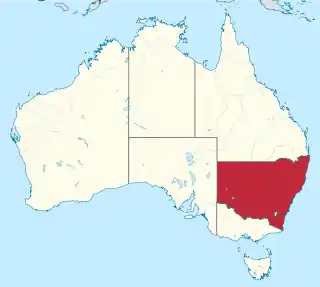
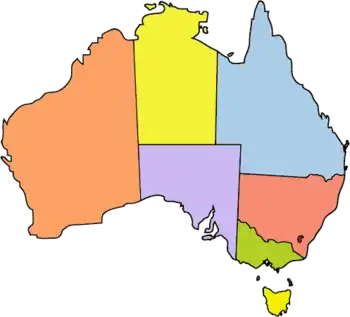
New South Wales (commonly abbreviated as NSW) is a state on the east coast of Australia. It borders Queensland to the north, Victoria to the south, and South Australia to the west. Its coast borders the Coral and Tasman Seas to the east. The Australian Capital Territory and Jervis Bay Territory are enclaves within the state. New South Wales' state capital is Sydney, which is also Australia's most populous city. , the population of New South Wales was over 8 million, making it Australia's most populous state. Just under two-thirds of the state's population, 5.3 million, live in the Greater Sydney area.
The Colony of New South Wales was founded as a British penal colony in 1788. It originally comprised more than half of the Australian mainland with its western boundary set at 129th meridian east in 1825. The colony then also included the island territories of Van Diemen's Land, Lord Howe Island, and Norfolk Island. During the 19th century, most of the colony's area was detached to form separate British colonies that eventually became the various states and territories of Australia. However, the Swan River Colony was never administered as part of New South Wales. (Full article...)
 Recognized content -

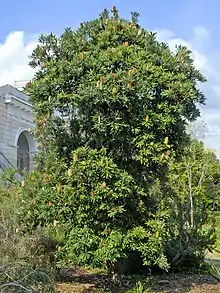 Tree of Banksia serrata at Villa Durazzo-Pallavicini
Banksia serrata, commonly known as the saw banksia, the old man banksia, the saw-tooth banksia or the red honeysuckle and as wiriyagan by the Cadigal people, is a species of woody shrub or tree of the genus Banksia, in the family Proteaceae. Native to the east coast of Australia, it is found from Queensland to Victoria with outlying populations on Tasmania and Flinders Island. Commonly growing as a gnarled tree up to 16 m (50 ft) in height, it can be much smaller in more exposed areas. This Banksia species has wrinkled grey bark, shiny dark green serrated leaves and large yellow or greyish-yellow flower spikes appearing over summer. The flower spikes, or inflorescences, turn grey as they age and pollinated flowers develop into large, grey, woody seed pods called follicles.
B. serrata is one of the four original Banksia species collected by Sir Joseph Banks in 1770, and one of four species published in 1782 as part of Carolus Linnaeus the Younger's original description of the genus. There are no recognised varieties, although it is closely related to Banksia aemula. Throughout its range, it grows exclusively in sandy soil, and is usually the dominant plant in scrubland or low woodland. B. serrata is pollinated by and provides food for a wide array of vertebrate and invertebrate animals in the autumn and winter months, and is an important source of food for honeyeaters. It is a common plant of parks and gardens. (Full article...)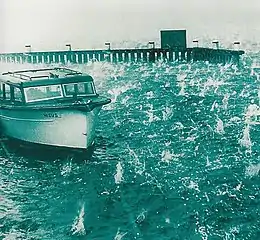 A boat at Rose Bay in water which is being churned by the hailstones.
The 1947 Sydney hailstorm was a natural disaster which struck Sydney, Australia, on 1 January 1947. The storm cell developed on the morning of New Year's Day, a public holiday in Australia, over the Blue Mountains, hitting the city and dissipating east of Bondi in the mid-afternoon. At the time, it was the most severe storm to strike the city since recorded observations began in 1792.
The high humidity, temperatures and weather patterns of Sydney increased the strength of the storm. The cost of damages from the storm were, at the time, approximately £750,000 (US$3 million); this is the equivalent of around A$45 million in modern figures. The supercell dropped hailstones larger than 8 centimetres (3.1 in) in diameter, with the most significant damage occurring in the central business district and eastern suburbs of Sydney. (Full article...).jpg.webp) Official portrait of O'Connor, c. 1910
Official portrait of O'Connor, c. 1910
Richard Edward O'Connor QC (4 August 1851 – 18 November 1912) was an Australian politician and judge.
A barrister and later Queen's Counsel, O'Connor was active in the campaign for Australian Federation and was a close associate of Edmund Barton. He served as New South Wales Minister for Justice in the Dibbs ministry from 1891 to 1893 while a member of the New South Wales Legislative Council (1888–98), and was a member of the constitutional committee at the Federal Convention that drafted the Australian Constitution. A member of the first federal ministry as Vice-President of the Executive Council, O'Connor led the government in the Senate, the first person to do so, from 1901 to 1903, playing a key role in the development of that chamber's role in Australian politics. (Full article...) McKenzie in uniform c. 1940
Florence Violet McKenzie OBE (née Granville; 28 September 1890 – 23 May 1982), affectionately known as "Mrs Mac", was Australia's first female electrical engineer, founder of the Women's Emergency Signalling Corps (WESC) and lifelong promoter for technical education for women. She campaigned successfully to have some of her female trainees accepted into the all-male Navy, thereby originating the Women's Royal Australian Naval Service (WRANS). Some 12,000 servicemen passed through her signal instruction school in Sydney, acquiring skill in Morse code and visual signalling (flag semaphore and International Code of Signals).
She set up her own electrical contracting business in 1918, and apprenticed herself to it, in order to meet the requirements of the Diploma in Electrical Engineering at Sydney Technical College Described at the time as Australia's "Mademoiselle Edison", in 1922 she became the first Australian woman to take out an amateur radio operator's licence. Through the 1920s and 1930s, her "Wireless Shop" in Sydney's Royal Arcade was renowned amongst Sydney radio experimenters and hobbyists. She founded The Wireless Weekly in 1922, established the Electrical Association for Women in 1934, and wrote the first "all-electric cookbook" in 1936. She corresponded with Albert Einstein in the postwar years. (Full article...).jpg.webp) P. t. terminalis at the Australian National Botanic Gardens
P. t. terminalis at the Australian National Botanic Gardens
Persoonia terminalis, also known as the Torrington geebung, is a shrub belonging to the family Proteaceae, and native to northern New South Wales and southern Queensland in eastern Australia. Reported as a subspecies of Persoonia nutans in 1981, it was described as a species by Lawrie Johnson and his colleague Peter Weston in 1991.
Two subspecies—P. t. terminalis and P. t. recurva—are recognised; both are found on well-drained acidic soils in sclerophyll forests, and P. t. terminalis is also found on granite outcrops. Although similar in appearance, they differ in leaf length and curvature. Both have a restricted range, with P. t. terminalis found in an area of under 100 square kilometres (39 square miles; 25,000 acres). (Full article...)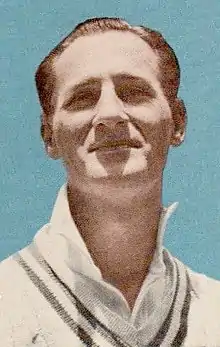 Saggers in around 1948
Ronald Arthur Saggers (15 May 1917 – 17 March 1987) was an Australian cricketer who played for New South Wales. He played briefly for the Australian team, playing six Tests between 1948 and 1950. In his Test cricket career he made 24 dismissals (16 catches and 8 stumpings) and scored 30 runs at an average of 10.00.
As a wicket-keeper, Saggers was "tidy and unobtrusive", and the understudy to Don Tallon on the 1948 Australian tour of England. The touring party, led by Donald Bradman in his last season, was nicknamed The Invincibles and was widely regarded as one of the strongest ever. Saggers played in the Test match at Headingley, where he took three catches, and his only other experience of Test cricket was on the tour to South Africa in 1949–50, in which Tallon did not take part. Saggers played in all five Tests and took 21 dismissals, but Tallon replaced him for the home Ashes series against England the following season. (Full article...)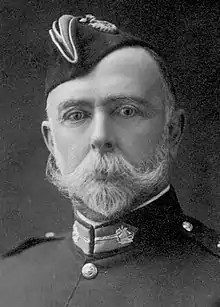 Neild in 1901
John Cash Neild (4 January 1846 – 8 March 1911) was an Australian politician who served as a Senator from New South Wales from 1901 to 1910.
Neild's family arrived in Australia in 1860, and he worked as an insurance agent and company manager before winning election to the New South Wales Legislative Assembly in 1885. He served intermittently until 1901 and had a tumultuous career as a backbencher, eventually contributing significantly to the fall of the Reid government in 1899. He also established his own volunteer regiment, which had a difficult and sometimes hostile relationship with military command. (Full article...)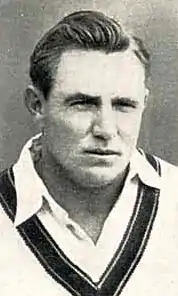
Raymond Russell Lindwall MBE (3 October 1921 – 23 June 1996) was a cricketer who represented Australia in 61 Tests from 1946 to 1960. He is widely regarded as one of the greatest fast bowlers of all time. He also played top-flight rugby league football with St. George, appearing in two grand finals for the club before retiring to fully concentrate on Test cricket.
A right-arm fast bowler of express pace, Lindwall was widely regarded as the greatest pace bowler of his era and one of the finest of all time. He modelled his action on the great England fast bowler Harold Larwood. Together with Keith Miller, Lindwall formed a new-ball pairing regarded as one of the greatest to have played cricket. Lindwall was known for his classical style, with a smooth and rhythmic run-up and textbook side-on bowling action, from which he generated his trademark outswinger which moved away late at high pace. Lindwall mixed his outswinger with a searing yorker, subtle changes of pace and an intimidating bouncer that skidded at the heads of opposing batsmen. Later in his career, Lindwall developed an inswinger, which together with his variety, pace and control made him the most feared paceman of his time. Lindwall was a fine all round cricketer; he was a hard-hitting batsman who scored two centuries at Test level and often improved Australia's position with his lower order batting. Lindwall's best known performance was his role in leading the Australian bowling during the 1948 tour of England under Don Bradman; the 1948 Australian team went through the tour undefeated and gained the sobriquet The Invincibles which saw it regarded as one of the finest teams in cricketing history. Lindwall's place in Australian cricket history saw him inducted into the Australian Cricket Hall of Fame in 1996 as one of the ten inaugural members. In 2000, Lindwall was named in the Australian Cricket Board's Team of the Century. (Full article...)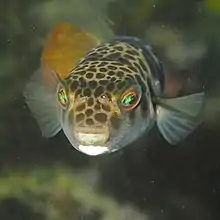
The smooth toadfish (Tetractenos glaber) is a species of fish in the pufferfish family Tetraodontidae. It is native to shallow coastal and estuarine waters of southeastern Australia, where it is widespread and abundant. French naturalist Christophe-Paulin de La Poix de Fréminville described the species in 1813, though early records confused it with its close relative, the common toadfish (T. hamiltonii). The two are the only members of the genus Tetractenos after going through several taxonomic changes since discovery.
Up to 16 cm (6+1⁄4 in) long with distinctive leopard-like dark markings on its dorsal side, the smooth toadfish has a rounded front and tapers to a narrow tail at the back. Unlike most of its relatives, it does not have prominent spines on its body. Like other pufferfish, it can inflate itself with water or air. It forages for its preferred foods—molluscs and crustaceans—in sand and mud of the bottom sediment. Often an unwanted catch by anglers, the smooth toadfish is highly poisonous because of the tetrodotoxin present in its body, and eating it may result in death. (Full article...)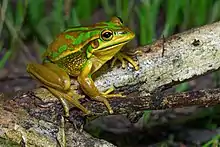
The green and golden bell frog (Ranoidea aurea), also named the green bell frog, green and golden swamp frog and green frog, is a species of ground-dwelling tree frog native to eastern Australia. Despite its classification and climbing abilities, it does not live in trees and spends almost all of its time close to ground level. It can reach up to 11 cm (4.5 in) in length, making it one of Australia's largest frogs.
Coloured gold and green, the frogs are voracious eaters of insects, but will also eat larger prey, such as worms and mice. They are mainly diurnal, although this is mostly to warm in the sun. They tend to be less active in winter except in warmer or wetter periods, and breed in the warmer months. Males reach maturity after around 9 months, while for the larger females, this does not occur until they are two years old. The frogs can engage in cannibalism, and males frequently attack and injure one another if they infringe on one another's space. (Full article...)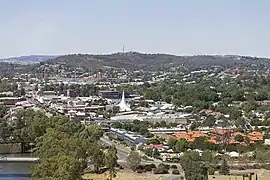 Aerial view of central Wagga Wagga
Wagga Wagga (/ˌwɒɡə ˈwɒɡə/; informally called Wagga) is a major regional city in the Riverina region of New South Wales, Australia. Straddling the Murrumbidgee River, with an urban population of more than 56,000 as of June 2018, Wagga Wagga is the state's largest inland city, and is an important agricultural, military, and transport hub of Australia. The ninth largest inland city in Australia, Wagga Wagga is located midway between the two largest cities in Australia—Sydney and Melbourne—and is the major regional centre for the Riverina and South West Slopes regions.
The central business district is focused around the commercial and recreational grid bounded by Best and Tarcutta Streets and the Murrumbidgee River and the Sturt Highway. The main shopping street of Wagga is Baylis Street which becomes Fitzmaurice Street at the northern end. The city is accessible from Sydney via the Sturt and Hume Highways, Adelaide via the Sturt Highway and Albury and Melbourne via the Olympic Highway and Hume Highway. The city is in an alluvial valley and much of the city has a problem with urban salinity. (Full article...)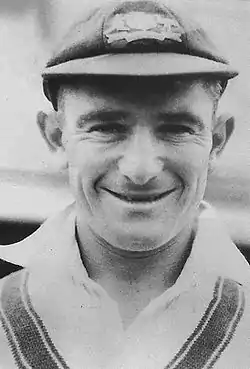 Barnes in cricket whites
Sidney George Barnes (5 June 1916 – 16 December 1973) was an Australian cricketer and cricket writer, who played 13 Test matches between 1938 and 1948. Able to open the innings or bat down the order, Barnes was regarded as one of Australia's finest batsmen in the period immediately following the Second World War. He helped create an enduring record when scoring 234 in the second Test against England at Sydney in December 1946; exactly the same score as his captain, Don Bradman, in the process setting a world-record 405-run fifth wicket partnership. Barnes averaged 63.05 over 19 innings in a career that, like those of most of his contemporaries, was interrupted by the Second World War.
He made his first-class debut at the end of the 1936–37 season when selected for New South Wales, and he was later included in the team for the 1938 Australian tour of England, making his Test debut in the final international of the series. On the resumption of Test cricket after the war, he was picked as the opening partner to Arthur Morris. Barnes was a member of The Invincibles, the 1948 Australian team that toured England without losing a single match. Retiring from cricket at the end of that tour, Barnes attempted a comeback to Test cricket in the 1951–52 season that was ultimately and controversially unsuccessful. (Full article...)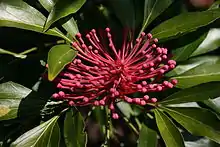
Alloxylon pinnatum, known as Dorrigo waratah, is a tree of the family Proteaceae found in warm-temperate rainforest of south-east Queensland and northern New South Wales in eastern Australia. It has shiny green leaves that are either pinnate (lobed) and up to 30 cm (12 in) long, or lanceolate (spear-shaped) and up to 15 cm (5.9 in) long. The prominent pinkish-red flower heads, known as inflorescences, appear in spring and summer; these are made up of 50 to 140 individual flowers arranged in corymb or raceme. These are followed by rectangular woody seed pods, which bear two rows of winged seeds.
Known for many years as Oreocallis pinnata, it was transferred to the new genus Alloxylon by Peter Weston and Mike Crisp in 1991. This genus contains the four species previously classified in Oreocallis that are found in Australasia. Its terminal globular flowers indicate that the species is pollinated by birds. Classified as near threatened under the Queensland Nature Conservation Act 1992, the Dorrigo waratah has proven difficult to keep alive in cultivation. (Full article...) Alex Wilkinson was club captain from 2007 to 2012.
Central Coast Mariners Football Club is an Australian professional association football club based in Gosford, on the Central Coast of New South Wales. The club was formed in November 2004, and the team played their first competitive match in May 2005, when they entered the 2005 Australian Club World Championship Qualifying Tournament. The Mariners play their home matches at Central Coast Stadium. 181 players have made a competitive first-team appearance for the club; those players are listed here. Players are listed in order of their first appearance for the Mariners, and alphabetical order by surname for players who debuted simultaneously.
The Mariners' record appearance-maker is John Hutchinson, who made 271 appearances over a 10-year playing career, ahead of Matt Simon. Hutchinson also holds the record for the most starts, having started in 232 games. Simon is the club's top goalscorer with 66 goals in his eleven seasons with the club, twenty-three more than next-highest scorer Adam Kwasnik. Fourteen players have made 100 appearances or more, including five members of the 2013 A-League Grand Final winning team. Danny Vukovic is the only goalkeeper to have made over 100 appearances for the side. Eight players have held the position of club captain, Alex Wilkinson for the longest period (five years). (Full article...).jpg.webp)
Edward Pulsford (29 September 1844 – 29 September 1919) was an English-born Australian politician and free-trade campaigner.
Pulsford established a successful business with his father as commission agents in Yorkshire before moving his interests to New South Wales in 1883. There he became a vigorous campaigner for free trade, and was a co-founder of the Free Trade and Liberal Association in that colony, the body that would later become the machine behind the Free Trade Party. Although his attempts to enter the New South Wales Legislative Assembly were abortive, he was appointed to the Legislative Council in 1895 and served until 1901, when he was elected to the Senate. An uncompromising opponent of all forms of protectionism, following the 1909 Fusion of the anti-Labour forces he joined the Liberal Party only with reluctance. (Full article...)
Selected image
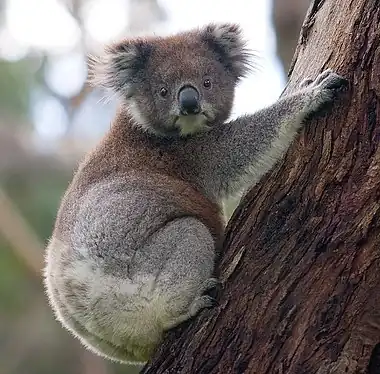
The koala is found in coastal regions of eastern and southern Australia, from near Adelaide to the southern part of Cape York Peninsula. Populations also extend for considerable distances inland in regions with enough moisture to support suitable woodlands. The koala is the national animal emblem of New South Wales.
Related portals
(Northern
Territory) |
WikiProjects
 |
 |
| WikiProject New South Wales | WikiProject Australia |
Selected articles -
%252C_Harbour_Bridge_--_2019_--_2179.jpg.webp) View from Port Jackson, October 2019
View from Port Jackson, October 2019
The Sydney Harbour Bridge is a steel through arch bridge in Sydney, spanning Sydney Harbour from the central business district (CBD) to the North Shore. The view of the bridge, the harbour, and the nearby Sydney Opera House is widely regarded as an iconic image of Sydney, and of Australia itself. Nicknamed "The Coathanger" because of its arch-based design, the bridge carries rail, vehicular, bicycle and pedestrian traffic.
Under the direction of John Bradfield of the New South Wales Department of Public Works, the bridge was designed and built by British firm Dorman Long of Middlesbrough, and opened in 1932. The bridge's general design, which Bradfield tasked the NSW Department of Public Works with producing, was a rough copy of the Hell Gate Bridge in New York City. This general design document, however, did not form any part of the request for tender, which remained sufficiently broad as to allow cantilever (Bradfield's original preference) and even suspension bridge proposals. The design chosen from the tender responses was original work created by Dorman Long, who leveraged some of the design from its own Tyne Bridge which, though superficially similar, does not share the graceful flares at the ends of each arch which make the harbour bridge so distinctive. It is the eighth longest spanning-arch bridge in the world and the tallest steel arch bridge, measuring 134 m (440 ft) from top to water level. It was also the world's widest long-span bridge, at 48.8 m (160 ft) wide, until construction of the new Port Mann Bridge in Vancouver was completed in 2012. (Full article...).jpg.webp)
University House is a heritage-listed building in Newcastle in New South Wales, Australia. Located on the corner of King Street and Auckland Street, it was designed by architect Emil Sodersten in association with local architectural practice Pitt and Merewether. An example of Art Deco style, the design was inspired by the streamlined functionalism of contemporary architecture in Europe.
The building was constructed between 1937 and 1939 for the Newcastle Electricity Supply Council Administration and was originally known as N.E.S.C.A House. The interior, designed by Guy Allbut, originally comprised a demonstration theatre, showroom, offices and staff accommodation. In 1959, when Shortland County Council became responsible for electricity supply in the Hunter Region, they constructed a three-storey extension at the back of the building. A tower was added in 1967 and remodelling was carried out in 1969 and 1970. After the council vacated the building in 1987, a radio station and an architectural practice moved in. The building only sustained cosmetic damage during the 1989 Newcastle earthquake. In 1995, the University of Newcastle established a library there. It was added to the New South Wales State Heritage Register on 2 April 1999. (Full article...) Mountain ranges surrounding Mount Kosciuszko.
The Snowy Mountains, known informally as "The Snowies", is an IBRA subregion in southern New South Wales, Australia, and is the tallest mountain range in mainland Australia, being part of the continent's Great Dividing Range cordillera system. It makes up the northeastern half of the Australian Alps (the other half being the Victorian Alps) and contains Australia's five tallest peaks, all of which are above 2,100 m (6,890 ft), including the tallest Mount Kosciuszko, which reaches to a height of 2,228 m (7,310 ft) above sea level. The offshore Tasmanian highlands makes up the only other major alpine region present in the whole of Australia.
The Snowy Mountains experiences large natural snowfalls every winter and late autumn, normally during May, June, July, August and early September, with the snow cover melting by late spring. It is considered to be one of the centres of the Australian ski industry during the winter months, with all four snow resorts in New South Wales being located in the region. The range is host to the mountain plum-pine, a low-lying type of conifer. (Full article...) View south from Byron Bay, the most easterly point on mainland Australia
Northern Rivers is the most north-easterly region of the Australian state of New South Wales, located between 590 and 820 kilometres (370 and 510 mi) north of the state capital, Sydney, and encompasses the catchments and fertile valleys of the Clarence, Richmond, and Tweed rivers. It extends from Tweed Heads in the north (adjacent to the Queensland border) to the southern extent of the Clarence river catchment which lies between Grafton and Coffs Harbour, and includes the main towns of Tweed Heads, Byron Bay, Ballina, Kyogle, Lismore, Casino and Grafton. At its most northern point, the region is 102 kilometres (63 mi) south-southeast of the Queensland capital, Brisbane.
As with all regions of New South Wales, it has no official status, although state government department offices and local governments in the area work together for purposes such as tourism, education, water catchment management and waste management. This area has a mild, sub-tropical climate. Major industries are agriculture, fisheries, public services (particularly health) and tourism; the region is also popular for niche crops, hobby farmers, and retirees from life in the larger cities. (Full article...) Coat of Arms, granted in 1931.
The Bank of New South Wales (BNSW), also known commonly as The Wales, was the first bank in Australia, being established in Sydney in 1817 and situated on Broadway. During the 19th century, the bank opened branches throughout Australia and New Zealand, expanding into Oceania in the 20th century. It merged with many other financial institutions, finally merging with the Commercial Bank of Australia in 1982 and being renamed to the Westpac Banking Corporation on 4 May that year under the Bank of New South Wales (Change of Name) Act 1982. (Full article...)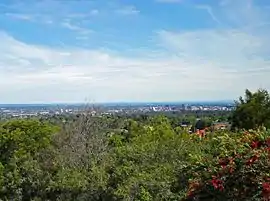 The view from Mobbs Hill has been a noted feature of the district for generations
Carlingford (/ˈkɑːrlɪŋfərd/) is a suburb of Sydney, in the state of New South Wales, Australia. Carlingford is 22 kilometres north-west of the Sydney central business district in the local government area of City of Parramatta. Carlingford is in the Hills District and Northern Sydney regions.
Carlingford is amongst the middle of three different regions of Sydney. The suburb sits in the north-eastern outskirts of the Greater Western Sydney region and is on the south-eastern outskirts of the Hills District and western outskirts of Northern Sydney. The section of Carlingford east of Pennant Hills Road is considered part of the Northern Sydney region, while the rest of the suburb, west of Pennant Hills Road, is referred to as part of The Hills District. (Full article...)- The COVID-19 pandemic in New South Wales is part of the ongoing worldwide pandemic of the coronavirus disease 2019 (COVID-19) caused by severe acute respiratory syndrome coronavirus 2 (SARS-CoV-2). The first confirmed case in New South Wales was identified on 19 January 2020 in Sydney where three travellers returning from Wuhan, Hubei, China, tested positive for the virus.
, there had been over 1,863,186 confirmed cases in NSW: 1,149,142 confirmed cases from PCR testing, and nearly 714,044 positive rapid antigen tests (RAT) since mid-January 2022. 17,509,209 vaccines have been administered. (Full article...) 
Football Australia is the governing body of soccer, futsal, and beach soccer within Australia, headquartered in Sydney. Although the first governing body of the sport was founded in 1911, Football Australia in its current form was only established in 1961 as the Australian Soccer Federation. It was later reconstituted in 2003 as the Australian Soccer Association before adopting the name of Football Federation Australia in 2005. In contemporary identification, a corporate decision was undertaken to institute that name to deliver a "more united football" in a deliberation from the current CEO, James Johnson. The name was changed to Football Australia in December 2020.
Football Australia oversees the men's, women's, youth, Paralympic, beach and futsal national teams in Australia, the national coaching programs and the state governing bodies for the sport. It sanctions professional, semi-professional and amateur soccer in Australia. Football Australia made the decision to leave the Oceania Football Confederation (OFC), for which it was a founding member, and become a member of the Asian Football Confederation (AFC) on 1 January 2006 and ASEAN Football Federation (AFF) on 27 August 2013. (Full article...)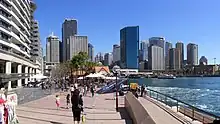 Sydney Cove, Circular Quay
Sydney Cove (Eora: Warrane) is a bay on the southern shore of Sydney Harbour, one of several harbours in Port Jackson, on the coast of Sydney, New South Wales. Sydney Cove is a focal point for community celebrations, due to its central Sydney location between the Sydney Opera House and the Sydney Harbour Bridge. (Full article...)- The University of Technology Sydney (UTS) is a public research university located in Sydney, New South Wales, Australia. Although its origins are said to trace back to the 1830s, the university was founded in its current form in 1988. As of 2021, UTS enrols 45,221 students through its 9 faculties and schools.
The university is regarded as one of the world's leading young universities (under 50 years old), ranked 1st in Australia and 11th in the world by the 2021 QS World University Rankings Young Universities. (Full article...) - Greater Newcastle (locally /ˈnjuːkɑːsəl/ NEW-kah-səl; Awabakal: Mulubinba) is a regional metropolitan area and the second-most-populated district in the state of New South Wales, Australia. It includes the cities of Newcastle and Lake Macquarie; it is the hub of the Lower Hunter region, which includes most parts of the local government areas of City of Newcastle, City of Lake Macquarie, City of Cessnock, City of Maitland and Port Stephens Council.
Located at the mouth of the Hunter River, it is the predominant city within the Hunter Region. Famous for its coal, Newcastle is the largest coal exporting harbour in the world, exporting 159.9 million tonnes of coal in 2017. Beyond the city, the Hunter Region possesses large coal deposits. Geologically, the area is located in the central-eastern part of the Sydney Basin. (Full article...) 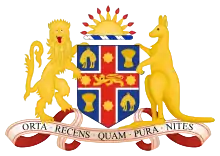
The Supreme Court of New South Wales is the highest state court of the Australian State of New South Wales. It has unlimited jurisdiction within the state in civil matters, and hears the most serious criminal matters. Whilst the Supreme Court is the highest New South Wales court in the Australian court hierarchy, an appeal by special leave can be made to the High Court of Australia.
Matters of appeal can be submitted to the New South Wales Court of Appeal and Court of Criminal Appeal, both of which are constituted by members of the Supreme Court, in the case of the Court of Appeal from those who have been commissioned as judges of appeal. (Full article...)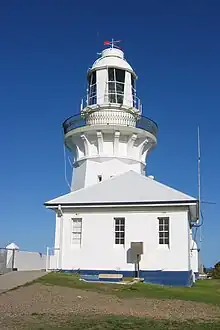 Smoky Cape Lighthouse, near South West Rocks
Smoky Cape Lighthouse is a heritage-listed active lighthouse located on Smoky Cape, a headland in Arakoon east of the town of South West Rocks, Kempsey Shire, New South Wales, Australia, and within the Hat Head National Park. It directs boats towards the entrance to the Macleay River, which is located just to the north of the lighthouse.
It is one of the last major lighthouse complexes designed by the New South Wales colonial architect of the time, James Barnet, and was one of Australia's last lighthouses to be designed for architectural excellence.
Standing on a granite headland 111 metres (364 ft) above the sea, its light is the highest in New South Wales. (Full article...)- The University of Sydney (USYD), also known as Sydney University, or informally Sydney Uni, is a public research university located in Sydney, Australia. Founded in 1850, it is the oldest university in Australia and is one of the country's six sandstone universities. The university comprises eight academic faculties and university schools, through which it offers bachelor, master and doctoral degrees.
The university consistently ranks highly both nationally and internationally. QS World University Rankings ranked the university 41st in the world. The university is also ranked first in Australia and fourth in the world for QS graduate employability. It is one of the first universities in the world to admit students solely on academic merit, and opened their doors to women on the same basis as men. (Full article...) 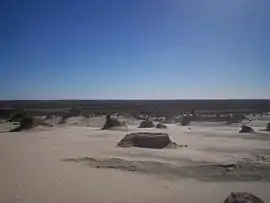 Mungo Lunette, looking south towards Mildura, 2007.
Mungo National Park is a protected national park that is located in south-western New South Wales, in eastern Australia. The 110,967-hectare (274,210-acre) national park is situated approximately 875 kilometres (544 mi) west of Sydney in the Balranald Shire. Mungo National Park is the traditional meeting place of the Muthi Muthi, Nyiampaar and Barkinji Aboriginal Nations. People are no longer able to climb the sand dunes by themselves as stricter rules have been enforced, all visitors groups need to be accompanied by an accredited tour guide to access the sand dunes.
The national park is part of the UNESCO World Heritage–listed Willandra Lakes Region, an area of 2,400 square kilometres (930 sq mi) that incorporates seventeen dry lakes. The seventeen dry lakes are not all called Mungo but are all declared world heritage. The creek that used to flow into Mungo is being preserved as a sacred site. The national park is about 75 kilometres (47 mi) south-east of Pooncarie, 110 kilometres (68 mi) north-east of Mildura and approximately 145 kilometres (90 mi), 90 minutes drive south-west of Ivanhoe. The roads to, in or around the park are unsealed and can be accessed in 2-wheel-drive cars, but councils will close the road in wet weather. (Full article...)
Did you know (auto-generated)

- ... that Mary Kate Barlow was made a dame of the Holy Sepulchre in recognition of her contribution to the Eucharistic congress of 1928 held in Sydney, Australia?
- ... that at the time of her death at age 90, Lilliane Brady was the mayor of Cobar Shire and the longest-serving female mayor in New South Wales's history?
- ... that the "Cuddle with a Koala" experience at Featherdale Wildlife Park was stopped in 1988 when New South Wales law was changed to restrict koala handling?
- ... that Victorian post office official William Rundell also collected stamps in his spare time, acquiring 48 copies of the "Sydney view" stamps of New South Wales?
General images -
 Founding of the settlement of Port Jackson at Botany Bay in New South Wales in 1788 - Thomas Gosse (from History of New South Wales)
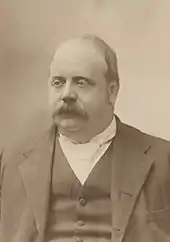 Sir George Reid was Premier of New South Wales in the lead up to Federation. (from History of New South Wales)
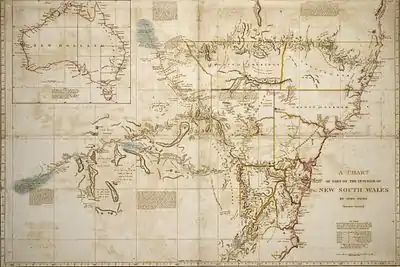 A chart of part of the interior of New South Wales by John Oxley, Surveyor General, 1822 (from History of New South Wales)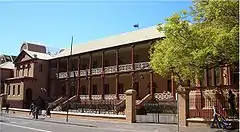
 Mr E.H. Hargraves, The Gold Discoverer of Australia, returning the salute of the gold miners - Thomas Tyrwhitt Balcombe, 1851 (from History of New South Wales)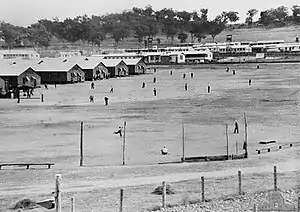

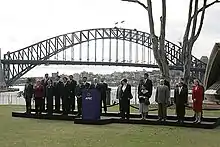 World leaders with Prime Minister John Howard in Sydney for the 2007 APEC conference (from History of New South Wales)
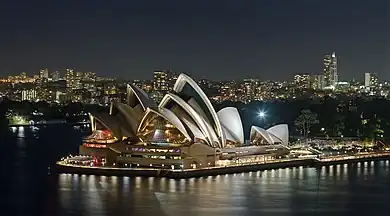 The Sydney Opera House was opened in 1973. (from History of New South Wales)
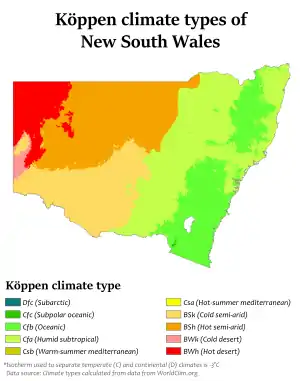 Köppen climate types in New South Wales (from Geography of New South Wales)
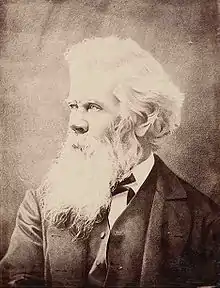 Sir Henry Parkes was a Premier of New South Wales and one of the "Fathers of Australian Federation" (from History of New South Wales)
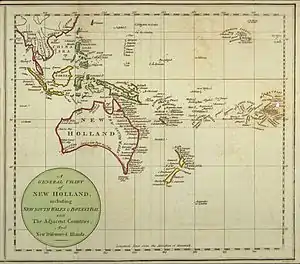 A General Chart of New Holland including New South Wales & Botany Bay with The Adjacent Countries and New Discovered Lands, published in An Historical Narrative of the Discovery of New Holland and New South Wales, London, Fielding and Stockdale, November 1786 (from History of New South Wales)
 Olympic colours on the Sydney Harbour Bridge in the year 2000 (from History of New South Wales)
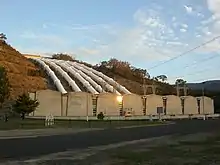 Tumut 3 Power Station was constructed as part of the vast Snowy Mountains Scheme in New South Wales (1949–1974). Construction necessitated the expansion of Australia's immigration program. (from History of New South Wales)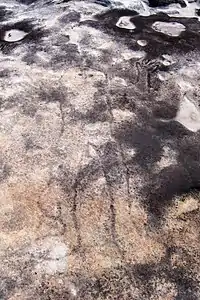
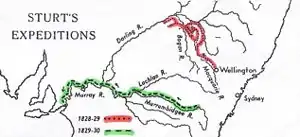 Early expeditions of Charles Sturt (from History of New South Wales)
 Aboriginal tribes in New South Wales, from an 1892 map (from History of New South Wales)
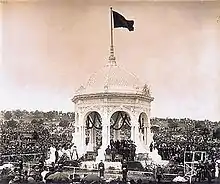 Federation Pavilion, Centennial Park, Sydney, 1 January 1901. (from History of New South Wales)
 Governor Arthur Phillip hoists the British flag over the new colony at Sydney in 1788 (from History of New South Wales)
.jpg.webp) Landing of Lieutenant James Cook at Botany Bay, 29 April 1770 (from History of New South Wales)
Landing of Lieutenant James Cook at Botany Bay, 29 April 1770 (from History of New South Wales)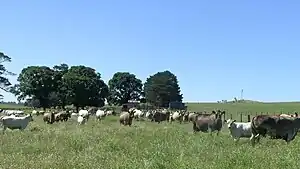 Murray Grey cows and calves (from Economy of New South Wales)
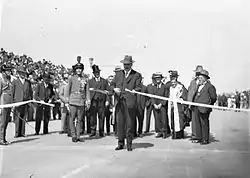 Ribbon ceremony to open the Sydney Harbour Bridge on 20 March 1932. Breaking protocol, the soon to be dismissed Premier Jack Lang cuts the ribbon while Governor Philip Game looks on. (from History of New South Wales)
.jpg.webp) Dry paddocks in the Riverina region during the 2007 drought (from History of New South Wales)
Dry paddocks in the Riverina region during the 2007 drought (from History of New South Wales)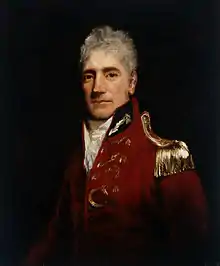 The 5th Governor of New South Wales, Lachlan Macquarie, was influential in establishing civil society in Australia (from History of New South Wales)
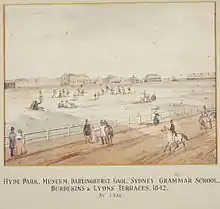 Hyde Park, Sydney with the Australian Museum under construction in the distance, 1842 (from History of New South Wales)
 A 630 lb gold specimen from Hill End, unearthed in 1872 (from History of New South Wales)
Topics
Categories

More portals
In the news
- 17 April 2023 – Recycling in Australia
- Further sites of illicit soft plastic storage are found in Sydney after the collapse of commercial plastic recycler REDcycle. After taking $20 million from Coles and Woolworths to recycle soft plastics at 2,000 locations, the company instead stored 12,000 tonnes of plastics at more than 44 locations across Australia. (9 News) (The Guardian)
Associated Wikimedia
The following Wikimedia Foundation sister projects provide more on this subject:
-
 Commons
Free media repository -
 Wikibooks
Free textbooks and manuals -
 Wikidata
Free knowledge base -
 Wikinews
Free-content news -
 Wikiquote
Collection of quotations -
 Wikisource
Free-content library -
 Wikiversity
Free learning tools -
 Wikivoyage
Free travel guide -
 Wiktionary
Dictionary and thesaurus
-
 List of all portalsList of all portals
 -
 The arts portal
 -
 Biography portal
 -
 Current events portal
 -
 Geography portal
 -
 History portal
 -
 Mathematics portal
 -
 Science portal
 -
 Society portal
 -
 Technology portal
 -
 Random portalRandom portal
 -
 WikiProject PortalsWikiProject Portals