Portal:Australia

.svg.png.webp) Welcome to the Australia portal!
Welcome to the Australia portal!
| Showcase | Content | Interesting facts | Contributing |
Introduction
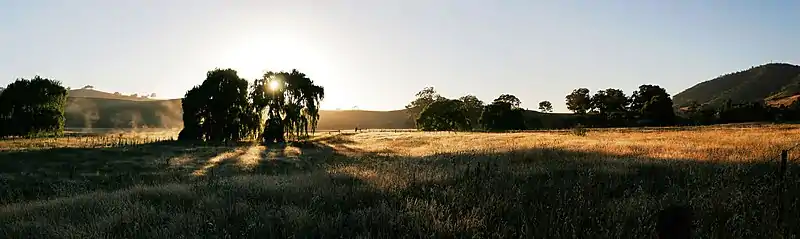
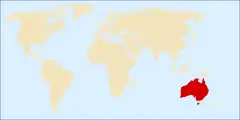
Australia, officially the Commonwealth of Australia, is a sovereign country comprising the mainland of the Australian continent, the island of Tasmania, and numerous smaller islands. Australia is the largest country by area in Oceania and the world's sixth-largest country. Australia is the oldest, flattest, and driest inhabited continent, with the least fertile soils. It is a megadiverse country, and its size gives it a wide variety of landscapes and climates, with deserts in the centre, tropical rainforests in the north-east, tropical savannas in the north, and mountain ranges in the south-east.
The ancestors of Aboriginal Australians began arriving from south-east Asia approximately 65,000 years ago, during the last ice age. Arriving by sea, they settled the continent and had formed approximately 250 distinct language groups by the time of European settlement, maintaining some of the longest known continuing artistic and religious traditions in the world. Australia's written history commenced with the European maritime exploration of Australia. The Dutch navigator Willem Janszoon was the first known European to reach Australia, in 1606. In 1770, the British explorer James Cook mapped and claimed the east coast of Australia for Great Britain, and the First Fleet of British ships arrived at Sydney in 1788 to establish the penal colony of New South Wales. The European population grew in subsequent decades, and by the end of the 1850s gold rush, most of the continent had been explored by European settlers and an additional five self-governing British colonies established. Democratic parliaments were gradually established through the 19th century, culminating with a vote for the federation of the six colonies and foundation of the Commonwealth of Australia on 1 January 1901. This began a process of increasing autonomy from the United Kingdom, highlighted by the Statute of Westminster Adoption Act 1942, and culminating in the Australia Act 1986.
Australia is a federal parliamentary constitutional monarchy, comprising six states and ten territories. Australia's population of nearly 26 million is highly urbanised and heavily concentrated on the eastern seaboard. Canberra is the nation's capital, while its most populous city and financial centre is Sydney. The next four largest cities are Melbourne, Brisbane, Perth, and Adelaide. It is ethnically diverse and multicultural, the product of large-scale immigration, with almost half of the population having one parent born overseas. Australia's abundant natural resources and well-developed international trade relations are crucial to the country's economy, which generates its income from various sources including services, mining exports, banking, manufacturing, agriculture and international education. Australia ranks amongst the highest in the world for quality of life, health, education, economic freedom, civil liberties and political rights.
Featured article -
 Featured articles are displayed here, which represent some of the best content on English Wikipedia.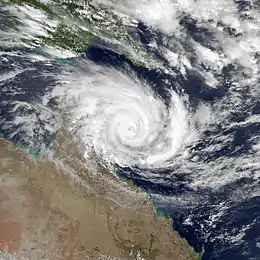
Selected biography -

Did you know (auto-generated) -
- ... that Australian rules footballer Kate Lutkins, the best on ground at this year's AFL Women's Grand Final, played with a painful foot injury that required surgery?
- ... that Mertome Village in Bayswater, Western Australia was the first aged care complex to be built by a local government in Australia?
- ... that in 1999 Jan Fullerton became the first woman to be appointed Director General of the National Library of Australia?
- ... that Tonia Shand became Australia's first woman high commissioner to Sri Lanka in 1988?
- ... that following a career-ending injury while playing Australian rules football, Justin Clarke became a Rhodes scholar in 2021?
- ... that indigenous Australian artist Daniel Boyd has depicted colonial figures including Captain James Cook and Governor Arthur Phillip as pirates?
- ... that it is compulsory for educational providers of international students to register with CRICOS in Australia?
- ... that Australian religious sister Bridget Partridge fled her convent in 1920 dressed only in her nightgown, precipitating a national sectarian scandal?
In the news
- 3 May 2023 – 2023 Sudan conflict
- Australia's Royal Australian Air Force evacuates 36 Australians from Sudan, reportedly overnight. (Sydney Morning Herald) (ABC News Australia)
- 21 April 2023 –
- Wreckage of the Imperial Japanese Navy ship SS Montevideo Maru, sunk during World War II, is found after 81 years in the South China Sea, off the coast of Luzon Island. The ship, which was carrying over 1,000 prisoners of war, including 850 Australian POWs, represented the largest loss of life for the Australian armed forces during the Second World War. (CNN)
- 20 April 2023 – Solar eclipse of April 20, 2023
- A hybrid solar eclipse occurs across the South Pacific in Australia, East Timor, and Indonesia. (The New York Times) (People)
- 17 April 2023 – Recycling in Australia
- Further sites of illicit soft plastic storage are found in Sydney after the collapse of commercial plastic recycler REDcycle. After taking $20 million from Coles and Woolworths to recycle soft plastics at 2,000 locations, the company instead stored 12,000 tonnes of plastics at more than 44 locations across Australia. (9 News) (The Guardian)
- 13 April 2023 – 2022–23 Australian region cyclone season
- Cyclone Ilsa
- Cyclone Ilsa makes landfall between De Grey and Pardoo Roadhouse in Western Australia, Australia, as a category five cyclone. (ABC News Australia)
Selected pictures -
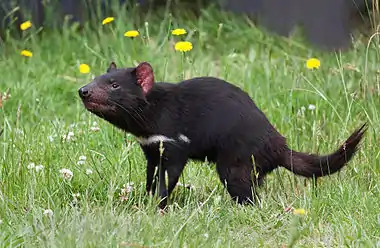 Photo: JJ HarrisonThe Tasmanian devil (Sarcophilus harrisii) is a carnivorous marsupial found in the wild only on the Australian island of Tasmania. It is characterised by its stocky and muscular build, black fur, pungent odour, extremely loud and disturbing screech, keen sense of smell, and ferocity when feeding. Its large head and neck allow it to generate the strongest bite per unit body mass of any living mammal.
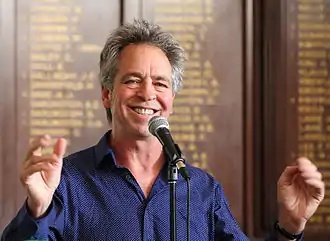 Photo: John O'Neill; edit: JJ HarrisonBrian Nankervis (b. 1956), an Australian comedian and writer, shown here during a live performance. Nankervis rose to popularity while playing Raymond J. Bartholomeuz on Hey Hey It's Saturday; since 2005 he has been a host of the gameshow RocKwiz.
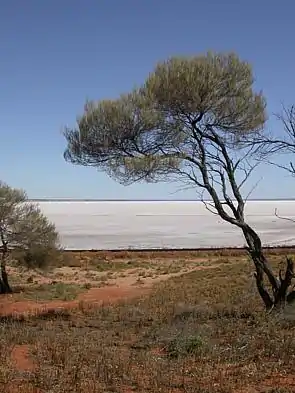 Lake Hart in South Australia.
The Lake Eyre Basin has a drainage basin that covers one-sixth of all Australia. It is one of the largest internal drainage systems in the world, and covers roughly 1.2 million square kilometres, including much of inland Queensland, large portions of South Australia and the Northern Territory, and a part of western New South Wales.
Photo credit: User:Tannin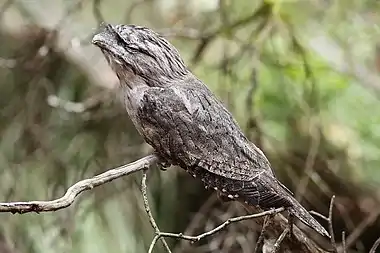 Photo: Benjamint444The Tawny Frogmouth (Podargus strigoides) is a large species of frogmouth found throughout the Australian mainland, Tasmania, and southern New Guinea. Unlike the owl for which it is often mistaken, the Tawny Frogmouth is not a bird of prey. Instead, it is almost exclusively insectivorous. For defense, it relies on cryptic camouflage, standing still to appear part of a branch.
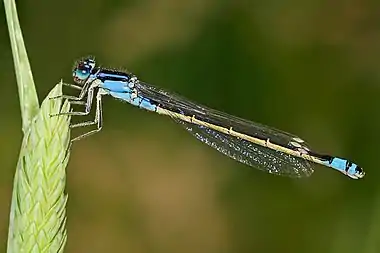 Photo credit: Fir0002The Common bluetail (Ischnura heterosticta) is a small Australian damselfly of the family Coenagrionidae. Most males have blue eyes, blue thorax and a blue ringed tail. The females are green or light brown.
.jpg.webp) Photo: Steven Rasmussen; edit: KeraunoscopiaAustralian artistic gymnast Lauren Mitchell (b. 1991) performing a layout step-out on the balance beam during the 41st World Artistic Gymnastics Championships in London, United Kingdom, on 14 October 2009; at the Championships, Mitchell won two silver medals, one for the balance beam and another for floor exercises. Since her first medal in 2007, Mitchell has placed in the World Championships, World Cup, and Commonwealth Games, and competed in two Olympic Games.
Photo: Steven Rasmussen; edit: KeraunoscopiaAustralian artistic gymnast Lauren Mitchell (b. 1991) performing a layout step-out on the balance beam during the 41st World Artistic Gymnastics Championships in London, United Kingdom, on 14 October 2009; at the Championships, Mitchell won two silver medals, one for the balance beam and another for floor exercises. Since her first medal in 2007, Mitchell has placed in the World Championships, World Cup, and Commonwealth Games, and competed in two Olympic Games. Tallow Beach.
Byron Bay is a coastal town in the state of New South Wales of almost 30,000 people. Located approximately 800 kilometres north of Sydney and 200 kilometres south of Brisbane, the town is situated near Cape Byron at the eastern-most point of the Australian continent. The town is a popular tourist destination and is known for its pristine beaches, wildlife, alternative lifestyle and music festivals.
Photo credit: Mike Lehmann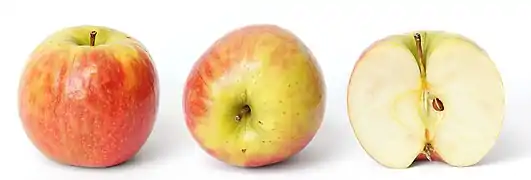 Photo credit: Fir0002Two whole Cripps Pink apples and a cross-section of a third. More commonly known by the trademarked name "Pink Lady", this apple cultivar was originally bred by John Cripps by crossing the Australian apple Lady Williams with a Golden Delicious. The apple shape is ellipsoid, it has a distinctive pink hue mixed with a green "background," and taste is tart.
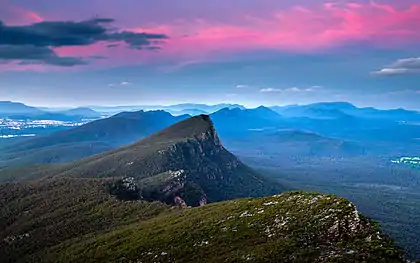 The western part of the Park. To the right is the rock formation known as The Fortress.
The Grampians is a mountain range and national park in Victoria, located 235 kilometres west of Melbourne. The ranges were named in 1836 by Surveyor-General of New South Wales, Sir Thomas Mitchell, after the Grampian Mountains in his native Scotland, but are also known by the name Gariwerd, from one of the local Australian Aboriginal languages.
Photo credit: Stevage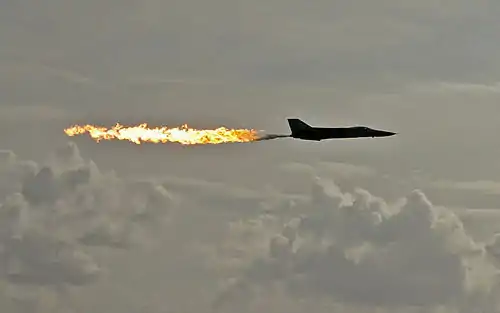 Photo credit: John O'NeillFuel dumping is a practice used by aircraft that are equipped to jettison fuel in the event of certain types of emergency situations. This RAAF F-111 aircraft is performing a dump-and-burn fuel dump at the Australian International Airshow, a procedure where the fuel is intentionally ignited using the plane's afterburner. This type of fuel dumping is also referred to as "torching" or a "zippo".
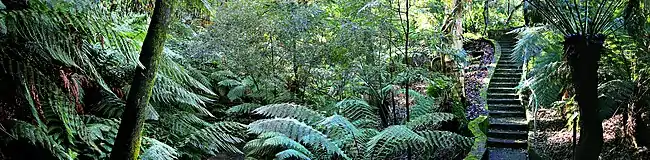 Rainforest walk at the National Botanical Gardens
The Australian National Botanic Gardens are located in Canberra and are administered by the Commonwealth Government Department of the Environment and Heritage. The botanic gardens are a collection of native Australian flora arrange by taxonomy or natural ecological groupings. The gardens maintains a wide variety of botanical resources for researchers and cultivates native plants threatened in the wild. The concept for a national botanic gardens developed in the 1930s as Canberra was built, with the gardens officially opened in 1970 on a site of 90 hectares astride the Black Mountain
Photo credit: Fir0002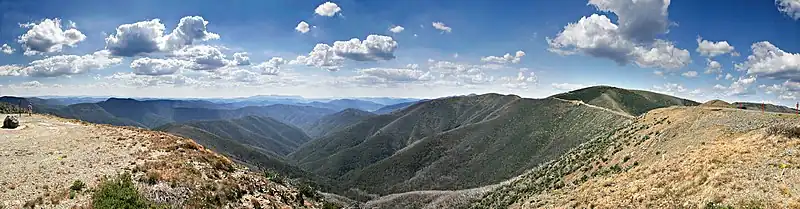 Alpine Range scenery as viewed just past Mt Hotham.
The Australian Alps are the highest mountain ranges of mainland Australia. They are located in south-eastern Australia, straddling far southern New South Wales and eastern Victoria. The Alps contain the Australian mainland's only peaks exceeding 2,000 metres AHD and it is only here that snow occurs regularly.
Photo credit: Fir0002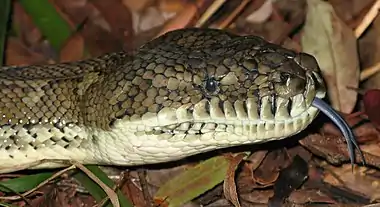 Photo credit: LiquidGhoulThe head of a Coastal Carpet Python, the largest subspecies of Morelia spilota, a non-venomous Australian python, showing its forked tongue, a feature common to many reptiles, who smell using the tip of their tongue. Having a forked tongue allows them to tell which direction a smell is coming from.
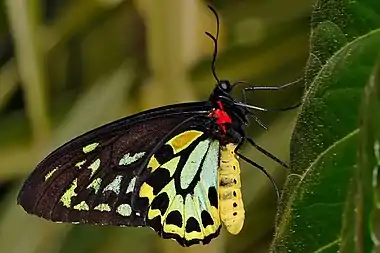 Photo credit: Fir0002The Cairns Birdwing (Ornithoptera euphorion) is a birdwing butterfly of the Papilionidae family. It is Australia's largest butterfly, and is native to the tropical north of Queensland.
 Photo credit: Fir0002Nick Heidfeld and Nico Rosberg at corner 6 of the 2008 Australian Grand Prix, during one of the race's safety car periods. This first race of the 2008 Formula One season was won by McLaren-Mercedes driver Lewis Hamilton. Heidfeld and Rosberg finished second and third, respectively.
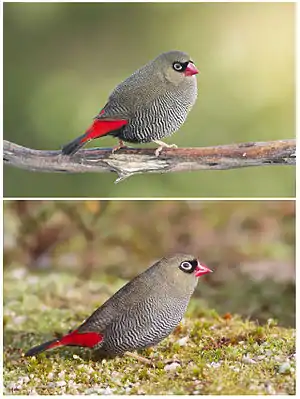 Photo: JJ HarrisonA Beautiful Firetail (Stagonopleura bella) male (top) and female. In this common Australian species of estrildid finch, nest-building and raising children is done collaboratively.
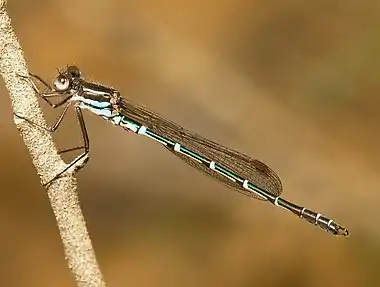 Photo: JJ HarrisonThe Metallic Ringtail (Austrolestes cingulatus) is an Australian species of damselfly, so named because of its glossy metallic colouration and the "rings" on each abdominal segment. It is widely distributed in Tasmania, Victoria, eastern New South Wales and south eastern Queensland.
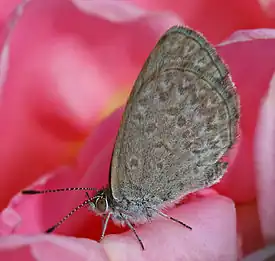 Photo credit: John O'NeillA Common Grass Blue (Zizina labradus), a small Australian butterfly. This specimen, perched on a rose, is approximately 10 millimetres (0.4 in) in size. Females generally have a larger wingspan compared to males (23 and 20 mm or 0.9 and 0.8 in respectively).
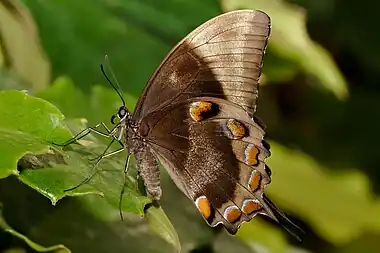 Photo credit: Fir0002The Ulysses Butterfly (Papilio ulysses) is a large Australian swallowtail with a wingspan of about 14 cm (5.5 in). The top of the butterfly’s wings are an iridescent electric blue; the underside is a more subdued black and brown coloration. When the butterfly is perched the intense blue of its wings is hidden (as seen here), helping it to blend in with its surroundings.
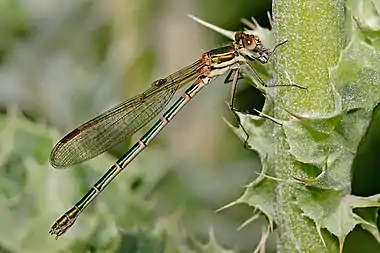 Photo credit: Fir0002A female Metallic Ringtail (Austrolestes cingulatus), an Australian damselfly, eating its prey. Each abdominal segment is marked by a pale "ring"; this combined with its glossy metallic coloration give the insect its common name.
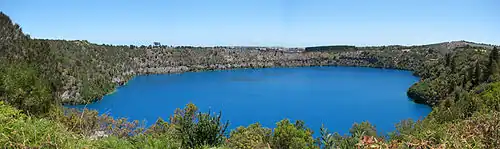 Blue Lake.
Blue Lake is a large lake located in an extinct volcanic caldera in Mount Gambier. It is known as Waawor in the local Aboriginal language. During summer and the surrounding months, the lake takes on a vibrant blue colour, returning to a colder steely-grey colour for winter. The exact cause of this phenomenon is still a matter of conjecture but it is generally considered likely that it revolves around the warming of the surface layers of the lake during the summer months to around 25 degrees celsius, causing calcium carbonate to precipitate out of solution and enabling micro-crystallites of calcium carbonate to form. This results in a scatter of the blue wavelength of sunlight. The movement of planktonic life-forms within the lake during the seasons and during the day may also play a part in the visibility changes.
Photo credit: Aaron Allen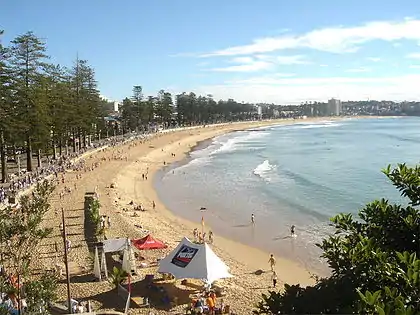 A view of Manly Beach looking North from above the Manly Surf Lifesaving Club at the Southern end of the beach.
Photo credit: Petesmiles
On this day
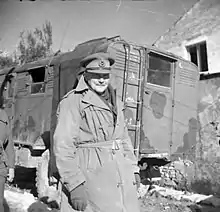
- 1941 – The Battle of Crete, involving the Australian 6th Division, begins.
- 1997 – A Human Rights and Equal Opportunity Commission report calls for an apology for an early government policy of removing Aboriginal children from their parents and placing them in institutions.
General images
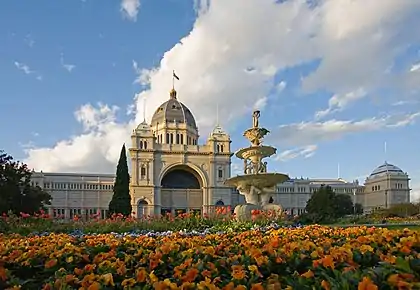 The Royal Exhibition Building, Melbourne (from Culture of Australia)
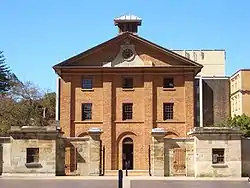 Hyde Park Barracks, Sydney (from Culture of Australia)
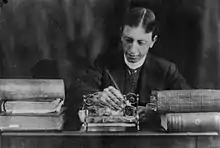
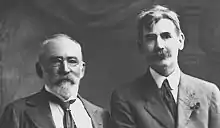 The Bulletin, founded by J. F. Archibald (left), nurtured bush poets such as Henry Lawson (right). (from Culture of Australia)
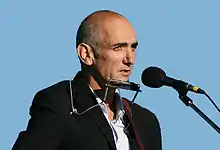 Singer-songwriter Paul Kelly (from Culture of Australia)
.jpg.webp)
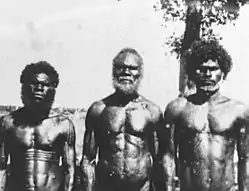 Men from Bathurst Island, 1939 (from Aboriginal Australians)
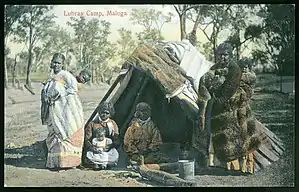 Historical image of Aboriginal Australian women and children, Maloga, New South Wales around 1900 (in European dress) (from Aboriginal Australians)
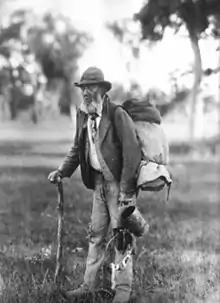 A swagman in bushman's apparel, wearing a brimmed hat and carrying swag, and billy can. (from Culture of Australia)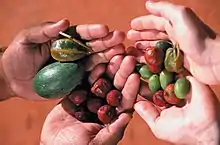
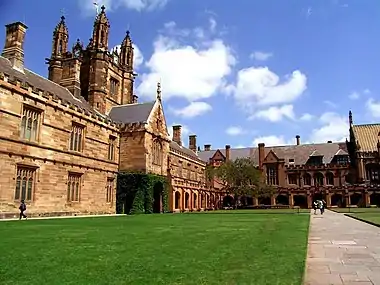 The University of Sydney (from Culture of Australia)
.jpg.webp) Kylie Minogue is hailed as one of Australia's most successful pop musicians (from Culture of Australia)
Kylie Minogue is hailed as one of Australia's most successful pop musicians (from Culture of Australia).jpg.webp) The SBS building in Melbourne's Federation Square. SBS is Australia's multicultural broadcaster. (from Culture of Australia)
The SBS building in Melbourne's Federation Square. SBS is Australia's multicultural broadcaster. (from Culture of Australia) Corroboree at Newcastle by convict artist Joseph Lycett, ca. 1818. Aboriginal Australian religious practices associated with the Dreamtime have been practised for tens of thousands of years. (from Culture of Australia)
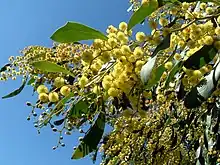 Golden Wattle, Australia's floral emblem and the source of Australia's national colors, green and gold (from Culture of Australia)
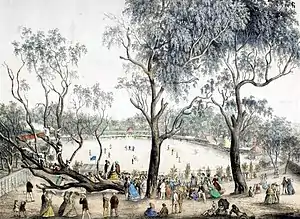 Cricket match at the Melbourne Cricket Ground, 1860s (from Culture of Australia)
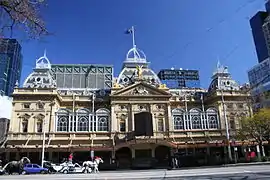 The Princess Theatre in Melbourne (from Culture of Australia)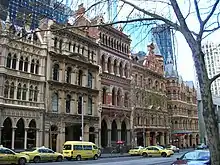
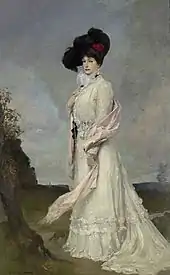 Portrait of Madame Melba by Rupert Bunny (from Culture of Australia)
 Governor Arthur Phillip hoists the British flag over the new colony at Sydney in 1788. (from Culture of Australia)
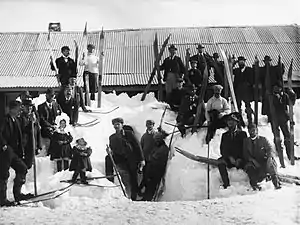 Skiing in Australia began in Kiandra, a goldmining town in the Snowy Mountains of New South Wales, in the 1860s. (from Culture of Australia)
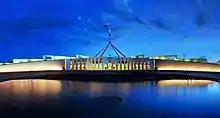 Parliament House, Canberra (from Culture of Australia)
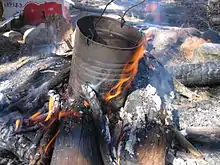 A billycan used for heating water (from Culture of Australia)
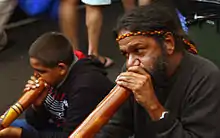 Didgeridoo performers (from Culture of Australia)
 Countries of birth of Australian estimated resident population, 2006 (from Culture of Australia)
 The initial human settlement of Oceania is estimated to be between 60 and 40 kya. The archaeogenetic results indicate a colonization of Australia (southern Sahul) before 37 kya and an incubation period in northern Sahul (Papua New Guinea) followed by westward expansions within Australia after ~28 kya. Principal component analysis of ancient and present-day individuals from Eurasian populations. (from Aboriginal Australians)
.jpg.webp) A group of Australian men wearing budgie smugglers. (from Culture of Australia)
A group of Australian men wearing budgie smugglers. (from Culture of Australia)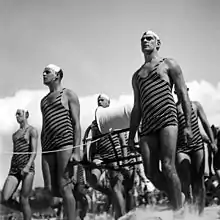 The surf lifesaving movement originated in Australia. (Pictured: surf lifesavers, Bondi Beach, 1930s). (from Culture of Australia)
 PCA of Orang Asli (Semang) and Andamanese, with worldwide populations in HGDP. (from Aboriginal Australians)
 The first State of Origin shield (from Culture of Australia)
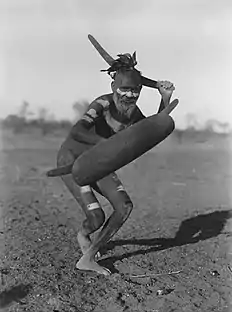 A Luritja man demonstrating method of attack with boomerang under cover of shield (1920) (from Culture of Australia)
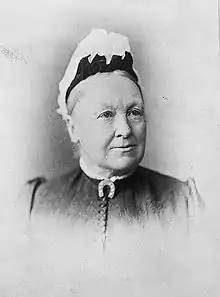 South Australian suffragette Catherine Helen Spence (1825–1910). The Australian colonies established democratic parliaments from the 1850s and began to grant women the vote in the 1890s. (from Culture of Australia)
 An Aboriginal encampment near the Adelaide foothills in an 1854 painting by Alexander Schramm (from Aboriginal Australians)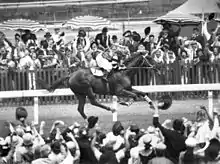
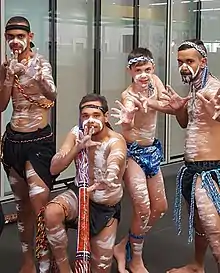 Noongar traditional dancers, Perth, Australia (from Aboriginal Australians)
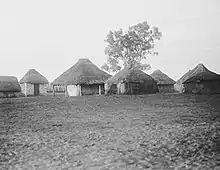 Aboriginal dwellings in Hermannsburg, Northern Territory, 1923. Image: Herbert Basedow (from Aboriginal Australians)
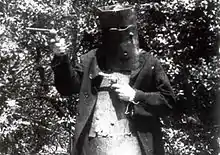 Actor playing the bushranger Ned Kelly in The Story of the Kelly Gang (1906), the world's first feature film (from Culture of Australia)
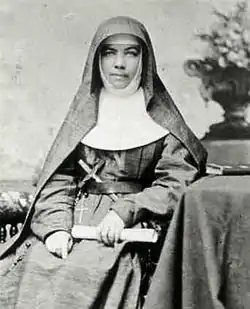 St Mary Mackillop established an extensive network of schools and is Australia's first canonised saint of the Catholic Church. (from Culture of Australia)
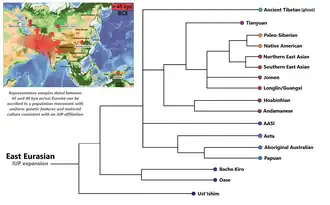 Phylogenetic position of the Aboriginal Australian lineage among other East-Eurasians. (from Aboriginal Australians)
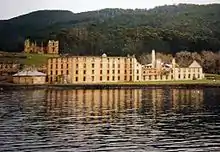 Convict architecture at Port Arthur, Tasmania (from Culture of Australia)
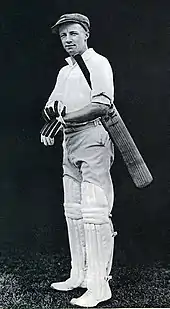 Donald Bradman is often cited as statistically the greatest sportsman of any major sport. (from Culture of Australia)
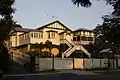 A typical Queenslander house in Brisbane (from Culture of Australia)
 Cover of Old Bush Songs, Banjo Paterson's 1905 collection of bush ballads (from Culture of Australia)
 A commemorative statue of John Simpson Kirkpatrick, a famous stretcher bearer who was killed in the Gallipoli Campaign. (from Culture of Australia)
 The Wiggles performing in the United States in 2007 (from Culture of Australia)
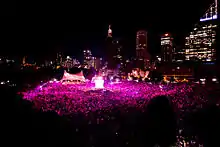 Founded in 1993, Sydney's Tropfest is the world's largest short film festival. (from Culture of Australia)
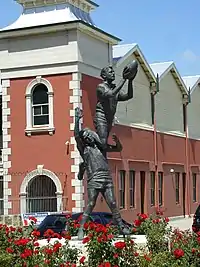 Statue in Fremantle of an Australian rules footballer taking a spectacular mark (from Culture of Australia)
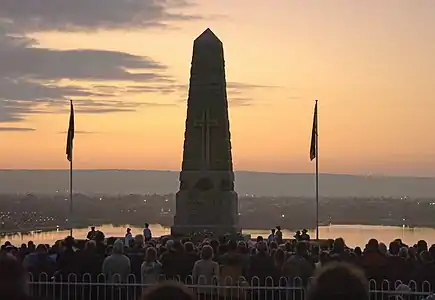 Anzac Day dawn services are held throughout Australia every April. (from Culture of Australia)
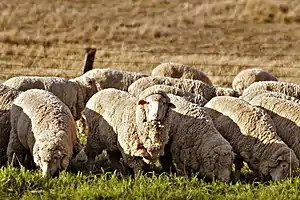 Sheep grazing in rural Australia. Early British settlers introduced Western stock and crops and Australian agriculture now produces an abundance of fresh produce. (from Culture of Australia)
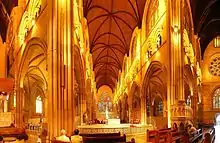 Interior of St Mary's Cathedral, Sydney (from Culture of Australia)
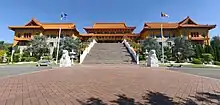 Nan Tien Temple, a Buddhist temple in Wollongong. Multicultural immigration has increased Australia's religious diversity. (from Culture of Australia)
Topics
Sub-portals
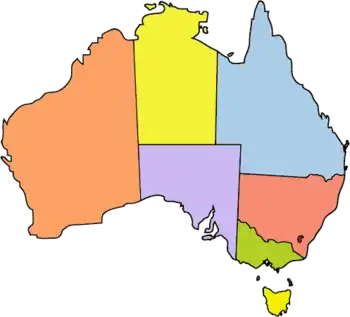
(Northern Territory) Victoria Australian Capital Territory |
Categories

More portals
WikiProject
Flag of the Commonwealth of Australia |
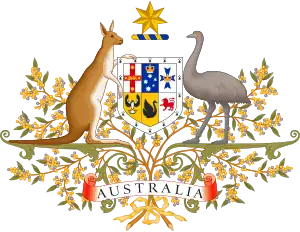 Coat of Arms of the Commonwealth of Australia |
 | |
Consider joining WikiProject Australia, a WikiProject dedicated to improving Wikipedia's coverage of topics related to Australia. The project page and its subpages contain suggestions on formatting and style of articles, which can be discussed at the project's notice board. To participate, simply add your name to the project members page.
As of 20 May 2023, there are 197,998 articles within the scope of WikiProject Australia. Including non-article pages, such as talk pages, redirects, categories, etcetera, there are 494,868 pages in the project.
Associated Wikimedia
The following Wikimedia Foundation sister projects provide more on this subject:
-
 Commons
Free media repository -
 Wikibooks
Free textbooks and manuals -
 Wikidata
Free knowledge base -
Wikinews
Free-content news -
 Wikiquote
Collection of quotations -
 Wikisource
Free-content library -
 Wikiversity
Free learning tools -
 Wikivoyage
Free travel guide -
 Wiktionary
Dictionary and thesaurus
More portals
-
 List of all portalsList of all portals
 -
 The arts portal
 -
 Biography portal
 -
 Current events portal
 -
 Geography portal
 -
 History portal
 -
 Mathematics portal
 -
 Science portal
 -
 Society portal
 -
 Technology portal
 -
 Random portalRandom portal
 -
 WikiProject PortalsWikiProject Portals