Malaysia national football team
The Malaysia national football team (Malay: Pasukan bola sepak kebangsaan Malaysia) represents Malaysia in international football and is controlled by the Football Association of Malaysia. The national team is recognised by FIFA as the successor of the defunct Malaya national football team which was founded for the 1963 Merdeka Tournament one month before the institution of Malaysia. The team is officially nicknamed Harimau Malaya in reference to the Malayan Tiger.[6]
 | ||||||||||||||||||||||||||||||||||||||||||||
| Nickname(s) | Harimau Malaya (Malayan Tiger)[1] | |||||||||||||||||||||||||||||||||||||||||||
|---|---|---|---|---|---|---|---|---|---|---|---|---|---|---|---|---|---|---|---|---|---|---|---|---|---|---|---|---|---|---|---|---|---|---|---|---|---|---|---|---|---|---|---|---|
| Association | Football Association of Malaysia | |||||||||||||||||||||||||||||||||||||||||||
| Confederation | AFC (Asia) | |||||||||||||||||||||||||||||||||||||||||||
| Sub-confederation | AFF (Southeast Asia) | |||||||||||||||||||||||||||||||||||||||||||
| Head coach | Kim Pan-gon | |||||||||||||||||||||||||||||||||||||||||||
| Captain | Dion Cools | |||||||||||||||||||||||||||||||||||||||||||
| Most caps | Soh Chin Ann (195)[2] | |||||||||||||||||||||||||||||||||||||||||||
| Top scorer | Mokhtar Dahari (89)[3] | |||||||||||||||||||||||||||||||||||||||||||
| Home stadium | Bukit Jalil National Stadium | |||||||||||||||||||||||||||||||||||||||||||
| FIFA code | MAS | |||||||||||||||||||||||||||||||||||||||||||
| ||||||||||||||||||||||||||||||||||||||||||||
| FIFA ranking | ||||||||||||||||||||||||||||||||||||||||||||
| Current | 138  7 (6 April 2023)[4] 7 (6 April 2023)[4] | |||||||||||||||||||||||||||||||||||||||||||
| Highest | 75 (August 1993) | |||||||||||||||||||||||||||||||||||||||||||
| Lowest | 178 (15 March 2018) | |||||||||||||||||||||||||||||||||||||||||||
| First international | ||||||||||||||||||||||||||||||||||||||||||||
 Malaysia 1–1 Thailand Malaysia 1–1 Thailand  (Kuala Lumpur, Malaysia; 12 October 1963)[n 1] | ||||||||||||||||||||||||||||||||||||||||||||
| Biggest win | ||||||||||||||||||||||||||||||||||||||||||||
Malaysia 11–0 Philippines .svg.png.webp) (Tehran, Iran; 7 September 1974) | ||||||||||||||||||||||||||||||||||||||||||||
| Biggest defeat | ||||||||||||||||||||||||||||||||||||||||||||
 United Arab Emirates 10–0 Malaysia United Arab Emirates 10–0 Malaysia (Abu Dhabi, United Arab Emirates; 3 September 2015) | ||||||||||||||||||||||||||||||||||||||||||||
| AFC Asian Cup | ||||||||||||||||||||||||||||||||||||||||||||
| Appearances | 4 (first in 1976) | |||||||||||||||||||||||||||||||||||||||||||
| Best result | Group stage (1976, 1980, 2007) | |||||||||||||||||||||||||||||||||||||||||||
| AFF Cup | ||||||||||||||||||||||||||||||||||||||||||||
| Appearances | 14 (first in 1996) | |||||||||||||||||||||||||||||||||||||||||||
| Best result | Champions (2010) | |||||||||||||||||||||||||||||||||||||||||||
Medal record
| ||||||||||||||||||||||||||||||||||||||||||||







.svg.png.webp)
.svg.png.webp)
.svg.png.webp)
Consisting of the group of 4 teams (the other three being Singapore, Vietnam and Thailand) of Southeast Asia who have each won the ASEAN Football Championship at least once, having won it once, Malaysia has however failed to reach wins outside their region other than a bronze won at the Asian Games in 1974. Having participated in the Summer Olympics once and three AFC Asian Cups, the team has never progressed beyond the group stage.
Malaysia's biggest opponents on the international stage are its geographical neighbours – Indonesia, Thailand, Vietnam and Singapore – with past matches produced and in particular, fixtures involving Indonesia being the most heated among these that corresponds to political and social issues, named as 'Nusantara Derby'.[7] Since the 2020s, Malaysia significantly uses naturalised players of various different nationalities in an attempt to improve the prospects of its national football team.[8]
Etymology
The Harimau Malaya nickname has been used by the team's predecessor, Malaya national football team. The nickname referred to the national animal of Malaysia, the Malayan tiger.[9][10] Another source stated the name was believed to have been derived from a Malayan football player from Stulang Laut, Johor named Abdullah Mohd Don (Dollah Don).[11] The player had been called "Harimau Malaya" by the founding father of Indonesia, Sukarno when he managed to equalise against an Indonesian football club by scoring a hat-trick in a match between Singaporean Malay Club and Peseja (Persija Jakarta) in 1953 after trailing 3 goals behind them.[12][13]
History
Early years (1963–1969)
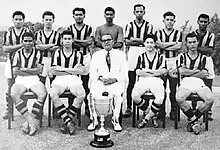
Prior to 16 September 1963, North Borneo (now Sabah), Sarawak, Malaya and Singapore were represented by their own national teams, a situation which pre-dated the establishment Malaysia.[16] Malaya and Singapore often competed in international competitions such as the Merdeka Tournament while North Borneo and Sarawak competed in Borneo Cup. Malaya's biggest achievement in football was becoming the bronze medalist of the 1962 Asian Games held in Jakarta, Indonesia after defeating South Vietnam 4–1 lead by Abdul Ghani Minhat, who at that time was the first Asian player to reach 50 goals for the men's national teams.[17]

The beginning of the Malaysian football team match took place in Merdeka Stadium on 8 August 1963 with the combined strength of Singapore and Malaya (although the federation only existed after 16 September 1963). With the combined forces of Malaya and Singapore, the team began by facing Japan, and lost 3–4.[18] The team continued to use a combination of players from Singapore and Malay Peninsula until the formation of the Malaysia team, wherein the Football Association of Malaya was succeeded by the Football Association of Malaysia (FAM). The combination players with Singapore ended when the latter separated from Malaysia along with the establishment of Football Association of Singapore (FAS) and their subsequent reaffiliation with FIFA in 1965.[19] Since then the squad was only represented by West Malaysian players, mainly due to travel time difficulties to East Malaysia and the players were not well known to the mainstream West Malaysian football. From 1966 to 1970, Chow Chee Keong was voted by Asian Football Confederation as the best Asian's goalkeeper for 5 straight years.[20]
Olympic Tournament & Asia Competition (1970–1980)
In 1971, James Wong of Sabah was the first player from East Malaysia to represent the country.[21][22] Malaysia qualified for the 1972 Olympics in Munich, beating Japan 3–0, South Korea 1–0, Taiwan 3–0 and the Philippines 5–0 along the way.[23] Although they managed to defeat the United States 3–0, they lost the other two matches with a score of 0–3 to West Germany and 0–6 to Morocco, ranking 10th in the final standings.[24][25][26][27] Since 1972, Mokhtar Dahari has been considered a legendary football player for the Malaysian team maintaining his place as one of the best players in Asia.[28] He manage to score a total of 125 goals in 167 appearances for Malaysia (including matches played against club sides, national 'B' teams and selection teams).[29][30] Against other nations' national 'A' teams, he scored 89 goals in 142 appearances.[31][32][33] This makes him once the world's top scorer for men's national teams.[34][35]
Together with the record of Soh Chin Ann. According to both RSSSF and IFFHS, Soh is the player with the most international caps in men's football and become the first men's footballers to reach 200 or more international caps.[36][37] Two years later, Malaysia won their second bronze medal at the 1974 Asian Games after defeating North Korea 2–1.[38] The team went on to qualify twice in a row for the AFC Asian Cup, in 1976 and 1980.[39] It was only in 1977; when the FAM sent a talent scout to the East.[40][41] The list continued by the late James Yaakub of Sarawak in 1977. The team also won the Merdeka Tournament four times, became runner-up three times and achieved third place twice during the 1970s.[42] Malaysia qualified again for the 1980 Olympics in Moscow, beating Indonesia 6–1, South Korea 3–0, Brunei 3–1, Philippines 8–0 and tied with Japan 1–1.[43] Thus, the team meet south korea in the play-off match. Malaysia won the play-off against South Korea with a 2–1 scored in the Merdeka Stadium and qualified but joined the US-led boycott of the games as the Malaysian government made a decision to protest the Soviet Union's invasion of Afghanistan.[44][45][46]
1976 AFC Asian Cup Group A
| Team | Pld | W | D | L | GF | GA | GD | Pts |
|---|---|---|---|---|---|---|---|---|
 Kuwait Kuwait |
2 | 2 | 0 | 0 | 3 | 0 | +3 | 4 |
 China China |
2 | 0 | 1 | 1 | 1 | 2 | −1 | 1 |
| Malaysia |
2 | 0 | 1 | 1 | 1 | 3 | −2 | 1 |
Malaysia participated the 1976 AFC Asian Cup for the first time, meeting Kuwait and China in Group A. During the tournament, Malaysia came in last in the group, losing 0–2 to Kuwait in the opening match but managed to hold China to a 1–1 draw in the second match.
1980 AFC Asian Cup Group B
| Team | Pld | W | D | L | GF | GA | GD | Pts |
|---|---|---|---|---|---|---|---|---|
.svg.png.webp) South Korea South Korea |
4 | 3 | 1 | 0 | 10 | 2 | +8 | 7 |
| Kuwait |
4 | 2 | 1 | 1 | 8 | 5 | +3 | 5 |
| Malaysia |
4 | 1 | 2 | 1 | 5 | 5 | 0 | 4 |
 Qatar Qatar |
4 | 1 | 1 | 2 | 3 | 8 | −5 | 3 |
| United Arab Emirates |
4 | 0 | 1 | 3 | 3 | 9 | −6 | 1 |
Malaysia made its second Asian Cup appearance in 1980, placed in Group B alongside South Korea, Kuwait, and the United Arab Emirates. They managed to hold South Korea 1–1 in the first match, but would lose 1–3 to Kuwait before regaining a 2–0 victory against United Arab Emirates. Malaysia would eventually finish 3rd after holding Qatar 1–1 in their last match.
Falling performances and drought (1990–2009)

In 1994, Malaysian football was embroiled in one of the largest bribery scandals in the country.[47][48] With the dearth of mainstream interest and lack of funds, Malaysian football has failed to repeat the performances of the 1970s and 1980s to qualify into major tournaments, despite the recruitment of Claude LeRoy. Allan Harris appointed as a new head coach in 2001. Harris came with strong credentials, having assisted Terry Venables at FC Barcelona. In the second half of 2004, FAM appoint Bertalan Bicskei, former Hungarian goalkeeper and national coach, to succeed Allan Harris. Bicskei led the national side to third place at the regional Tiger Cup tournament, but was demoted to youth development duties by FAM for his actions during a friendly against Singapore in Penang on 8 June 2005. Bicskei, disgusted by the standard of officiating, threw a bottle onto the pitch before confronting a Singapore player. In September 2005, his contract was terminated after a mutual agreement.[49]
Norizan Bakar became the next head coach of the Malaysian team. He guided the Malaysian squad to the 2007 AFF Championship semifinals in 2007, where Malaysia lost through penalties to Singapore. Norizan's position as the head coach was criticised by the Malaysian football community, fans and officials alike, after the team's performances during the 2007 AFC Asian Cup as co-host of the edition, where Malaysia lost to China 1–5, Uzbekistan 0–5 and Iran 0–2. After the removal of Norizan Bakar, B. Sathianathan took over as head coach. Although he guided the squad to win the 2007 Merdeka Tournament, Malaysia once again failed to qualify for the World Cup after losing 1–4 and drawing 0–0 with Bahrain in the qualifying round. In March 2008, Sathianathan once again reach the final of the Merdeka Tournament. However, Malaysia lost on penalties to Vietnam. Sathianathan also led Malaysia to the semi-finals of the 2008 Myanmar Grand Royal Challenge Cup. However, Malaysia then shockingly lost 1–4 to eventual winners, Myanmar.[50]
During the 2008 AFF Championship, Malaysia started their campaign with a 3–0 win over Laos, but were defeated in the second match by Vietnam with a score of 2–3 and were finally eliminated when they lost 0–3 to Thailand in the final match of the group stage. This was the first time that the Malaysian squad had not passed through the group stages in 12 years. There are also reports that match-fixing and bribery that infiltrate the Malaysian football in the 1994 are returned.[51] In the 2011 Asian Cup qualifiers, the Malaysian team lost 0–5 to the United Arab Emirates. This defeat was the final straw in the eyes of Malaysian supporters, and in February 2009, the contracts of Sathianathan and manager Soh Chin Ann were terminated.[52]
AFF Championship triumph (2010)
In April 2009, K. Rajagopal was named the new coach of Malaysia replacing B. Sathianathan and took over the position in July 2009, of which he also looked after the Malaysia under-23 squad.[54] Rajagopal's first match was against Zimbabwe, which Malaysia won 4–0.[55] Rajagopal also coached Malaysia in two games against visiting English champions, Manchester United, losing both matches 2–3 and 0–2. During his time as the coach of the Under-23 team, Rajagopal led Malaysia to their fifth SEA Games gold medal and also led Malaysia to qualify for the second round of the 2010 Asian Games as one of the best four third-placed teams after a lapse of 32 years.[56][57]
During the 2010 AFF Championship, a total of 14 Malaysia's players were under the age of 23. Placed in group A and lost the first match to host Indonesia 1–5, Malaysia bounced back from defeat drawing Thailand and beating Laos 5–1. As runner up of group, Malaysia qualified for the semi-finals to meet Group B winners and defending champions Vietnam. In the first leg of the semifinal, Malaysia won 2–0 on home soil and later drew 0–0 in the second leg, advancing to the final with an aggregate of 2–0.[58] An opportunity of revenge opened up in the finals as Malaysia again met Indonesia, who were unbeaten in all previous matches.
On the first leg of the finals at home, Malaysia won 3–0. Malaysia scored twice through Safee Sali and once through Mohd Ashaari Shamsuddin on a night when Bukit Jalil National Stadium was filled over capacity for the first time since it was built. The match attracted so many people that after tickets were sold out, policemen manning the gates were seen allowing friends and relatives into the stadium, causing people having to trespass onto the cable bridge above the electronic display besides standing on the aisles and corridors to view the game. On the second leg of the finals that was held in Jakarta, Malaysia lost 1–2 to Indonesia but the final aggregate was 4–2 to Malaysia, thus Malaysia were awarded the title. It was the first time in history that Malaysia were crowned the champions of AFF Championship and a trophy in the international stage.[59]
Stagnation (2011–present)
Since the 2010s, the expectations of improved performances rose, but the team still failed to deliver any new high achievements or set new records.[60] In June 2014, Dollah Salleh replaced Rajagobal as the head coach after his contract has ended.[61] Dollah guided Malaysia to the final of the 2014 AFF Championship but failed to replicate the same form as the previous head coach. In the following international fixtures, the coach has also recorded 0–6 losses to Oman and Palestine as well as 1–1 draw against Timor-Leste. However, the 0–10 defeat to the United Arab Emirates, Malaysia's worst ever defeat in 50 years, prompted his resignation as the head coach.[62] The place was taken by interim coach Ong Kim Swee who was later promoted as the head coach until the end of March 2017.[63] The official coaching post then was taken over by Portuguese coach Nelo Vingada in the hopes of raising the Malaysian football performances. On 13 June, Malaysia played their first match in the 2019 AFC Asian Cup qualification against Lebanon. Despite having a 1–0 lead during the first half, they eventually lost the match with a score 1–2.[64] Malaysia's poor performance however, continued. Despite given high hopes and expectations from the match against Hong Kong, Malaysia only managed a 1–1 draw, before losing to the same team 0–2 in Hong Kong. As for the result, frustration happened in the team and Malaysia suffered two consecutive defeats against North Korea, with both matches ended 1–4. Malaysia also lost the second final match against Lebanon in Beirut by 1–2. With only 1 draw and 5 defeats, Malaysia was subsequently eliminated from the qualification.[65] The coaching position was taken over by the team assistant coach Tan Cheng Hoe in late 2017 after Vingada stepped down following a string of poor results.[66]
After failure to qualify for the 2019 AFC Asian Cup, Malaysia proceeded its journey in the 2018 AFF Championship and was grouped with rival Vietnam together with Myanmar, Laos and Cambodia. Malaysia won the second place with three wins and only one loss against Vietnam. By qualifying as group runners-up, Malaysia faced Thailand, the fierce rival in their long-time head-to-head records as well the reigning champions in the tournament, where they were able to overcome the latter by holding them 2–2 in Thailand's home stadium of Bangkok, winning the match by away goals rule in one of the tournament's greatest shock despite being tied 0–0 earlier at home.[67][68] In the finals, they met Vietnam again and held the latter 2–2 at home before losing 0–1 in Vietnam's home ground of Hanoi, subsequently finishing the tournament with an aggregate of 2–3 as the runners-up for the third time in their AFF Cup history.[69] Despite being unable to achieve the AFF Cup the second time, the enhancing performance of Malaysia was seen with the emergence of new talents coming from its youth football development which brought a hope in future.[9][70]
Malaysia participated in 2022 World Cup campaign from the first round due to poor record previously, but with its first opponent was only Timor-Leste, Malaysia easily destroyed the Timorese 12–2 on aggregate.[71] There, they joined the second round where the team was surprisingly grouped in a group containing three other Southeast Asian rivals Thailand, Indonesia and Vietnam; alongside the United Arab Emirates. Malaysia opened their game with a 3–2 comeback victory over rival Indonesia in a match with full scandal and strong Anti-Malaysian sentiment among Indonesians.[72] It was followed by an unlucky 1–2 home loss to the UAE, and to add the irony, Malaysia took the lead from early minute only to see itself being beaten at home.[73] The next encounter against rival Vietnam in Hanoi, which was the rematch of 2018 AFF Championship, ended with another Malaysian defeat as the Malay Tigers fell 0–1.[74] However, Malaysia has not been eliminated as the team can still get an opportunity to qualify further. Then, Malaysia managed one of the most famous victories in their FIFA World Cup campaign, beating neighbor and regional powerhouse Thailand 2–1 at home to keep its dream alive.[75] Malaysia boosted its confidence with its victory over Thailand to overcome a demoralized Indonesia, also at home, 2–0, to occupy second spot behind Vietnam and above Thailand.[76]
Following Malaysia's failure to qualify for the semi-finals of the AFF Cup 2020 in Singapore, Tan Cheng Hoe resigned as the head coach of Football Association of Malaysia.[77] On 21 January 2022, South Korean national Kim Pan-gon was hired as the new national team head coach.[78] On 26 March 2022, Malaysia lost against Singapore 2–1 as part of the 2022 FAS Tri-Nations Series.[79][80]
2023 AFC Asian Cup qualification
Under Kim Pan-gon, Malaysia started their campaign with a 3–1 win over Turkmenistan.[81] It was followed by an 1–2 loss to Bahrain; in which Bahrain took back the lead with a late penalty after Malaysia had equalised.[82] However, Malaysia won 4–1 against Bangladesh in their final match, thus placing second in the group overall.[83] This resulted in Malaysia succeeding to qualify for the 2023 AFC Asian Cup, 15 years after their last appearance as hosts of the 2007 edition, which granted automated qualification, as well as their first successful qualification in 42 years since the 1980 AFC Asian Cup.[84]
Team image
Media coverage
All matches of Malaysia are shown live on Astro Arena (friendlies, World Cup (2nd round only), and Media Prima (Asian Cup qualifiers), RTM (AFF Championship matches (except 2014 season), World Cup and Asian Cup qualifiers), and (AFF Championship matches for 2014 season only). All matches are broadcast with both English (Astro only) and Malaysian commentary.[85]
Kits
| Kit provider | Period | Ref |
|---|---|---|
 Adidas Adidas |
1970–2007 | |
 Nike Nike |
2007–present | [86] |






From the 1970s to 2007, the national team kit was manufactured and sponsored by Adidas. Since 2007, the official Malaysia team kit is manufactured by Nike. The home kit design of black and yellow stripes is a throwback to the kit used by Malayan national team in the 1920s. The national team of the 1970s also sported similar stripes, which are supposed to be reminiscent of the stripes of a tiger.
In November 2010, Nike Malaysia created a new football kit specially made for the 2010 AFF Championship. The home kit's design of black and yellow stripes is shaped by a black row of lines. The away kit features a plain blue front and red and white at the edge of the sleeves. Nike used the Malaysian flag as their logo instead of putting the Football Association of Malaysia logo to remembering the team success in the 1970s.[87] On the underside of the flag, the quote "Tanah Tumpahnya Darahku" (The land that I spill my blood for) can be found. The quote is part of the Malaysia National Anthem, alluding that they are doing their best for the country.
The practice of using the flag on the kits ended when Malaysia got a new kit in late 2016. They have the FAM logo on the kits.
Grounds
Home Stadium
Malaysia's home stadium is the Bukit Jalil National Stadium. The stadium capacity is 87,411 (seated)[88] which makes it the ninth largest football stadium in the world. Malaysia's previous national stadium was the Merdeka Stadium before the Bukit Jalil sports complex was constructed. Malaysia also uses other stadiums for their matches such as the Kuala Lumpur Stadium.
| Malaysia national football team home stadiums | ||||
|---|---|---|---|---|
| Image | Stadium | Capacity | Location | Last match |
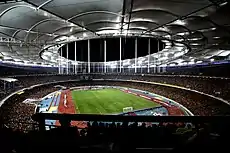 |
Bukit Jalil National Stadium | 87,500 | Bukit Jalil, Kuala Lumpur | v  Singapore Singapore(24 December 2022; 2022 AFF Championship) |
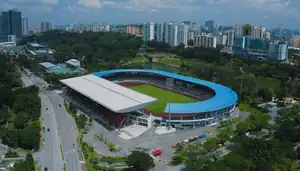 |
Kuala Lumpur Stadium | 18,000 | Cheras, Kuala Lumpur | v  Maldives Maldives(14 December 2022; Friendly) |
Training ground Wisma FAM is the main headquarters for the Football Association of Malaysia which located at Kelana Jaya, Malaysia. The training facility for the Malaysia national football team also located at the Wisma FAM. Others than that, it also serves as a meeting point for the coaches and national players. Also equipped with a room for press statement and small apartment rooms available for the national players during the training camp. Sometimes, ticket matches also sold on this training facility.
Supporters

Ultras Malaya is the name of the major supporters for the national team in Malaysia. They are known for their high fanaticism and support towards the national team. In every international match the national team played, they are found in a group standing at the supporters area. The main colours for these supporter are usually in black with a yellow scarf and banners just like the national team kits colours. These supporters always bring flares, drums and large national flags to the stadiums.[89]
Sponsorship
According to the website of Football Association of Malaysia, Malaysia main sponsors include Telekom Malaysia, Bank Islam, Yakult, Nike, 100plus, One Goal, MYCAT and Malaysia Airlines.[90]
Rivalries
Malaysia has rivalries with Indonesia, Singapore, Thailand and Vietnam. These rivalries are rooted in geographical closeness.
Indonesia is Malaysia's most heated rival and matches between two teams usually draw large supporters alike. The rivalry traces its background from the infamous Indonesia–Malaysia confrontation. Due to the strong nationalist sentiments in both sides, the rivalry has always been taken with high priority.[91]
Singapore is Malaysia's only recent rival. Their rivalry is mostly rekindled only when it comes to the AFF Championship, and is also less heated than Malaysia's rivalry with Indonesia.[92]
Thailand is Malaysia's other traditional rival, with matches between two teams also draw large supporters alike. Malaysia holds a significant distinction for being undefeated at home to Thailand since the 1971, as well as having a better head-to-head record with 41 wins, 35 draws and 35 losses.[93]
As South Vietnam, the Vietnamese side had a poorer performance, with only 3 wins, 3 draws and 7 losses, during that time the Malaysians posed as a formidable side in Southeast Asia. Since reintegration, however, Vietnam has overwhelmed in the head-to-head record against Malaysia with 14 wins, 3 draws and only 6 losses since 1991. Vietnam has also been maintaining the series of unbeaten match against Malaysia since 2014.
Results and fixtures
The following is a list of match results in the last 12 months, as well as any future matches that have been scheduled.
Win Draw Loss Fixture
2022
| 27 May Friendly | Malaysia | 4–0 |  Brunei Brunei | Kuala Lumpur, Malaysia |
| 21:00 UTC+8 | Stadium: Bukit Jalil Stadium |

| 1 June Friendly | Malaysia | 2–0 |  Hong Kong Hong Kong | Kuala Lumpur, Malaysia |
| 21:00 UTC+8 | Report | Stadium: Bukit Jalil Stadium |
| 8 June 2023 Asian Cup qualification | Turkmenistan  | 1–3 | Malaysia | Kuala Lumpur, Malaysia |
| 21:00 UTC+8 |
|
Report |
|
Stadium: Bukit Jalil Stadium Attendance: 21,591 Referee: Omar Al-Yaqoubi (Oman) |
| 11 June 2023 Asian Cup qualification | Malaysia | 1–2 |  Bahrain Bahrain | Kuala Lumpur, Malaysia |
| 21:00 UTC+8 |
|
Report | Stadium: Bukit Jalil Stadium Attendance: 63,925 Referee: Sadullo Gulmurodi (Tajikistan) |
| 14 June 2023 Asian Cup qualification | Malaysia | 4–1 |  Bangladesh Bangladesh | Kuala Lumpur, Malaysia |
| 21:00 UTC+8 | Report |
|
Stadium: Bukit Jalil Stadium Attendance: 52,964 Referee: Zaid Thamer Mohammed (Iraq) |
| 22 September 2022 King's Cup | Thailand | 1–1 (3–5 p) | Malaysia | Chiang Mai, Thailand |
| 20:30 UTC+8:30 |
|
Report |
|
Stadium: 700th Anniversary Stadium Attendance: 16,219 Referee: Muhammaq Taqi (Singapore) |
| Penalties | ||||


| 25 September 2022 King's Cup | Tajikistan  | 0–0 (3–0 p) | Malaysia | Chiang Mai, Thailand |
| 20:30 UTC+7 | Report | Stadium: 700th Anniversary Stadium Attendance: 488 Referee: Wiwat Jumpaoon (Thailand) | ||
| Penalties | ||||
| 9 December Friendly | Malaysia | 4–0 |  Cambodia Cambodia | Kuala Lumpur, Malaysia |
| 21:00 UTC+8 | Report | Stadium: Bukit Jalil Stadium Attendance: 8,332 Referee: Mongkolchai Pechsri (Thailand) |
| 14 December Friendly | Malaysia | 3–0 | Maldives | Kuala Lumpur, Malaysia |
| 21:00 UTC+8 | Report | Stadium: Kuala Lumpur Stadium Attendance: 6,002 Referee: Sivakorn Pu-udom (Thailand) |
| 21 December AFF Championship GS | Myanmar  | 0–1 | Malaysia | Yangon, Myanmar |
| 16:30 UTC+6:30 | Report |
|
Stadium: Thuwunna Stadium Attendance: 4,500 Referee: Ahmed Faisal Al Ali (Jordan) |
| 24 December AFF Championship GS | Malaysia | 5–0 |  Laos Laos | Kuala Lumpur, Malaysia |
| 20:30 UTC+8 | Report | Stadium: Bukit Jalil Stadium Attendance: 29,961 Referee: Kim Jong-hyeok (South Korea) |
| 27 December AFF Championship GS | Vietnam  | 3–0 | Malaysia | Hanoi, Vietnam |
| 19:00 UTC+7 |
|
Report | Stadium: Mỹ Đình National Stadium Attendance: 17,545 Referee: Ryuji Sato (Japan) |
2023
| 3 January AFF Championship GS | Malaysia | 4–1 | Singapore | Kuala Lumpur, Malaysia |
| 20:30 UTC+8 | Report |
|
Stadium: Bukit Jalil Stadium Attendance: 65,147 Referee: Mohammed Al Hoish (Saudi Arabia) |
| 7 January AFF Championship SF Leg 1 | Malaysia | 1–0 | Thailand | Kuala Lumpur, Malaysia |
| 20:30 UTC+8 |
|
Report | Stadium: Bukit Jalil Stadium Attendance: 62,989 Referee: Kim Dae-yong (South Korea) |
| 10 January AFF SF Leg 2 | Thailand | 3–0 (3–1 agg.) | Malaysia | Pathum Thani, Thailand |
| 19:30 UTC+7 | Report | Stadium: Thammasat Stadium Attendance: 18,927 Referee: Adham Makhadmeh (Jordan) |
| 23 March Friendly | Malaysia | 1–0 | Turkmenistan | Johor, Malaysia |
| 22:00 UTC+8 |
|
Report | Stadium: Sultan Ibrahim Stadium |
| 28 March Friendly | Malaysia | 2–0 | Hong Kong | Johor, Malaysia |
| 22:00 UTC+8 | Stadium: Sultan Ibrahim Stadium Attendance: 4,593 |
| 14 June 2023 Friendly | Malaysia | v |  Solomon Islands Solomon Islands | Terengganu, Malaysia |
| 21:00 UTC+8 | Stadium: Sultan Mizan Zainal Abidin Stadium |
| 20 June 2023 Friendly | Malaysia | v |  Yemen Yemen | Terengganu, Malaysia |
| 21:00 UTC+8 | Stadium: Sultan Mizan Zainal Abidin Stadium |
| 16 November 2026 WCQ / 2027 ACQ | Malaysia | v | Kuala Lumpur, Malaysia | |
| Stadium: Bukit Jalil Stadium |
2024
| 16 January Asian Cup GS | Malaysia | v |  Jordan Jordan | Qatar |
| --:-- UTC+3 |
| 22 January Asian Cup GS | Bahrain | v | Malaysia | Qatar |
| --:-- UTC+3 |
| 28 January Asian Cup GS | South Korea  | v | Malaysia | Qatar |
| --:-- UTC+3 |
| 26 March 2026 WCQ / 2027 ACQ | Malaysia | v | Kuala Lumpur, Malaysia | |
| Stadium: Bukit Jalil Stadium |
| 11 June 2026 WCQ / 2027 ACQ | Malaysia | v | Kuala Lumpur, Malaysia | |
| Stadium: Bukit Jalil Stadium |
Coaching staff
- As of 23 February 2022
| Malaysia coaching staff | ||||
|---|---|---|---|---|
| Roles | Names | Appointment date | ||
| Technical Director | .svg.png.webp) Scott O'Donell Scott O'Donell |
21 Jan 2022 | ||
| Head coach | Kim Pan-gon |
21 Jan 2022 | ||
| Assistant Coach | Park Bo-bae |
17 Feb 2022 | ||
 Pau Martí Pau Martí |
17 Feb 2022 | |||
| E. Elavarasan |
17 Feb 2022 | |||
| Goalkeeping Coach | Cho Jun-ho |
17 Feb 2022 | ||
| Fitness Coach | Park Ji-hyeon |
30 Oct 2022 | ||
| Performance Analyst | Lim Jae-hun |
17 Feb 2022 | ||
Coaching record
- As of 23 March 2023
| List of head coaches | ||||||||||
|---|---|---|---|---|---|---|---|---|---|---|
| Name | Period | GP | W | D | L | GS | GA | GD | Win % | |
| Peter Velappan |
1963 | |||||||||
| Choo Seng Quee |
1963–1964[n 2] | 11 | 3 | 3 | 5 | 23 | 23 | +0 | 27.27 | |
| Otto Westphal |
1965–1966 | 12 | 1 | 4 | 7 | 11 | 25 | −14 | 8.33 | |
| Clement De Silva |
1966 | |||||||||
| Peter Velappan |
1966 | |||||||||
| Nagalingam Rajoo |
1967 | |||||||||
| Dettmar Cramer |
1967 | |||||||||
| Edwin Dutton |
1967 | |||||||||
 Harold Hassall Harold Hassall |
1968 | |||||||||
| Peter Velappan |
1968 | |||||||||
| Abdul Ghani Minhat |
1969 | 11 | 5 | 2 | 4 | 18 | 18 | +0 | 45.45 | |
| Harold Hassall |
1970 | |||||||||
 Dave MacLaren Dave MacLaren |
1970 | |||||||||
| C. Arasaratnam |
1971 | 39 | 21 | 6 | 12 | 81 | 61 | +20 | 53.85 | |
| Jalil Che Din |
1972 | 26 | 13 | 3 | 10 | 41 | 34 | +7 | 50.00 | |
| Tam Sitwa |
1973 | 0 | 0 | 0 | 0 | 0 | 0 | +0 | — | |
| M. Kuppan |
1973 | 27 | 12 | 7 | 8 | 41 | 28 | +13 | 44.44 | |
| Jalil Che Din |
1974 | 18 | 8 | 4 | 6 | 35 | 30 | +5 | 44.44 | |
| M. Kuppan |
1974–1977 | 82 | 36 | 24 | 22 | 154 | 90 | +64 | 43.90 | |
| Chow Kwai Lam |
1978 | 22 | 11 | 3 | 8 | 40 | 35 | +5 | 50.00 | |
| Karl-Heinz Weigang |
1979–1982 | 67 | 21 | 21 | 25 | 96 | 89 | +7 | 31.34 | |
| M. Chandran |
1982–1983 | 14 | 6 | 1 | 7 | 15 | 17 | −2 | 42.86 | |
| Frank Lord |
1983–1985 | 37 | 17 | 11 | 9 | 63 | 36 | +27 | 45.95 | |
| Mohamad Bakar |
1985–1986 | 13 | 4 | 3 | 6 | 17 | 24 | −7 | 30.77 | |
 Jozef Vengloš Jozef Vengloš |
1986–1987 | 13 | 6 | 3 | 4 | 21 | 13 | +8 | 46.15 | |
| Abdul Rahman Ibrahim |
1987 | 10 | 1 | 4 | 5 | 8 | 12 | −4 | 10.00 | |
| Richard Bate |
1988 | 5 | 1 | 2 | 2 | 4 | 10 | −6 | 20.00 | |
| M. Chandran |
1988 | 4 | 1 | 1 | 2 | 4 | 6 | −2 | 25.00 | |
| Trevor Hartley |
1989 | 8 | 6 | 0 | 2 | 14 | 5 | +9 | 75.00 | |
| Ahmad Shafie |
1990 | 4 | 0 | 1 | 3 | 0 | 7 | −7 | 0.00 | |
| Rahim Abdullah |
1991 | 6 | 1 | 1 | 4 | 7 | 12 | −5 | 16.67 | |
| Ken Worden |
1992–1993 | 17 | 5 | 6 | 6 | 26 | 22 | +4 | 29.41 | |
.svg.png.webp) Claude Le Roy Claude Le Roy |
1994–1995 | 5 | 1 | 1 | 3 | 6 | 10 | −4 | 20.00 | |
.svg.png.webp) Hatem Souisi Hatem Souisi |
1995 | 6 | 2 | 1 | 3 | 12 | 8 | +4 | 33.33 | |
| Wan Jamak Wan Hassan |
1996–1997 | 22 | 10 | 6 | 6 | 35 | 18 | +17 | 45.45 | |
| Hatem Souisi |
1998 | 4 | 0 | 2 | 2 | 1 | 4 | −3 | 0.00 | |
| Abdul Rahman Ibrahim |
1998–2000 | 29 | 15 | 3 | 11 | 56 | 44 | +12 | 51.72 | |
| Allan Harris |
2001–2004 | 31 | 7 | 7 | 17 | 38 | 57 | −19 | 22.58 | |
| K. Rajagopal |
2004C | 0 | 0 | 0 | 0 | 0 | 0 | +0 | — | |
 Bertalan Bicskei Bertalan Bicskei |
2004–2005 | 18 | 9 | 1 | 8 | 28 | 27 | +1 | 50.00 | |
| Norizan Bakar |
2005–2007 | 18 | 4 | 5 | 9 | 23 | 28 | −5 | 22.22 | |
| B. Sathianathan |
2007–2008 | 13 | 5 | 4 | 4 | 29 | 19 | +10 | 38.46 | |
| K. Rajagopal |
2009–2013 | 52 | 14 | 15 | 23 | 65 | 76 | −11 | 26.92 | |
| Ong Kim Swee (caretaker) |
2014 | 3 | 1 | 2 | 0 | 2 | 1 | +1 | 33.33 | |
| Dollah Salleh |
2014–2015 | 18 | 4 | 4 | 10 | 19 | 46 | −27 | 22.22 | |
| Ong Kim Swee |
2015–2017 | 21 | 7 | 6 | 8 | 20 | 27 | −7 | 33.33 | |
 Nelo Vingada Nelo Vingada |
2017 | 7 | 0 | 1 | 6 | 6 | 16 | −10 | 0.00 | |
| Tan Cheng Hoe |
2017–2022 | 40 | 20 | 4 | 16 | 74 | 53 | +21 | 50.00 | |
| Kim Pan-gon |
2022–present | 18 | 12 | 2 | 4 | 36 | 14 | +22 | 66.67 | |
Players
Current squad
The following 27 players were called up for the centralised training camp scheduled to be held from 18 March 2023 onwards ahead of the friendly matches against Turkmenistan and Hong Kong on 23 and 28 March 2023, respectively.[94]
Caps and goals correct as of 28 March 2023, after the match against Hong Kong.
Recent call-ups
The following players have been called up for the team within the last 12 months and are still available for selection.
Player records
- As of 10 January 2023[95]
- Players in bold are still active with Malaysia.
- This list does not include players who represented Malaya (1948−1962).
Most appearances
| Rank | Player | Caps | Goals | Career |
|---|---|---|---|---|
| 1 | Soh Chin Ann | 219 | 13 | 1969–1984 |
| 2 | Shukor Salleh | 172 | 5 | 1970–1981 |
| 3 | Mokhtar Dahari | 142 | 89 | 1972–1985 |
| 4 | Arumugam Rengasamy | 142 | 0 | 1973–1986 |
| 5 | Zainal Abidin Hassan | 129 | 50 | 1980–1997 |
| 6 | Chandran Mutveeran | 122 | 2 | 1965–1974 |
| 7 | Santokh Singh | 119 | 7 | 1973–1984 |
| 8 | Aidil Zafuan | 98 | 3 | 2007–present |
| 9 | Namat Abdullah | 95 | 7 | 1968–1975 |
| 10 | Ahmad Yusof | 92 | 6 | 1981–1993 |
Top goalscorers
| Rank | Player | Goals | Caps | Ratio | Career |
|---|---|---|---|---|---|
| 1 | Mokhtar Dahari | 89 | 142 | 0.63 | 1972–1985 |
| 2 | Zainal Abidin Hassan | 50 | 129 | 0.39 | 1980–1997 |
| 3 | Isa Bakar | 45 | 69 | 0.68 | 1974–1981 |
| 4 | Shaharuddin Abdullah | 39 | 70 | 0.56 | 1967–1974 |
| 5 | Dollah Salleh | 33 | 81 | 0.41 | 1985–1996 |
| 6 | James Wong | 23 | 36 | 0.64 | 1972–1981 |
| Safee Sali | 23 | 76 | 0.3 | 2006–2017 | |
| 8 | Thanabalan Nadarajah | 20 | 46 | 0.43 | 1964–1969 |
| Wong Choon Wah | 20 | 88 | 0.23 | 1968–1977 | |
| 9 | Rusdi Suparman | 18 | 35 | 0.51 | 1996–2001 |
| Safawi Rasid | 18 | 52 | 0.35 | 2016–present | |
Competitive record
Champion Runners-up Third place Fourth place
FIFA World Cup
| [[FIFA World Cup|FIFA World Cup finals]] record | [[FIFA World Cup qualification|Qualification]] record | |||||||||||||||
|---|---|---|---|---|---|---|---|---|---|---|---|---|---|---|---|---|
| Year | Round | Position | Pld | W | D* | L | GF | GA | Round | Pld | W | D | L | GF | GA | |
 1930 1930 |
See Malaya national football team 1 | See Malaya national football team 1 | ||||||||||||||
.svg.png.webp) 1934 1934 | ||||||||||||||||
 1938 1938 | ||||||||||||||||
.svg.png.webp) 1950 1950 | ||||||||||||||||
.svg.png.webp) 1954 1954 | ||||||||||||||||
 1958 1958 | ||||||||||||||||
 1962 1962 | ||||||||||||||||
| 1966 |
Did not enter | Did not enter | ||||||||||||||
 1970 1970 | ||||||||||||||||
| 1974 |
Did not qualify | Round 1 | 4 | 1 | 1 | 2 | 2 | 4 | ||||||||
 1978 1978 |
Round 1 | 4 | 1 | 2 | 1 | 7 | 6 | |||||||||
| 1982 |
Round 1 | 3 | 0 | 1 | 2 | 3 | 8 | |||||||||
| 1986 |
Round 1 | 4 | 2 | 1 | 1 | 6 | 2 | |||||||||
 1990 1990 |
Round 1 | 6 | 3 | 1 | 2 | 8 | 8 | |||||||||
| 1994 |
Round 1 | 6 | 2 | 2 | 2 | 16 | 7 | |||||||||
| 1998 |
Round 1 | 6 | 3 | 2 | 1 | 5 | 3 | |||||||||
.svg.png.webp)  2002 2002 |
Round 1 | 6 | 2 | 1 | 3 | 8 | 11 | |||||||||
| 2006 |
Round 2 | 6 | 0 | 0 | 6 | 2 | 18 | |||||||||
 2010 2010 |
Round 1 | 2 | 0 | 1 | 1 | 1 | 4 | |||||||||
 2014 2014 |
Round 2 | 4 | 1 | 1 | 2 | 8 | 10 | |||||||||
 2018 2018 |
Round 2 | 8 | 1 | 1 | 6 | 3 | 30 | |||||||||
| 2022 |
Round 2 | 10 | 6 | 0 | 4 | 22 | 14 | |||||||||
.svg.png.webp) 2026 2026 |
To be determined | To be determined | ||||||||||||||
| Total | N/A | 0/22 | 0 | 0 | 0 | 0 | 0 | 0 | N/A | 69 | 22 | 14 | 33 | 91 | 125 | |
Olympic Games
| [[Football at the Summer Olympics|Olympic Games]] record | Qualification record | ||||||||||||||||
|---|---|---|---|---|---|---|---|---|---|---|---|---|---|---|---|---|---|
| Year | Round | Position | Pld | W | D* | L | GF | GA | Round | Pld | W | D | L | GF | GA | ||
 1948 1948 |
See Malaya national football team 1 | See Malaya national football team 1 | |||||||||||||||
 1952 1952 | |||||||||||||||||
| 1956 | |||||||||||||||||
| 1960 | |||||||||||||||||
| 1972 |
Round 1 | 10th of 16 | 3 | 1 | 0 | 2 | 3 | 9 | Group stage Q | 4 | 4 | 0 | 0 | 12 | 0 | ||
| 1976 |
Did not qualify | Group stage | 4 | 2 | 0 | 2 | 17 | 5 | |||||||||
 1980 1980 |
Withdrew B | Group stage Q | 5 | 4 | 1 | 0 | 21 | 3 | |||||||||
| 1984 |
Did not qualify | Final stage | 12 | 6 | 3 | 3 | 16 | 10 | |||||||||
| 1988 |
Group stage | 2 | 0 | 1 | 1 | 2 | 3 | ||||||||||
| 1992 – present |
See Malaysia under-23 football team 2 | See Malaysia under-23 football team 2 | |||||||||||||||
| Total | Appearance: 1 | Best: 10th | 3 | 1 | 0 | 2 | 3 | 9 | - | 27 | 16 | 5 | 6 | 68 | 21 | ||
AFC Asian Cup
| [[AFC Asian Cup|AFC Asian Cup]] record | [[AFC Asian Cup qualifiers|Qualification]] record | |||||||||||||||
|---|---|---|---|---|---|---|---|---|---|---|---|---|---|---|---|---|
| Year | Round | Position | Pld | W | D* | L | GF | GA | Round | Pld | W | D | L | GF | GA | |
.svg.png.webp) 1956 1956 |
See Malaya national football team 1 | See Malaya national football team 1 | ||||||||||||||
| 1960 | ||||||||||||||||
 1964 1964 |
Did not qualify | Group stage | 3 | 1 | 0 | 2 | 9 | 10 | ||||||||
 1968 1968 |
Group stage | 4 | 1 | 1 | 2 | 4 | 5 | |||||||||
| 1972 |
Group stage | 5 | 4 | 0 | 1 | 15 | 3 | |||||||||
| 1976 |
Group stage | 5th of 6 | 2 | 0 | 1 | 1 | 1 | 3 | Group stage Q | 4 | 3 | 1 | 0 | 6 | 1 | |
| 1980 |
Group stage | 6th of 10 | 4 | 1 | 2 | 1 | 5 | 5 | Group stage Q | 5 | 2 | 2 | 1 | 8 | 4 | |
| 1984 |
Did not qualify | Group stage | 4 | 2 | 1 | 1 | 10 | 3 | ||||||||
| 1988 |
Group stage | 4 | 1 | 1 | 2 | 4 | 6 | |||||||||
| 1992 |
Group stage | 3 | 0 | 2 | 1 | 2 | 6 | |||||||||
| 1996 |
Group stage | 2 | 1 | 1 | 0 | 5 | 2 | |||||||||
 2000 2000 |
Group stage | 6 | 2 | 1 | 3 | 12 | 13 | |||||||||
| 2004 |
Group stage | 6 | 1 | 2 | 3 | 9 | 12 | |||||||||
 2007 2007 |
Group stage | 16th of 16 | 3 | 0 | 0 | 3 | 1 | 12 | Qualified as co-hosts | |||||||
| 2011 |
Did not qualify | Group stage | 4 | 0 | 0 | 4 | 2 | 12 | ||||||||
| 2015 |
Group stage | 6 | 2 | 1 | 3 | 5 | 7 | |||||||||
| 2019 |
Third round | 14 | 1 | 2 | 11 | 8 | 45 | |||||||||
| 2023 |
Qualified | Third round | 13 | 8 | 0 | 5 | 30 | 18 | ||||||||
 2027 2027 | To be determined | To be determined | ||||||||||||||
| Total | Appearances: 3 | Best: 5th | 9 | 1 | 3 | 5 | 7 | 20 | - | 82 | 29 | 15 | 38 | 129 | 147 | |
AFF Championship
|
| ||||||||||||||||||||||||||||||||||||||||||||||||||||||||||||||||||||||||||||||||||||||||||||||||||||||||||||||||||||||||||||||||||||||||||||||||||||||||||||||||||||||||||||

Asian Games
|
| |||||||||||||||||||||||||||||||||||||||||||||||||||||||||||||||||||||||||||||||||||||||||||||||||||||||||||||||||||||||||||||||||||||||||||||||||
Southeast Asian Games
|
| |||||||||||||||||||||||||||||||||||||||||||||||||||||||||||||||||||||||||||||||||||||||||||||||||||||||||||||||||||||||||||||||||||||||||||||||||||||||||||||||||||||||||||||||||||||||||||||||||||||||||||||||||||||||||||||||||||||||
.svg.png.webp)
- * : Denotes draws include knockout matches decided via penalty shoot-out.
- 1 : Represented in the competition by Malaya national football team.
- 2 : Represented in the competition by Malaysia national under-23 football team.
- 3 : Not a FIFA 'A' international competition.
- 4 : Represented in the competition by Malaysia national under-22 football team.
- 5 : Previously known as Southeast Asian Peninsular Games (SEAP Games).
- B : Qualified to the final round, but boycotted the tournament.
- C : These matches are not regarded as part of the national team's record, nor are caps awarded.
- Q : Qualified to the final round of participating tournament
- S : Shared the medal
Notes:
- Red border colour indicates tournament was held on home soil
Head-to-head record
Last update was against Hong Kong on 28 March 2023.
| Malaysia national football team head-to-head records | |||||||||
|---|---|---|---|---|---|---|---|---|---|
| Opponents | Pld | W | D | L | GF | GA | GD | Confederation | Last Match |
.svg.png.webp) Afghanistan Afghanistan | 3 | 2 | 1 | 0 | 9 | 2 | +7 | AFC | 23 March 2019; Friendly |
| Australia | 7 | 1 | 0 | 6 | 1 | 19 | −18 | AFC | 7 October 2011; Friendly |
| Bahrain | 11 | 2 | 3 | 6 | 15 | 24 | −9 | AFC | 11 June 2022; 2023 Asian Cup qualification |
| Bangladesh | 10 | 7 | 2 | 1 | 14 | 4 | +10 | AFC | 14 June 2022; 2023 Asian Cup qualification |
 Bhutan Bhutan | 1 | 1 | 0 | 0 | 7 | 0 | +7 | AFC | 1 April 2018; Friendly |
 Bosnia and Herzegovina Bosnia and Herzegovina | 3 | 0 | 1 | 2 | 2 | 5 | −3 | UEFA | 27 June 2001; Merdeka Tournament SF |
| Brazil | 1 | 0 | 0 | 1 | 0 | 4 | −4 | CONMEBOL | 25 May 2002; Friendly |
| Brunei | 11 | 11 | 0 | 0 | 48 | 3 | +45 | AFC | 27 May 2022; Friendly |
| Cambodia | 29 | 22 | 3 | 4 | 88 | 27 | +61 | AFC | 9 December 2022; Friendly |
| Canada | 1 | 0 | 0 | 1 | 0 | 5 | −5 | CONCACAF | 25 August 1986; Merlion Cup |
| China | 11 | 0 | 2 | 9 | 3 | 32 | −29 | AFC | 10 September 2013; Friendly |
.svg.png.webp) Chinese Taipei Chinese Taipei | 11 | 6 | 2 | 3 | 22 | 12 | +10 | AFC | 7 September 2018; Friendly |
| England | 1 | 0 | 0 | 1 | 2 | 4 | −2 | UEFA | 12 June 1991; Friendly |
 Fiji Fiji | 5 | 2 | 1 | 2 | 5 | 8 | −3 | OFC | 5 July 2018; Friendly |
| Finland | 1 | 1 | 0 | 0 | 2 | 1 | +1 | UEFA | 21 February 1997; 1997 Dunhill Cup – Friendly |
| Germany | 1 | 0 | 0 | 1 | 0 | 3 | −3 | UEFA | 29 August 1972; Summer Olympic |
| Hong Kong | 23 | 11 | 6 | 6 | 35 | 24 | +11 | AFC | 28 March 2023; Friendly |
 India India | 22 | 10 | 6 | 6 | 45 | 27 | +18 | AFC | 16 November 2011; Friendly |
| Indonesia | 76 | 26 | 18 | 32 | 108 | 122 | –14 | AFC | 19 December 2021; 2020 AFF Championship |
 Iran Iran | 5 | 0 | 0 | 5 | 0 | 11 | −11 | AFC | 18 July 2007; AFC Asian Cup |
 Iraq Iraq | 8 | 0 | 3 | 5 | 3 | 14 | −11 | AFC | 20 October 2003; 2004 AFC Asian Cup qualification |
| Israel | 2 | 0 | 0 | 2 | 3 | 11 | −8 | UEFA, AFC | 3 September 1974; Asian Games |
 Jamaica Jamaica | 1 | 0 | 0 | 1 | 0 | 2 | −2 | CONCACAF | 28 June 2007; Friendly |
| Japan | 22 | 8 | 7 | 7 | 31 | 26 | +5 | AFC | 7 February 2004; Friendly |
| Jordan | 5 | 0 | 2 | 3 | 0 | 6 | −6 | AFC | 30 August 2019; Friendly |
 Kenya Kenya | 1 | 0 | 1 | 0 | 0 | 0 | 0 | CAF | 12 August 2009; Friendly |
 Kyrgyzstan Kyrgyzstan | 1 | 0 | 0 | 1 | 0 | 1 | −1 | AFC | 16 October 2018; Friendly |
| Kuwait | 12 | 2 | 2 | 8 | 8 | 29 | −21 | AFC | 8 November 2013; Friendly |
| Laos | 14 | 11 | 2 | 1 | 49 | 6 | +43 | AFC | 24 December 2022; 2022 AFF Championship |
 Lesotho Lesotho | 2 | 2 | 0 | 0 | 9 | 0 | +9 | CAF | 11 September 2009; Friendly |
 Liberia Liberia | 1 | 1 | 0 | 0 | 3 | 1 | +2 | CAF | 27 August 1984; Merdeka Tournament |
 Libya Libya | 3 | 0 | 2 | 1 | 2 | 2 | 0 | CAF | 30 September 1980; Islamic Games |
 Liechtenstein Liechtenstein | 1 | 0 | 0 | 1 | 0 | 1 | −1 | UEFA | 5 October 1981; Friendly |
| Lebanon | 2 | 0 | 0 | 2 | 2 | 4 | –2 | AFC | 27 March 2018; 2019 AFC Asian Cup Q – 3rd round |
 Macau Macau | 3 | 2 | 1 | 0 | 14 | 0 | +14 | AFC | 28 March 2016; Friendly |
| Maldives | 5 | 5 | 0 | 0 | 14 | 1 | +13 | AFC | 14 December 2022; Friendly |
 Mongolia Mongolia | 1 | 0 | 1 | 0 | 2 | 2 | 0 | AFC | 22 March 2018; Friendly |
 Morocco Morocco | 3 | 1 | 0 | 2 | 3 | 8 | −5 | CAF | 7 February 1981; Friendly |
| Myanmar | 51 | 24 | 8 | 19 | 89 | 67 | +22 | AFC | 24 November 2018; 2018 AFF Championship |
 Nepal Nepal | 7 | 6 | 1 | 0 | 23 | 0 | +23 | AFC | 2 June 2019; Friendly |
 New Zealand New Zealand | 13 | 2 | 2 | 9 | 9 | 31 | −22 | OFC | 23 February 2006; Friendly |
 North Korea North Korea | 8 | 1 | 3 | 4 | 5 | 14 | −9 | AFC | 13 November 2017; Asian Cup qualification |
 Oman Oman | 5 | 1 | 0 | 4 | 2 | 6 | −4 | AFC | 23 March 2015; Friendly |
 Pakistan Pakistan | 4 | 3 | 0 | 1 | 15 | 4 | +11 | AFC | 10 Oct 2008; Friendly |
 Palestine Palestine | 4 | 1 | 0 | 3 | 4 | 16 | −12 | AFC | 12 November 2015; 2018 FIFA World Cup qualification |
 Papua New Guinea Papua New Guinea | 3 | 2 | 0 | 1 | 15 | 4 | +11 | OFC | 14 November 2016; Friendly |
 Philippines Philippines | 15 | 11 | 3 | 1 | 59 | 3 | +56 | AFC | 23 March 2022; 2022 FAS Tri-Nations Series |
| Qatar | 6 | 0 | 3 | 3 | 3 | 11 | −8 | AFC | 19 November 2013; 2015 AFC Asian Cup qualification |
| Saudi Arabia | 10 | 1 | 2 | 7 | 8 | 21 | −13 | AFC | 24 March 2016; 2018 FIFA World Cup qualification |
 Senegal Senegal | 1 | 1 | 0 | 0 | 1 | 0 | +1 | CAF | 13 August 1982; Merdeka Tournament |
| Singapore | 50 | 20 | 16 | 14 | 79 | 57 | +23 | AFC | 3 January 2023; 2022 AFF Championship |
| South Korea | 54 | 11 | 9 | 34 | 47 | 98 | −51 | AFC | 3 October 2002; Asian Games |
 South Vietnam South Vietnam | 13 | 7 | 3 | 3 | 27 | 15 | +12 | AFC | 23 March 1975; Asian Cup qualification |
 Sri Lanka Sri Lanka | 9 | 8 | 0 | 1 | 33 | 7 | +26 | AFC | 5 October 2019; Friendly |
| Sweden | 1 | 0 | 0 | 1 | 1 | 3 | −2 | UEFA | 14 November 1979; Friendly |
 Syria Syria | 4 | 2 | 0 | 2 | 10 | 8 | +2 | AFC | 22 August 2017; Friendly |
| Tajikistan | 3 | 1 | 1 | 1 | 2 | 4 | −2 | AFC | 25 September 2022; 2022 King's Cup |
| Thailand | 115 | 43 | 36 | 36 | 163 | 154 | +9 | AFC | 10 January 2023; 2022 AFF Championship |
 Timor-Leste Timor-Leste | 6 | 5 | 1 | 0 | 22 | 3 | +19 | AFC | 11 June 2019; 2022 FIFA World Cup qualification |
 Turkey Turkey | 1 | 0 | 0 | 1 | 0 | 3 | −3 | UEFA | 5 October 1980 Islamic Games |
| Turkmenistan | 2 | 2 | 0 | 0 | 4 | 1 | 2 | AFC | 23 March 2023; Friendly |
| United Arab Emirates | 10 | 2 | 0 | 8 | 6 | 28 | −22 | AFC | 4 June 2021; 2022 FIFA World Cup qualification |
| United States | 1 | 1 | 0 | 0 | 3 | 0 | +3 | CONCACAF | 29 August 1972; Summer Olympics |
| Uruguay | 1 | 0 | 0 | 1 | 0 | 6 | −6 | CONMEBOL | 1 June 1985; Friendly |
 Uzbekistan Uzbekistan | 7 | 0 | 0 | 7 | 3 | 26 | −23 | AFC | 9 October 2021; Friendly |
| Vietnam | 23 | 5 | 3 | 15 | 20 | 34 | −14 | AFC | 12 December 2021; 2022 AFF Championship |
| Yemen | 3 | 2 | 0 | 1 | 4 | 3 | +1 | AFC | 5 March 2014; Asian Cup qualification |
| Total | 749 | 295 | 157 | 297 | 1205 | 1078 | +127 | ||
FIFA ranking
Last update was on 2023. Source:[96]
Worst Ranking Best Ranking Worst Mover Best Mover
| Malaysia's FIFA world rankings | |||||||||||
|---|---|---|---|---|---|---|---|---|---|---|---|
| Rank | Year | Games Played |
Won | Lost | Drawn | Best | Worst | ||||
| Rank | Move | Rank | Move | ||||||||
| 138 | 2023 | 5 | 4 | 0 | 1 | 138 | +7 | 145 |  0 0 | ||
| 145 | 2022 | 14 | 9 | 2 | 3 | 145 | +9 | 154 | –1 | ||
| 154 | 2021 | 10 | 3 | 7 | 0 | 153 | +1 | 155 |  –1 –1 | ||
| 153 | 2020 | 0 | 0 | 0 | 0 | 153 | +1 | 154 | 0 | ||
| 154 | 2019 | 13 | 9 | 0 | 4 | 154 | +9 | 168 | –1 | ||
| 178 | 2018 | 17 | 8 | 5 | 4 | 167 | +12 | 178 | –4 | ||
| 174 | 2017 | 8 | 0 | 6 | 2 | 155 | +4 | 174 | –12 | ||
| 161 | 2016 | 14 | 4 | 5 | 5 | 156 | +9 | 174 | –8 | ||
| 170 | 2015 | 11 | 2 | 6 | 3 | 153 | +4 | 171 | –11 | ||
| 154 | 2014 | 15 | 5 | 7 | 3 | 141 | +9 | 156 | –8 | ||
| 154 | 2013 | 7 | 1 | 5 | 1 | 154 | +4 | 164 | –5 | ||
| 158 | 2012 | 16 | 5 | 5 | 6 | 148 | +5 | 163 | –6 | ||
| 148 | 2011 | 10 | 3 | 4 | 3 | 138 | +7 | 155 | –6 | ||
| 144 | 2010 | 10 | 4 | 4 | 2 | 139 | +3 | 159 | –5 | ||
| 160 | 2009 | 8 | 1 | 4 | 3 | 150 | +5 | 163 | –8 | ||
| 156 | 2008 | 11 | 5 | 3 | 3 | 151 | +9 | 170 | –6 | ||
| 159 | 2007 | 15 | 3 | 8 | 8 | 149 | +7 | 166 | –7 | ||
| 152 | 2006 | 6 | 0 | 3 | 3 | 124 | +1 | 153 | –19 | ||
| 123 | 2005 | 4 | 1 | 3 | 0 | 111 | +6 | 123 | –7 | ||
| 120 | 2004 | 14 | 5 | 8 | 1 | 114 | +4 | 122 | –4 | ||
| 116 | 2003 | 7 | 1 | 3 | 3 | 99 | +21 | 119 | –11 | ||
| 128 | 2002 | 9 | 3 | 4 | 2 | 111 | +1 | 128 | –6 | ||
| 111 | 2001 | 11 | 3 | 6 | 2 | 105 | +3 | 111 | –3 | ||
| 107 | 2000 | 24 | 13 | 7 | 4 | 104 | +8 | 117 | –3 | ||
| 117 | 1999 | 8 | 4 | 4 | 0 | 113 | +2 | 118 | –3 | ||
| 113 | 1998 | 3 | 0 | 2 | 1 | 88 | +3 | 113 | –11 | ||
| 87 | 1997 | 14 | 6 | 5 | 3 | 84 | +13 | 97 | –3 | ||
| 96 | 1996 | 8 | 4 | 1 | 3 | 91 | +21 | 112 | –10 | ||
| 106 | 1995 | 5 | 1 | 3 | 1 | 94 | +14 | 117 | –23 | ||
| 89 | 1994 | 5 | 1 | 3 | 8 | 84 | +8 | 95 | –6 | ||
| 79 | 1993 | 14 | 6 | 5 | 3 | 75 | +16 | 79 | –2 | ||
- Notes
Honours and achievements
Continental
| Asian Games | ||||
|---|---|---|---|---|
| Honours | Years | Head coach | Team | |
 Bronze medal Bronze medal |
1974 | Jalil Che Din |
Squad | |
Regional
|
| ||||||||||||||||||||||||||||||||||||||||||||||||||||||||||||||||||||||||||||||||||||||


Summary
| Overview | |||||
|---|---|---|---|---|---|
| Event | 1st place | 2nd place | 3rd place | 4th place | 5th place |
| FIFA World Cup | 0 | 0 | 0 | 0 | 0 |
| Summer Olympic Games | 0 | 0 | 0 | 0 | 0 |
| AFC Asian Cup | 0 | 0 | 0 | 0 | 1 |
| Asian Games | 0 | 0 | 1 | 0 | 0 |
| AFF Cup | 1 | 3 | 3 | 1 | 2 |
| SEA Games | 3 | 4 | 4 | 1 | 4 |
| Total | 4 | 7 | 8 | 2 | 7 |
See also
- Malaysia national football team results
- Malaysia national under-23 football team
- Malaysia national under-22 football team
- Malaysia national under-19 football team
- Malaysia national under-16 football team
- Malaysia women's national football team
- Malaysia national futsal team
- Malaysia women's national futsal team
- Malaysia League XI
- Football Association of Malaysia
- List of Malaysia footballers born outside Malaysia
Notes
- Result count since after the Federation of Malaysia formation on 16 September 1963.[5]
- Earned Malaysian nationality after Malaysia formed on 16 September 1963. Became Singaporean after Singapore separation from Malaysia in 1965.
References
- Ooi Kin Fai (3 April 2017). "FAM reverts team name back to Harimau Malaya". Goal.com. Archived from the original on 5 April 2017. Retrieved 4 April 2017.
- Mamrud, Roberto (30 June 2021). "Soh Chin Ann– Double Century of International Appearances". Rec.Sport.Soccer Statistics Foundation. Archived from the original on 22 April 2022. Retrieved 30 June 2021.
- Mamrud, Roberto (18 March 2021). "Mohamed Mokhtar Dahari – Century of International Appearances". Rec.Sport.Soccer Statistics Foundation. Archived from the original on 18 June 2021. Retrieved 18 March 2021.
- "The FIFA/Coca-Cola World Ranking". FIFA. 6 April 2023. Retrieved 6 April 2023.
- "Malaysia matches, ratings and points exchanged". World Football Elo Ratings: Malaysia. Archived from the original on 17 January 2018. Retrieved 24 November 2016.
- Fai, Ooi Kin (25 September 2022). "Harimau Malaya lose King's Cup final after penalty shootout heartbreak". nst.com.my. Chiang Mai, Thailand: New Straits Times. Archived from the original on 26 September 2022. Retrieved 26 September 2022.
- "WATCH: Indonesia vs Malaysia - Experts explain why Derbi Nusantara Is The Biggest Rivalry In Asean". FOX Sports Asia. Archived from the original on 17 November 2019. Retrieved 18 November 2019.
- Emmanuel Santa Maria Chin (30 July 2018). "PM open to foreign-born players in national football team". The Malay Mail. Retrieved 3 April 2019.
- "In-form Malaysia primed to shine". Asian Football Confederation. 22 August 2019. Archived from the original on 22 August 2019. Retrieved 16 September 2019.
- Francesca DiPiazza (1 January 2006). Malaysia in Pictures. Twenty-First Century Books. pp. 14–. ISBN 978-0-8225-2674-2.
- "Football legend Dollah Don dies". Sports247. 24 December 2014. Archived from the original on 29 October 2022. Retrieved 29 October 2022.
- Mohamad Fahd Rahmat (25 December 2014). "Harimau Malaya tinggal kenangan" [Malayan Tiger in memories] (in Malay). Harian Metro. Archived from the original on 8 November 2015. Retrieved 8 November 2015.
- Ahmad Sharidan Mohd (6 December 2012). "Nama Harimau Malaya Diberikan Oleh Bung Karno!" [The name of Malayan Tiger is given by Sukarno!] (in Indonesian). Kompasiana. Archived from the original on 8 November 2015. Retrieved 8 November 2015.
- "ASIAN ICONS: TUNKU ABDUL RAHMAN PUTRA AL HAJ". AFC at Wayback Machine. 5 August 2014. Archived from the original on 23 September 2016. Retrieved 13 January 2018.
- "OCM Sports Museum & Hall of Fame: Tunku Abdul Rahman". OCM at Wayback Machine. 12 April 2010. Archived from the original on 12 April 2010. Retrieved 15 January 2019.
- "Tengku: A real feast of soccer". The Straits Times. National Library Board. 9 August 1963. p. 17. Archived from the original on 10 April 2016. Retrieved 29 March 2016.
- Mamrud, Roberto (30 March 2021). "Abdul Ghani Minhat – Goals in International Matches". Rec.Sport.Soccer Statistics Foundation. Archived from the original on 26 June 2021. Retrieved 30 March 2021.
- Norman Siebel (9 August 1963). "Majid Missed a Penalty and Malaysia Crash". The Straits Times. National Library Board. p. 18. Archived from the original on 10 April 2016. Retrieved 29 March 2016.
- Younghan Cho (17 March 2016). Football in Asia: History, Culture and Business. Routledge. pp. 61–. ISBN 978-1-317-59832-9. Archived from the original on 5 August 2020. Retrieved 23 July 2019.
- AFC President offers condolences on passing of Malaysian legend Chow Chee Keong Archived 26 February 2018 at the Wayback Machine, Asian Football Confederation(AFC)
- Terrence Netto (2 December 1976). "Sabahan may be Mokhtar's replacement". The Straits Times. National Library Board. p. 25. Archived from the original on 10 April 2016. Retrieved 29 March 2016.
- Mohd Izham Unnip Abdullah (25 December 2015). "Hassan Sani, James Wong curah bakti bersama Sabah" [Hassan Sani, James Wong served with Sabah] (in Malay). Berita Harian. Archived from the original on 19 March 2018. Retrieved 19 March 2018.
- Games of the XX. Olympiad Football Qualifying Tournament (Munchen, Germany, 1972) - RSSSF
- XX. Olympiad Munich 1972 Football Tournament - RSSSF
- Olympic Football Tournament Munich 1972 Germany FR - Malaysia at FIFA.com
- Olympic Football Tournament Munich 1972 Malaysia - USA at FIFA.com
- Olympic Football Tournament Munich 1972 Morocco - Malaysia at FIFA.com
- Alan Teh Leam Seng (14 July 2018). "Supermokh: Remembering our greatest footballer". New Straits Times. Archived from the original on 18 June 2021. Retrieved 18 July 2018.
- Zainal, Zulhilmi (19 June 2013). "Malaysian Football Legends: Mokhtar Dahari". Goal.com. Archived from the original on 30 June 2021. Retrieved 30 June 2021.
- "La leggenda di Mokhtar Dahari, l'anima del Calcio malesiano" [The Legend of Mokhtar Dahari, the soul of Malaysian football] (in Italian). Uomo nel Pallone. 30 August 2016. Archived from the original on 7 June 2022. Retrieved 9 June 2022.
- Mamrud, Roberto (18 March 2021). "Mohamed Mokhtar Dahari – Century of International Appearances". Rec.Sport.Soccer Statistics Foundation. Archived from the original on 18 June 2021. Retrieved 18 March 2021.
- "Restaging Relentless Ronaldo equals international goals world record". UEFA. Archived from the original on 23 June 2021. Retrieved 23 June 2021.
- FIFA [@FIFAcom] (29 June 2021). "The joint-9th top men's scorer!" (Tweet). Archived from the original on 29 June 2021. Retrieved 29 June 2021 – via Twitter.
- "Mokhtar pernah jadi penjaring terbanyak dunia". Syafiq Aznan (in Malay). Berita Harian. 24 June 2021. Archived from the original on 24 June 2021. Retrieved 24 June 2021.
- "The 10 all-time men's international top scorers". Gary Parkinson. FourFourTwo. 26 June 2021. Archived from the original on 2 August 2021. Retrieved 26 June 2021.
- Mamrud, Roberto (30 June 2021). "Soh Chin Ann– Double Century of International Appearances". Rec.Sport.Soccer Statistics Foundation. Archived from the original on 22 April 2022. Retrieved 30 June 2021.
- "IFFHS ALL TIME RECORD ON PLAYERS WITH MOST GAMES". IFFHS. 15 May 2022. Archived from the original on 22 May 2022. Retrieved 15 May 2022.
- "Asian Games 1974" - RSSSF
- "Kelayakan Piala Asia 1976 & 1980" (in Malay). Legasi Lagenda. Archived from the original on 8 June 2022. Retrieved 8 June 2022.
- P'ng Hong Kwang (10 June 1977). "Sabah FA: Give us a chance". The Straits Times. National Library Board. p. 30. Archived from the original on 10 April 2016. Retrieved 29 March 2016.
- P'ng Hong Kwang (8 June 1977). "FAM now look East for fresh soccer talent". The Straits Times. National Library Board. p. 23. Archived from the original on 10 April 2016. Retrieved 29 March 2016.
- "Merdeka Tournament". International football.net. 25 October 2008. Retrieved 31 August 2012.
- Football Qualifying Tournament (Moscow, Soviet Union, 1980) - Zone Asia. RSSSF
- Ronald Smothers (19 July 1996). "OLYMPICS;Bitterness Lingering Over Carter's Boycott". The New York Times. Archived from the original on 14 December 2017. Retrieved 17 May 2017.
- Daryl Goh (10 February 2016). "The glory days of Malaysian football". Star2.com. Archived from the original on 19 March 2018. Retrieved 19 March 2018.
- Ryan Stanley (14 August 2016). "Jejak Wira Olimpik 1980 : 'The Hurricane' pecahkan tembok Korea Selatan" [The footsteps of the 1980 Olympics Heroes : 'The Hurricane' broke the wall of South Korea] (in Malay). Berita Harian. Archived from the original on 19 March 2018. Retrieved 19 March 2018.
- "Good money, bad money". The Economist. 4 June 2015. Archived from the original on 4 June 2018. Retrieved 4 June 2018.
- Johannan Sim (25 May 2016). "The 1994 scandal that destroyed Malaysian football". cilisos.my. Archived from the original on 4 June 2018. Retrieved 4 June 2018.
- "Bicskei Bertalan feláll a malajziai kispadról" [Bertalan Bicskei stands up from the Malaysian bench] (in Hungarian). Origo. 18 September 2005. Archived from the original on 29 March 2016. Retrieved 29 March 2016.
- Karel Stokkermans (21 December 2009). "Grand Royal Challenge Cup 2008 (Yangon)". RSSSF. Archived from the original on 29 March 2016. Retrieved 29 March 2016.
- Ossian Shine; Greg Stutchbury (15 October 2008). "Soccer-Corruption appearing again in Malaysian sport, chief says". Reuters. Archived from the original on 4 June 2018. Retrieved 4 June 2018.
- "Malaysia sacks national football coach". Agence France-Presse. AsiaOne. 1 February 2009. Archived from the original on 29 March 2016. Retrieved 29 March 2016.
- AFF2010 – Indonesia vs Malaysia (Final 2nd leg) Suzuki Cup on YouTube. (See 00:24 for the player name) Retrieved on 8 February 2018.
- "Coach Rajagopal urges Malaysians to support team irrespective of results". The Star. 20 December 2009. Archived from the original on 29 November 2010. Retrieved 29 March 2016.
- "Malaysia Trounce Zimbabwe". ASEAN Football Federation. 13 July 2009. Archived from the original on 29 March 2016. Retrieved 29 March 2016.
- "Malaysia Down Vietnam To Win SEA Games Gold Medal". Goal.com. 17 December 2009. Archived from the original on 29 March 2016. Retrieved 29 March 2016.
- "Malaysia enter last 16 but crippled by injuries and suspensions". The Star. 14 November 2010. Archived from the original on 17 November 2010. Retrieved 14 November 2010.
- Vũ Mạnh (15 December 2010). "Malaysia – Việt Nam 2–0: Tay trắng sân khách, ĐTVN gặp khó ở lượt về" [Malaysia – Vietnam 2–0: White hands away from home, Vietnam team finds it difficult to make a coming back] (in Vietnamese). The Thao Van Hoa. Archived from the original on 29 March 2016. Retrieved 29 March 2016.
- "Malaysia win their first ASEAN Cup". Việt Nam News. 30 December 2010. Archived from the original on 29 March 2016. Retrieved 29 March 2016.
- John Duerden (7 July 2012). "Malaysia: A new hope". ESPN Inc. Archived from the original on 19 June 2018. Retrieved 11 July 2012.
- "Dollah Salleh is M'sia's new national football coach". Agence France-Presse. The Sun. 9 July 2014. Archived from the original on 6 April 2017. Retrieved 11 June 2017.
- Darren Goon (9 May 2015). "Is Dollah Salleh the worst Malaysia head coach over the past decade?". FourFourTwo. Archived from the original on 21 May 2017. Retrieved 11 June 2017.
- Omar Zin (5 September 2015). "OFFICIAL: OKS appointed as interim boss to replace Dollah". FourthOfficial.com. Archived from the original on 21 May 2017. Retrieved 11 June 2017.
- "AFC ASIAN CUP UAE 2019™ (Malaysia vs. Lebanon)". AFC. Archived from the original on 18 June 2017. Retrieved 14 June 2017.
- Ooi Kin Fai. "Malaysia's entire 2019 Asian Cup qualification in full". Goal.com. Archived from the original on 4 June 2018. Retrieved 4 June 2018.
- "FAM: Tan Cheng Hoe to take over as Harimau Malaya head coach". The Star. 7 December 2017. Archived from the original on 24 May 2019. Retrieved 29 June 2018.
- "Football: Malaysia, Thailand draw 0-0 in Suzuki Cup semi-final first leg stalemate". The Straits Times. 1 December 2018. Archived from the original on 31 August 2019. Retrieved 31 August 2019.
- "Malaysia in AFF Suzuki Cup final after defeating Thailand on away goals". The Star. 5 December 2018. Archived from the original on 31 August 2019. Retrieved 31 August 2019.
- Trung Hung (15 December 2018). "Vietnam crowned champions of AFF Suzuki Cup 2018". Nhân Dân. Archived from the original on 31 August 2019. Retrieved 31 August 2019.
- "Going the 'Malaysian Way'". New Straits Times. 14 August 2019. Archived from the original on 31 August 2019. Retrieved 31 August 2019.
- "Harimau Malaya eliminate Timor Leste with 12-2 aggregate win". MalayMail. 11 June 2019. Archived from the original on 26 October 2019. Retrieved 15 November 2019.
- "Crowd trouble mars Malaysia's comeback win over Indonesia in World Cup qualifier". Channel News Asia. 6 September 2019. Archived from the original on 26 October 2019. Retrieved 15 November 2019.
- "UAE fight back to edge Malaysia 2 - 1 in World Cup qualifier". MalayMail. 10 September 2019. Archived from the original on 25 September 2019. Retrieved 15 November 2019.
- "World cup 2022 qualifier: Vietnam 1-0 Malaysia". VOVWorld. 10 October 2019. Archived from the original on 25 May 2021. Retrieved 15 November 2019.
- T. Avineshwaran (14 November 2019). "Malaysia beat Thailand 2-1 to claim second win in WC qualifiers". The Star (Malaysia). Archived from the original on 19 November 2019. Retrieved 15 November 2019.
- T. Avineshwaran (19 November 2019). "Malaysia beat Indonesia 2-0 in WC qualifiers to end year on a high". The Star (Malaysia). Archived from the original on 20 November 2019. Retrieved 26 November 2019.
- "Tan Cheng Hoe resigns as Malaysia head coach after disappointing Suzuki Cup campaign". CNA. 3 January 2022. Retrieved 4 January 2022.
- Lee, Seng Foo. "Kim Pan-gon named new Harimau Malaya head coach". english.stadiumastro.com. Retrieved 21 January 2022.
- "S'pore beats M'sia 2-1 in FAS Tri-Nations Series, Ikhsan Fandi scores both goals". Morhership. 26 March 2022. Retrieved 26 March 2022.
- "Football: Ikhsan Fandi brace gives Lions win over Malaysia in front of record crowd". The Straits Times. 26 March 2022. Retrieved 26 March 2022.
- "Malaysia overpower Turkmenistan in Asian Cup qualifier". New Straits Times. Retrieved 8 June 2022.
- "Bahrain hit back to beat Malaysia with late penalty". New Straits Times. Retrieved 11 June 2022.
- "Malaysia qualify for 2023 Asian Cup after beating Bangladesh 4-1". Borneo Post Online. Retrieved 14 June 2022.
- "Kim Pan-gon named new Harimau Malaya head coach". The Star. Retrieved 14 June 2022.
- "Siaran Media: FAM Umum RTM & Astro Penyiar Rasmi Aksi Harimau Malaya" [Press Release: FAM Announces RTM & Astro as the Official Broadcaster for Tiger Matches] (in Malay). Football Association of Malaysia. 4 September 2019. Archived from the original on 6 September 2019. Retrieved 6 September 2019.
- "FA of Malaysia sign four-year deal with Nike". The Star. 8 January 2007. Archived from the original on 8 February 2018. Retrieved 8 February 2018.
- "Nike Malaysia 2014–2015 Kits Released". Footy Headlines. 31 October 2014. Archived from the original on 22 April 2016. Retrieved 29 March 2016.
- "Malaysia – Malaisie". Fussball Tempel (Football Stadiums of the World). Archived from the original on 4 April 2016. Retrieved 29 March 2016.
- "Ultras Malaya". MalaysiaKini. 23 November 2011. Archived from the original on 10 September 2012. Retrieved 13 November 2014.
- "FAM Sponsors". Archived from the original on 22 December 2018. Retrieved 29 March 2016.
See at the bottom of the website.
- "Inside the Malaysia v Indonesia rivalry: From pitch invasions to armoured personnel carriers | Goal.com". Archived from the original on 18 July 2020. Retrieved 23 July 2020.
- "Football: Historic rivalry between Singapore and Malaysia to be renewed at KL SEA Games, Football News & Top Stories - the Straits Times". 7 October 2016. Archived from the original on 23 July 2020. Retrieved 23 July 2020.
- "Malaysia national football team: Record v Thailand". Archived from the original on 23 July 2020. Retrieved 23 July 2020.
- "Final Squad". Football Association of Malaysia.
- Mamrud, Roberto. "Malaysia - Record International Players". RSSSF. Archived from the original on 27 September 2022. Retrieved 30 December 2021.
- "FIFA-ranking". Archived from the original on 27 January 2023. Retrieved 10 April 2023.
- "Results and fixtures of Malaya". WildStat.com. Archived from the original on 18 July 2011. Retrieved 29 March 2016.
- "Results and fixtures of Malaysia". WildStat.com. Archived from the original on 31 December 2010. Retrieved 29 March 2016.
- "Malaysia Profile". FIFA. Archived from the original on 23 March 2016. Retrieved 29 March 2016.
External links
- Official website of the Football Association of Malaysia
- Malaysia national team on FIFA.com / News / Fixtures and results / Ranking / League (all archived)
- Malaysia national team on the-afc.com
Titles | |||||||||||||||||
|---|---|---|---|---|---|---|---|---|---|---|---|---|---|---|---|---|---|
| |||||||||||||||||

.svg.png.webp)
.svg.png.webp)
Competitions | |||||||||||||||||||||||||||||||||||||||||||||||||||||||||||||||||||||||||
|---|---|---|---|---|---|---|---|---|---|---|---|---|---|---|---|---|---|---|---|---|---|---|---|---|---|---|---|---|---|---|---|---|---|---|---|---|---|---|---|---|---|---|---|---|---|---|---|---|---|---|---|---|---|---|---|---|---|---|---|---|---|---|---|---|---|---|---|---|---|---|---|---|---|
| |||||||||||||||||||||||||||||||||||||||||||||||||||||||||||||||||||||||||
.svg.png.webp)
.svg.png.webp)
| |||||||||||||||||||||||||||||||||||||||||||
