NGC 1333
NGC 1333 is a reflection nebula located in the northern constellation Perseus, positioned next to the southern constellation border with Taurus and Aries.[3] It was first discovered by German astronomer Eduard Schönfeld in 1855.[4] The nebula is visible as a hazy patch in a small telescope, while a larger aperture will show a pair of dark nebulae designated Barnard 1 and Barnard 2.[5] It is associated with a dark cloud L1450 (Barnard 205). Estimates of the distance to this nebula range from 980–1,140 ly (300–350 pc).[4]
| Reflection nebula | |
|---|---|
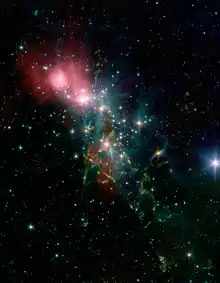 An infrared image of NGC 1333 by the Spitzer Space Telescope | |
| Observation data: J2000.0 epoch | |
| Right ascension | 03h 29m 11.3s[1] |
| Declination | +31° 18′ 36″[1] |
| Distance | 967 ly (296.5 pc)[1] ly |
| Apparent magnitude (V) | 5.6 |
| Apparent dimensions (V) | 6′ x 3′ |
| Constellation | Perseus |
| Designations | Ced 16, GN 03.26.1, LBN 741[2] |
This nebula is in the western part[4] of the Perseus molecular cloud and is a young region of very active star formation,[6] being one of the best-studied objects of its type.[4] It contains a fairly typical hierarchy of star clusters that are still embedded in the molecular cloud in which they formed,[7] which are split into two main sub-groups to the north and south. Most of the infrared emission is happening in the southern part of the nebula. A significant portion of the stars seen in the infrared are in the pre-main sequence stage of their evolution.[6]
The nebula region has a combined mass of approximately 450 M☉,[4] while the cluster contains around 150 stars with a median age of a million years and a combined mass of 100 M☉. The average star formation rate is 10×10−4 M☉ yr–1.[4] Within the nebula are 20 young stellar objects producing outflows, including Herbig–Haro objects, and a total of 95 X-ray sources that are associated with known members of embedded star clusters.[6] In 2011 researchers reported finding 30 to 40 brown dwarf objects in the cloud and in the Rho Ophiuchi cloud complex.[8]
Gallery
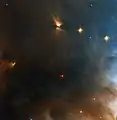 A small region of NGC 1333 taken by Hubble Space Telescope.[9]
 There are 5 Herbig–Haro objects (numbered 7 to 11) in NGC 1333.[10]
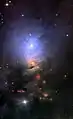 NGC 1333 by the Mount Lemmon Sky Center
.jpg.webp) The region south of NGC 1333 in infrared. It shows the dark clouds Barnard 203 and 204
The region south of NGC 1333 in infrared. It shows the dark clouds Barnard 203 and 204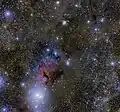 Perseus giant molecular cloud with star nurseries IC348 and NGC1333
References
- Soubiran, C.; et al. (November 2018). "Open cluster kinematics with Gaia DR2". Astronomy & Astrophysics. 619: 11. arXiv:1808.01613. Bibcode:2018A&A...619A.155S. doi:10.1051/0004-6361/201834020. S2CID 125754189. A155.
- "NGC 1333". SIMBAD. Centre de données astronomiques de Strasbourg. Retrieved 2020-08-15.
- Sinnott, Roger W.; Perryman, Michael A. C. (1997). Millennium Star Atlas. Vol. 1. Sky Publishing Corporation and the European Space Agency. ISBN 0-933346-84-0.
- Walawender, J.; et al. (December 2008). Reipurth, Bo (ed.). NGC 1333: A Nearby Burst of Star Formation (PDF). Handbook of Star Forming Regions. ASP Monograph Publications. Vol. 1. p. 346. Bibcode:2008hsf1.book..346W. Retrieved 2020-08-15.
- Inglis, Michael (2004). Astronomy of the Milky Way. Springer London. p. 167. ISBN 1-85233-709-5.
- Getman, Konstantin V.; et al. (August 2002). "Chandra Study of Young Stellar Objects in the NGC 1333 Star-forming Cloud". The Astrophysical Journal. 575 (1): 354–377. arXiv:astro-ph/0204252. Bibcode:2002ApJ...575..354G. doi:10.1086/341219. S2CID 15786877.
- Schulz, Norbert S. (2005). From Dust To Stars. Praxis Publishing Limited. p. 213. ISBN 9783540237112.
- "Rogue Failed Star Is One of Smallest Ever Seen". space.com. 11 October 2011. Retrieved 11 October 2011.
- "Champions League". www.spacetelescope.org. Retrieved 4 November 2019.
- "The smoking gun of a newborn star". www.spacetelescope.org. Retrieved 31 December 2018.
External links

- Agrupació Astronòmica d'Eivissa (AAE)
- Cala d'Hort Telescope (TCH)
- Spitzer Space Telescope page on NGC 1333
- NASA Astronomy Picture of the Day: Dusty NGC 1333 (24 November 2005)
- NASA Astronomy Picture of the Day: In the Center of Reflection Nebula NGC 1333 (21 May 2007)
- Amateur photography
- See NGC1333 in WorldWide Telescope
| |||||||||||||
| Stars |
| ||||||||||||
| |||||||||||||
| Star clusters |
| ||||||||||||
| Nebulae |
| ||||||||||||
| Galaxies |
| ||||||||||||
| |||||||||||||
| |||||||||||||
 Category Category | |||||||||||||