GRB 221009A
GRB 221009A also known as Swift J1913.1+1946 was an unusually bright and long-lasting gamma-ray burst (GRB) jointly discovered by the Neil Gehrels Swift Observatory and the Fermi Gamma-ray Space Telescope on October 9, 2022. The gamma-ray burst lasted for more than ten hours following detection[1][2] and for several hours was bright enough in visible frequencies to be observable by amateur astronomers.[3] The event yielded one of the closest gamma-ray bursts to Earth and is among the most energetic and luminous known to science.[4] A burst as energetic and as near to Earth as 221009A is thought to be a once-in-10,000-year event.[5][6]
 Ten-hour timelapse of GRB 221009A, as seen by the Fermi Gamma-ray Space Telescope | |
| Duration | 10 hours |
|---|---|
| Constellation | Sagitta |
| Right ascension | 19h 13m 03.48s |
| Declination | +19° 46′ 24.6″ |
| Distance | 2.4 billion light years |
| Redshift | 0.151 |
| Other designations | Swift J1913.1+1946,SN 2022xiw |
 Related media on Commons Related media on Commons | |
Characterization
GRB 221009A came from the constellation of Sagitta and occurred an estimated 1.9 billion years ago,[7] however its source is now 2.4 billion light-years away from Earth due to the expansion of the universe during the time-of-flight to Earth.[8] The burst's high-intensity emissions spanned 15 orders of magnitude on the electromagnetic spectrum, from radio emissions to gamma rays. Radio signals broadcast by the winding-down of whatever process created the initial burst will likely linger for years to come.[9] This broadband emission offers the rare opportunity to study normally-fleeting GRBs in great detail.[7][9]
Observation
The burst saturated the Fermi Gamma-ray Space Telescope's detector,[10] which captured gamma ray photons with energies exceeding 100 GeV.[11] GRB 221009A is by far the most productive event for very high energy (VHE) photons ever witnessed by scientific instrumentation. Prior to GRB 221009A, the number of very high energy photons detected over the entire history of GRB astronomy numbered only a few hundred. When the burst's radiation arrived at Earth the Large High Altitude Air Shower Observatory (LHAASO) alone saw more than 5,000 such VHE photons. Some of these photons arrived at Earth carrying a record 18 TeV of energy,[12][3] more than can be produced at the Large Hadron Collider (LHC) at the European Center for Nuclear Research (CERN).[13] Russia's Carpet-2 facility at the Baksan Neutrino Observatory may have also recorded a single 251-TeV photon from this burst.[10]
GRB 221009A was subsequently observed by the Neutron Star Interior Composition Explorer (NICER),[7] the Monitor of All-sky X-ray Image (MAXI), the Imaging X-ray Polarimetry Explorer (IXPE),[14][15][16] the International Gamma-ray Astrophysics Laboratory (INTEGRAL), the XMM-Newton space telescope,[17] and many others.[13][18]
Possible causes
GRB 221009A may have been caused by a massive star undergoing a supernova,[3] or by the birth of a black hole.[11] Supernovae often lead to the formation of a black hole if the parent star is too massive for stable neutron star formation, and it is not yet known which part of, or whether, the death of a star was responsible for this gamma-ray burst. Some physicists speculate that the exceptionally high-energy photons observed during 221009A could be the result of previously theoretical or unknown physical processes involving dark matter,[10] axions, or decaying sterile neutrinos.[19] As yet there is no conclusive evidence that this gamma-ray burst was caused by a supernova,[20][21][22][23] nor have any of the enormous number of neutrinos emitted by supernovae been detected.[24] Lightning detectors in India and Germany picked up signs that the Earth's ionosphere was perturbed for several hours by the burst, though only mildly,[4][10][25] as well as an enormous influx of electrically charged particles.[26]
Record magnitude
Some astronomers referred to the burst as the "brightest of all time", or by the acronym "BOAT".[10][27] This claim easily justified by the record of known gamma-ray bursts.[6] The power of gamma-ray bursts may be gauged by the degree of interaction between the gamma rays they emit and the ubiquitous lanes of interstellar dust in deep space. Such interactions generate an afterglow in X-ray frequencies, usually seen as concentric rings of scattered X-rays with the gamma ray burst at the center. GRB 221009A is only the seventh gamma-ray burst known to have generated these rings.[5] The X-ray afterglow of 221009A was hundreds of times brighter than any seen before[28] and as of June 2023 a record twenty X-ray afterglow rings have been identified around the burst.[29]
Relevance to new physics
Through comparison of data collected by different observatories scientists concluded that the 221009A event was 50 to 70 times brighter than the previous record holder.[18][5] The extremely bright peak and long afterglow may help physicists study the manner in which matter interacts at relativistic speeds, the only known regime capable of generating gamma ray photons with more then 100 GeV of energy.[7] Study of 221009A and similarly extreme events are at present humanity's only access to particles with energies larger than any that can be generated artificially. The close examination of 221009A may eventually yield physical explanations that are neither predicted by nor accounted for in the Standard Model.[10]
Gallery
 Near-simultaneous observations were made of GRB221009A from Gemini South in Chile. The image is a combination of 4 exposures in I, J, H, K with two instruments taken in the morning of Friday, October 14, 2022.[30]
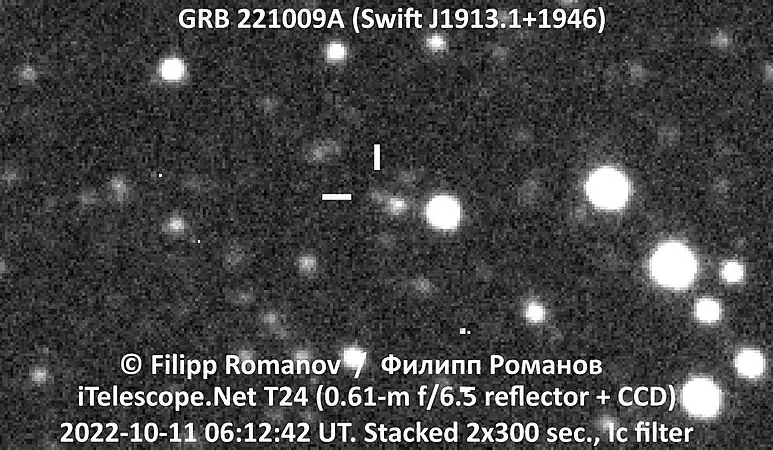 Optical afterglow of GRB 221009A imaged by amateur astronomer using remote telescope
![Swift's X-ray image of GRB 221009A shows circular rings around the gamma-ray burst. Dust in the Milky Way scattered the x-ray emission of the gamma-ray burst, creating the rings.[29]](../I/Xrt_image_crop.jpg.webp)
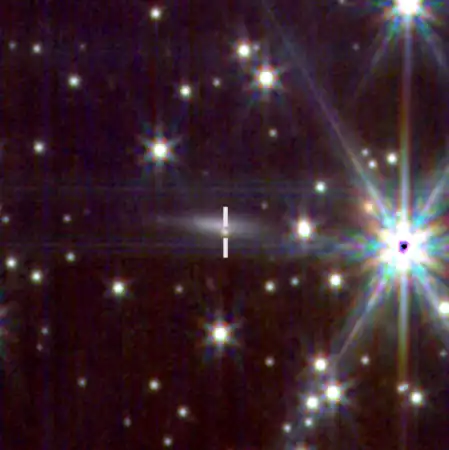 Near-infrared afterglow and host galaxy seen by Webb's NIRCam.
See also
References
- Dichiara, S.; Gropp, J. D.; Kennea, J. A.; Kuin, N. P. M.; Lien, A. Y.; Marshall, F. E.; Tohuvavohu, A.; Williams, M. A.; Neil Gehrels Swift Observatory Team (2022). "Swift J1913.1+1946 a new bright hard X-ray and optical transient". The Astronomer's Telegram. 15650: 1. Bibcode:2022ATel15650....1D.
- Starr, Michelle (October 12, 2022). "Scientists Just Detected a Colossal Gamma-Ray Burst, And It's a Record-Breaker". ScienceAlert. Retrieved October 14, 2022.
- Ahmed, Issam (October 16, 2022). "Astronomers are captivated by brightest flash ever seen". AFP. Phys.org.
- Plait, Phil (October 21, 2022). "The Brightest Gamma-Ray Burst Ever Recorded Rattled Earth's Atmosphere". Scientific American.
- Reddy, Francis (March 28, 2023). "NASA Missions Study What May Be a 1-In-10,000-Year Gamma-ray Burst". NASA. Retrieved March 29, 2023.
- Burns, Eric; et al. (2023). "GRB 221009A: The BOAT". The Astrophysical Journal Letters. 946 (1): L31. arXiv:2302.14037. Bibcode:2023ApJ...946L..31B. doi:10.3847/2041-8213/acc39c. S2CID 257219686.
- Reddy, Francis (October 13, 2022). "NASA's Swift, Fermi Missions Detect Exceptional Cosmic Blast". NASA’s Goddard Space Flight Center.
- Dickinson, David (April 6, 2023). "Brightest Gamma-ray Burst Shines Light on Milky Way Structure". Universe Today. Retrieved June 15, 2023.
- Laskar, Tanmoy; et al. (2023). "The Radio to GeV Afterglow of GRB 221009A". The Astrophysical Journal Letters. 946 (1): L23. arXiv:2302.04388. Bibcode:2023ApJ...946L..23L. doi:10.3847/2041-8213/acbfad. S2CID 256697486.
- O'Callaghan, Jonathan (October 26, 2022). "Brightest-Ever Space Explosion Could Help Explain Dark Matter". Quanta Magazine. Retrieved October 27, 2022.
- Nemiroff, Robert; Jerry, Bonnell (October 15, 2022). "GRB 221009A". Astronomy Picture of the Day. NASA. Retrieved January 12, 2023.
- Sahu, Sarira; Medina-Carrillo, B.; Sánchez-Colón, G.; Rajpoot, Subhash (2023). "Deciphering the ∼18 TeV Photons from GRB 221009A". The Astrophysical Journal Letters. 942 (L30): L30. arXiv:2211.04057. Bibcode:2023ApJ...942L..30S. doi:10.3847/2041-8213/acac2f. S2CID 253397820.
- Sullivan, Will (October 21, 2022). "This Powerful Gamma-Ray Blast Was the 'Brightest of All Time'". Smithsonian Magazine. Retrieved January 12, 2023.
- Maginot, Hannah (December 29, 2022). "NASA's IXPE Quickly Observes Aftermath of Incredible Cosmic Blast – "This Is Now or Never"". SciTech Daily. Retrieved January 12, 2023.
- Negro, Michela; Di Lalla, Niccolò; Omodei, Nicola; Veres, Péter; Silvestri, Stefano; Manfreda, Alberto; Burns, Eric; Baldini, Luca; Costa, Enrico; Ehlert, Steven R.; Kennea, Jamie A.; Liodakis, Ioannis; Marshall, Herman L.; Mereghetti, Sandro; Middei, Riccardo (March 1, 2023). "The IXPE View of GRB 221009A". The Astrophysical Journal Letters. 946 (1): L21. arXiv:2301.01798. Bibcode:2023ApJ...946L..21N. doi:10.3847/2041-8213/acba17. ISSN 2041-8205. S2CID 255440524.
- Hensley, Kerry (March 29, 2023). "Focusing on the Brightest Gamma-ray Burst of All Time". AAS Nova. Retrieved April 12, 2023.
- "ESA spacecraft catch the brightest ever gamma-ray burst". European Space Agency. October 21, 2022. Retrieved January 12, 2023.
- Chinese Academy of Sciences (March 28, 2023). "Insight-HXMT and GECAM-C observations of the brightest-of-all-time GRB 221009A". Phys.org. Retrieved March 29, 2023.
- Smirnov, A.Y.; Trautner, A. (2022). "GRB 221009A Gamma Rays from Radiative Decay of Heavy Neutrinos?". arXiv:2211.00634 [hep-ph].
- Shrestha, Manisha; et al. (2023). "Limit on Supernova Emission in the Brightest Gamma-Ray Burst, GRB 221009A". The Astrophysical Journal Letters. 946 (1): L25. arXiv:2302.03829. Bibcode:2023ApJ...946L..25S. doi:10.3847/2041-8213/acbd50. S2CID 257405480.
- Fulton, M. D.; et al. (2023). "The Optical Light Curve of GRB 221009A: The Afterglow and the Emerging Supernova". The Astrophysical Journal Letters. 946 (1): L22. arXiv:2301.11170. Bibcode:2023ApJ...946L..22F. doi:10.3847/2041-8213/acc101. S2CID 257687906.
- Levan, A. J.; et al. (2023). "The First JWST Spectrum of a GRB Afterglow: No Bright Supernova in Observations of the Brightest GRB of all Time, GRB 221009A". The Astrophysical Journal Letters. 946 (1): L28. arXiv:2302.07761. Bibcode:2023ApJ...946L..28L. doi:10.3847/2041-8213/acc2c1. S2CID 256868610.
- Srinivasaragavan, Gokul P.; et al. (2023). "A Sensitive Search for Supernova Emission Associated with the Extremely Energetic and Nearby GRB 221009A". Astrophysical Journal Letters. 949 (2): L39. arXiv:2303.12849. Bibcode:2023ApJ...949L..39S. doi:10.3847/2041-8213/accf97. S2CID 257687577.
- Abbasi, R.; et al. (2023). "Limits on Neutrino Emission from GRB 221009A from MeV to PeV Using the IceCube Neutrino Observatory". The Astrophysical Journal Letters. 946 (1): L26. arXiv:2302.05459. Bibcode:2023ApJ...946L..26A. doi:10.3847/2041-8213/acc077. S2CID 256827599.
- Hayes, Laura A.; Gallagher, Peter T. (2023). "A Significant Sudden Ionospheric Disturbance Associated with Gamma-Ray Burst GRB 221009A". Research Notes of the AAS. American Astronomical Society. 6 (10): 222. doi:10.3847/2515-5172/ac9d2f. S2CID 253157644.
- Battiston, R.; et al. (2023). "Observation of Anomalous Electron Fluxes Induced by GRB221009A on CSES-01 Low-energy Charged Particle Detector". The Astrophysical Physics Journal Letters. 946 (1): L29. Bibcode:2023ApJ...946L..29B. doi:10.3847/2041-8213/acc247. S2CID 257801868.
- Miller, Katrina (October 2022). "The 'Brightest of All Time' Gamma-Ray Burst Sparks a Supernova Hunt". Wired. Retrieved October 27, 2022.
- "Brightest Gamma-Ray Burst Yet Lit Up the Sky". Sky & Telescope. October 17, 2022. Retrieved October 27, 2022.
- Tiengo, Andrea; et al. (2023). "The Power of the Rings: The GRB 221009A Soft X-Ray Emission from Its Dust-scattering Halo". The Astrophysical Journal Letters. 946 (1): L30. arXiv:2302.11518. Bibcode:2023ApJ...946L..30T. doi:10.3847/2041-8213/acc1dc. S2CID 257079095.
- "Telescopes Standing Sentry". NOIRLab. Retrieved January 17, 2023.
- Tiengo, Andrea; Pintore, Fabio; Vaia, Beatrice; Filippi, Simone; Sacchi, Andrea; Esposito, Paolo; Rigoselli, Michela; Mereghetti, Sandro; Salvaterra, Ruben; Siljeg, Barbara; Bracco, Andrea; Bosnjak, Zeljka; Jelic, Vibor; Campana, Sergio (March 1, 2023). "The power of the rings: the GRB 221009A soft X-ray emission from its dust-scattering halo". The Astrophysical Journal Letters. 946 (1): L30. arXiv:2302.11518. Bibcode:2023ApJ...946L..30T. doi:10.3847/2041-8213/acc1dc. ISSN 2041-8205. S2CID 257079095.
2022 in space | ||
|---|---|---|
| ||
Space probe launches  |
|   |
| Impact events | ||
| Selected NEOs |
| |
| Discoveries | ||
| Comets | ||
| Space exploration |
| |
| ||
