Vagabond (manga)
Vagabond (Japanese: バガボンド, Hepburn: Bagabondo) is a Japanese epic martial arts manga series written and illustrated by Takehiko Inoue. It portrays a fictionalized account of the life of Japanese swordsman Musashi Miyamoto, based on Eiji Yoshikawa's novel Musashi. It has been serialized in Kodansha's seinen manga magazine Morning since September 1998, with its chapters collected into thirty-seven tankōbon volumes as of July 2014.
| Vagabond | |
_vol._1.png.webp) First tankōbon volume cover, featuring Miyamoto Musashi | |
| バガボンド (Bagabondo) | |
|---|---|
| Genre | |
| Manga | |
| Written by | Takehiko Inoue |
| Published by | Kodansha |
| English publisher | |
| Imprint | Morning KC |
| Magazine | Morning |
| Demographic | Seinen |
| Original run | September 17, 1998 – May 21, 2015 (on hiatus) |
| Volumes | 37 |
Viz Media licensed the series for English release in North America and has published the current thirty-seven volumes as of April 2015. The series is currently on an extended hiatus, with the latest chapter released in May 2015.
As of December 2012, the manga had over 82 million copies in circulation, making it one of the best-selling manga series of all time. In 2000, Vagabond won the 24th Kodansha Manga Award for the General category, as well as the Grand Prize of the 6th Tezuka Osamu Cultural Prize in 2002.
Summary
The story starts in 1600, in the aftermath of the decisive Battle of Sekigahara. Two 17-year-old teenagers who joined the losing side, Takezō Shinmen and Matahachi Hon'iden, lie wounded in the battlefield and pursued by survivor hunters. They manage to escape and swear to become Invincible Under The Heavens (天下無双, Tenka Musō). They find housing with two women, but are soon attacked by the Tsujikaze gang, and in the confusion of the fight their paths separate: Takezō decides to become a vagabond and wander the world challenging strong opponents, and Matahachi chooses to stay with the women. Takezō returns to his hometown, the Miyamoto village, to tell Matahachi's mother, Osugi Hon'iden, that her son is alive. However, Osugi reacts hostile because the village detests Takezō for his extremely violent and antisocial tendencies, and because the future of the Hon'iden gentry family is compromised now that their heir Matahachi is missing. Osugi pulls strings to accuse Takezō of being a criminal. Takezō fights his pursuers but is eventually caught by the monk Takuan Sōhō, who makes him reconsider his purpose in life. Takuan frees him and, to make him start his life anew, renames him Musashi Miyamoto.
After a 4 years timeskip, Musashi's arrival to Kyōto, his fight against the Yoshioka swords. Musashi takes several students but area catches a fire, leading to the fight being postponsed. Musashi is rescued by Matahachi and treated by Takuan. Musashi decides to continue his training with a young boy, Jōtarō, wanting him to teach him. In Musashi and Jōtarō's arrival to the Hōzōin spears, Musashi's first fight against the Hōzōin, its aftermath, Musashi's second fight against Hōzōin Inshun. Inshun's superiority causes Musashi to escape driven by fear but trains a for a rematch where he briefly overpowers his rival. Its aftermath, Otsū's situation with the Yagyū, while Matahachi becomes famous while stealing the name of a famous samurai known as Kojirō Sasaki. Musashi and Jōtarō's arrive to the Yagyū swords, the events while deliberating how to enter the Yagyū headquarters, Musashi's meeting with the 4 seniors, his solo fight against the Yagyū men, his encounter with Sekishūsai Yagyū and their talk, the fight's aftermath. Musashi's training, Matahachi and his family's troubles, the events directly leading to Musashi's fight against Baiken Shishido.
The story then reverts to 17 years before the story's start, featuring Kojirō Sasaki's difficult upbringing with Jisai Kanemaki adopting him, various displays of character backstories, and his growth as a genius samurai despite being disabled. At his coming-of-age, Ittōsai returns dragging Kojirō to a night fight. He travels of with Ittōsai and Gonnosuke with a brief encounter with Takezō at the battlefield of Sekihagara, their splitting, the situation of Sadakore's squad, the fights against the peasant groups, Kojirō's fight against Sadakore's squad.
After Kojiro's arc ends, Musashi meets Kojiro again while playing with a snowman simulating a brief swordfight in the process. Musashi meets Matahachi who expresses jealousy over Musashi's achievements and apparent relationship with Otsu. This angers Musashi and leaves his old friend. Musashi then fights the 70 Yoshioka all alone. Although he kills all of them, one of the leaves him with a severe wound. The aftermath of Musashi's solo battle, has him his return to wandering despite being offered the position of mentor. Meanwhile, Matahachi's mother passes away, leaving his son to tell the story of the manga.
Musashi's new wandering leads him meet the orphan Iori, whom he decides to raise while dealing with a village with poor fields. Musashi, Iori and Toyozaemon's journey to the retirement estate of Yūsai Hosokawa, Otsū and Jōtarō's situation living with the Yagyū, while Kojirō deals with the Hosokawa.
Production
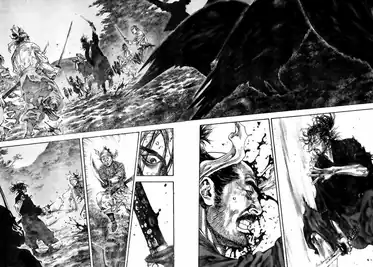
After finishing the basketball manga Slam Dunk, Takehiko Inoue wanted to write something more realistic. While Slam Dunk was aimed to a young demography, Vagabond is aimed towards an adult one. Nevertheless, he did not find differences between the baskebtall players and samurais since he claimed that none of them like losing. In retrospect, Inoue's experience with changing demographies feels obligatory as he believes manga authors should challenge themselves.[6] Furthermore, he called Vagabond as an experiment about him writing in contrast to the his more simplistic he made before.[7] Inoue started Vagabond having wondered what the character was like when he read Musashi. Having come off of drawing a sports manga, he wanted to create a series about more basic concepts, such as "life and death, the human condition, etc.". Rather than portray Musashi's later life in his "enlightened state", which has been written about often, the author chose to depict the lesser known "young man reaching that point of enlightenment when he comes from a place of being so like an animal". In 2009, he stated that he made his weekly deadline thanks to only having to draw the people, with his five assistants drawing the backgrounds.[8] When drawing, Inoue avoids speed lines and instead keeps showing bodies based on his understanding how human bodies work.[9]
Since not much is known about the real Musashi, Inoue wanted to give his own take which he considers more modern than other related works. He regards the artwork for Vagabond as a challenge in contrast to Slam Dunk and Real.[10] The author clarifies there are other activities besides fighting which are important for the protagonist. Should Inoue make Miyamoto constantly follow fights, the main character would die. Rather than tell a story, Inoue wants to shows the life of Miyamoto which he considers poetry. When Musashi comes face to face with Sekishusai, Inoue tries to make the artwork appeal to the readers.[11] In contrast to popular belief, Inoue's Musashi does not follow bushido but instead a more unique path with a growth path that he finds realistic.[9] Moreover, he does not consider Musashi a samurai, but instead as a ronnin.[6] Other changes Inoue put when writing the manga was to make the supporting characters have different personalities from the novel. Inoue also expressed difficulties when drawing scene were the characters are wounded, most notably when Musashi battles the 70 Yoshioka which took a lot of energy to properly make. This scene was also a new idea he had when writing the manga as he felt that Musashi required a major challenge than in the novel.[12]
In April 2009, Inoue told Nishinippon Shimbun that he suspected Vagabond would be ending "within one or two years". Claiming that he did not know how it would end, but that it had entered its final stages.[13] In January 2010, he confirmed it would be ending within the year.[14] However, in September during a hiatus due to health concerns, Inoue announced that the ending had been delayed until 2011.[15] Inoue posted an update on his website in December 2010, stating that Vagabond would not return until he regained "enthusiasm" for the series.[4]
After eighteen-months, Vagabond returned to Morning as a monthly series in March 2012.[16] The manga went on what was supposed to be a four-month hiatus in February 2014, with the reason stated being for Inoue to work on research.[17] However, it was not until January 2015 that the series resumed.[18] The series is currently on an extended hiatus since May 21, 2015, with its 327th chapter, "The Man named Tadaoki", being the latest chapter.[19]
Release
Written and illustrated by Takehiko Inoue, Vagabond is based on Eiji Yoshikawa's 1935 novel Musashi. It started serialization in Kodansha's seinen manga magazine Morning on September 17, 1998.[lower-alpha 1] Inoue started the series Real in Weekly Young Jump in 1999, and serialized it alongside Vagabond. As of July 2014, the Vagabond chapters have been collected into 37 tankōbon volumes by Kodansha.
Viz Media began releasing Vagabond in English in North America in 2002.[22] Their release retains the color pages from the series' magazine run, and the company has published 37 volumes as of April 21, 2015.[23] Viz's release is distributed in Australasia by Madman Entertainment.[24] In 2008, Viz began re-releasing the series in a format that collects three of the volumes into one.[25] There are currently 12 VIZBIG editions released.[26]
Two art books for the series were released on October 23, 2006; Water containing the manga's colored art and new pieces, and Sumi (墨) containing the black and white art as well as early rough sketches. Both were published in North America by Viz on September 16, 2008.[27][28]
Reception
Awards
Vagabond won the Grand Prize for manga at the 4th Japan Media Arts Festival in 2000. The following is an excerpt from the speech congratulating Takehiko Inoue: "From Toyotomi to Tokugawa. Musashi Miyamoto grew up amidst the turn of two great eras. Mr. Inoue has taken the powerful Musashi who was sometimes called a 'beast' and drawn him as a vagabond. The artist brags about boldly challenging the national literary work of Eiji Yoshikawa, even so, the sense of speed that he creates is impressive. I send my applause to the artist for creating a new image of Musashi".[29][30] The same year, the series won the 24th Kodansha Manga Award in the general category.[31] Vagabond also received the Grand Prize of the 6th Tezuka Osamu Cultural Prize in 2002, and the North American version earned Inoue a nomination for the 2003 Eisner Award in the Best Writer/Artist category.[17]
Critical response
As of December 2012, Vagabond had over 82 million copies in circulation worldwide.[32]
In early releases of the manga, MangaLife found Musashi appealing for his quest of strength and Inoue's detailed artwork despite its slow pacing.[33] However, they criticized the early journey of Musashi due the emphasis on violence over his mental development and lamented his lack of connections with Matahachi.[34] The eventual release of the sixth volume received more acclaim from the Manga Life for further developing Musashi's bushido, his acceptance of his weak point and how Matahachi also kept appearing despite the two still not meeting.[35] The Fandom Post was drawn out by the writing of Inoue when reading the first manga volume, praising its large amount of content and whether or not Musashi is still capable of being a true warrior when interacting with the monk Takuan.[36] A similar comment was given by ComicBookBin with the reviewer claiming that his impression of Vagabond was so impressive that it reminded him of the comic book Batman: The Dark Knight Returns, praising the way Inoue portrays violence in a realistic fashion.[37] Another aspect praised by the same site was the lack of large amount of dialogue needed to describe the characters.[38]
According to Crunchyroll, both Slam Dunk's Hanamichi Sakuragi and Musashi are similar protagonists being young, egotistical prodigies, but "Inoue’s Musashi is a force of nature." He went to call Inoue's take on Musashi unique when compared to the ones often depicted in fiction.[39] Comic Book Resources praised the way Musashi addresses Bushido, the Code of the Samurai, which makes him honorable.[40] Besides the recurring fight scene, the story arc where Musashi tries to take care of villagers as it retains the handling of Bushido but without relying on action but instead other types of strength. Nevertheless, this arc was critcized for retaining a slow pacing.[41][42] Japan Times regarded Musashi's growth from the ruthless warrior to a wise monk warrior to be well executed across the narrative.[43]
In a comparison with the original novel, the manga was noted to be more adult but still not as well written as the novel.[44] On the other hand, Los Angeles Times regarded Vagabond as a "samurai masterpiece" for the contrast it makes with the novel by deepening the characerization of Musashi and alternate take on the rival Kojiro. Another aspect praised by Los Angeles Times was how the protagonist makes philosophy about strength and his goal as the arc of the Yoshioka where the main character kills 70 men ends with him retaining severe wound on his foot that weakens him and makes him question what is being invincible.[45] According to Hobby Consolas, Vagabond deserves the praise it gets both in narratve and artwork theme.[46] One Piece writer Eiichiro Oda claimed he enjoyed the manga for touching deep themes and how it helped Inoue grow as an artist.[47]
Notes
- It started in Morning #40 (1998),[20] with cover date September 17, 1998.[21]
References
- Kosaka, Kris (January 7, 2017). "'Vagabond': An epic manga based on the life of a 17th-century samurai". The Japan Times. Retrieved May 1, 2019.
- Cha, Kai-Ming; MacDonald, Heidi (November 30, 2007). "Takehiko Inoue Unveils Mural at New Kinokuniya". Publishers Weekly. Retrieved April 20, 2020.
Inoue is also the mangaka (manga creator) behind the epic ongoing series, Vagabond (Viz Media), based on Japan's most revered and influential samurai warrior, Miyamoto Musashi.
- Douresseaux, Leroy (April 23, 2015). "Vagabond: Volume 37 manga review". ComicBookBin. Retrieved May 12, 2020.
- Loo, Egan (December 7, 2010). "Vagabond Manga Remains on Indefinite Hiatus". Anime News Network. Retrieved February 26, 2014.
- "The Official Website for Vagabond". Viz Media. Retrieved October 27, 2017.
- "ZN Manga: Entrevista con Takehiko Inoue «No tengo conciencia de ser alguien famoso.»". Zona Negativa. Retrieved May 11, 2023.
- "Entrevista a Takehiko Inoue (traducción)". Hablando de Manga. Retrieved May 11, 2023.
- Aoki, Deb. "Interview: Takehiko Inoue". Liveabout. About.com. Archived from the original on March 3, 2016. Retrieved October 10, 2021.
- "Entrevista Takehiko Inoue". DeCulture. Retrieved May 5, 2023.
- Cha, Kai-Ming; MacDonald, Heidi (November 26, 2007). "Takehiko Inoue Unveils Mural at New Kinokuniya". Publishers Weekly. Archived from the original on December 26, 2007. Retrieved November 5, 2009.
- "Morning". No. April. Kodansha. 2010.
{{cite magazine}}: Cite magazine requires|magazine=(help) - "Entrevista Conjunta: Takehiko Inoue y Eiichiro Oda – Tercera Parte". Ramen Para Dos. Retrieved May 11, 2023.
- Loo, Egan (April 24, 2009). "Takehiko Inoue: Vagabond Manga Will End in 1-2 Years". Anime News Network. Retrieved February 26, 2014.
- Loo, Egan (January 4, 2010). "Inoue Confirms End of Vagabond Manga by Year's End". Anime News Network. Retrieved February 26, 2014.
- Loo, Egan (September 8, 2010). "Takehiko Inoue Delays Vagabond Manga's Return & Finale". Anime News Network. Retrieved February 26, 2014.
- Ransom, Ko (February 9, 2012). "Vagabond Manga's Return Slated for March 15". Anime News Network. Retrieved January 23, 2014.
- Loveridge, Lynzee (February 16, 2014). "Vagabond Manga to Go on 4-Month Hiatus". Anime News Network. Retrieved February 16, 2014.
- Loo, Egan (January 6, 2015). "Vagabond Manga to Resume on January 29". Anime News Network. Retrieved January 13, 2015.
- Inoue, Takehiko [@inouetake] (May 21, 2015). 【お知らせ】本日発売のモーニングにバガボンド327話「忠興という名の川」掲載です。 (Tweet) (in Japanese). Retrieved July 14, 2021 – via Twitter.
- "Works". itplanning.co.jp. Archived from the original on May 23, 2020. Retrieved May 23, 2020.
- モーニング 1998年 表示号数40. Media Arts Database (in Japanese). Agency for Cultural Affairs. Archived from the original on May 24, 2020. Retrieved May 24, 2020.
- Inoue, Takehiko; Yoshikawa, Eiji (2002). Vagabond, Vol. 1. ISBN 1591160340.
- Inoue, Takehiko (April 21, 2015). Vagabond, Vol. 37. ISBN 978-1421577449.
- Hayward, Jon (December 8, 2006). "Madman announces December acquisitions". Anime News Network. Retrieved January 23, 2014.
- Vagabond, Vol. 1 (Vizbig ed.). ISBN 1421520540.
- "VIZ: The Official Website for Vagabond". Viz Media. Retrieved October 6, 2020.
- Inoue, Takehiko (September 16, 2008). Water (Vagabond Illustration Collection). ISBN 978-1421520582.
- Inoue, Takehiko (September 16, 2008). Sumi (Vagabond Illustration Collection). ISBN 978-1421520575.
- "Grand Prize - Vagabond | Award | Manga Division | 2000 [4th] Japan Media Arts Festival Archive". Japan Media Arts Festival. Retrieved October 22, 2022.
- Japan Media Arts Plaza. "2000 Japan Media Arts Festival Manga Division Grand Prize Vagabond". Archived from the original on October 11, 2007. Retrieved August 26, 2007.
- Joel Hahn. "Kodansha Manga Awards". Comic Book Awards Almanac. Archived from the original on August 16, 2007. Retrieved August 21, 2007.
- コンテンツビジネス概論‐12 (PDF) (in Japanese). Ritsumeikan University. December 13, 2012. p. 12. Archived from the original (PDF) on February 22, 2014. Retrieved November 29, 2013.
- "Vagabond 1". Manga Life. Archived from the original on October 14, 2007. Retrieved May 10, 2023.
- "Vagabond 3 review". Manga Life. Archived from the original on October 14, 2007. Retrieved May 10, 2023.
- "Vagabond 6 review". Manga Life. Archived from the original on October 11, 2007. Retrieved May 10, 2023.
- "Vagabond Volume 1 Manga review". Fandom Post. Retrieved May 10, 2023.
- "Vagabond VIZBIG Edition: Volume 9". Comic Book Bin. Retrieved May 10, 2023.
- "Vagabond: Volume 33". Comic Book Bin. Retrieved May 10, 2023.
- "FEATURE: Monthly Mangaka Spotlight 9: Takehiko Inoue". Crunchyroll. Retrieved April 24, 2023.
- "Vagabond: 10 Reasons It's A Must-Read Manga". Comic Book Resources. Retrieved April 24, 2023.
- "Vagabond Vol. #36 Manga Review". Fandom Post. Retrieved May 10, 2023.
- "Vagabond Vol. #37 Manga Review". Fandom Post. Retrieved May 10, 2023.
- "'Vagabond': An epic manga based on the life of a 17th-century samurai". Japan Times. Retrieved April 24, 2023.
- Wilson, William Scott (2013). "The Lone Samurai". Japan Times. Shambhala. ISBN 978-1590309872.
- Solomon, Charles (October 2, 2011). "'Vagabond': Takehiko Inoue creates a samurai masterpiece". Los Angeles Times. Archived from the original on August 20, 2015.
- "Trabajos Takehiko Inoue". Hobby Consolas (in Spanish). Retrieved May 11, 2023.
- "Entrevista conjunta: Takehiko Inoue y Eiichiro Oda – Primera Parte". Ramen Para Dos (in Spanish). Retrieved May 11, 2023.
External links
- Vagabond on the official Morning website (in Japanese)
- Takehiko Inoue official website
- Vagabond (manga) at Anime News Network's encyclopedia