The Kingdom (film)
The Kingdom is a 2007 action thriller film directed by Peter Berg and starring Jamie Foxx, Chris Cooper, and Jennifer Garner. The film is set in Saudi Arabia, and is based on the 1996 bombing of the Khobar housing complex, also on the 2004 Khobar massacre and the two 2003 bombings of four compounds in Riyadh. It was released in the United States on September 28, 2007.
| The Kingdom | |
|---|---|
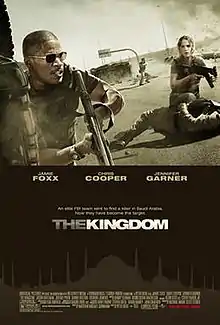 Theatrical release poster | |
| Directed by | Peter Berg |
| Written by | Matthew Michael Carnahan |
| Produced by | |
| Starring | |
| Cinematography | Mauro Fiore |
| Edited by |
|
| Music by | Danny Elfman |
Production companies |
|
| Distributed by | Universal Pictures |
Release dates |
|
Running time | 110 minutes |
| Countries | |
| Language | English |
| Budget | $70-72.5 million[3][4] |
| Box office | $87 million[4] |
Plot
During a softball game at an American oil company housing compound in Riyadh, Saudi Arabia, al-Qaeda terrorists set off a bomb, killing Americans and Saudis. While one team hijacks a car and shoots residents, a suicide bomber in police uniform blows himself up, killing everyone near him. Sergeant Haytham of the Saudi State Police kills the carjackers. The FBI Legal Attaché in Saudi Arabia, Special Agent Fran Manner, calls his US colleague, Special Agent Ronald Fleury, to advise him about the attack. Manner is discussing the situation with DSS Special Agent Rex Burr when a second bomb is detonated, killing them both and many others.
At FBI Headquarters in Washington, D.C., Fleury briefs his rapid deployment team on the attack. Although the U.S. Justice Department and the U.S. State Department hinder FBI efforts to investigate, Fleury blackmails the Saudi ambassador into allowing an FBI investigative team into Saudi soil. Fleury gathers forensic examiner Janet Mayes, intelligence analyst Adam Leavitt, and bomb technician Grant Sykes. On arrival, they are met by Colonel Faris al-Ghazi, the commander of the Saudi State Police Force providing security at the compound. The investigation is led by General Al Abdulmalik of the SANG, who, due to his inexperience in criminal investigation, makes it impossible for Fleury and his team permission to investigate.
The FBI team is invited to the palace of Saudi Prince Ahmed bin Khaled for dinner. At the palace, Fleury convinces the Prince that Colonel al-Ghazi is a better fit to lead the investigation. With this change in leadership, the Americans are allowed hands-on access to the crime scene. While searching for evidence, Sergeant Haytham and Sykes discover the second bomb was detonated in an ambulance. Fleury learns the brother of one of the dead terrorists had access to ambulances and police uniforms. Al-Ghazi orders a special forces team to raid a house, managing to kill a few heavily armed terrorists. Following the raid, the team discovers clues, including photos of the U.S. and other Western embassies in Riyadh. The U.S. Embassy Deputy Chief of Mission Damon Schmidt notifies Fleury and his team that they have been ordered to return to the United States.
On their way to King Khalid International Airport, their convoy is attacked and incapacitated, and Leavitt is kidnapped. Al-Ghazi commandeers a civilian vehicle and the team chases the car holding Leavitt into the dangerous Al-Suwaidi neighborhood of Riyadh. As they pull up, a gunman fires rocket-propelled grenades at them and a fierce firefight starts. Meanwhile, Leavitt is carried into a room inside a complex, where the terrorists prepare to stage and film his execution.
While Sykes and Haytham watch the entrance to the complex, al-Ghazi, Fleury, and Mayes follow a blood trail and kill many gunmen inside. Mayes, separated from the others, finds the room holding Leavitt and saves him just in time. As al-Ghazi and the team start to leave. Fleury then realizes there is a trail of blood leading to the back of the apartment, where a family stays. After noticing several clues, al-Ghazi realizes the grandfather is the terrorist leader. Abu Hamza's teenage grandson walks out of the bedroom and shoots al-Ghazi in the neck, then points his gun at Mayes, prompting Fleury to kill him. Al-Ghazi bleeds out in Fleury's arms. Abu Hamza pulls out an assault rifle and is killed by Haytham. As Abu Hamza dies, another grandchild hugs him and Abu Hamza whispers something into his ear.
At al-Ghazi's house, Fleury and Haytham meet his family. Fleury comforts al-Ghazi's son the same way he comforted Special Agent Manner's son. Fleury and his team return to the U.S., where they are commended by FBI Director James Grace for their work. Leavitt asked Fleury and Mayes what he had whispered to her to calm her down. The scene cuts to Abu Hamza's daughter asking her own son about his grandfather's last words. The boy tells his mother, "Don't fear them, my child. We are going to kill them all," a similar line to what Fleury had whispered to Mayes.
Cast
- Jamie Foxx as Special Agent Ronald Fleury
- Chris Cooper as Special Agent Grant Sykes
- Jennifer Garner as Special Agent Janet Mayes
- Jason Bateman as Special Agent Adam Leavitt
- Ashraf Barhom as Colonel Faris Al-Ghazi, Saudi State Police
- Ali Suliman as Sergeant Haytham, Saudi State Police
- Jeremy Piven as Damon Schmidt
- Richard Jenkins as FBI Director Robert Grace
- Tim McGraw as Aaron Jackson
- Kyle Chandler as Special Agent Francis Manner
- Frances Fisher as Elaine Flowers
- Danny Huston as US Attorney General Gideon Young
- Kelly AuCoin as Ellis Leach
- Anna Deavere Smith as Maricella Canavesio
- Minka Kelly as Miss Ross
- Amy Hunter as Lyla Fleury
- T.J. Burnett as Kevin Fleury
- Omar Berdouni as Saudi Prince Ahmed Bin Khaled.
- Raad Rawi as Prince Thamer
- Mahmoud Said as Brigadier General Al Abdulmalik
- Trevor St. John as Earl Ripon
- Ashley Scott as Janine Ripon
Production
Prior to filming, director Peter Berg spent two weeks in Saudi Arabia researching the film.[5] Filming began on July 10, 2006, on the west side of the old Maricopa County Courthouse in Phoenix, Arizona. Additional scenes were being filmed concurrently in Mesa, Arizona; the scenes at the American compound were shot at the Polytechnic campus of Arizona State University.[6] In some of the trailer frames, saguaro cacti not native to Saudi Arabia are visible in the background. The scenes in the men's locker room at the beginning of the film were filmed in the men's locker room and detention area of the Gilbert Police Department. The FBI briefing scene was filmed in the media amphitheater/classroom in the same police building. The high speed driving scenes were filmed on Loop 202, which runs through Mesa and Gilbert, just prior to its opening for public use only a few miles from the ASU campus.
While shooting on location in Mesa, Berg was involved in a fatal accident that resulted in the death of another crew member. The SUV he was riding in collided with a John Deere Gator all-terrain vehicle driven by assistant property master Nick Papac. Papac died three hours later. On August 8, 2008, Papac's parents Michael Papac and Michele Bell filed a lawsuit against the director, a driver, and the production company.[7] The lawsuit was dropped in 2008.[8] Filming resumed one day after the incident.
On-location filming took place in Abu Dhabi, United Arab Emirates for two weeks in mid-September.[5] Since Universal Pictures does not have an office in the Middle East, the production was facilitated by a local production firm called Filmworks, based in Dubai.[9] Filming also took place at the Emirates Palace hotel in Abu Dhabi.[10][11]
The film's production cost an estimated $70–72.5 million.[3][4]
Reception
Critical response
Review aggregator website Rotten Tomatoes reports an approval rating of 51% based on 180 reviews, with a rating average of 5.8/10. The site's critical consensus reads, "While providing several top-notch action scenes, The Kingdom ultimately collapses under the weight of formula and muddled politics."[12] At Metacritic, which assigns a normalized rating to reviews, the film has an average weighted score of 56 out of 100, based on 37 critics, indicating "mixed or average reviews".[13] Audiences polled by CinemaScore gave the film an average grade of "B+" on an A+ to F scale.[14]
Weekly Standard columnist John Podhoretz called the film "perfectly paced" and "remarkably crisp and satisfying", arguing that it evokes the films The Taking of Pelham One Two Three, Dog Day Afternoon, and The New Centurions.[15] The New York Times critic A. O. Scott called it "a slick, brutishly effective genre movie". He also stated that "Just as Rambo offered the fantasy do-over of the aftermath of the Vietnam War, The Kingdom can be seen as a wishful revisionist scenario for the American response to Islamic fundamentalist terrorism."[16] Peter Travers of Rolling Stone gave the film three stars out of four, remarking "Fleury goes John Wayne on their ass."[17] Evan Williams of The Australian called it "an excellent thriller" and stated that it "may be the first Hollywood film to confront Saudi involvement in international terrorism."
New York Post critic Lou Lumenick stated that "Hollywood provides the Islamic world another reason to hate America with The Kingdom," calling it "xenophobic" and "pandering."[18] The A.V. Club's Scott Tobias gave the movie a C, criticizing the movie's "queasy brand of escapism" by offering the audience the pleasure of "[w]inning imaginary wars" and giving an idealized portrayal of the efficiency of American intelligence. He says the film appeals to the audience's "basest instincts" and that, despite one sympathetic Arab character, the film could be tarred as racist.[19] Lisa Schwarzbaum of Entertainment Weekly accused the film of "treating its audience like cash-dispensing machines".[20] Kenneth Turan of The Los Angeles Times called it "a slick excuse for efficient mayhem that's not half as smart as it would like to be." He added that "the film's thematic similarity to those jingoistic World War II-era 'Yellow Peril' films makes it hard not to feel your humanity being diminished." Scholar Moustafa Bayoumi has critiqued the racialization of Arabs in the film (along with The Siege) and suggested it is representative of an emerging sub-genre he says is defined by "the notion of African-American leadership of the Arab world, intertwined with friendship with it."[21]
Middle Eastern reception
Faisal Abbas, media editor of the London-based international Arabic journal Asharq Al Awsat, wrote on the newspaper's English website that "despite some aspects which might be perceived by some as negative, many might be pleasantly surprised after watching this film, bearing in mind that Arabs have for a long time been among Hollywood's favorite villains." Faisal concluded that "In all cases, the film is definitely action-packed, and perhaps Saudis and Arabs may enjoy it more than Americans, as events are depicted as taking place in the Saudi capital…and it is not every day that you watch a Hollywood-style car chase happening on the streets of Riyadh. For Westerners, the movie might be an interesting "insight" to a culture that is very different to their own."[22]
In a review titled One good Arab for The Guardian, Palestinian writer Sharif Nashashibi argues the film is one in a long tradition of Western works where Arabs are vilified and Americans are portrayed as heroes, only that this time it bothered to add "a token Arab 'good guy'", equating good with pro-American, "to make up for the fact that the rest of the Arab characters are bad." All other Arab characters in the movie, he says, "are portrayed negatively - from the brutal, hate-filled, anti-western, religiously fanatical terrorists, to the inept, corrupt, heavy-handed, secretive and frustratingly bureaucratic Saudi authorities", as opposed to the "humanity, grief, compassion, determination, ability and patriotism of most of the American characters". He concludes that "The Kingdom perpetuates negative stereotypes for a quick buck and an adrenaline rush, at a time in the world where breeding such ignorance and prejudice has proven catastrophic." He also took issue with what he perceived to be star Jamie Foxx's anti-Arab comments to Jon Stewart on the Daily Show, despite being "treated 'like royalty' in the United Arab Emirates" during the shooting.[23]
Box office performance
The Kingdom grossed $47.5 million in the United States and $39 million in other territories for a worldwide gross of $86.6 million.[24]
The film grossed $17.1 million in 2,733 theatres in the United States and Canada in its opening weekend, ranking #2 at the box office.[25] It also grossed £919,537 in the United Kingdom,[3] about $1.9 million.[26]
References
- "The Kingdom (2007)". British Film Institute. Archived from the original on July 13, 2012. Retrieved July 3, 2014.
- "The Kingdom". Lumiere. European Audiovisual Observatory. Retrieved July 3, 2014.
- "The Kingdom". Box Office Mojo.
- "The Kingdom (2007) - Financial Information". Retrieved 17 March 2017.
- "Exclusive: The Kingdom 's Peter Berg - ComingSoon.net". 21 September 2007. Retrieved 17 March 2017.
- "ASU Campus makes big screen debut in 'Kingdom'". ASU State Press. October 1, 2007. Archived from the original on October 13, 2007.
- "'Hancock' director sued over death". CNN. 2008-08-08. Archived from the original on August 14, 2008. Retrieved 2008-09-14.
- "Lawsuit dropped against director Berg". ContactMusic. 2008-12-08. Archived from the original on 2012-07-24. Retrieved 2009-07-30.
- Jaafar, Ali (December 3, 2006). "Dubai surfaces as regional film hub". Variety.
- "Nos. 51 and 52: Peter Berg, Director of The Kingdom". 19 September 2007. Retrieved 17 March 2017.
- Gorov, Lynda (September 23, 2007). "Feeling the heat". The Boston Globe.
- "The Kingdom (2007)". Rotten Tomatoes. IGN Entertainment. Retrieved January 13, 2009.
- "The Kingdom: Reviews". Metacritic. CNET Networks. Retrieved January 13, 2009.
- "Home". CinemaScore. Retrieved 2022-03-23.
- Podhoretz, John (October 8, 2017). "One for the Good Guys". The Weekly Standard. Retrieved January 24, 2017.
- Scott, A. O. (September 28, 2007). "F.B.I. Agents Solve the Terrorist Problem". The New York Times. Retrieved May 25, 2010.
- Travers, Peter (October 4, 2007). "The Kingdom". Rolling Stone. Retrieved January 24, 2017.
- Lumenick, Lou (September 28, 2007). "The King-Dumb". New York Post.
- "The Kingdom". The A.V. Club. Sep 27, 2007.
- "Movie Review: The Kingdom". Entertainment Weekly.
- Bayoumi, Moustafa. "The Race is On." Middle East Report, March 10, 2010. Accessed on January 13, 2022.
- Asharq Alawsat Newspaper (English) Archived October 10, 2007, at the Wayback Machine
- "One good Arab". The Guardian. October 29, 2007.
- "The Kingdom (2007) – International Box Office". Box Office Mojo. Retrieved 2007-10-21.
- "The Kingdom (2007) – Weekend Box Office". Box Office Mojo. Retrieved 2007-10-24.
- "Currency Converter - Yahoo! Finance". Archived from the original on 13 July 2012. Retrieved 17 March 2017.
External links
- Official website
- The Kingdom at IMDb
- The Kingdom at AllMovie
- Article about the banning of "The Kingdom" from Babylon & Beyond, the Los Angeles Times' Middle East blog