Portal:Singapore

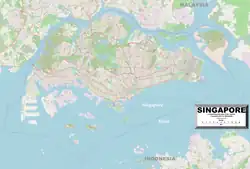
 Welcome to the Singapore Portal Welcome to the Singapore Portal .svg.png.webp) .jpg.webp) Map of Singapore Singapore (/ˈsɪŋ(ɡ)əpɔːr/ (
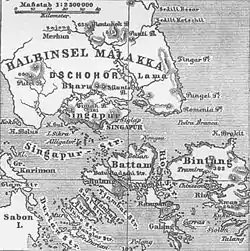
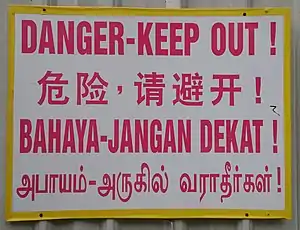
 listen)), officially the Republic of Singapore, is an island country and city-state in maritime Southeast Asia. It is located about one degree of latitude (137 kilometres or 85 miles) north of the equator, off the southern tip of the Malay Peninsula, bordering the Strait of Malacca to the west, the Singapore Strait to the south, the South China Sea to the east, and the Straits of Johor to the north. The country's territory is composed of one main island, 63 satellite islands and islets, and one outlying islet; the combined area of these has increased by 25% since the country's independence as a result of extensive land reclamation projects. It has the third highest population density in the world, although there are numerous green and recreational spaces as a result of urban planning. With a multicultural population and in recognition of the cultural identities of the major ethnic groups within the nation, Singapore has four official languages – English, Malay, Mandarin, and Tamil. English is the lingua franca, with its exclusive use in numerous public services. Multi-racialism is enshrined in the constitution and continues to shape national policies in education, housing, and politics. listen)), officially the Republic of Singapore, is an island country and city-state in maritime Southeast Asia. It is located about one degree of latitude (137 kilometres or 85 miles) north of the equator, off the southern tip of the Malay Peninsula, bordering the Strait of Malacca to the west, the Singapore Strait to the south, the South China Sea to the east, and the Straits of Johor to the north. The country's territory is composed of one main island, 63 satellite islands and islets, and one outlying islet; the combined area of these has increased by 25% since the country's independence as a result of extensive land reclamation projects. It has the third highest population density in the world, although there are numerous green and recreational spaces as a result of urban planning. With a multicultural population and in recognition of the cultural identities of the major ethnic groups within the nation, Singapore has four official languages – English, Malay, Mandarin, and Tamil. English is the lingua franca, with its exclusive use in numerous public services. Multi-racialism is enshrined in the constitution and continues to shape national policies in education, housing, and politics.
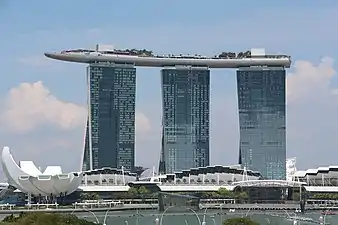
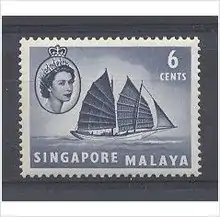
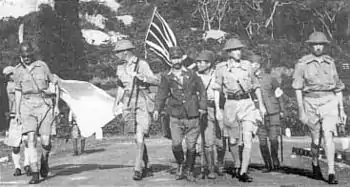
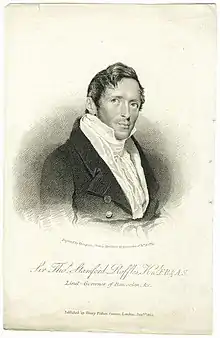
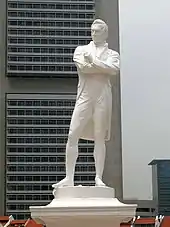
Singapore's history dates back at least a millennium, having been a maritime emporium known as Temasek and subsequently as a major constituent part of several successive thalassocratic empires. Its contemporary era began in 1819 when Stamford Raffles established Singapore as an entrepôt trading post of the British Empire. In 1867, the colonies in Southeast Asia were reorganised and Singapore came under the direct control of Britain as part of the Straits Settlements. During World War II, Singapore was occupied by Japan in 1942, and returned to British control as a separate Crown colony following Japan's surrender in 1945. Singapore gained self-governance in 1959 and in 1963 became part of the new federation of Malaysia, alongside Malaya, North Borneo, and Sarawak. Ideological differences, most notably the perceived encroachment of the egalitarian "Malaysian Malaysia" political ideology led by Lee Kuan Yew into the other constituent entities of Malaysia—at the perceived expense of the bumiputera and the policies of Ketuanan Melayu—eventually led to Singapore's expulsion from the federation two years later; Singapore became an independent sovereign country in 1965. After early years of turbulence and despite lacking natural resources and a hinterland, the nation rapidly developed to become one of the Four Asian Tigers. With its growth based on international trade and economic globalisation, it integrated itself with the world economy through free trade with minimal-to-no trade barriers or tariffs, export-oriented industrialisation, and the large accumulation of received foreign direct investments, foreign-exchange reserves, and assets held by sovereign wealth funds. A highly developed country, it has the second-highest GDP per capita (PPP) in the world. Identified as a tax haven, Singapore is the only country in Asia with a AAA sovereign credit rating from all major rating agencies. It is a major aviation, financial, and maritime shipping hub, and has consistently been ranked as one of the most expensive cities to live in for expatriates and foreign workers. Singapore ranks highly in key social indicators: education, healthcare, quality of life, personal safety, infrastructure, and housing, with a home-ownership rate of 88 percent. Singaporeans enjoy one of the longest life expectancies, fastest Internet connection speeds, lowest infant mortality rates, and lowest levels of corruption in the world. Singapore is a unitary parliamentary republic with a Westminster system of unicameral parliamentary government, and its legal system is based on common law. While the country is a multi-party democracy with free elections, the government under the People's Action Party (PAP) wields significant control and dominance over politics and society. The PAP has governed the country continuously since full internal self-government was achieved in 1959, with 83 out of 104 seats in Parliament as of the 2020 general election with 61.23% of the popular vote. One of the five founding members of ASEAN, Singapore is also the headquarters of the Asia-Pacific Economic Cooperation (APEC) Secretariat, the Pacific Economic Cooperation Council (PECC) Secretariat, and is the host city of many international conferences and events. Singapore is also a member of the United Nations (UN), World Trade Organization (WTO), East Asia Summit (EAS), Non-Aligned Movement (NAM), and the Commonwealth of Nations. (Full article...)Selected article -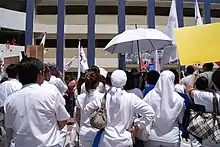 People's Action Party supporters at the nomination centre for Bukit Panjang Single Member Constituency and Holland-Bukit Timah Group Representation Constituency during the 2011 general election The right to vote in Singapore is not explicitly stated in Singapore's Constitution, but the Government has expressed the view that it may be inferred from the fact that Singapore is a representative democracy and from specific constitutional provisions, including Articles 65 and 66 which set out requirements for the prorogation and dissolution of Parliament and the holding of general elections. Speaking on the matter in Parliament in 2009, the Minister for Law, K. Shanmugam, said that the right to vote could not be a mere privilege as this would imply the existence of an institution superior to the body of citizens that is empowered to grant such a privilege, but that no such institution exists in a free country. In 1966 a Constitutional Commission chaired by Chief Justice Wee Chong Jin advocated entrenching the right to vote within the Constitution, but this was not taken up by the Parliament of the day. When this proposal was repeated during the 2009 parliamentary debate, the Government took the view that such entrenchment was unnecessary. In Taw Cheng Kong v. Public Prosecutor (1998), the High Court suggested on an obiter basis that voting is a privilege rather than a right. It has been suggested by law academic Thio Li-ann that, if called upon to decide the issue, the court might infer the existence of the right to vote in the Constitution from its text and structure, and from the fact that it is an adaptation of the Westminster system of democracy. If the right to vote were to be found to be implicit in the Constitution, the judiciary would be better able to protect the right when issues arise before the courts. (Full article...)Selected picture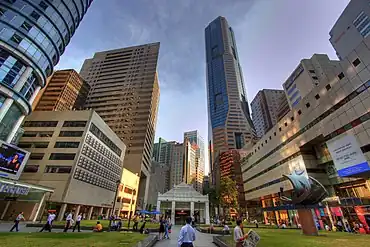 Raffles Place Raffles Place is a geographical location in Singapore, south of the mouth of the Singapore River. Located in the Downtown Core within the Central Area, it features some of the tallest buildings and landmarks of the country. Read more... General imagesThe following are images from various Singapore-related articles on Wikipedia.
Selected biography -
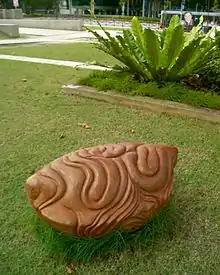
Han Sai Por (simplified Chinese: 韩少芙; traditional Chinese: 韓少芙; pinyin: Hán Shào Fú; born 19 July 1943) is a Singaporean sculptor. A graduate of the Nanyang Academy of Fine Arts (NAFA), East Ham College of Art, Wolverhampton College of Art (now the School of Art and Design of the University of Wolverhampton) and Lincoln University, New Zealand, she worked as a teacher and later as a part-time lecturer at NAFA, the LASALLE-SIA College of the Arts, and the National Institute of Education, Nanyang Technological University, before becoming a full-time artist in 1997. Han has participated in exhibitions locally and abroad, including events in China, Denmark, Japan, Malaysia, New Zealand and South Korea. Her first solo exhibition, entitled Four Dimensions, was held at the National Museum Art Gallery in 1993. Her sculptures can be found around the world, in Osaka and Shōdoshima, Kagawa Prefecture, in Japan; Kuala Lumpur and Sarawak in Malaysia; and Washington, D.C. In Singapore, sculptures commissioned from her can be seen at Capital Tower, the Defence Science Organisation National Laboratories, the Esplanade – Theatres on the Bay, the National Museum of Singapore, Revenue House, Singapore Changi Airport Terminal 3, Suntec City Mall, and Woodlands Regional Library. In 2001, Han was the founding President of the Sculpture Society (Singapore) and remains its Honorary President. She was the first artist in residence at the Society's Sculpture Pavilion at Fort Canning Park in 2009, where she worked on sculptures made from the trunks of tembusu trees. (Full article...)Did you know (auto-generated)
In this month
More did you know - A live adult Limicolaria flammea
Selected panoramaVivoCity (Chinese: 怡丰城) is the largest shopping mall in Singapore, located at the HarbourFront precinct . Opened on 7 October 2006, it marked the completion of the main structure by a topping-out ceremony on 18 April 2006 and was officially opened on December 1, 2006. Singapore topicsRelated portalsTasks Things you can do
CategoriesSelect [►] to view subcategories
 Singapore Central Business District Singapore Singapore-related lists Buildings and structures in Singapore Singaporean culture Economy of Singapore Education in Singapore Environment of Singapore Geography of Singapore Government of Singapore Health in Singapore History of Singapore Organisations based in Singapore People from Singapore Politics of Singapore Singaporean snack foods Society of Singapore Singapore stubs WikiprojectsRelated Wikiprojects:
 South East Asia South East AsiaAssociated WikimediaThe following Wikimedia Foundation sister projects provide more on this subject:
Discover Wikipedia using portals
| ||

.jpg.webp)
_by_Lieutenant_Philip_Jackson.jpg.webp)





%252C_St_Andrew's_Cathedral_--_2019_--_4534.jpg.webp)


.jpg.webp)