Portal:North Korea

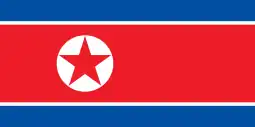
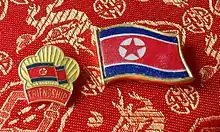
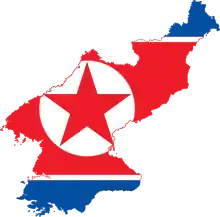 The North Korea Portal The North Korea PortalIntroductionNorth Korea, officially the Democratic People's Republic of Korea (DPRK), is a country in East Asia. It constitutes the northern half of the Korean Peninsula and borders China and Russia to the north at the Yalu (Amnok) and Tumen rivers, and South Korea to the south at the Korean Demilitarized Zone. North Korea's border with South Korea is a disputed border as both countries claim the entirety of the Korean Peninsula. The country's western border is formed by the Yellow Sea, while its eastern border is defined by the Sea of Japan. North Korea, like its southern counterpart, claims to be the legitimate government of the entire peninsula and adjacent islands. Pyongyang is the capital and largest city. In 1910, Korea was annexed by the Empire of Japan. In 1945, after the Japanese surrender at the end of World War II, Korea was divided into two zones along the 38th parallel, with the north occupied by the Soviet Union and the south occupied by the United States. Negotiations on reunification failed, and in 1948, separate governments were formed: the socialist and Soviet-aligned Democratic People's Republic of Korea in the north, and the capitalist, Western-aligned Republic of Korea in the south. The Korean War began in 1950, with an invasion by North Korea, and lasted until 1953. The Korean Armistice Agreement brought about a ceasefire and established a demilitarized zone (DMZ), but no formal peace treaty has ever been signed. Post-war North Korea benefited greatly from economic aid and expertise provided by other Eastern Bloc countries, particularly the Soviet Union and China. However, relations between North Korea and the Soviet Union soured after the ascension of Nikita Khrushchev to the Soviet premiership in 1953, as Khrushchev denounced Stalinism while Kim Il Sung, North Korea's first leader, upheld it. Kim briefly turned to China in the late 1950s before purging both pro-Soviet and pro-Chinese elements from the ruling Workers' Party of Korea and promoting his personal philosophy of Juche as the state ideology. From the 1970s, South Korea's economy began to boom whilst North Korea entered a state of stagnation. Pyongyang's international isolation sharply accelerated from the 1980s onwards as the Cold War came to an end and China opened up to the West. The fall of the Soviet Union in 1991 then brought about a full-scale collapse of the North Korean economy. From 1994 to 1998, North Korea suffered a famine that resulted in the deaths of between 240,000 and 420,000 people, and the population continues to suffer from malnutrition. According to Article 1 of the state constitution, North Korea is an "independent socialist state". It holds elections, though they have been described by independent observers as sham elections, as North Korea is a totalitarian dictatorship with a comprehensive cult of personality around the Kim family. The Workers' Party of Korea is the ruling party of North Korea and leads the Democratic Front for the Reunification of Korea, the sole legal political movement in the country. According to Article 3 of the constitution, Kimilsungism–Kimjongilism is the official ideology of North Korea. The means of production are owned by the state through state-run enterprises and collectivized farms. Most services – such as healthcare, education, housing, and food production – are subsidized or state-funded. (Full article...) Selected article -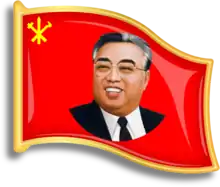 A Kim Il-sung badge Kim Il Sung and Kim Jong Il badges are lapel pins with portraits depicting either one or both of the Eternal Leaders of North Korea, Kim Il Sung and Kim Jong Il. The badges have been common since the late 1960s, and are produced by the Mansudae Art Studio. There are more than 20 different designs, some of which are more common than others. Common examples include red flag-shaped pins depicting either President Kim Il Sung or General Secretary Kim Jong Il, smaller circular pins with the same portraits on white backgrounds (often with silver or gold edging), and larger flag-shaped pins depicting both leaders. The badges were inspired by Chairman Mao badges worn by Chinese revolutionaries and citizens during the rule of Mao Zedong. Unlike their Chinese counterparts, which were never compulsory to wear, the North Korean badges have been an important part of North Korean attire for most of their history. As such, they are culturally more important than Mao badges ever were, and are a key part of North Korea's cult of personality. According to Jae-Cheon Lim, the badges are:(Full article...) Categories Category puzzle Select [►] to view subcategories
North Korea North Korea-related lists Buildings and structures in North Korea North Korean culture Economy of North Korea Education in North Korea Environment of North Korea Foreign charities operating in North Korea Geography of North Korea Government of North Korea Health in North Korea History of North Korea North Korean studies Organizations based in North Korea North Korean people Politics of North Korea Society of North Korea North Korea stubs Related portalsNorth Korea in the news
Selected image -
Korean People's Army copies of Russian BTR-80s on parade
Did you know (auto-generated)
More did you know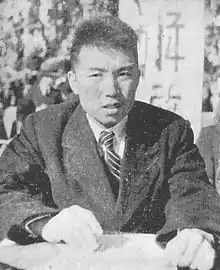 Kim Il-sung
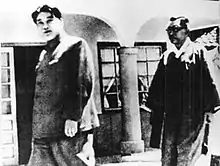
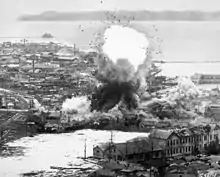
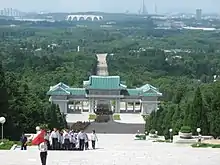
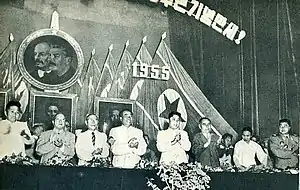
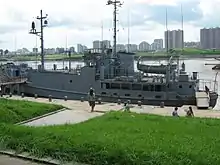
General images -The following are images from various North Korea-related articles on Wikipedia.
North Korea topicsThings you can do
Associated WikimediaThe following Wikimedia Foundation sister projects provide more on this subject:
Web resources
Notes Discover Wikipedia using portals
|