Portal:American Civil War

.svg.png.webp) |
.svg.png.webp) |
 The American Civil War Portal
.svg.png.webp)
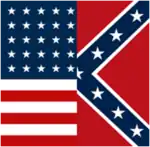
The American Civil War (1861–1865) was a sectional rebellion against the United States of America by the Confederate States, formed of eleven southern states' governments which moved to secede from the Union after the 1860 election of Abraham Lincoln as President of the United States. The Union's victory was eventually achieved by leveraging advantages in population, manufacturing and logistics and through a strategic naval blockade denying the Confederacy access to the world's markets.
In many ways, the conflict's central issues – the enslavement of African Americans, the role of constitutional federal government, and the rights of states – are still not completely resolved. Not surprisingly, the Confederate army's surrender at Appomattox on April 9,1865 did little to change many Americans' attitudes toward the potential powers of central government. The passage of the Thirteenth, Fourteenth and Fifteenth amendments to the Constitution in the years immediately following the war did not change the racial prejudice prevalent among Americans of the day; and the process of Reconstruction did not heal the deeply personal wounds inflicted by four brutal years of war and more than 970,000 casualties – 3 percent of the population, including approximately 560,000 deaths. As a result, controversies affected by the war's unresolved social, political, economic and racial tensions continue to shape contemporary American thought. The causes of the war, the reasons for the outcome, and even the name of the war itself are subjects of much discussion even today. (Full article)
Featured article
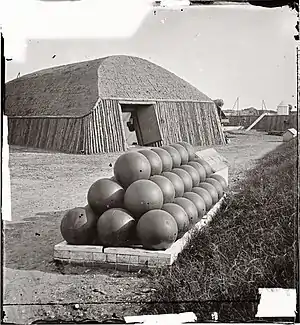 An ammunition magazine similar to those built at Fort Stanton. |
Fort Stanton was a Civil War-era fortification constructed in the hills above Anacostia in the District of Columbia, USA, and was intended to prevent Confederate artillery from threatening the Washington Navy Yard. It also guarded the approach to the bridge that connected Anacostia (then known as Uniontown) with Washington. Built in 1861, the fort was expanded throughout the war and was joined by two subsidiary forts: Fort Ricketts and Fort Snyder. Following the surrender of the Army of Northern Virginia, it was dismantled and the land returned to its original owner. It never saw combat. Abandoned after the war, the site of the fort was planned to be part of a grand "Fort Circle" park system encircling the city of Washington. Though this system of interconnected parks never was fully implemented, the site of the fort is today a park maintained by the National Park Service, and a historical marker stands near the fort's original location. (Full article...)
Grand Parade of the States

The area that eventually became the U.S. state of Montana played little direct role in the American Civil War. The closest the Confederate States Army ever came to the area was New Mexico and eastern Kansas, each over a thousand miles away. There was not even an organized territory using "Montana" until the Montana Territory was created on May 26, 1864, three years after the Battle of Fort Sumter. In 1861, the area was divided between the Dakota Territory and the Washington Territory, and in 1863, it was part of the Idaho Territory.
Nevertheless, Confederate sympathizers did have a presence in what is now the U.S. state of Montana. Those in the Montana Territory who supported the Confederate side were varied. Among them were Confederate sympathizers who were determined that some of Montana's gold would go into the Southern instead of Northern coffers. But most were those who would rather not fight in the war, which ranged from pure drifters to actual Confederate deserters. (Full article...)
Featured biography
 Portrait by Mathew Brady, c. 1870-1875 |
Andrew Johnson (December 29, 1808 – July 31, 1875) was the 17th president of the United States, serving from 1865 to 1869. He assumed the presidency following the assassination of Abraham Lincoln, as he was vice president at that time. Johnson was a Democrat who ran with Lincoln on the National Union Party ticket, coming to office as the Civil War concluded. He favored quick restoration of the seceded states to the Union without protection for the newly freed people who were formerly enslaved. This led to conflict with the Republican-dominated Congress, culminating in his impeachment by the House of Representatives in 1868. He was acquitted in the Senate by one vote.
Johnson was born into poverty and never attended school. He was apprenticed as a tailor and worked in several frontier towns before settling in Greeneville, Tennessee. He served as alderman and mayor there before being elected to the Tennessee House of Representatives in 1835. After briefly serving in the Tennessee Senate, Johnson was elected to the House of Representatives in 1843, where he served five two-year terms. He became governor of Tennessee for four years, and was elected by the legislature to the Senate in 1857. During his congressional service, he sought passage of the Homestead Bill which was enacted soon after he left his Senate seat in 1862. Southern slave states seceded to form the Confederate States of America, including Tennessee, but Johnson remained firmly with the Union. He was the only sitting senator from a Confederate state who did not resign his seat upon learning of his state's secession. In 1862, Lincoln appointed him as Military Governor of Tennessee after most of it had been retaken. In 1864, Johnson was a logical choice as running mate for Lincoln, who wished to send a message of national unity in his re-election campaign, and became vice president after a victorious election in 1864. (Full article...)
WikiProjects
- Military history WikiProject
- American Civil War task force
- United States military history task force
- United States WikiProject
- History WikiProject
- Biography WikiProject
Featured picture
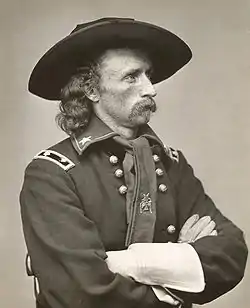 George Armstrong Custer, by George L. Andrews
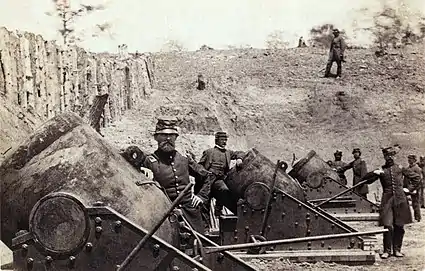 Siege of Yorktown, by James F. Gibson
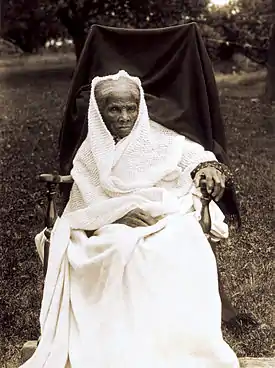
 Andersonville survivor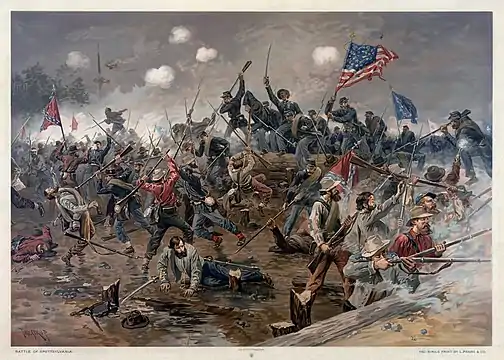

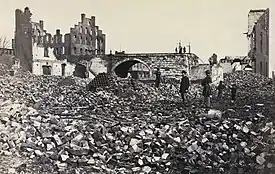 Richmond, Virginia after the American Civil War
 President Rutherford B. Hayes was the 19th President of the USA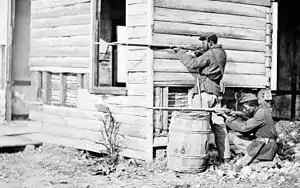
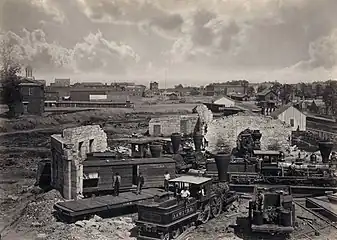 Atlanta roundhouse ruin at History of Atlanta, by George Barnard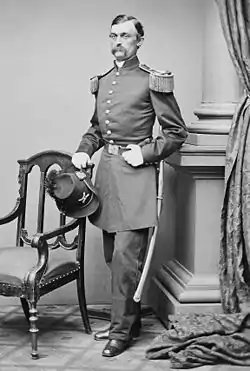
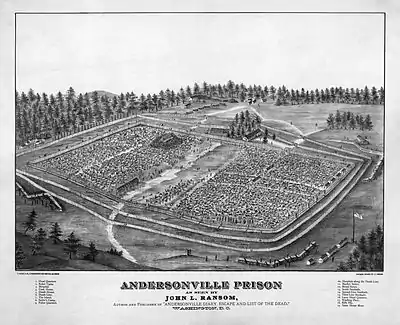 Andersonville Prison at Andersonville National Historic Site, by John L. Ransom
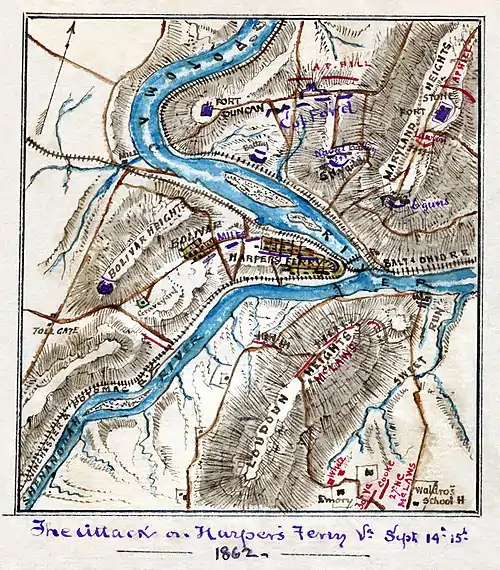
 Quaker guns, by George Barnard and James F. Gibson
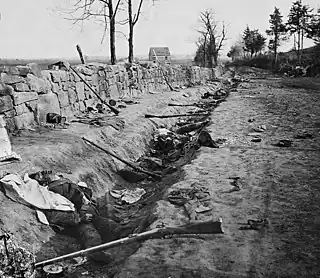 Confederate casualties at Chancellorsville during the American Civil War, by the National Archives and Records Administration
 The Chickahominy – Sumner's Upper Bridge at Peninsula campaign, by William McIlvaine
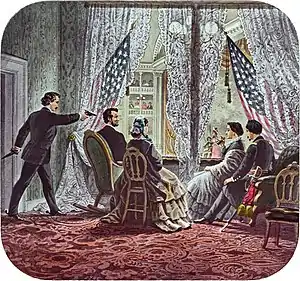
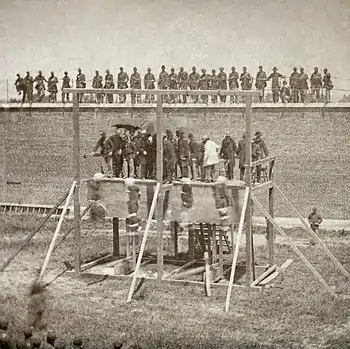 Military execution of the conspirators in the Abraham Lincoln assassination
.jpg.webp) Francis B. Spinola, Brigadier General for the Union in the American Civil War, and Congressman from New York
Francis B. Spinola, Brigadier General for the Union in the American Civil War, and Congressman from New York
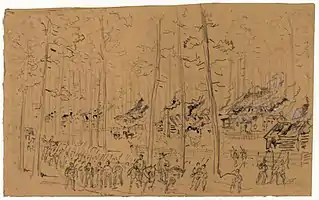 The original sketch of Sherman in South Carolina: The burning of McPhersonville, at and by William Waud

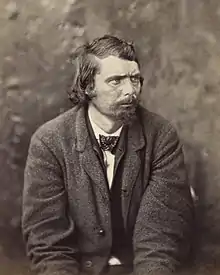

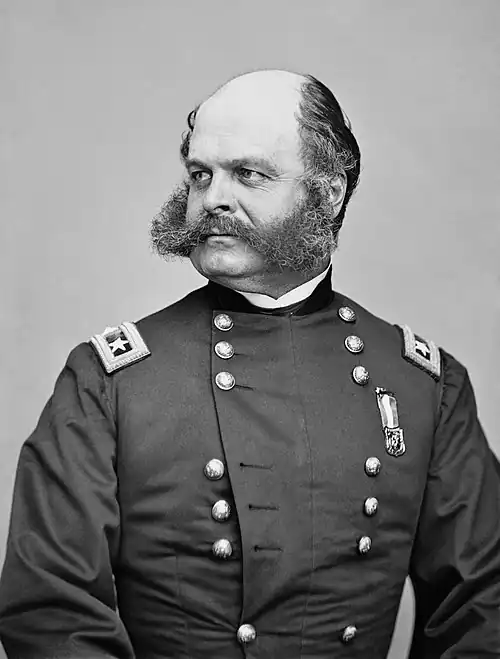
 Daniel McCallum, by the Brady National Photographic Art Gallery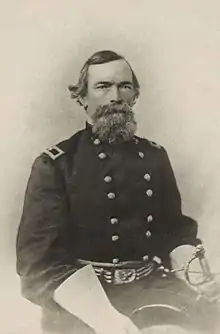

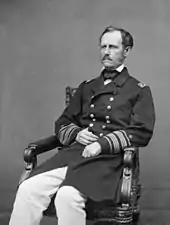
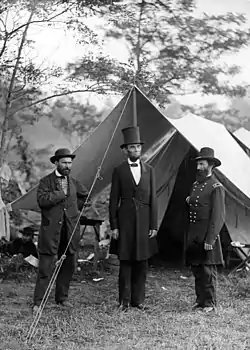 Allan Pinkerton, President Lincoln, and John A. McClernand in 1862 by Alexander Gardner
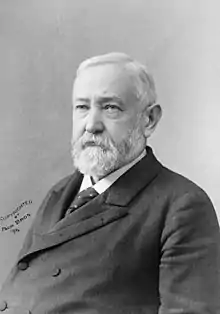 United States President (and former Brigadier-General) Benjamin Harrison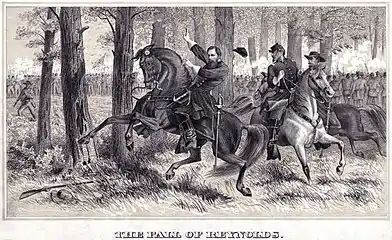
 The burning of Columbia at Columbia, South Carolina in the American Civil War, by William Waud
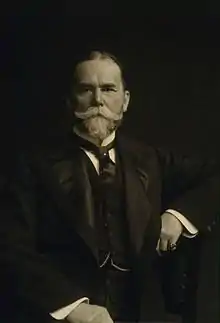 Abraham Lincoln's private secretary and biographer John Hay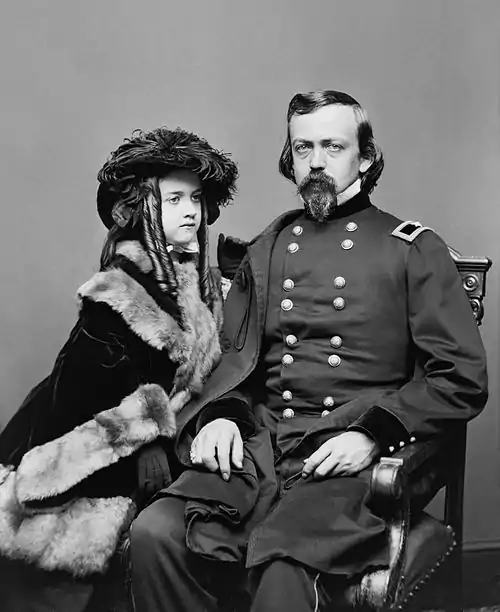

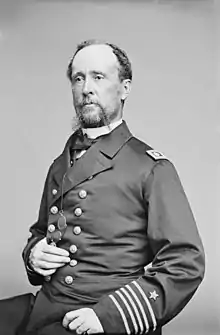

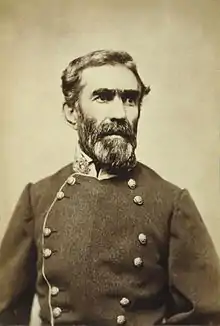
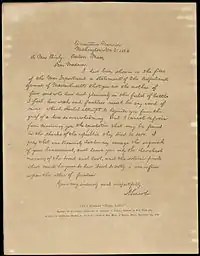 Lithographic facsimile of the Bixby letter, by Huber's Museum
 The print version of Sherman in South Carolina: The burning of McPhersonville at McPhersonville, South Carolina, by William Waud
Did you know...
- ... that Enoch Marvin Banks resigned from the University of Florida because of public outrage over his belief that the American Civil War was caused by slavery?
- ... that three high-ranking officers of USRC Robert McClelland remained with the ship after it surrendered and entered Confederate service?
- ... that according to one historian, James S. Rains made a "significant contribution to the Confederate war effort" by getting drunk?
- ... that Romeo and Juliet both served in the Union Navy?
- ... that Emma Dean Powell received a pass from General Ulysses S. Grant to accompany her husband to battlefield camps during the American Civil War after he lost his arm?
- ... that Byron Root Pierce was Michigan's last living Civil War general?
Subcategories
American Civil War topics

Related portals
Things you can do
- Attention needed
- ...to referencing and citation • ...to coverage and accuracy • ...to structure • ...to grammar • ...to supporting materials
- Popular pages
- Full list
- Cleanup needed
- The West Tennessee Raids
- Requested articles
- James Ashby (soldier) • Bluffton expedition • Benjamin D. Fearing • Charles A. Hickman • Richard Henry Jackson • James B. Speers • Charles S. Steedman • Battle of Barton's Station • Lawrence P. Graham • Thomas John Lucas • Daniel Henry Rucker • James Hughes Stokes • Frederick S. Sturmbaugh • Davis Tillson • Action at Nineveh (currently a redirect) • International response to the American Civil War • Spain and the American Civil War • Savannah Campaign Confederate order of battle • Native Americans in the American Civil War (currently disambiguation after deletion) • 1st Battalion, Mississippi Mounted Rifles (Union) • Battle of Lafayette • Requested American Civil War Medal of Honor recipients
- Expansion needed
- Battle of Boonsborough • Battle of Guard Hill • Battle of Rice's Station • Battle of Simmon's Bluff • Battle of Summit Point • Charleston Arsenal • Edenton Bell Battery • First Battle of Dalton • Blackshear Prison • Edwin Forbes • Hiram B. Granbury • Henry Thomas Harrison • Louis Hébert (colonel) • Benjamin G. Humphreys • Maynard Carbine • Hezekiah G. Spruill • Smith carbine • Edward C. Walthall • Confederate States Secretary of the Navy • Confederate States Secretary of the Treasury • David Henry Williams • Battle of Rome Cross Roads • Delaware in the American Civil War • Ironclad Board • United States Military Railroad • Kansas in the American Civil War • Rufus Daggett • Ebenezer Magoffin • Confederate Quartermaster-General's Department • First Corps, Army of Northern Virginia • Francis Laurens Vinton • Henry Maury • Other American Civil War battle stubs • Other American Civil War stubs
- Images needed
- Battle of Lone Jack • Preston Pond, Jr. • Melancthon Smith
- Merging needed
- 1st Regiment New York Mounted Rifles and 7th Regiment New York Volunteer Cavalry
- Citations needed
- 1st Alabama Cavalry Regiment (Union) • 4th Maine Battery • 33rd Ohio Infantry • 110th New York Volunteer Infantry • Battle of Hatcher's Run • Camp Dennison • Confederate colonies • CSS Resolute • Dakota War of 1862 • Florida in the American Civil War • Ethan A. Hitchcock (general) • Fort Harker (Alabama) • Gettysburg (1993 film) • Iowa in the American Civil War • Second Battle of Fort Sumter • Samuel Benton
- Translation needed
- Add an article here!
Associated Wikimedia
The following Wikimedia Foundation sister projects provide more on this subject:
-
 Commons
Free media repository -
 Wikibooks
Free textbooks and manuals -
 Wikidata
Free knowledge base -
 Wikinews
Free-content news -
 Wikiquote
Collection of quotations -
 Wikisource
Free-content library -
 Wikiversity
Free learning tools -
 Wikivoyage
Free travel guide -
 Wiktionary
Dictionary and thesaurus
-
 List of all portalsList of all portals
 -
 The arts portal
 -
 Biography portal
 -
 Current events portal
 -
 Geography portal
 -
 History portal
 -
 Mathematics portal
 -
 Science portal
 -
 Society portal
 -
 Technology portal
 -
 Random portalRandom portal
 -
 WikiProject PortalsWikiProject Portals
- Shortcuts to this page: Portal:ACW • P:ACW