Photochemical Factory "Foton", Bydgoszcz
The Foton factory in Bydgoszcz, Poland, was the first Polish producer,[1] from 1926 to 2007, of photosensitive material on photographic paper.
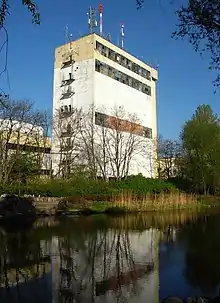 View of the factory building from the Five ponds valley ("Dolina Pięciu Stawów w Bydgoszczy") | |
| Type | Joint-stock company |
|---|---|
| Industry | Photographic paper |
| Founded | 1926 |
| Defunct | January 1, 2007, Bydgoszcz |
| Fate | Taken over |
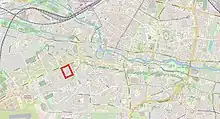
| Headquarters | 13 Piękna Street, Bydgoszcz , |
| Products | Photographic paper |
History
Interwar period, "ALFA" Company
Marian Dziatkiewicz (1890–1956) came from Witków near Gniezno. Educated as an engineer in Poznań, he bought in 1922, a factory of sweets and chocolate in Bygdoszcz, at 3 Garbary Street. He lived nearby at Kącik street.[2] In the mid-1920s, he closed down the factory and founded there in 1926, one of Poland's first firms of photochemical articles, named "ALFA". In his endeavour, he was backed by Tadeusz Cyprian, a lawyer, and an amateur in photography.
ALFA (Polish: Fabryka płyt, błon i papierów fotograficznych „Alfa") produced photographic plates, films, papers and chemicals.[3] The high quality of "Alfa" products brought the company recognition, despite the fierce competition of foreign companies.[4]
In the 1930s Marian received a government loan for the expansion of its factory: between 1933 and 1934 he had a new plant built at 13 Piekna street, which started operating circa 1938.[2] After this expansion, the panel of products increased together with their quality, which compared brands such as Kodak or Agfa.[4] In 1934, the factory produced the first lot of X-ray photographic films and X-ray papers, as well as "Kinopozytyw" batches for the Polish cinema industry.[4]
Marian Dziatkiewicz was hardworking, ambitious, and passionate. While increasing his production he actively popularized the art of photography, publishing advertising materials, guides, reference books, photography manuals, and a magazine presenting new products. In particular, he published 120,000 copies of a free textbook realized by his mentor Tadeusz Cyprian.[2]
At that time the firm had five machines producing photographic emulsion and manufactured annually 1,000,000 square metres (250 acres) of photo papers, and 30,000 square metres (7.4 acres) of photographic plates and films.[4] The Great Depression slightly affected the company, as it had no competitors in Poland. On the eve of WWII, the plant employed 300 people and was operating at full capacity.[5] In this period, Marian Dziatkiewicz had a representative office in Lviv (then in Poland). He also bought plots near Radom with the intention of building there a facility.[2]
German occupation
During the German occupation, the factory passed under Nazi rule and resumed production under the calling Fabrik Fotochemischer Erzeugnisse-"OPTA" ('Photochemical Products Factory-"Opta"').[6]
At the outbreak of the conflict, German representatives from the company "Agfa" inspected the plants in Bydgoszcz and were by surprised the quality of the polish products.[7]
Marian Dziatkiewicz then moved to Warsaw and spent the entire time of the war there.
Polish People's Republic (1947–1989)
In 1945, Dziatkiewicz regained his company back for a short time, as "ALFA", still located at 3 Garbary street, was soon nationalized and controlled by the state-owned enterprise "Film Polski" (Polish: Przedsiębiorstwo Państwowe Film Polski).[7] The engineer moved to Wrocław where he set up a firm producing a drug needed for stomach x-rays, but eventually, this business was also grabbed by the government. Marian Dziatkiewicz died in 1956.[2]
At the beginning of 1948, the company was renamed "FOTON".[7] It was then employing 188 people in Bydgoszcz, most of them were previous personnel from pre-war "ALFA".[8]
During this period the catalogue of products remained similar to pre-war times, including glass plates (e.g. "Omega", "Ultrapan"). It was still the only company in this industry in Poland: a second "FOTON" plant, based in Warsaw and heavily damaged by the war, was put back into operation in 1949. Since then, both "FOTON" facilities, in Bydgoszcz and Warsaw, get specialized: the Warsaw plant produced photosensitive materials for films (transparent substrate), while the Bydgoszcz plant dealt with papers, plates, and chemicals.[4]
In the 1950s "FOTON" was still using wooden machines from the "ALFA" period. In the 1970s, the entire production was moved from Garbary to Piękna street. The last manufacturing device from pre-war "ALFA" stopped working in the early 1980s.[7]
The "Bydgoskie Zakłady Fotochemiczne" output increased fourfold between 1950 and 1965, reaching annually:
- 4,500,000 square metres (1,100 acres) of photo papers;
- 900 tons of chemicals;
- 30,000 square metres (7.4 acres) of photo plates.
Later, the production relied on English technology, for which a license for industrial use was implemented in 1975.[9]
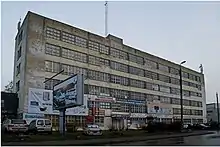
In 1969, to fulfill the license requirements, the factory was taken over by the Ministry of Chemical Industry and a new production complex was built at 13 Piękna Street in Szwederowo district, Bydgoszcz.[4] The building, although brand new, was equipped with old technology which dictated the lay out of the production line, where semi-finished materials had to flow down from above. This point explains the choice of the design for the edifice, similar to a skyscraper.[10]
In the mid-1960s, the Warsaw plant ceased producing color photographic materials and its manufacturing moved to Bydgoszcz, where the development of colored paper (called "Fotoncolor") was improved.[1] Furthermore, the company set up a laboratory in charge of processing materials for customers from all over Poland.[4]
"Bydgoskie Zakłady Fotochemiczne", together with the University of Technology in Wrocław (Phototechnical Department) successfully elaborated a native technology but its implementation was hampered by the lack of specialized machinery in Poland: at the time, this equipment could only be purchased from Western countries.[11]
In 1970 the company set up a new and experimental plant within Bydgoszcz's premises. Its aim was to meet the future needs of the Polish photochemical industry in terms of emerging technologies, as well as designing the associated producing devices. In 1973, the facility was expanded: eventually, its output increased fivefold.[4] By the end of the 1970s, "Bydgoskie Zakłady Fotochemiczne" laboratories formulated two types of negative films, "Foton Negatyw NB01" and "Foton Negatyw NB04", which were put on the Polish market in the 1980s.[1] Additionally, the manufacture of specialized products started, such as items for electrocardiography or tapes for train event recorders. In 1976, the plant employed about 900 employees, mostly women.[9]
"FOTON" facility in Bydgoszcz reached its peaked activity between 1960 and 1968. During this period, around 20% of its production was exported, mainly to India, Brazil, and Turkey. In the 1970s, purchasing countries were located in the Middle East, North Africa, and Central America. By and large, exports flourished till 1985:
- black and white photographic paper to the Soviet Union, Sweden, and the United States;
- color paper to Bulgaria;
- photographic film to Hungary, Yugoslavia, and Ecuador.
At the end of the 1980s, a significant amount of the production (i.e. color photography paper and processing chemicals) was earmarked for the Soviet market.[12]
Before the collapse of the USSR and the Polish People's Republic, Bydgoszcz's FOTON belonged to the "Union of the organic Industry Enterprises "Organika" (Polish: Zrzeszenie Przedsiębiorstw Przemysłu Organicznego „Organika") based in Warsaw.
Third Polish Republic (since 1989)
On 28 February 1992, the facility moved to the hands of the Polish State Treasury, as "FOTON SA".[9] In 1997, Foma Bohemia, a photographic company based in Hradec Králové, Czech Republic, acquired the majority of the company's shares.
Following the fall of the Communism in the 1990s and the ensuing economic turmoils, the plant experienced difficulties due to the contraction of the analog photography market. Nonetheless, the production of specialized materials (medical imaging, speed recorders) continued.[9]
When almost the entire market shifted to digital photography in the 21st century, "FOTON SA" could not adjust: on 1 January 2007, the company declared bankruptcy.[13] A similar fate befell the FOTON facility in Warsaw.
The same year, the commercial activity of "FOTON SA" was taken over by a new firm, "FOTON-BIS Sp. z o.o.", with headquarters located at 13 Piękna street in Bydgoszcz.
The "Bydgoszcz Museum of Photography" (Polish: Muzeum Fotografii w Bydgoszczy), established in 2004, keeps a large panel of "ALFA" and "FOTON" products, items, and paraphernalia in its collections.[14]
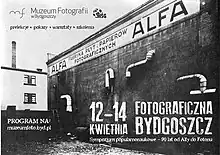
In April 2016 the museum organized a symposium on the occasion of the 90th anniversary of the setup of the company "ALFA".[15]
In October 2018 an exhibition titled "Women of FOTON" (Polish: Kobiety Fotonu) has been organized by the "Bydgoszcz Museum of Photography".[16]
Characteristics
Bydgoszcz "Foton" produces photographic papers with various emulsion sensitivities.[1] The plant is currently specialized in manufacturing:
- photographic paper (black and white or with various types and shades) for enlargements and contact copies, professional and registration documents;
- paper for color prints;
- diverse-purpose photographic plates;
- chemicals;
- photosensitive materials, photographic glass, darkroom filters, and positive film materials.
Gallery
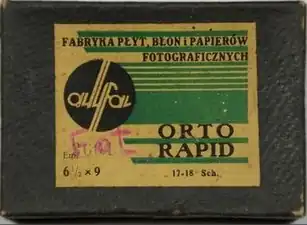 ALFA paper film
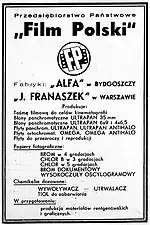 Advert for "Film Polski", a state-owned company which took over "ALFA" after WWII
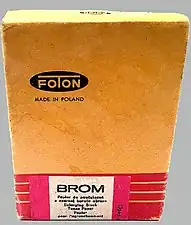 Brom paper film by "FOTON"
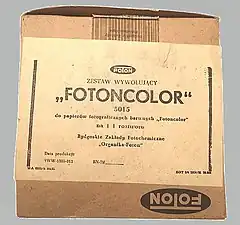 "Fotoncolor" product
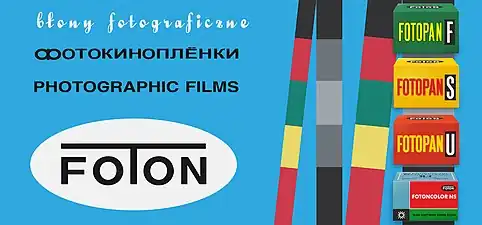 Advert for "FOTON" articles, ca 1980
See also

- Bydgoszcz
- (in Polish) Warszawskie Zakłady Fotochemiczne „Foton"
References
- Miszewski, David (2000). "Bydgoskie Zakłady Fotochemiczne". polskie-aparaty-fotograficzne. Archived from the original on 10 March 2017. Retrieved 16 October 2022.
- Zielazna, Jolanta (21 March 2007). "Cukierki, Alfa i cegielnia". pomorska.pl. Polska Press Sp. z o. o. Retrieved 22 October 2022.
- Nowości Fotograficzne. 1938, nr 2 (20). Bydgoszcz: „Alfa" Fabryka Płyt i Papierów Fotograficznych. 1938.
- Brakowski, Konrad (1973). Bez fotografii ani rusz... Kalendarz Bydgoski. Bydgoszcz: Towarzystwo Miłośników Miasta Bydgoszczy. pp. 154–158.
- Sudziński, Ryszard (1999). Życie gospodarcze Bydgoszczy w okresie II Rzeczypospolitej. Historia Bydgoszczy tom II część pierwsza 1920–1939. Bydgoszcz: Bydgoskie Towarzystwo Naukowe. pp. 77–176. ISBN 8390132907.
- Sudziński, Ryszard (2004). Życie gospodarcze Bydgoszczy w okresie II Rzeczypospolitej. Historia Bydgoszczy tom II część pierwsza 1939–1945. Bydgoszcz: Bydgoskie Towarzystwo Naukowe. pp. 235–273. ISBN 8392145402.
- Zielazna, Jolanta (20 June 2007). "Maszyny były drewniane". pomorska.pl. Polska Press Sp. z o. o. Retrieved 22 October 2022.
- Życie gospodarcze Bydgoszczy w okresie II Rzeczypospolitej. Historia Bydgoszczy tom II część pierwsza 1945–1955. Bydgoszcz: Bydgoskie Towarzystwo Naukowe. 2015. pp. 199–243. ISBN 9788360775448.
- Kamosiński, Sławomir (2015). Miasta przemysłowe dolnej Wisły. Historia polskich okręgów i rejonów przemysłowych. Tom I. Warszaw: Polskie Towarzystwo Historii Gospodarczej. p. 178. ISBN 9788394217013.
- Zielazna, Jolanta (30 December 2017). "Ponad 40 lat pracy w Fotonie w Bydgoszczy – wspomnienia". plus.pomorska.pl. Polska Press Sp. z.o.o. Retrieved 22 October 2022.
- Kamosiński, Sławomir (2007). Przemiany w technice i technologii produkcji. Sławomir Kamosiński, Mikroekonomiczny obraz przemysłu Polski Ludowej w latach 1950–1980 na przykładzie regionu kujawsko-pomorskiego. Poznań: Wydawnictwo Poznańskie. pp. 75–179. ISBN 9788371774201.
- Długosz, Jerzy (1995). Bydgoskie wyroby znane i cenione za granicą. Kalendarz Bydgoski. Bydgoszcz: Towarzystwo Miłośników Miasta Bydgoszczy. pp. 76–84.
- Widz11 (15 July 2015). "Bydgoskie Zakłady Fotochemiczne Foton". Bydgoskie Zakłady Fotochemiczne. Archived from the original on 1 December 2017. Retrieved 19 October 2022.
- "Muzeum Fotografii w Bydgoszczy". ludzieitechnika.pl. ludzieitechnika. 2014. Retrieved 22 October 2022.
- "Sympozjum z okazji jubileuszu 90-lecia fabryki "Alfa" w Muzeum Fotografii w Bydgoszczy". ludzieitechnika.pl. ludzieitechnika. 2016. Retrieved 22 October 2022.
- "Kobiety Fotonu". fotografistka.pl. Fundacja Fotografistka. 2022. Retrieved 22 October 2022.
Bibliography
- (in Polish) Brakowski, Konrad (1973). Bez fotografii ani rusz... Kalendarz Bydgoski. Bydgoszcz: Towarzystwo Miłośników Miasta Bydgoszczy. pp. 154–158.
- (in Polish) Czyńska, Małgorzata (2018). Kobiety Fotonu. Bydgoszcz: Farbiarnia. pp. 154–158. ISBN 9788395139307.
External links
- (in Polish) Bydgoskie Zakłady Fotochemiczne
- (in Polish) Bydgoszcz Museum of Photography
Companies in Bydgoszcz | ||
|---|---|---|
| Former companies |  | |
| Operating companies | ||