Klondike, Yukon
The Klondike (/ˈklɒndaɪk/; from Hän Tr'ondëk 'hammerstone water') is a region of the territory of Yukon, in northwestern Canada. It lies around the Klondike River, a small river that enters the Yukon River from the east at Dawson City.
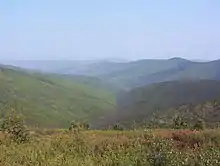
The area is merely an informal geographic region, and has no function to the territory as any kind of administrative region.
The Klondike is famed due to the Klondike Gold Rush, which started in 1896 and lasted until 1899. Gold has been mined continuously in that area, except for a pause in the late 1960s and early 1970s.
Climate
The climate is warm in the short summer, and very cold during the long winter. By late October, ice forms over the rivers. For the majority of the year, the ground is frozen to a depth of 1 to 3 metres (3 to 10 ft).[1]
Politics
Klondike is a district of the Legislative Assembly of Yukon. The current Premier of the Yukon, Liberal Sandy Silver, represents the electoral district of Klondike.
History
In mid-1901 an expedition left California hoping to prove that the Klondike was the site of the Biblical Garden of Eden! It was sponsored ($50,000) by Mr Morris K. Jessup; with an American naturalist (Norman Buxton) and two Russian scientists (Waldemar Bogaras and Waldemar Jochelson).[2][3]
As nothing further was heard from Mr Jessup it appears that the expedition was unsuccessful.
References
- Reynolds, Francis J., ed. (1921). . Collier's New Encyclopedia. New York: P. F. Collier & Son Company.
- "Notes (page down)". Papers Past (NZ). 1901.
- "Local and General (page down)". Papers Past (NZ). 1901.
Subdivisions of Yukon | |
|---|---|
| Municipalities | |
| Unorganized areas | |
| Communities (unincorporated) |
|
| Ghost towns | |
| Parks | |
| Regions | |
| |