José María Guido
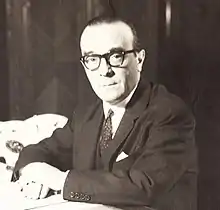
José María Guido (29 August 1910 – 13 June 1975) was President of Argentina, from 30 March 1962 to 12 October 1963.[1]
José María Guido | |
|---|---|
 | |
| President of Argentina | |
| In office 29 March 1962 – 12 October 1963 | |
| Vice President | None |
| Preceded by | Arturo Frondizi |
| Succeeded by | Arturo Umberto Illia |
| Provisional President of the Senate | |
| In office 31 March 1958 – 29 March 1962 | |
| Preceded by | Ramón Albariño |
| Succeeded by | Eduardo Gamond |
| National Senator | |
| In office 1 May 1958 – 29 March 1962 | |
| Constituency | Río Negro |
| Personal details | |
| Born | José María Guido Cibeira 29 August 1910 Buenos Aires, Argentina |
| Died | 13 June 1975 (aged 64) Buenos Aires, Argentina |
| Resting place | La Recoleta Cemetery, Buenos Aires, Argentina |
| Political party | Radical Civic Union |
| Spouse | Purificación Areal |
| Alma mater | National University of La Plata |
| Profession | Lawyer |
Biography
Early life
José María Guido was born in Buenos Aires on 20 August 1910 as one of the two sons of Italian immigrants J.M.E. Guido and Carmen Cibeda de Guido. He grew up in the capital's San Telmo barrio[2] and graduated from the University of La Plata law school in 1940.[3]
Political career
Prior to his involvement in politics, Guido worked as a provincial lawyer and was a member of the centrist Radical Civic Union (Unión Cívica Radical or UCR), the traditional party of Argentina's middle class. In 1946, he moved to Río Negro Province to work on developing the province's hydroelectric resources and became involved in UCR activity.[3]
Within a decade, Guido had become a national political figure. When the UCR split in 1956, he joined the Intransigent Radical Civic Union (Unión Cívica Radical Intransigente or UCRI) and as appointed to the party's Executive Committee secretariat.[3] In 1958, he was elected to the Argentine Senate representing Río Negro and was named Provisional President of the Senate, making him next in line for the Presidency following the resignation of Vice-President Alejandro Gómez in November 1958.[1]
Presidency
Guido ascended to the Presidency after the military deposed constitutionally elected President Arturo Frondizi on 29 March 1962. For over 12 hours after the military removed Frondizi from office, the Argentine Presidency was vacant as civilian leaders and their military allies worked to forestall the installation of a dictatorship. Since the Vice Presidency was also vacant due to Gómez's prior resignation, Guido, as Senate President was next in line under Article 75 of the Argentine Constitution and the 1868 law of succession (ley de acefalía). Guido was sworn in by the Supreme Court of Argentina, reportedly taking his oath on a copy of the Constitution to symbolize the preservation of constitutional procedure.[4]
Although nominally the head of a civilian administration, Guido was a "virtual captive"[5] of the armed forces during his nineteen months in office. A further complication was the split within the military between the Azules ("Blues"), also known as legalistas due to their support for a "legalist" transfer of power in accordance with the Constitution, and the Colorados ("Reds") who were eager to install a military dictator. The intense rivalry between the two factions culminated in violent confrontations in late 1962 and early 1963 that brought Argentina to the brink of civil war. The Azules emerged victorious in the ensuing battles, enabling Guido to remain in office and paving the way for the return to constitutional government through the July 1963 election that brought Arturo Umberto Illía of the Popular Radical party (Unión Cívica Radical del Pueblo or UCRP) to power.
Economic record and policy
In the final years of the Frondizi administration, the Argentine economy had recovered from the economic crisis of 1959 but continued to face high inflation (by historical standards) and balance of payments deficits due to poor harvests and an overvalued currency. By March 1962, foreign exchange reserves had fallen to USD $125 million, a 70% decrease from twelve months earlier.[6] Pressured by the military and agrarian interests, Guido appointed Álvaro Alsogaray as Minister of the Economy. Alsogaray had implemented an orthodox stabilization program under Frondizi and proceeded to enact a similarly restrictive agenda marked by fiscal austerity, tighter monetary and credit policies, and removal of foreign exchange controls. Determined to avoid deficit monetization at all costs, Alsogaray was responsible for a policy where government employees and contractors were paid in bonds rather than cash; recipients who sold their bonds were typically forced to take a discount of up to 40%.[6]
The result was a severe two-year recession. Real GDP decreased by -1.6% in 1962 and -2.4% in 1963. Due to a 59% devaluation of the peso and a reduction in subsidies for public services, the inflation rate accelerated from 13.5% in 1961 to 28.1% in 1962 and 26.0% in 1963. Despite austerity measures, depressed tax revenues meant that the budget deficit increased from 5.6% of GDP in 1961 to 7.9% in 1962 and 5.8% in 1963.[6] Urban unemployment reached 8.8% in July 1963, a level that would not be exceeded for thirty years. However, the stabilization program succeeded in its primary goal of averting a balance of payments crisis. Foreign exchange reserves increased to USD $320 million by the end of 1963.[7]
References
- Lentz, Harris M. (4 February 2014). Heads of States and Governments Since 1945. Routledge. p. 1888. ISBN 978-1-134-26497-1.
- Colas, Hector Jorge (31 March 2020). "José María Guido, el primer presidente patagónico". Editorial Río Negro. Retrieved 19 May 2023.
- "Argentina's Quiet Chief; Jose Maria Guido". timesmachine.nytimes.com. 3 April 1963. Retrieved 11 November 2022.
- Potash, Robert A. (1996). The Army & Politics in Argentina 1962-1973: From Frondizi's Fall to the Peronist Restoration. Stanford University Press. ISBN 0-8047-2414-8.
- Snow, Peter G. (1965). "Parties and Politics in Argentina: The Elections of 1962 and 1963". Midwest Journal of Political Science. 9 (1): 1–36 – via JSTOR.
- di Tella, Guido (1989). The Political Economy of Argentina, 1946-83. London: Macmillan Press. pp. 129–146. ISBN 0-333-44158-3.
- Sourrouille, Juan; Mallon, Richard D. (1975). Economic Policymaking in a Conflict Society: The Argentine Case. Cambridge: Harvard University Press. ISBN 0-674-22930-4.

| May Revolution and Independence War Period up to Asamblea del Año XIII (1810–1814) |  Flag of Argentina | |
|---|---|---|
| Supreme directors of the United Provinces of the Río de la Plata (1814–1820) | ||
| Unitarian Republic – First Presidential Government (1826–1827) | ||
| Pacto Federal and Argentine Confederation (1827–1862) | ||
| National Organization – Argentine Republic (1862–1880) | ||
| Generation of '80 – Oligarchic Republic (1880–1916) | ||
| First Radical Civic Union terms, after secret ballot (1916–1930) | ||
| Infamous Decade (1930–1943) | ||
| Revolution of '43 – Military Dictatorships (1943–1946) | ||
| First Peronist terms (1946–1955) | ||
| Revolución Libertadora – Military Dictatorships (1955–1958) | ||
| Fragile Civilian Governments – Proscription of Peronism (1958–1966) | ||
| Revolución Argentina – Military Dictatorships (1966–1973) | ||
| Return of Perón (1973–1976) | ||
| National Reorganization Process – Military Dictatorships (1976–1983) | ||
| Return to Democracy (1983–present) | ||