Iceland national football team
 | |||
| Nickname(s) | Strákarnir okkar (Our Boys) | ||
|---|---|---|---|
| Association | Knattspyrnusamband Íslands (KSÍ) | ||
| Confederation | UEFA (Europe) | ||
| Head coach | Åge Hareide[1] | ||
| Captain | Aron Gunnarsson | ||
| Most caps | Birkir Bjarnason (113) | ||
| Top scorer | Eiður Guðjohnsen Kolbeinn Sigþórsson (26) | ||
| Home stadium | Laugardalsvöllur | ||
| FIFA code | ISL | ||
| |||
| FIFA ranking | |||
| Current | 64  1 (6 April 2023)[2] 1 (6 April 2023)[2] | ||
| Highest | 18 (February–March 2018) | ||
| Lowest | 131 (April–June 2012) | ||
| First international | |||
Unofficial Faroe Islands 0–1 Iceland Faroe Islands 0–1 Iceland  (Tórshavn, Faroe Islands; 29 July 1930)[3] Official Iceland 0–3 Denmark  (Reykjavík, Iceland; 17 July 1946)[4] | |||
| Biggest win | |||
| Unofficial Iceland 9–0 Faroe Islands (Keflavík, Iceland; 10 July 1985)[5] Official  Liechtenstein 0–7 Iceland Liechtenstein 0–7 Iceland (Vaduz, Liechtenstein; 26 March 2023) | |||
| Biggest defeat | |||
| Denmark 14–2 Iceland (Copenhagen, Denmark; 23 August 1967) | |||
| World Cup | |||
| Appearances | 1 (first in 2018) | ||
| Best result | Group stage (2018) | ||
| European Championship | |||
| Appearances | 1 (first in 2016) | ||
| Best result | Quarter-finals (2016) | ||





The Iceland national football team (in Icelandic: Íslenska karlalandsliðið í knattspyrnu) represents Iceland in men's international football. The team is controlled by the Football Association of Iceland, and have been a FIFA member since 1947 and a UEFA member since 1957. The team's nickname is Strákarnir okkar, which means Our Boys in Icelandic.
The team has enjoyed success in the second half of the 2010s. In the qualifying rounds for the 2014 FIFA World Cup, Iceland reached the playoffs before losing to Croatia. Iceland reached its first major tournament, UEFA Euro 2016, after a qualification campaign which included home and away wins over the Netherlands. After advancing to the knockout stages of Euro 2016, Iceland defeated England in the Round of 16, advancing to the quarter-finals, where they lost to host nation France 5–2. They became the smallest nation by population to ever clinch a FIFA World Cup berth when they qualified for the 2018 tournament on 9 October 2017.[6] They drew with Argentina in their opening match, but nonetheless still went out in the group stage.[7][8]
History
20th century
Although Úrvalsdeild, the Icelandic Football League, was founded in 1912,[9] the country's first international match was played on 29 July 1930, against the Faroe Islands.[10] Although Iceland won 1–0 away, both teams were at the time unaffiliated with FIFA.[11] The first match officially recognised by FIFA took place in Reykjavík on 17 July 1946, a 0–3 loss to their future rivals Denmark.[12] The first international victory was against Finland in 1947.[13] For the first 20 years of the Football Association of Iceland (KSÍ)'s existence, the team mostly did not participate in qualifying for the FIFA World Cup or the UEFA European Championship. In 1954, Iceland applied to take part in qualification for the 1954 World Cup, but the application was rejected.[10] In qualification for the 1958 World Cup, Iceland finished last in their group with zero wins, conceding 26 goals.[10]
In 1980, Iceland won the first edition of the friendly tournament known as the Greenland Cup.[14]
Since 1974, the team has taken part in qualifying for every World Cup and European Championship. In 1994, the team reached their then best ever position in the FIFA World Rankings, 37th. This record stood until 2016 when they managed to reach 21st.[15] In a friendly against Estonia on 24 April 1996 in Tallinn, Eiður Smári Guðjohnsen entered as a substitute for his father Arnór. This marked the first time that a father and son played in the same international match.[16]
21st century
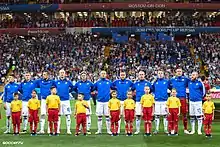
In qualification for Euro 2004, Iceland finished third in their group, one point behind Scotland.[17] As a result, they failed to qualify for a playoff spot.[18]
However, the following qualifying campaigns will be much more difficult for Iceland which will flirt with the last places of its respective groups, in particular during the Euro 2008 qualifiers where despite two unexpected successes against Northern Ireland (3–0 in the opening away, 2–1 at home in the return) and a heroic resistance in the first and second leg against the Spanish future winners of the competition (a 1–1 draw at home after having led the score and a short 0–1 defeat away), Our boys suffered several other heavy defeats, including two against Latvia, who had qualified for Euro 2004 as a surprise (0–4 away, 2–4 home), and one against Liechtenstein (0–3 away, after a 1–1 home draw).
The reasons for the lack of results of the selection were due to the absence of professionals on the island, the Icelanders played soccer for fun. Moreover, the hostile climate where winter lasts 8 months did not help the development of the sport, there were only two synthetic fields forcing the footballers to train on the gravel or in the snow. In the 2000s, Icelandic soccer will experience a real revolution. The economic boom will allow the authorities to create important structures with indoor pitches in synthetic turf, which results in the practice of soccer all year round without worrying about the weather conditions outside. These new structures encourage young people to turn to sports and even lead to a decrease in alcohol and tobacco consumption among teenagers.[19]
In 2014, Iceland almost secured qualification for their first World Cup.[20] Finishing second in Group D, they played Croatia in a two-leg playoff for qualification.[21][22] After holding them to a 0–0 draw in the home leg, they lost 2–0 away.[23]
Euro 2016
Iceland qualified for a major tournament for the first time in 2015 after finishing second in Group A of qualification for Euro 2016, losing only two games, and beating the Netherlands – which had finished third in the 2014 World Cup – twice.[24] During the qualification, they reached their then highest ranking in the FIFA World Rankings, 23rd.[25][26] Iceland were drawn into a group with Portugal, Hungary and Austria for the final tournament.
At the tournament finals, Iceland recorded 1–1 draws in their first two group stage matches against Portugal and Hungary. They then advanced from their group with a 2–1 victory against Austria.[27] Iceland qualified for the tournament's quarter-finals after a 2–1 upset win over England in the Round of 16, which led to England manager Roy Hodgson resigning in disgrace immediately after the final whistle.[28] However, they were eliminated by host nation France in the quarter-finals, 5–2.[29]

2018 World Cup
Iceland qualified for the 2018 World Cup, their first ever appearance in the world championship, securing qualification on 9 October 2017 after a 2–0 win against Kosovo. In doing so, they became the lowest-populated country ever to reach the finals.[30] Iceland were drawn to play Croatia, Argentina and Nigeria in a group that was considered by many as the "group of death".[31][32] Despite a challenging group, Iceland were tipped to advance from the group by several journalist websites, based on their impressive performance in Euro 2016.[33] Their maiden match at the World Cup was against 2014 runners-up Argentina, with Iceland surprisingly holding Argentina to a 1–1 draw.[34][35] However, their chances of advancing from the group were hurt following a 2–0 loss to Nigeria, with several missed opportunities in the first half and a penalty kick in the second half missed by Gylfi Sigurdsson, putting Iceland to play with full determination against already qualified Croatia.[36][37] Iceland lost to Croatia in their final group game; and because Argentina won against Nigeria, Iceland finished bottom of the group with just a point.[38][39]
2018–19 UEFA Nations League
After Euro 2016 and the 2018 World Cup, Iceland participated in the 2018–19 UEFA Nations League, in which they were in Group 2 of League A with Switzerland and Belgium. Many of Iceland's international matches in this competition were undermined by the repeated absence of some of their key players, often due to injury. Iceland lost all four games and faced relegation to League B,[40] but due to a rule change by UEFA, Iceland was not relegated to League B for the 2020–2021 edition.
Euro 2020 qualifiers
In group H of the Euro qualifiers with the world champions France, Turkey, Albania, Andorra and Moldova. Iceland lost both confrontations against Les Bleus (4–0 at the Stade de France and 1–0 at home on a penalty kick after the hour of play at the end of a tight game) and the away match against Albania 4–2, though achieved a win and a draw against Turkey. Iceland finished third behind France and Turkey and advanced to the playoffs, where they defeated Romania 2–1. On 12 November 2020, in their playoff game against Hungary, Iceland nearly secured qualification for Euro 2020, having led 1–0 for most of the match, thanks to a direct free kick by Gylfi Sigurðsson. However, Hungary scored two goals in under five minutes, the first in the 88th minute by Loïc Nego and the second in the second minute of added time by Dominik Szoboszlai, proving to be the winner, thereby securing qualification at Iceland's expense.[41]
Iceland had also suffered poor results in their UEFA Nations League campaign in League A, having lost all their group stage matches and failing to garner a single point, resulting in their relegation to League B the following season.[42] Manager Erik Hamrén ultimately resigned, following their poor performance that year.[43]
2022 World Cup qualifiers
Iceland also had a poor start to 2022 World Cup qualifiers, suffering two defeats at the beginning of the tournament, away against Germany (0–3) and Armenia (0–2). Preparation for the September games, where Iceland had the advantage of playing all three games at home after several away games and had played some encouraging friendlies in June, was disrupted by extra-sporting affairs involving both Kolbeinn Sigþórsson and Gylfi Sigurðsson accused of sexual offences[44][45] and thus absent from the month's games. The cases also led to the resignation of several senior officials of the Icelandic Football Association, including its president.[46] In the aftermath of these affairs, Iceland lost against Romania (0–2), drew against North Macedonia (2–2), and suffered a heavy loss against Germany (0–4); these results left Iceland in second-to-last place in Group J with four matches remaining. In the two October games, Iceland drew against Armenia (1–1) and defeated Liechtenstein (4–0). Despite these results, along with an away draw against Romania (0–0), Iceland was mathematically eliminated with one day remaining, being unable to recover enough points to reach second place.
This run of poor results has been attributed to several factors, both sporting and extra-sporting: the late generational renewal, a process partly hampered by a limited pool of footballers due to Iceland's demographics; the questionable tactical choices of the new coach, resulting in a lack of automatism among new players who are not used to playing together and the absence of a real standard team; and sexual assault scandals that have effectively sidelined some of the team's best players under investigation.[47][48]
Team image

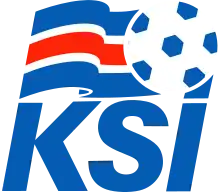
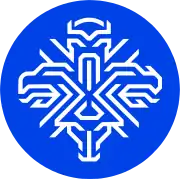
The national team uses a blue as the home colours and white as their second colours but their crest featuring stylized imagery of Iceland's four "guardian spirits" (Landvættir) in local folklore; a giant, a dragon, a bull, and an eagle. The team's crest was adopted in 2020 and was designed by Reykjavík-based firm Bradenburg. Previously the team used a team crest which features a shield-type symbol which consist the abbreviation of the Football Association of Iceland in Icelandic (KSI), strips which derives colors from the Flag of Iceland, and a football.[49][50]
Iceland's supporters became known for using Viking Thunder Clap chant in the mid-2010s, which involves fans clapping their hands above their heads and yelling "huh!" to the beat of a drum; the tradition originates from Scottish club Motherwell F.C. Iceland's Viking Clap first received wider international attention during the Euro 2016.[51]
Kit providers
The official kit is produced by German sports manufacturing company Puma since 2020. Before that the kit providers were Umbro (1975), Adidas (1976–1992), ABM (1992–1996), Reusch (1996–2001) and Erreà (2002–2020)
| Kit provider | Period |
|---|---|
 Umbro Umbro |
1975 |
 Adidas Adidas |
1976–1991 |
 ABM ABM |
1992–1996 |
| Reusch |
1996–2001 |
| Erreà |
2002–2020 |
| Puma |
2020– |
Results and fixtures
The following is a list of match results in the last 12 months, as well as any future matches that have been scheduled.
Win Draw Loss Fixture
2022
| 2 June 2022 2022–23 UEFA Nations League | Israel  | 2–2 | Iceland | Haifa, Israel |
| 18:45 (21:45 UTC+3) | Report |
|
Stadium: Sammy Ofer Stadium Attendance: 13,150 Referee: Andris Treimanis (Latvia) |
| 6 June 2022 2022–23 UEFA Nations League | Iceland | 1–1 |  Albania Albania | Reykjavík, Iceland |
| 20:45 (18:45; UTC±0) | Þorsteinsson  49' 49' |
Report | Seferi 30' |
Stadium: Laugardalsvöllur Attendance: 4,033 Referee: Craig Pawson (England) |
| 9 June 2022 Friendly | San Marino  | 0–1 | Iceland | Serravalle, San Marino |
| 20:45 UTC+2 | Report |
|
Stadium: Stadio Olimpico di Serravalle Referee: Michael Fabbri (Italy) |
| 13 June 2022 2022–23 UEFA Nations League | Iceland | 2–2 | Israel | Reykjavík, Iceland |
| 18:45 (21:45 UTC+3) |
|
Report |
|
Stadium: Laugardalsvöllur Attendance: 2,778 Referee: Duje Strukan (Croatia) |
| 22 September 2022 Friendly | Venezuela .svg.png.webp) | 0–1 | Iceland | Mödling, Austria |
| 18:00 UTC+2 |
|
Stadium: Motion invest Arena Referee: Sebastian Gishamer (Austria) |
| 27 September 2022 2022–23 UEFA Nations League | Albania | 1–1 | Iceland | Tirana, Albania |
| 20:45 UTC+2 | Ermir Lenjani 35' |
Report | Mikael Anderson 90+7' |
Stadium: Arena Kombëtare Attendance: 8,800 Referee: Ricardo de Burgos (Spain) |
| 6 November 2022 Friendly | Saudi Arabia  | 1–0 | Iceland | Abu Dhabi, United Arab Emirates |
| 16:00 UTC+4 | Abdulhamid 26' |
Report | Stadium: Mohammed bin Zayed Stadium Referee: Ahmed Eisa Darwich (United Arab Emirates) |
| 11 November 2022 Friendly | South Korea  | 1–0 | Iceland | Hwaseong, South Korea |
| 20:00 UTC+9 |
|
Report | Stadium: Hwaseong Stadium Attendance: 15,274 Referee: Jumpei Iida (Japan) |
| 16 November 2022 Baltic Cup Semi-final | Lithuania  | 0–0 (5–6 p) | Iceland | Vilnius, Lithuania |
| Report | Stadium: LFF Stadium | |||
| Penalties | ||||


| 19 November 2022 Baltic Cup Final | Latvia  | 1–1 (7–8 p) | Iceland | Riga, Latvia |
| 16:00 UTC+2 | Cigaņiks 67' |
Report | Jóhannesson 62' (pen.) |
Stadium: Daugavas stadions Referee: Joonas Jaanovits (Estonia) |
| Penalties | ||||
2023
| 8 January 2023 Friendly | Iceland | 1–1 |  Estonia Estonia | Albufeira, Portugal |
| A. Guðjohnsen 90+1' (pen.) |
Zenjov 45' |
Stadium: Estadio da Nora |
| 12 January 2023 Friendly | Sweden  | 2–1 | Iceland | Algarve, Portugal |
| E. Andersson 85' Ondrejka 90+4' |
S. Guðjohnsen 30' |
Stadium: Estádio Algarve |
| 23 March 2023 UEFA Euro 2024 qualifying | Bosnia and Herzegovina  | 3–0 | Iceland | Zenica, Bosnia and Herzegovina |
| 20:45 | Krunić 14', 40' Dedić 63' |
Report | Stadium: Bilino Polje Attendance: 9,234 Referee: Donatas Rumšas (Lithuania) |
| 26 March 2023 UEFA Euro 2024 qualifying | Liechtenstein | 0–7 | Iceland | Vaduz, Liechtenstein |
| 18:00 | Report | Ólafsson 3' Haraldsson 38'Gunnarsson 48', 68', 73' (pen.)A. Guðjohnsen 85'Ellertsson 87' |
Stadium: Rheinpark Stadion Attendance: 1,692 Referee: Jakob Kehlet (Denmark) |
| 17 June 2023 UEFA Euro 2024 qualifying | Iceland | v |  Slovakia Slovakia | Reykjavík, Iceland |
| 20:45 (18:45 UTC±0) | Report | Stadium: Laugardalsvöllur |
| 20 June 2023 UEFA Euro 2024 qualifying | Iceland | v |  Portugal Portugal | Reykjavík, Iceland |
| 20:45 (18:45 UTC±0) | Report | Stadium: Laugardalsvöllur |
| 8 September 2023 UEFA Euro 2024 qualifying | Luxembourg  | v | Iceland | Luxembourg City, Luxembourg |
| 20:45 | Report | Stadium: Stade de Luxembourg |
| 11 September 2023 UEFA Euro 2024 qualifying | Iceland | v | Bosnia and Herzegovina | Reykjavík, Iceland |
| 20:45 (18:45 UTC±0) | Report | Stadium: Laugardalsvöllur |
| 13 October 2023 UEFA Euro 2024 qualifying | Iceland | v | Luxembourg | Reykjavík, Iceland |
| 20:45 (18:45 UTC±0) | Report | Stadium: Laugardalsvöllur |
| 16 October 2023 UEFA Euro 2024 qualifying | Iceland | v | Liechtenstein | Reykjavík, Iceland |
| 20:45 (18:45 UTC±0) | Report | Stadium: Laugardalsvöllur |
| 16 November 2023 UEFA Euro 2024 qualifying | Slovakia | v | Iceland | Trnava, Slovakia |
| 20:45 | Report | Stadium: Štadión Antona Malatinského |
Coaching staff
| Position | Name |
|---|---|
| Head coach |  Åge Hareide Åge Hareide |
| Assistant coach | Joey Guðjónsson |
| Technical advisor | Bjarni Jakobsson |
| Training coach | Birkir Eyjólfsson |
| Fitness coach | Ari Þór Örlygsson |
| First-Team Doctor | Jóhannes Rúnarsson |
| Goalkeeper coach | Halldór Björnsson |
| Athletic coach | Arnór Snær Guðmundsson |
| Physiotherapist | Sverrir Sigþórsson |
| Advisor | Lars Lagerback |
Players
Current squad
The following players were called up for the UEFA Euro 2024 qualifying matches against Bosnia and Herzegovina and Liechtenstein on 23 March and 26 March 2023 respectively.[56]
Caps and goals are correct as of 26 March 2023, after the match against Liechtenstein.[57][58]
Recent call-ups
The following players have been called up to the Iceland squad in the last 12 months.
| Pos. | Player | Date of birth (age) | Caps | Goals | Club | Latest call-up |
|---|---|---|---|---|---|---|
| GK | Elías Rafn Ólafsson | 11 March 2000 | 4 | 0 | Midtjylland |
v. Bosnia and Herzegovina, 23 March 2023 INJ |
| GK | Frederik Schram | 19 January 1995 | 7 | 0 | Valur |
v. Sweden, 12 January 2023 |
| GK | Sindri Kristinn Ólafsson | 19 January 1997 | 0 | 0 | FH |
v. South Korea, 11 November 2022 |
| GK | Ingvar Jónsson | 18 October 1989 | 8 | 0 | Víkingur Reykjavík |
v. San Marino, 9 June 2022 INJ |
| DF | Sverrir Ingi Ingason | 5 August 1993 | 40 | 3 |  PAOK PAOK |
v. Bosnia and Herzegovina, 23 March 2023 INJ |
| DF | Höskuldur Gunnlaugsson | 26 September 1994 | 8 | 0 | Breiðablik |
v. Sweden, 12 January 2023 |
| DF | Damir Muminovic | 13 May 1990 | 6 | 0 | Breiðablik |
v. Sweden, 12 January 2023 |
| DF | Valgeir Lunddal Friðriksson | 24 September 2001 | 5 | 0 | Häcken |
v. Sweden, 12 January 2023 |
| DF | Róbert Orri Þorkelsson | 3 April 2002 | 4 | 0 | .svg.png.webp) Montréal Montréal |
v. Sweden, 12 January 2023 |
| DF | Hörður Ingi Gunnarsson | 14 August 1998 | 2 | 0 | Sogndal |
v. South Korea, 11 November 2022 |
| DF | Logi Tómasson | 13 September 2000 | 2 | 0 | Víkingur Reykjavík |
v. South Korea, 11 November 2022 |
| DF | Rúnar Þór Sigurgeirsson | 28 December 1999 | 2 | 0 | Öster |
v. South Korea, 11 November 2022 |
| DF | Viktor Örn Margeirsson | 22 July 1994 | 1 | 0 | Breiðablik |
v. South Korea, 11 November 2022 |
| DF | Hjörtur Hermannsson | 8 February 1995 | 25 | 1 | Pisa |
v. Albania, 27 September 2022 |
| DF | Brynjar Ingi Bjarnason | 6 December 1999 | 14 | 2 | Vålerenga |
v. Israel, 13 June 2022 |
| DF | Atli Barkarson | 19 March 2001 | 4 | 0 | SønderjyskE |
v. Israel, 13 June 2022 |
| DF | Ari Leifsson | 19 April 1998 | 4 | 0 | Strømsgodset |
v. Israel, 13 June 2022 |
| MF | Aron Sigurðarson | 8 October 1993 | 8 | 2 | Horsens |
v. Sweden, 12 January 2023 |
| MF | Júlíus Magnússon | 28 June 1998 | 5 | 0 | Víkingur Reykjavík |
v. Sweden, 12 January 2023 |
| MF | Viktor Örlygur Andrason | 5 February 2000 | 4 | 0 | Víkingur Reykjavík |
v. Sweden, 12 January 2023 |
| MF | Dagur Dan Þórhallsson | 2 May 2000 | 4 | 0 |  Orlando City Orlando City |
v. Sweden, 12 January 2023 |
| MF | Kristall Máni Ingason | 18 January 2002 | 4 | 0 | Rosenborg |
v. Sweden, 12 January 2023 |
| MF | Bjarni Mark Antonsson | 27 December 1995 | 3 | 0 | Start |
v. Sweden, 12 January 2023 |
| MF | Aron Bjarnason | 14 October 1995 | 1 | 0 | Sirius |
v. Sweden, 12 January 2023 |
| MF | Nökkvi Þeyr Þórisson | 13 August 1999 | 1 | 0 | .svg.png.webp) Beerschot Beerschot |
v. Estonia, 8 January 2023 |
| MF | Birkir Bjarnason (vice-captain) | 27 May 1988 | 113 | 15 | Viking |
v. Latvia, 19 November 2022 |
| MF | Viktor Karl Einarsson | 30 January 1997 | 4 | 0 | Breiðablik |
v. South Korea, 11 November 2022 |
| MF | Bjarki Steinn Bjarkason | 11 May 2000 | 2 | 0 | Foggia |
v. South Korea, 11 November 2022 |
| MF | Jónatan Ingi Jónsson | 15 March 1999 | 2 | 0 | Sogndal |
v. South Korea, 11 November 2022 |
| MF | Valdimar Þór Ingimundarson | 28 April 1999 | 2 | 0 | Sogndal |
v. South Korea, 11 November 2022 |
| MF | Daníel Hafsteinsson | 12 November 1999 | 1 | 0 | KA |
v. South Korea, 11 November 2022 |
| MF | Albert Guðmundsson | 15 June 1997 | 33 | 6 | Genoa |
v. Israel, 13 June 2022 |
| MF | Willum Þór Willumsson | 23 October 1998 | 1 | 0 |  Go Ahead Eagles Go Ahead Eagles |
v. Israel, 2 June 2022 INJ |
| FW | Sveinn Aron Guðjohnsen | 12 May 1998 | 19 | 2 | Elfsborg |
v. Sweden, 12 January 2023 |
| FW | Ísak Þorvaldsson | 1 May 2001 | 4 | 0 | Rosenborg |
v. Sweden, 12 January 2023 |
| FW | Danijel Djuric | 5 January 2003 | 3 | 0 | Víkingur Reykjavík |
v. Sweden, 12 January 2023 |
| FW | Óttar Magnús Karlsson | 21 February 1997 | 11 | 2 | Virtus Francavilla |
v. South Korea, 11 November 2022 |
| FW | Jason Daði Svanþórsson | 31 December 1999 | 3 | 0 | Breiðablik |
v. South Korea, 11 November 2022 |
| FW | Hólmbert Friðjónsson | 19 April 1993 | 6 | 2 | Holstein Kiel |
v. Israel, 2 June 2022 WD |
INJ Withdrew due to injury | ||||||
.
Previous squads
|
|
Records
Most caps
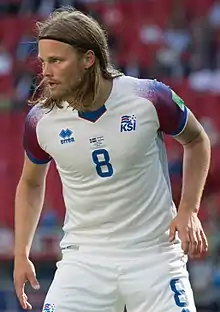
| Rank | Player | Caps | Goals | Career |
|---|---|---|---|---|
| 1 | Birkir Bjarnason | 113 | 15 | 2010–present |
| 2 | Rúnar Kristinsson | 104 | 3 | 1987–2004 |
| 3 | Birkir Már Sævarsson | 103 | 3 | 2007–2021 |
| 4 | Aron Einar Gunnarsson | 101 | 5 | 2008–present |
| 5 | Ragnar Sigurðsson | 97 | 5 | 2007–2020 |
| 6 | Kári Árnason | 90 | 6 | 2005–2021 |
| 7 | Hermann Hreiðarsson | 89 | 5 | 1996–2011 |
| 8 | Eiður Guðjohnsen | 88 | 26 | 1996–2016 |
| 9 | Jóhann Berg Guðmundsson | 84 | 8 | 2008–present |
| 10 | Ari Freyr Skúlason | 83 | 0 | 2009–2021 |
Top goalscorers
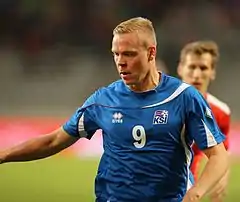
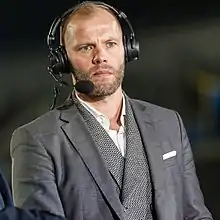
| Rank | Player | Goals | Caps | Ratio | Career |
|---|---|---|---|---|---|
| 1 | Kolbeinn Sigþórsson | 26 | 64 | 0.41 | 2010–2021 |
| Eiður Guðjohnsen | 26 | 88 | 0.3 | 1996–2016 | |
| 3 | Gylfi Sigurðsson | 25 | 78 | 0.32 | 2010–present |
| 4 | Ríkharður Jónsson | 17 | 33 | 0.52 | 1947–1965 |
| 5 | Alfreð Finnbogason | 15 | 65 | 0.23 | 2010–present |
| Birkir Bjarnason | 15 | 113 | 0.13 | 2010–present | |
| 7 | Ríkharður Daðason | 14 | 44 | 0.32 | 1991–2004 |
| Arnór Guðjohnsen | 14 | 73 | 0.19 | 1979–1997 | |
| 9 | Þórður Guðjónsson | 13 | 58 | 0.22 | 1993–2004 |
| 10 | Tryggvi Guðmundsson | 12 | 42 | 0.29 | 1997–2008 |
| Heiðar Helguson | 12 | 55 | 0.22 | 1999–2011 | |
Competitive record
FIFA World Cup
| FIFA World Cup record | FIFA World Cup qualification record | ||||||||||||||||
|---|---|---|---|---|---|---|---|---|---|---|---|---|---|---|---|---|---|
| Year | Round | Position | Pld | W | D | L | GF | GA | Squad | Pld | W | D | L | GF | GA | ||
 1930 1930 |
Not a FIFA member | Not a FIFA member | |||||||||||||||
.svg.png.webp) 1934 1934 | |||||||||||||||||
.svg.png.webp) 1938 1938 | |||||||||||||||||
.svg.png.webp) 1950 1950 | |||||||||||||||||
.svg.png.webp) 1954 1954 |
Did not enter | Did not enter | |||||||||||||||
| 1958 |
Did not qualify | 4 | 0 | 0 | 4 | 6 | 26 | ||||||||||
 1962 1962 | Did not enter | Did not enter | |||||||||||||||
| 1966 | |||||||||||||||||
 1970 1970 | |||||||||||||||||
| 1974 |
Did not qualify | 6 | 0 | 0 | 6 | 2 | 29 | ||||||||||
 1978 1978 |
6 | 1 | 0 | 5 | 2 | 12 | |||||||||||
 1982 1982 |
8 | 2 | 2 | 4 | 10 | 21 | |||||||||||
| 1986 |
6 | 1 | 0 | 5 | 4 | 10 | |||||||||||
| 1990 |
8 | 1 | 4 | 3 | 6 | 11 | |||||||||||
| 1994 |
8 | 3 | 2 | 3 | 7 | 6 | |||||||||||
.svg.png.webp) 1998 1998 |
10 | 2 | 3 | 5 | 11 | 16 | |||||||||||
.svg.png.webp)  2002 2002 |
10 | 4 | 1 | 5 | 14 | 20 | |||||||||||
| 2006 |
10 | 1 | 1 | 8 | 14 | 27 | |||||||||||
 2010 2010 |
8 | 1 | 2 | 5 | 7 | 13 | |||||||||||
 2014 2014 |
12 | 5 | 3 | 4 | 17 | 17 | |||||||||||
 2018 2018 |
Group stage | 28th | 3 | 0 | 1 | 2 | 2 | 5 | Squad | 10 | 7 | 1 | 2 | 16 | 7 | ||
 2022 2022 |
Did not qualify | 10 | 2 | 3 | 5 | 12 | 18 | ||||||||||
| 2026 |
To be determined | To be determined | |||||||||||||||
| Total | Group stage | 1/22 | 3 | 0 | 1 | 2 | 2 | 5 | — | 116 | 30 | 22 | 64 | 128 | 233 | ||
| List of FIFA World Cup matches | ||||||
|---|---|---|---|---|---|---|
| Year | Round | Opponent | Score | Result | Date | Venue |
| 2018 | Group D | Argentina | 1–1 | Draw | 16 June 2018 | Moscow, Russia |
 Nigeria Nigeria | 2–0 | Loss | 22 June 2018 | Volgograd, Russia | ||
 Croatia Croatia | 1–2 | Loss | 26 June 2018 | Rostov-on-Don, Russia | ||
UEFA European Championship
| UEFA European Championship record | Qualification record | ||||||||||||||||
|---|---|---|---|---|---|---|---|---|---|---|---|---|---|---|---|---|---|
| Year | Round | Position | Pld | W | D | L | GF | GA | Squad | Pld | W | D | L | GF | GA | ||
 1960 1960 |
Did not enter | Did not enter | |||||||||||||||
.svg.png.webp) 1964 1964 |
Did not qualify | 2 | 0 | 1 | 1 | 3 | 5 | ||||||||||
| 1968 |
Did not enter | Did not enter | |||||||||||||||
| 1972 | |||||||||||||||||
.svg.png.webp) 1976 1976 |
Did not qualify | 6 | 1 | 2 | 3 | 3 | 8 | ||||||||||
| 1980 |
8 | 0 | 0 | 8 | 2 | 21 | |||||||||||
| 1984 |
8 | 1 | 1 | 6 | 3 | 13 | |||||||||||
| 1988 |
8 | 2 | 2 | 4 | 4 | 14 | |||||||||||
| 1992 |
8 | 2 | 0 | 6 | 7 | 10 | |||||||||||
| 1996 |
8 | 1 | 2 | 5 | 3 | 12 | |||||||||||
| 2000 |
10 | 4 | 3 | 3 | 12 | 7 | |||||||||||
| 2004 |
8 | 4 | 1 | 3 | 11 | 9 | |||||||||||
 2008 2008 |
12 | 2 | 2 | 8 | 10 | 27 | |||||||||||
  2012 2012 |
8 | 1 | 1 | 6 | 6 | 14 | |||||||||||
| 2016 |
Quarter-finals | 8th | 5 | 2 | 2 | 1 | 8 | 9 | Squad | 10 | 6 | 2 | 2 | 17 | 6 | ||
 2020 2020 |
Did not qualify | 12 | 7 | 1 | 4 | 17 | 14 | ||||||||||
| 2024 |
To be determined | To be determined | |||||||||||||||
| Total | Quarter-finals | 1/16 | 5 | 2 | 2 | 1 | 8 | 9 | – | 108 | 31 | 18 | 59 | 98 | 160 | ||
| List of UEFA European Football Championship matches | ||||||
|---|---|---|---|---|---|---|
| Year | Round | Opponent | Score | Result | Date | Venue |
| 2016 | Group F | Portugal | 1–1 | Draw | 14 June 2016 | Saint-Étienne, France |
 Hungary Hungary | 1–1 | Draw | 18 June 2016 | Marseille, France | ||
| Austria | 2–1 | Win | 22 June 2016 | Paris, France | ||
| Round of 16 | England | 2–1 | Win | 27 June 2016 | Nice, France | |
| Quarter- finals | France | 2–5 | Loss | 3 July 2016 | Paris, France | |


Honours
- Baltic Cup
- Champions (1): 2022
- Greenland Cup
- Champions (2): 1980, 1984
- China Cup
- Runners-up (1): 2017
FIFA ranking history
Source:[61]
| 1992 | 1993 | 1994 | 1995 | 1996 | 1997 | 1998 | 1999 | 2000 | 2001 | 2002 | 2003 | 2004 | 2005 | 2006 | 2007 | 2008 | 2009 | 2010 | 2011 | 2012 | 2013 | 2014 | 2015 | 2016 | 2017 | 2018 | 2019 | 2020 | 2021 |
|---|---|---|---|---|---|---|---|---|---|---|---|---|---|---|---|---|---|---|---|---|---|---|---|---|---|---|---|---|---|
| 46 | 47 | 39 | 50 | 60 | 72 | 64 | 43 | 50 | 52 | 58 | 58 | 93 | 94 | 93 | 90 | 83 | 92 | 112 | 104 | 90 | 49 | 33 | 36 | 21 | 22 | 37 | 39 | 46 | 62 |
See also
Notes
References
- "Åge Hareide nýr þjálfari A landsliðs karla". KSÍ (in Icelandic). 14 April 2023.
- "The FIFA/Coca-Cola World Ranking". FIFA. 6 April 2023. Retrieved 6 April 2023.
- Courtney, Barrie (16 May 2008). "Faroe Islands – List of International Matches". RSSSF. Retrieved 3 November 2010.
- Nygård, Jostein (16 May 2008). "International matches of Iceland". RSSSF. Retrieved 3 November 2010.
- Nygård, Jostein (16 May 2008). "International matches of Iceland". RSSSF. Retrieved 16 October 2011.
- "Iceland become smallest nation ever to qualify for World Cup finals". The Guardian. 9 October 2017. Retrieved 10 October 2017.
- "Lionel Messi penalty saved by Halldórsson as Iceland hold Argentina". The Guardian. 16 June 2018. Retrieved 19 October 2019.
- "Iceland bow out of World Cup after defeat by Croatia in final group game". The Guardian. 26 June 2018. Retrieved 19 October 2019.
- "Icelandic Premier League – Úrvalsdeild / Pepsi-deildin (Review)". Blog.fieldoo.com/. 19 March 2014. Archived from the original on 12 June 2018. Retrieved 28 June 2016.
- Ian King (21 October 2013). "Northern Lights: The Sudden Ascent Of The Iceland National Football Team". Twohundredpercent.net. Archived from the original on 4 January 2018. Retrieved 28 June 2016.
- "Football in Iceland | The Secret to Success | Guide to Iceland". Guide to Iceland. 23 July 2017. Retrieved 19 August 2018.
- "Iceland". beinsports.com. 3 June 2016. Retrieved 28 June 2016.
- "Iceland – Member associations". Uefa.org. 20 May 2016. Archived from the original on 23 June 2016. Retrieved 29 June 2016.
- "Greenland Cups 1980-84". RSSSF. Retrieved 19 August 2018.
- Allied Newspapers Ltd (19 October 2014). "An Icelandic summer". Timesofmalta.com. Retrieved 29 June 2016.
- "Iceland's father and son team". The Independent. 25 April 1996. Retrieved 10 October 2017.
- "BBC SPORT | Football | Euro 2004 | Euro 2004 Qualifying Group Five". BBC News. 11 October 2003. Retrieved 29 June 2016.
- "BBC SPORT | Football | Internationals | Germany reach Euro 2004". BBC News. 11 October 2003. Retrieved 29 June 2016.
- "L'Islande, tout sauf un miracle". lequipe.fr. Archived from the original on 2 July 2017. Retrieved 9 May 2022.
- Nunns, Hector (1 January 1970). "BBC Sport – World Cup play-offs: How Iceland can set World Cup record". Bbc.co.uk. Retrieved 28 June 2016.
- "Iceland 0–0 Croatia". BBC Sport. 15 November 2013. Retrieved 29 June 2016.
- "FIFA World Cup Play-Off: Croatia v Iceland". FourFourTwo.com. 17 November 2013. Retrieved 29 June 2016.
- "Croatia 2–0 Iceland". BBC Sport. 19 November 2013. Retrieved 29 June 2016.
- Motez Bishara (6 June 2016). "Euro 2016: Iceland's incredible rise to Europe's top - CNN.com". Edition.cnn.com. Retrieved 29 June 2016.
- Allied Newspapers Ltd. "An Icelandic summer". timesofmalta.com. Retrieved 3 July 2016.
- Gonzalez, Roger (1 October 2015). "FIFA rankings: Argentina No. 1, USA below Iceland, Mexico, Algeria". CBSSports.com. Retrieved 3 July 2016.
- Ough, Tom (22 June 2016). "Iceland 2–1 Austria, Euro 2016: Rearguard action and late winner set up England tie for competition's smallest nation". Telegraph. Archived from the original on 24 June 2016. Retrieved 27 June 2016.
- Wallace, Sam (27 June 2016). "England 1 Iceland 2, Euro 2016 – Humiliation as Joe Hart clanger sees Roy Hodgson's men crash out in Nice". Telegraph. Archived from the original on 12 January 2022. Retrieved 27 June 2016.
- Smyth, Rob (3 July 2016). "France 5–2 Iceland: Euro 2016 quarter-final – as it happened". The Guardian. Retrieved 3 July 2016.
- "Iceland become smallest nation ever to qualify for World Cup finals". The Guardian. 9 October 2017. Retrieved 10 October 2017.
- "Fifa World Cup 2018 group of death: This is the toughest draw". Evening Standard. Retrieved 28 June 2018.
- FIFA.com. "2018 FIFA World Cup Russia™ - FIFA.com". www.fifa.com. Archived from the original on 20 May 2014. Retrieved 28 June 2018.
- (www.dw.com), Deutsche Welle. "World Cup Russia 2018: For Iceland, anything is possible | DW | 30.05.2018". DW.COM. Retrieved 28 June 2018.
- FIFA.com. "2018 FIFA World Cup Russia™ - Matches - Argentina - Iceland - FIFA.com". www.fifa.com. Archived from the original on 12 June 2018. Retrieved 28 June 2018.
- "World Cup 2018: Debutants Iceland hold Argentina to 1-1 draw". BBC Sport. 16 June 2018. Retrieved 28 June 2018.
- FIFA.com. "2018 FIFA World Cup Russia™ - Matches - Nigeria - Iceland - FIFA.com". www.fifa.com. Archived from the original on 12 June 2018. Retrieved 28 June 2018.
- Glendenning, Barry (22 June 2018). "Nigeria 2-0 Iceland: World Cup 2018 – as it happened". The Guardian. ISSN 0261-3077. Retrieved 28 June 2018.
- FIFA.com. "2018 FIFA World Cup Russia™ - Matches - Iceland - Croatia - FIFA.com". www.fifa.com. Archived from the original on 12 June 2018. Retrieved 28 June 2018.
- "World Cup 2018: Iceland out after defeat by group winners Croatia". BBC Sport. 26 June 2018. Retrieved 28 June 2018.
- Yoesting, Travis (15 November 2018). "What Has Happened To Icelandic Soccer? Iceland 2018 Record". the18.com. Retrieved 26 December 2022.
- "Euro 2020 play-offs: Hungary fightback stuns Iceland, North Macedonia qualify". www.theguardian.com. 12 November 2020.
- Elliott, Alexander (19 November 2020). "Iceland relegated in Nations League". RÚV. Retrieved 11 December 2020.
- O'Connor, Philip (14 November 2020). "Iceland soccer coach Hamren to step down after England game". Reuters. Retrieved 18 November 2020.
- "L'Islande face à un scandale d'agression sexuelle, Sigthorsson dans le viseur". So Foot. 31 August 2021. Retrieved 3 September 2021.
- "Un joueur d'Everton suspecté d'abus sexuels sur mineurs". So Foot. 20 July 2021. Retrieved 3 September 2021.
- "Islande : démission collective à la Fédération après un scandale d'agression sexuelle, Sigthorsson dans le viseur". L'Équipe. 31 August 2021. Retrieved 3 September 2021.
- Arthur Jeanne (8 October 2021). "Islande in the dark". So Foot. Retrieved 25 October 2021.
- Romain Rouillard (11 November 2021). "Mondial 2022 : en Islande, le clapping de 2016 ne résonne plus". Le Figaro. Retrieved 12 November 2021.
- Steven, Rachael. "Iceland's national football team gets a new identity". Creative Review. Retrieved 6 July 2020.
- "Iceland's Goalkeeper-Film Director Makes Reveal Video for Bold New Crest". Sports Illustrated. ABG-SI LLC. 1 July 2020. Retrieved 6 July 2020.
- West, Jenna (15 June 2018). "What Does Iceland's Skol Viking Clap Mean?". Sports Illustrated. ABG-SI LLC. Retrieved 6 July 2020.
- "A-landslið karla - HM 2022 - 2021 - Knattspyrnusamband Íslands". ksi.is (in Icelandic). KSÍ. Retrieved 16 January 2021.
- "Stakt mót - Knattspyrnusamband Íslands". ksi.is (in Icelandic). KSÍ. Retrieved 16 January 2021.
- "Stakt mót - Knattspyrnusamband Íslands". www.ksi.is (in Icelandic). KSÍ. Retrieved 17 January 2022.
- "A landslið karla - Þjóðadeild - 2022". www.ksi.is (in Icelandic). KSÍ. Retrieved 17 January 2022.
- "Hópurinn fyrir mars-leiki í undankeppni EM 2024". www.ksi.is (in Icelandic). KSÍ. Retrieved 19 March 2023.
- "Iceland-Bosnia | UEFA Nations League 2023 | UEFA.com". UEFA.
- "Most Iceland Caps - EU-Football.info". eu-football.info.
- "Leikmenn - Knattspyrnusamband Íslands". www.ksi.is (in Icelandic). KSÍ. Retrieved 25 March 2021.
- Nygård, Jostein. "Iceland - Record International Players". RSSSF.
- "FIFA World Ranking – Associations: Iceland". FIFA.
External links
- Football Association of Iceland
- FIFA profile
- Iceland National Team (1946–2000) by Jostein Nygård (Norway)
- RSSSF archive of results 1946–
- RSSSF archive of most capped players and highest goalscorers
| National teams |
| ||||
|---|---|---|---|---|---|
| League system |
| ||||
| Domestic cups |
| ||||
| Annual tournaments |
| ||||
| Youth |
| ||||
| Culture | |||||
Squads | |||||||||||||
|---|---|---|---|---|---|---|---|---|---|---|---|---|---|
| |||||||||||||
Finalists | |||||||||||||||||
|---|---|---|---|---|---|---|---|---|---|---|---|---|---|---|---|---|---|
| |||||||||||||||||
.svg.png.webp)
.svg.png.webp)