House of Leaves
House of Leaves is the debut novel by American author Mark Z. Danielewski, published in March 2000 by Pantheon Books. A bestseller, it has been translated into a number of languages, and is followed by a companion piece, The Whalestoe Letters.
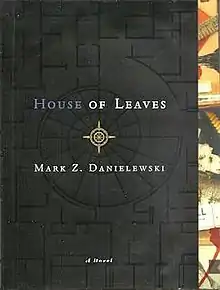 First-edition cover | |
| Author | Mark Z. Danielewski |
|---|---|
| Country | United States |
| Genre | Horror Satire Postmodernism |
| Publisher | Pantheon, Random House |
Publication date | March 7, 2000 |
| Media type | Print (paperback and hardcover) |
| Pages | 709 (paperback) |
| ISBN | 0-375-70376-4 |
| Followed by | The Whalestoe Letters |
A work of pseudepigrapha, House of Leaves purports to be a monograph critiquing a documentary film, while simultaneously narrating the events of the film, in which a family discovers a seemingly endless labyrinth in their house. This framing device results in multiple narrative voices, including the book's supposed author, compiler, and editors, as well as the documentary's cast, whose relationships to each other give rise to inconsistencies and mysteries.
The book is formatted by academic publishing conventions, including exhibits, appendices, and an index, as well as numerous footnotes. It is also distinguished by convoluted page layouts: some pages contain only a few words or lines of text, arranged to mirror the events in the story, often creating both an agoraphobic and a claustrophobic effect. At points, the book must be rotated to be read, making it a prime example of ergodic literature.[1][2]
The book is most often described as a horror story, though the author has also endorsed readers' interpretation of it as a love story. [3] House of Leaves has also been described as a "satire of academic criticism."[4]
Summary
Rather than Danielewski, the title page of House of Leaves credits two men named Zampanò and Johnny Truant as its authors. In an introduction dated 1998, Truant claims to have found the book as an unfinished manuscript left by the recently deceased Zampanò, having never met the author in life. Truant, a Los Angeles tattoo parlor employee, decided to complete and submit the work for posthumous publication. The rest of the book is punctuated by footnotes by Truant, whether fact-checking, editorializing, translating, or interjecting seemingly irrelevant anecdotes. Truant's work is further supplemented by uncredited professional editors, who profess to have, in turn, never met Truant.
Zampanò's text claims that The Navidson Record, a documentary film directed by an acclaimed photojournalist named Will Navidson, became an American cultural phenomenon upon its theatrical release in 1993, generating volumes of multidisciplinary academic literature, as well as extensive media coverage in popular culture. In support, Zampanò cites or quotes articles, journals, symposia, books, magazines, TV programs, and interviews, many supposedly dedicated to this film. Throughout, Zampanò intersperses overwhelmingly esoteric summaries of tangential topics, such as photography, architecture, Biblical studies, and radiometric dating.
Truant, however, debunks The Navidson Record as a wholesale fabrication, citing his own findings that the film does not exist; that Navidson is a fictionalization of the real-life photojournalist Kevin Carter; and that Zampanò outright invented numerous sources and quotes. Truant also determines that Zampanò copied secondary sources to hide his own inexpertise in various subjects. More paradoxically, Zampanò purports to authoritatively write about filmmaking and documentary film techniques despite being blind. At the same time, Truant's own factual errors, limited knowledge, and open admission to adulterating Zampanò's work also throw his own reliability into question.
The text is also marred by missing pages, missing footnotes, missing supplemental documents, and text accidentally or deliberately destroyed by Zampanò, Truant, or unknown causes.
The Navidson Record
Flouting conventions of academic writing, Zampanò narrates the lives of the Navidson family during the events depicted in The Navidson Record, set in April 1990, including unfilmed events sourced from media and public records. The family are Will Navidson; his unmarried partner, Karen Green, a former fashion model; and their two children, Chad and Daisy.
The Navidson Record is described as the inadvertent product of an autobiographical documentary project: having recently moved into a new home in Virginia, the Navidsons installed cameras throughout the house to capture candid family moments. The family's daily life was soon upended by doors appearing in once-blank walls of their house, opening onto new rooms that extend, impossibly, beyond the house's outside dimensions.
Most of the film is described as footage from Navidson's ventures into a hallway leading from the living room to a maze-like complex, containing an enormous spiral staircase which appears to descend endlessly. Over Karen's objections, Navidson organized methodical, filmed explorations of the maze, later accompanied by a crew of professional explorers and survivalists. Within the maze, they recorded footage of a multitude of corridors and rooms, completely unlit and featureless, with smooth ash-gray walls, floors, and ceilings. The maze is said to be silent save for the sound of a periodic low growl, which is never fully explained.
The explorations, already challenged by the maze's inhospitable and ever-shifting nature, finally led to disaster when one of the crew killed another and turned on the rest of the party. Though the rest of the party emerged from the maze after many ordeals, the house itself transformed in a hostile fashion, killing Navidson's brother Tom and forcing the family to frantically escape.
Karen separated from Navidson, departing to New York City with their children. She turned to filmmaking herself to reconcile her relationship with Navidson, while also showing his footage to literary, artistic, and scientific authorities such as Stephen King, Stanley Kubrick, Douglas Hofstadter, Ken Burns, Harold Bloom, Camille Paglia, Hunter Thompson, Anne Rice, and Jacques Derrida. Navidson, still investigating the house, sought explanations from laboratory analysis, only to learn that samples taken from the maze are older than the Earth itself.
Ultimately, Navidson returned to the house alone, leaving only a seemingly incoherent letter for Karen. Despite ample preparation, Navidson became inextricably trapped in the maze. Navidson's camera captured himself attempting to read a book titled House of Leaves in total darkness; having lost all supplies, he resorted to burning the book page by page to provide light for reading.
Meanwhile, Karen followed Navidson, finding the house now normal and the hallway gone. She resumed living in the house, becoming confident that Navidson can still be found within. One day, the hallway reappeared to Karen, and she entered for the first time. She found Navidson emaciated and maimed by frostbite and injury, but they materialized together safely outside the house. The film concludes with Navidson and Karen marrying, and reuniting their family in Vermont.
Johnny's story
Truant's footnotes frequently segue into personal digressions, documenting his descent into obsession, delusions, and paranoia as he compiles the manuscript. He recounts tales of sexual encounters, his lust for a tattooed dancer he calls Thumper, and his bar-hopping with Lude. Truant also writes about his childhood living with an abusive foster father. Even as he grows increasingly unstable, Truant remains steadfast in his editorial work, neglecting all else.
Truant's story ends with chapter XXI, interrupting The Navidson Record just before Karen discovers the hallway. Entirely written by Truant, this chapter recounts the conclusion of his downward spiral after Lude's death. Truant invents two different accounts of positive turnarounds, only to disavow both. He then describes setting fire to the completed manuscript, and, after a struck-out passage in purple – the only such passage in the entire book – Truant tells an ambiguous story about a woman who loses her baby in childbirth. The remaining chapters conclude with no further text by Truant.
The Whalestoe Letters
The Whalestoe Letters, a compilation of letters written by Truant's mother Pelafina during her committal at The Three Attic Whalestoe Institution, are published both as an appendix to House of Leaves and as a standalone book with additional content.
Though Pelafina's letters and Johnny's footnotes contain similar accounts of their past, their memories also differ greatly at times, due to both Pelafina's and Johnny's questionable mental states. Pelafina was placed in the mental institution after supposedly attempting to strangle Johnny, only to be stopped by her husband. She remained there after Johnny's father's death. Johnny claims that his mother meant him no harm and claimed to strangle him only to protect him from missing her. It is unclear, however, if Johnny's statements about the incident—or any of his other statements, for that matter—are factual.
Characters
Johnny Truant
Johnny Truant serves a dual role, as primary editor of Zampanò's academic study of The Navidson Record and protagonist as revealed through footnotes and appendices.
In the beginning of the book, Truant appears to be a normal, reasonably attractive young man who happens upon a trunk full of notes left behind by the now deceased Zampanò. As Truant begins to do the editing, however, he begins to lose the tenuous grip he has on reality, and his life begins to erode around him. He stops bathing, rarely eats, stops going to work, and distances himself from essentially everyone, all in pursuit of organizing the book into a finished work that, he hopes, will finally bring him peace.
Initially intrigued by Zampanò's isolative tendencies and surreal sense of reality, Johnny unknowingly sets himself up as a victim to the daunting task that awaits him. As he begins to organize Zampanò's manuscripts, his personal footnotes detail the deterioration of his own life with analogous references to alienation and insanity: once a trespasser to Zampanò's mad realm, Truant seems to become more comfortable in the environment as the story unfolds. He even has hallucinations that parallel those of Zampanò and members of the house search team when he senses "...something inhuman..." behind him (page 26).
Zampanò
Zampanò is the blind author of The Navidson Record. Approximately eighty years old at the time of his death, he is described by neighbors as "eccentric" and "crazy." While little information is given explicitly about Zampanò's past, blindness, or personality, Johnny's introduction does state that Zampanò went blind sometime in the 1950s. Zampanò also suffers from graphomania. Truant learns second-hand about Zampanò's writing process and character by interviewing various students and social workers, exclusively female, who volunteered as readers for his research.
Danielewski made Zampanò blind as a reference to blind authors Homer, John Milton and Jorge Luis Borges.[5]
Pelafina H. Lièvre
Pelafina, more commonly referred to as simply "P.", is Johnny's institutionalized mother who appears in the appendix to the text. Her story is more fully developed in The Whalestoe Letters.
Minor characters in Johnny's story
Lude: Johnny Truant's best friend, Lude is also the one that informs him of Zampanò's vacant apartment. Lude is a minor character, but some of his characteristics and actions are important in understanding Johnny. Lude assists Johnny many times in obtaining phone numbers of girls when they visit bars, clubs, and restaurants. Several times, Johnny mentions that he wishes he had not answered Lude's call late at night. Every time Johnny and Lude are together they seem to involve themselves in difficult situations. He is killed in a motorcycle accident near the end of the novel.
Thumper: A stripper who is a regular client of the tattoo parlour where Truant works. Although Johnny has encounters with many women, he remains fixated on Thumper throughout. Thumper's real name is eventually revealed to Johnny, but never to the reader.
Will Navidson
Will Navidson is described as having become a successful photographer thanks to an early military career in war-torn regions, though haunted by his role as an impartial documentarist of war. Navidson is said to be a Pulitzer winner and recipient of prestigious arts grants, who has jeopardized his relationship with Karen due to years of prolonged absences while working overseas. Many citations to critics, scholars, and media coverage present Navidson as a well-known public figure, with his notoriety further compounded by the film's release; the extent of this public interest is such that academics are supposedly divided into three conflicting schools of thought interpreting his unexplained motivations for returning to the house.
Karen Green
Karen is Will's partner and a former fashion model. She suffers from claustrophobia, and throughout the novel refuses to enter the labyrinth within her house. She also seems to be extremely insecure regarding her relationship with Will; he is 'her rock,' though it is confirmed that she had at least three long-term affairs during the course of their relationship. Curiously, the events of the novel only seem to reduce her dependence on Will (as well as contributing to the eventual dissolution of their relationship). It is speculated that, during Karen's childhood, her stepfather once took Karen and her sister into a barn in their backyard, putting one sister in a well while he raped the other, and vice versa. This event is widely considered to be the cause of her claustrophobia. However, several footnotes and comments about the incident question this claim (another of many examples of the use of an unreliable narrator in the novel). In the aftermath of the events in the house, she becomes an unlikely editor, approaching many real characters (including Stephen King, Stanley Kubrick, Hunter S. Thompson, Douglas Hofstadter, Harold Bloom, and Jacques Derrida) for comment on The Navidson Record, albeit comment within the fictional universe of the novel. Eventually, she is reunited with Navidson after she conquers her claustrophobia and saves him from the abyss of the labyrinth.
Tom Navidson
Tom is Will Navidson's somewhat estranged twin brother; Tom is a carpenter with substance addiction problems, who is markedly less successful than Will in his personal and professional life. After approximately 8 years of little contact, Will contacts Tom when he notices that his house is larger on the inside than the outside. A section of the novel, called "Tom's Story", is a partial transcript of documentary evidence and radio communication with the outside world during his vigil within the labyrinth, which he spends alone with his radio, waiting for Will. This section is referred to in the book as a "sometimes funny, sometimes bizarre history of thoughts passing away in the atrocity of that darkness" (page 252). He often refers to "Mr. Monster" and many of the jokes and anecdotes he provides are religious in nature. However, in a test of his true character, he bravely saves Will's children from being swallowed by the house before being swallowed himself.
Billy Reston
Billy is an engineer and a friend of Will's, whom Will enlists early on in the story to help him try to find a rational explanation for the house's oddities. Billy uses a wheelchair, having been paralyzed from the waist down in a freak engineering accident in India; Will happened to be on the scene and took a photo of Billy moments before he became paralyzed. Billy came across the photo after his accident and kept it as a reminder that he was fortunate to have survived. Once the house's irregularities become more extreme, Billy joins Will and Tom in a thorough analysis; after Holloway and his men go missing, Billy insists on joining Will on the rescue mission, navigating the maze in his wheelchair. He eventually saves Will and Holloway's men from Holloway by engaging in a firefight with him, holding him back long enough for the house to "consume" Holloway. Billy survives the journey into the maze, but suffers persistent cold spells afterward as well as sustaining damage to his wheelchair.
Holloway Roberts
Holloway is an experienced explorer whom Will contacts in an effort to properly explore the labyrinth beneath his house. Holloway is presented as the consummate outdoorsman: He has successfully engaged in numerous expeditions which would have killed normal men, and is an expert in all forms of survivalist equipment, from spelunking gear to firearms. He engages in two brief explorations of the labyrinth before deciding to take his men on a third, prolonged expedition, prior to which they load themselves up with enough food and water to last several days and enough provisions to—they believe—safely guide them back home. During the course of this exploration, Holloway reaches the bottom of the Great Staircase and becomes deranged due to finding nothing but more empty hallways. The house's bizarre architecture leads him to believe an image he sees down a hall is the "monster" stalking them when, in fact, he is actually looking at his own men; he shoots one of them, and, upon realizing what he has done, suffers a complete psychological breakdown and tries to murder them. Eventually, the house "traps" him by sealing him inside a series of locked chambers; alone and insane, Holloway records a series of unsettling final messages on a video camera before filming himself committing suicide. The tape of his death is recovered by Will from the labyrinth. The seconds leading up to the end of the tape reveal that either 1) Holloway's corpse is devoured by the "monster" he is convinced is real or 2) Holloway merely disappears into the blackness of the house.
When the House begins to attempt to harm the others late in the novel, Reston calls out Holloway's name. Whether Holloway had some influence on the house's actions (before or after his suicide) is left ambiguous.
Minor characters in The Navidson Record
Kirby 'Wax' Hook: Another explorer of the labyrinth in Navidson's house. He is ultimately shot in the shoulder by Holloway, but he survives. The House leaves him with limited functionality in that shoulder, and an inexplicable case of impotence. However, after Navidson reenters the House for a fifth and final exploration, these symptoms disappear. Wax has a reputation as a flirt, who constantly attempts to hook up with women. He kisses Karen Green, a scene which Will later witnesses on camera.
Jed Leeder: The third explorer of the labyrinth in Navidson's house. He is shot by Holloway in the jaw, killing him.
Chad Navidson: Will Navidson and Karen Green's son, the older sibling. Around the times of the explorations, Chad is described as becoming increasingly aggressive and wandering.
Daisy Navidson: Will Navidson and Karen Green's daughter. During the explorations of the house, Daisy is described as suffering from echolalia.
Format
Danielewski wrote the book in longhand and revised it with a word processor. He then flew to Pantheon's NY headquarters to do the typesetting himself in QuarkXPress because he only trusted himself with the book's vision.[6]
The book contains copious footnotes, many of which contain footnotes themselves, including references to fictional books, films or articles.[7]
Colors
House of Leaves includes frequent and seemingly systematic color changes. While Danielewski leaves much of the interpretation of the choice of colors up to the reader, several distinct patterns emerge upon closer examination.[8]
Notable examples include:
- The word "house" is colored blue (gray for non-color editions of the book and light gray for red editions). In many places throughout the book, it is offset from the rest of the text in different directions at different times. Foreign-language equivalents of house, such as the German Haus and the French maison, are also blue. These colorizations even extend to text on the book's copyright page.
- In all colored editions, the word minotaur and all struckthrough passages are colored red.
- Many references to Johnny's mother are colored purple.
Font changes
Throughout the book, various changes in font serve as a way for the reader to quickly determine which of its multiple narrators’ work they are currently following. In the book, there are four fonts used by the four narrators. These are: Times New Roman (Zampanò), Courier (Johnny), Bookman (The Editors), and Dante (Johnny's mother).[9] (Additional font changes are used intermittently—Janson for film intertitles, Book Antiqua for a letter written by Navidson, and so on.)
Companion works
The book was followed by a companion piece called The Whalestoe Letters, a series of letters written to the character Johnny Truant by his mother while she was confined in a mental institution. Some (but not all) of the letters are included in the second edition.
House of Leaves was accompanied by a companion piece (or vice versa), a full-length album called Haunted recorded by Danielewski's sister, Anne Danielewski, known professionally as Poe. The two works cross-pollinated heavily over the course of their creations, each inspiring the other in various ways. Poe's statement on the connection between the two works is that they are parallax views of the same story. House of Leaves references Poe and her songs several times, not only limited to her album Haunted, but Hello as well. One example occurs when the character Karen Green is interviewing various academics on their interpretations of the short film "Exploration #4"; she consults a "Poet," but there is a space between the "Poe" and the "t," suggesting that Poe at one point commented on the book. It may also be a reference to Edgar Allan Poe.
The album Haunted also draws heavily from the novel, featuring tracks called "House of Leaves", "Exploration B" and "5&½ Minute Hallway", and many less obvious references. The video for "Hey Pretty" also features Mark Danielewski reading from House of Leaves (pp. 88–89), and in House of Leaves, the band Liberty Bell's lyrics were also songs on Poe's album.
In 2017, Danielewski entered talks to adapt the novel into a TV series,[10][11] stating that if a deal was not made by February 2020, the project would be abandoned.[12] Ultimately, Danielewski published screenplays of three episodes online.[13] A sequel to the book, the screenplays both adapt the original story and extend it to the present day. Past sequences, depicted as filmed by a then-young filmmaker named Mélisande Avignon, contradict the book significantly: Zampanó's [sic] work, found by Truant, was not a manuscript but film and tapes containing the actual footage of The Navidson Record. This and Avignon's film are later seized, and public knowledge of them suppressed, by a "data disposal" company called Skiadyne. In the present, unknown forces steal both films from Skiadyne and return them to Avignon, leading to a high-stakes fight for control. The book House of Leaves, now academically studied as a work of fiction, becomes embroiled in a "fake fiction" scandal when Avignon publicizes its factual basis by leaking the films.
Reception
Stephen Poole, writing in The Guardian, admired the book's parody of academia: "Danielewski...weaves around his brutally efficient and genuinely chilling story a delightful and often very funny satire of academic criticism."[14] Steven Moore, writing in The Washington Post, also praised the novel: "Danielewski's achievement lies in taking some staples of horror fiction – the haunted house, the mysterious manuscript that casts a spell on its hapless reader – and using his impressive erudition to recover the mythological and psychological origins of horror, and then enlisting the full array of avant-garde literary techniques to reinvigorate a genre long abandoned to hacks."[15] The Village Voice's Emily Barton was less impressed: "Danielewski’s bloated and bollixed first novel certainly attempts to pass itself off as an ambitious work; the question for each reader is if the payoff makes the effort of slogging through its endless posturing worthwhile."[16]
References
- Murphy, Cath (22 November 2013). "Book Brawl: House of Leaves vs. Night Film". LitReactor. Archived from the original on 9 May 2016. Retrieved 25 April 2016.
- Corrigan, Marianne; Ogden, Ash (2013). "Explorations in the Ergodic". Alluvium. 2 (2). doi:10.7766/alluvium.v2.2.01. Archived from the original on 2016-05-09. Retrieved 2016-04-25.
- Danielewski expands on this point in an interview: "I had one woman come up to me in a bookstore and say, 'You know, everyone told me it was a horror book, but when I finished it, I realized that it was a love story.' And she's absolutely right. In some ways, genre is a marketing tool." Wittmershaus, Eric (2000-05-06), "Profile: Mark Z. Danielewski", Flak Magazine, archived from the original on 2011-06-29, retrieved 2008-07-19
- Poole, Steven (2000-07-15), "Gothic scholar", Guardian Unlimited, archived from the original on 2007-02-13, retrieved 2007-03-04
- Borges: Influence and References: Mark Z. Danielewski. Retrieved March 15, 2007. Archived 2014-10-15 at the Wayback Machine
- Kirschenbaum, Matthew G. Track Changes: A Literary History of Word Processing, page 203.
- One such footnote references Not True, Man: Mi Ata Beni? by Eta Ruccalla. Another references "All Accurate" by Nam Eurtton. Note that "Eta Ruccalla" is "All Accurate" backwards, and "Nam Eurtton" is "Not True, Man" backwards.
- Wittmershaus, Eric (2000-05-06), "Review of House of Leaves", Flak Magazine, archived from the original on 2007-02-10, retrieved 2007-02-10
- Hawthorne, Elise (March 14, 2010). "Font Functions in "House of Leaves"". Archived from the original on December 1, 2017. Retrieved November 23, 2017.
- Wampler, Scott (July 9, 2018). "Mark Z. Danielewski Wrote The Pilot For A HOUSE OF LEAVES TV Series". Birth.Movies.Death. Archived from the original on December 11, 2018. Retrieved December 10, 2018.
- Hughes, William (July 11, 2018). "Mark Z. Danielewski's script for a House Of Leaves TV pilot is just as bewildering and fascinating as the book". The A.V. Club. Archived from the original on December 11, 2018. Retrieved December 10, 2018.
- @markdanielewski (23 September 2019). ""If a deal isn't in place by Feb..."" (Tweet) – via Twitter.
- @markdanielewski (March 10, 2020). ""Where've you been? Read them now!"" (Tweet). Retrieved September 17, 2020 – via Twitter.
- Poole, Steven (2000-07-15). "Guardian review: House of Leaves by Mark Z Danielewski". the Guardian. Archived from the original on 2019-12-07. Retrieved 2019-12-07.
- Moore, Steven (2000-04-09). "The Ash Tree Project". Washington Post. Archived from the original on 2019-09-11. Retrieved 2019-12-07.
- Barton, Emily (2000-04-11). "Typographical Terror". The Village Voice. Archived from the original on 2019-12-08. Retrieved 2019-12-07.
Sources
- Danielewski, Mark Z. (2000-03-07), House of Leaves (2nd ed.), New York: Pantheon Books, Random HouseISBN 0375703764 paperback. ISBN 0-375-42052-5 hardcover. ISBN 0-375-41034-1 hardcover/signed.
Further reading
- Bemong, Nele (January 2003), "Exploration #6: The Uncanny in Mark Z. Danielewski's House of Leaves", Image [&] Narrative: Online Magazine of the Visual Narrative, vol. 5, ISSN 1780-678X
- Brick, Martin (January 2004), "Blueprint(s): Rubric for a Deconstructed Age in House of Leaves", Philament, vol. 2, ISSN 1449-0471, archived from the original on 2016-03-06
- Brigitte, Félix (2005), "Exploration #6: l'architecture narrative de House of Leaves de Mark Z. Danielewski", Cahiers Charles V, vol. 38, pp. 43–73, doi:10.3406/cchav.2005.1404, ISSN 0184-1025
- Chanen, Brian (2007), "Surfing the Text: The Digital Environment in Mark Z. Danielewski's "House of Leaves"", European Journal of English Studies, vol. 11, no. 2, pp. 163–176, doi:10.1080/13825570701452755, ISSN 1382-5577, S2CID 142565632
- Cox, Katherine (2006), "What Has Made Me? Locating Mother in the Textual Labyrinth of Mark Z. Danielewski's House of Leaves", Critical Survey, 18 (2): 4–15, doi:10.3167/001115706780600756
- Dawson, Conor Michael (2012), "The Horror! The Horror!: Traumatic Repetition in Joseph Conrad's Heart of Darkness and Mark Z. Danielewski's House of Leaves" (PDF), Postgraduate English, vol. 25, archived (PDF) from the original on 2022-10-09
- Graulund, Rune (2006), "Text and Paratext in Mark Z. Danielewski's House of Leaves", Word and Image, 22 (4): 379–388, doi:10.1080/02666286.2006.10435766, S2CID 194062316
- Hansen, Mark B. N. (Winter 2004), "The Digital Topography of Mark Z. Danielewski's House of Leaves", Contemporary Literature, vol. 45, no. 4, pp. 597–636, ISSN 0010-7484
- Hayles, N. Katherine (December 2002), "Saving the Subject: Remediation in House of Leaves", American Literature: A Journal of Literary History, Criticism, and Bibliography, vol. 74, no. 4, pp. 779–806, doi:10.1215/00029831-74-4-779, ISSN 0002-9831, S2CID 163123851
- McCaffery, Larry; Gregory, Sinda (Winter 2003), "Haunted House: An Interview with Mark Z. Danielewski", Critique: Studies in Contemporary Fiction, 44 (2): 99–135, doi:10.1080/00111610309599940, S2CID 161403629
- McGrath, Laura B. (2015), "Only a Book": Reading the Footnotes in House of Leaves, pp. 121–136, doi:10.1515/9783110449075-008, ISBN 9783110447439
- Pressman, Jessica (Spring 2006), "House of Leaves: Reading the Networked Novel", Studies in American Fiction, vol. 34, no. 1, pp. 107–128, ISSN 0091-8083
- Slocombe, Will (Spring 2005), "'This Is Not for You': Nihilism and the House That Jacques Built", Modern Fiction Studies, vol. 51, no. 1, pp. 88–109, doi:10.1353/mfs.2005.0015, ISSN 0026-7724, S2CID 170463827
External links

- House of Leaves official forum
- Random House Reader's Guide Archived 2006-11-13 at the Wayback Machine
- Interview by Eric Wittmershaus (archive) on The Modern Word
- Review by Powell's Books (archive)
- Review by Shipwreck Library (original link Archived 2006-09-03 at the Wayback Machine)
- Review by Ted Gioia of The New Canon (blog)
- Review of House of Leaves: The Screenplay by Justin Bruce