Charles Lynch (politician)
Charles Lynch (August 8, 1783 – February 9, 1853) was a Democratic and Whig politician who served as Governor of Mississippi and was a former enslaver.
Charles Lynch | |
|---|---|
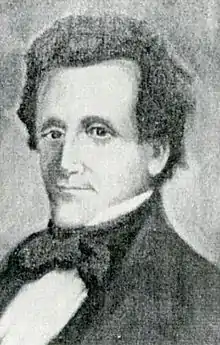 | |
| 8th and 11th Governor of Mississippi | |
| In office June 12, 1833 – November 20, 1833 | |
| Preceded by | Abram M. Scott |
| Succeeded by | Hiram Runnels |
| In office January 7, 1836 – January 8, 1838 | |
| Preceded by | John A. Quitman |
| Succeeded by | Alexander G. McNutt |
| Member of the Mississippi State Senate | |
| In office 1827 | |
| In office 1832–1833 | |
| Personal details | |
| Born | August 8, 1783 Jefferson County, Virginia (in modern-day Shelby County, Kentucky), U.S. |
| Died | February 9, 1853 (aged 69) Monticello, Mississippi, U.S. |
| Political party | Democratic (before 1833) Whig (1833–1852) |
Biography
Charles Lynch was born in 1783 in what is now Shelby County, Kentucky (then a part of Jefferson County, Virginia – Kentucky would be formed from Virginia and admitted as a state in its own right in 1792). He was educated in Kentucky, became a farmer, and lived in Sumter, South Carolina before moving to Monticello, Mississippi. According to the 1820 US Federal Census, Lynch also enslaved seven people. Originally a Democrat, he was appointed Lawrence County probate judge in 1821. He was elected to the Mississippi State Senate and served in 1827. In 1831 he was an unsuccessful candidate for governor; in 1832, he was a delegate to the state constitutional convention.
Lynch returned to the Mississippi Senate in 1832. He was elected President of the Senate, and in June 1833, he succeeded Governor Abram L. Scott, who had died in office. He completed Scott's term, serving until November 1833, when he was succeeded by Hiram Runnels.
In 1835 Lynch, now a Whig, ran successfully for governor. He took office in January 1836 and served a two-year term. Mississippi became involved in central banking by chartering the Union Bank during his tenure. In addition, ten new counties were formed. The Panic of 1837 harmed Mississippi's economy, and Lynch did not run for reelection.
After his term expired in January 1838, Lynch remained active in government as the state's Commissioner of Public Buildings. He was also the president of the Alabama and Mississippi Railroad and Bank.
He died on February 9, 1853, and was buried at Greenwood Cemetery in Jackson, Mississippi.
External links
- Charles Lynch at National Governors Association
- Charles Lynch at The Political Graveyard
- Charles Lynch at 1820 US Federal Census
.svg.png.webp)