Bosniaks of Croatia
Bosniaks of Croatia are one of the ethnic minorities of the Republic of Croatia. According to the 2021 Croatian census, there were 24,131 Bosniaks, or 0.62% of the total population, making them the third largest ethnic group in the country after Croats and Serbs.[1]
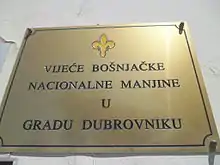 Bosniak National Minority Council in Dubrovnik | |
| Total population | |
|---|---|
| 24,131 (2021) | |
| Languages | |
| Bosnian, Croatian | |
| Religion | |
| Predominantly Sunni Islam | |
| Related ethnic groups | |
| Other Slavic peoples, especially South Slavs |
| Part of a series on |
| Bosniaks |
|---|
.svg.png.webp) |
Bosniaks are officially recognized as an autochthonous national minority, and as such, they elect a special representative to the Croatian Parliament, shared with members of four other national minorities.[2] Most Bosniaks live in the capital Zagreb (8,119), Istria County (6,146) and Primorje-Gorski Kotar County (4,877).[3]
Religion
Bosniaks of Croatia are predominantly Muslims, with 21,119 (87.52) subscribing to this confession according to the 2021 Croatian census. They're followed by 1,113 (4.61%) Bosniaks who declared as atheists or non-religious and 367 (1.52%) declared as agnostics. There were 981 (4.07%) Bosniaks of undisclosed or unknown confession, while the rest belonged to various Christian denominations or other religions.[1]
References
- "Census of population, households and dwellings in 2021 – population of Republic of Croatia". Croatian Bureau of Statistics. 31 January 2023. Retrieved 14 April 2023.
- "Pravo pripadnika nacionalnih manjina u Republici Hrvatskoj na zastupljenost u Hrvatskom saboru". Zakon o izborima zastupnika u Hrvatski sabor (in Croatian). Croatian Parliament. Retrieved 2011-12-29.
- "Population by Ethnicity, by Towns/Municipalities, 2011 Census". Census of Population, Households and Dwellings 2011. Zagreb: Croatian Bureau of Statistics. December 2012.
Bosniak diaspora | ||
|---|---|---|
| Europe |  | |
| Asia | ||
| Americas | ||
| Oceania | ||