Black Knight (film)
Black Knight is a 2001 American fantasy adventure buddy comedy film directed by Gil Junger and starring Martin Lawrence with Marsha Thomason, Tom Wilkinson, Vincent Regan, and Kevin Conway in supporting roles. In the film, Lawrence plays Jamal, a theme park employee who is transported through time to medieval England. The film was shot at various locations in North Carolina, mainly Wilmington and Carolina Beach. Black Knight was theatrically released on November 21, 2001 to negative reviews and grossed $39.9 million against a production budget of $50 million.
| Black Knight | |
|---|---|
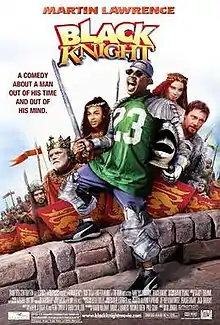 Theatrical release poster | |
| Directed by | Gil Junger |
| Written by | Darryl J. Quarles Peter Gaulke Gerry Swallow |
| Produced by | Arnon Milchan Darryl J. Quarles Michael Green Paul Schiff |
| Starring | Martin Lawrence |
| Cinematography | Ueli Steiger |
| Edited by | Michael R. Miller |
| Music by | Randy Edelman |
Production companies | |
| Distributed by | 20th Century Fox |
Release date |
|
Running time | 95 minutes |
| Countries | United States Poland |
| Language | English |
| Budget | $50 million[1] |
| Box office | $39.9 million[1] |
Plot
Jamal Walker is a slacker working at Medieval World theme park, which is about to have big competition from Castle World. While cleaning the park's moat, he tries to retrieve a medallion and gets sucked into 1328 England.
He first meets the drunkard Knolte, then finds what he believes is Castle World, so he goes to investigate. They believe he is a French Moor, from Normandy, as he tells them he is from Florence and Normandie, a famous intersection in LA.
Jamal is soon taken to King Leo, who assumes he is the Normandy messenger he's expecting to unite England and Normandy. He realizes it isn't a theme park after witnessing the beheading of a rebel leader. Introducing himself as Jamal "Sky" Walker, his high school basketball nickname, he gains the king's trust by accidentally preventing his assassination and is made a lord and head of security.
Jamal learns from Victoria, a chambermaid, that the king overthrew the former queen. Jamal, believing he can't help, tells her so. Debating with Victoria, who insists that his medallion deems him to be a man of honor, she leaves, frustrated with his cowardice.
Later that night, Princess Regina, the king's daughter who is infatuated with Jamal, sneaks into his bed. He believes she is Victoria, so sleeps with her. The real Norman messenger arrives, seeking the Princess Regina's hand in marriage for his liege, so Jamal is exposed as a fraud. The infuriated king throws him into the dungeon to be executed.
In the dungeon, two failed assassins tell the tale of the Black Knight. He could not be bought or bribed, and fought for justice. He had been swallowed whole with a gold sword by a fierce dragon, so he cut himself from its belly and could himself breathe the fire of the dragon.
The three are brought forth for execution. As a last resort, Jamal claims to be a sorcerer and attempts to scare the superstitious onlookers to escape. As the executioner begins to choke on an apple, the crowd believes Jamal to have cast a spell of death upon him. In the commotion, he saves him with the Heimlich Maneuver.
Using this distraction and flaming arrows fired from outside the walls, Jamal escapes the castle with Victoria and Knolte's aid. He learns that Knolte had been the former queen's knight who was disgraced when she lost her throne. Jamal soon understands he must help overthrow King Leo and help restore the queen to her throne.
With some effort, Jamal convinces the decimated rebels and townsfolk to overthrow the king together while noting that King Leo is no King Arthur. Using modern-day tactics from American football and pro wrestling, he gives the peasants the means to fight the armed and armored king's guards. Out of gratitude, Knolte teaches Jamal some basic sword-fighting manoeuvres, and also tells him that he has an idea that may give them an advantage in the upcoming battle.
The next day, Knolte and the rebels storm the castle, only to be surrounded by guards and Leo's bodyguard, Percival. Seemingly outmatched, the rebels are pushed back. The tide turns briefly when the legendary Black Knight charges in, breathing fire and scattering the guards, but he falls from his horse and is revealed to be Jamal.
Using their newfound skills, the peasants overpower the guards, but Knolte is severely wounded by Percival's longbow, who takes Victoria hostage. When a scared King Leo asks Percival for safety he, already seen as pathetic and weak, is killed by him and thrown into the moat. Charging to the rescue, Jamal surprises Percival with his fighting skills, knocking him out and rescuing Victoria. However, Percival comes to and is then shot dead by Knolte before he can kill Jamal. Jubilation abounds when the rebels realize victory is theirs.
After the queen's reign is restored, Jamal is knighted. During the dubbing, he awakes back at the Medieval World surrounded by his co-workers and a medical team, who saved him from drowning in the moat, implying that his entire adventure was a dream. Jamal's whole attitude changes from his experience, and he helps to improve Medieval World, so they won't go out of business.
Later on, walking around the new Medieval World, Jamal meets Nicole, who looks just like Victoria. They talk a little, and he asks her out to lunch. Unfortunately, he forgets to get Nicole's number, and when he tries to catch up to her, he accidentally falls back into the moat, waking up in the Colosseum of Ancient Rome, where he is about to be devoured by lions as he runs from them.
Cast
- Martin Lawrence as Jamal Walker/"Skywalker", a Medieval World worker who ends up in Medieval times.
- Tom Wilkinson as Sir Knolte of Marlborough, a knight who allies with Jamal.
- Marsha Thomason as:
- Victoria, a chambermaid.
- Nicole, a woman in the present day who resembles Victoria.
- Vincent Regan as Percival, King Leo's bodyguard.
- Erik Jensen as Derek
- Kevin Conway as King Leo, a tyrannical king.
- Daryl Mitchell as Steve
- Michael Countryman as Phillip
- Helen Carey as the unnamed Queen who was overthrown by King Leo.
- Jeannette Weegar as Princess Regina, the daughter of King Leo.
- Dikran Tulaine as Dennis
- Robert Alan Harris as King Leo's Squire
Production
Development
The film was announced to release on November 21, 2001 by Fox.[2]
Reception
Box office
The film opened at #4 at the U.S. box office on its opening weekend with $11.2 million.[3] Black Knight grossed $39.9 million worldwide against a $50 million budget, making it a box office bomb.
Critical response
On Rotten Tomatoes, the film has an approval rating of 14% based on 98 reviews, with an average rating of 3.52/10. The site's consensus states, "Black Knight feels like a lazily constructed movie, filled with lame gags and constant mugging from Lawrence."[4] The film has also drawn attention from scholars. Addressing it as one of the few contemporary films that cast African American characters in medieval settings, Laurie A. Finke and Martin B. Shichtman noted that the film provided commentary on early 21st-century race relations in the United States, noting that despite his triumphs in the medieval setting, by the end, Jamal "continues to live in white America, which requires hybridity, not dominance, from African American men. He may be a better man for his excellent medieval adventure, but he is still black, poor, underemployed, and living in the hood.”[5]
Awards and nominations
Motion Picture Sound Editors
- Nominated for Golden Reel Award for Best Sound Editing - Music - Feature Film, Domestic and Foreign
See also
References
- Black Knight (2001). Box Office Mojo. Retrieved 2010-11-23.
- "Fox/New Regency Comedy Black Knight, Starring Martin Lawrence, to Open Nov. 21". Business Wire. Berkshire Hathaway. July 11, 2001. Archived from the original on August 21, 2001. Retrieved June 5, 2019 – via Yahoo.com.
- "Domestic 2001 Weekend 47". Box Office Mojo. Retrieved September 30, 2020.
- "Black Knight (2001)". Rotten Tomatoes. Retrieved 2019-08-10.
- Finke, Laurie; Shichtman, Martin (2010). Cinematic illuminations: the Middle Ages on film. Baltimore: Johns Hopkins University Press. p. 364. ISBN 9780801893445.