1951 Australian federal election
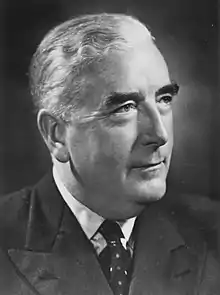
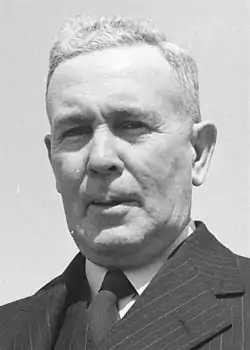
The 1951 Australian federal election was held in Australia on 28 April 1951. All 121 seats in the House of Representatives and all 60 seats in the Senate were up for election, due to a double dissolution called after the Senate rejected the Commonwealth Bank Bill.[1] The incumbent Liberal–Country coalition led by Prime Minister Robert Menzies defeated the opposition Labor Party led by Ben Chifley with a modestly reduced majority,[2] and secured a majority in the Senate.[3] This was the last time the Labor party ever held a Senate majority. Chifley died just over a month after the election.
.svg.png.webp) | ||||||||||||||||||||||||||||||||||||||||
| ||||||||||||||||||||||||||||||||||||||||
All 123[lower-alpha 1] seats of the House of Representatives 61 seats were needed for a majority in the House All 60 seats of the Senate | ||||||||||||||||||||||||||||||||||||||||
|---|---|---|---|---|---|---|---|---|---|---|---|---|---|---|---|---|---|---|---|---|---|---|---|---|---|---|---|---|---|---|---|---|---|---|---|---|---|---|---|---|
| Opinion polls | ||||||||||||||||||||||||||||||||||||||||
| Registered | 4,981,965  1.4% 1.4% | |||||||||||||||||||||||||||||||||||||||
| Turnout | 4,565,899 (92%) ( 5.1 pp) | |||||||||||||||||||||||||||||||||||||||
| ||||||||||||||||||||||||||||||||||||||||
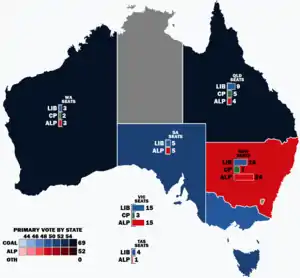 Popular vote by state with graphs indicating the number of seats won. Seat totals are not determined by popular vote by state but instead via results in each electorate. | ||||||||||||||||||||||||||||||||||||||||
| ||||||||||||||||||||||||||||||||||||||||

Issues
Although the Coalition had won a comfortable majority in the House in 1949, Labor still had a four-seat majority in the Senate. Chifley thus made it his business to obstruct Menzies's agenda at every opportunity. Realizing this, Menzies sought to call a double dissolution at the first opportunity in hopes of gaining control of both houses. He thought he had his chance in 1950, when he introduced a bill to ban the Australian Communist Party. However, after a redraft, Chifley let the bill pass.
A few months later, the Senate rejected the Commonwealth Bank Bill 1950, in which the Coalition government aimed to establish a "Commonwealth Bank Board", which Labor believed would be filled with private banking interests.[4] This finally gave Menzies an excuse to call a double dissolution. While the Coalition lost five House seats to Labor, it still had a solid mandate. More importantly, it picked up six Senate seats, giving it control over both chambers.
Results
House of Representatives
| Party | Votes | % | Swing | Seats | Change | ||
|---|---|---|---|---|---|---|---|
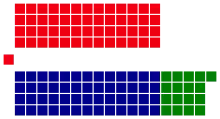
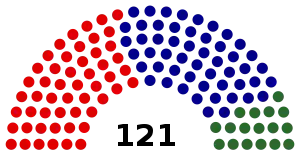
| Liberal–Country coalition | 2,298,512 | 50.34 | +0.08 | 69 | –5 | ||
| Liberal | 1,854,799 | 40.62 | +1.23 | 52 | –3 | ||
| Country | 443,713 | 9.72 | –1.15 | 17 | –2 | ||
| Labor | 2,174,840 | 47.63 | +1.65 | 54[lower-alpha 2] | +6 | ||
| Communist | 44,782 | 0.98 | +0.09 | 0 | 0 | ||
| Independents | 47,765 | 1.05 | –1.11 | 0 | –1 | ||
| Total | 4,565,899 | 123 | |||||
| Two-party-preferred (estimated) | |||||||
| Liberal–Country coalition | Win | 50.70 | −0.30 | 69 | −5 | ||
| Labor | 49.30 | +0.30 | 52 | +5 | |||
- Notes
- Three members were elected unopposed – two Labor and one Liberal.
Senate
| Party | Votes | % | Swing | Seats won | Seats held | Change | ||
|---|---|---|---|---|---|---|---|---|
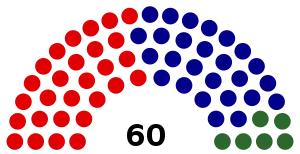
| Liberal–Country coalition | 2,198,687 | 49.70 | –0.71 | 32 | 32 | +6 | ||
| Liberal–Country joint ticket | 1,925,631 | 43.52 | –1.12 | 22 | N/A | N/A | ||
| Liberal | 273,056 | 6.17 | +0.41 | 10 | 26 | +5 | ||
| Country | N/A | N/A | N/A | N/A | 6 | +1 | ||
| Labor | 2,029,751 | 45.88 | +0.99 | 28 | 28 | −6 | ||
| Communist | 93,561 | 2.11 | +0.02 | 0 | 0 | 0 | ||
| Lang Labor | 60,549 | 1.37 | +1.37 | 0 | 0 | 0 | ||
| Protestant People's | 13,090 | 0.30 | –0.59 | 0 | 0 | 0 | ||
| Henry George Justice | 6,015 | 0.14 | +0.14 | 0 | 0 | 0 | ||
| Independents | 22,584 | 0.51 | –1.20 | 0 | 0 | 0 | ||
| Total | 4,424,237 | 60 | 60 | |||||
Seats changing hands
| Seat | Pre-1951 | Swing | Post-1951 | ||||||
|---|---|---|---|---|---|---|---|---|---|
| Party | Member | Margin | Margin | Member | Party | ||||
| Australian Capital Territory, ACT | Independent | Lewis Nott | 3.8 | 6.7 | 2.9 | Jim Fraser | Labor | ||
| Ballaarat, Vic | Liberal | Alan Pittard | 0.4 | 1.6 | 1.2 | Bob Joshua | Labor | ||
| Hume, NSW | Country | Charles Anderson | 1.0 | 1.3 | 0.3 | Arthur Fuller | Labor | ||
| Kingston, SA | Liberal | Jim Handby | 1.6 | 3.4 | 1.8 | Pat Galvin | Labor | ||
| Leichhardt, Qld | Country | Tom Gilmore | 1.0 | 1.3 | 0.3 | Harry Bruce | Labor | ||
| Wannon, Vic | Liberal | Dan Mackinnon | 0.8 | 1.9 | 1.1 | Don McLeod | Labor | ||
Opinion polling
| Primary vote[lower-alpha 3] |
|---|
See also
Notes
- The Northern Territory and Australian Capital Territory each had one seat, but members for the territories did not have full voting rights until 1966 and did not count toward government formation.
- Including Northern Territory and Australian Capital Territory
- Most of the gallup polls were adjusted to proportion the polls based around the two major party groups (Liberal/Country, Labor). Furthermore, the Country Party was not polled as an individual option but as a part of the Liberal/Country Coalition.
References
- "Chapter 21 – Relations with the House of Representatives". Odgers' Australian Senate Practice (14th ed.). Parliament of Australia. Simultaneous dissolutions of 1951. Retrieved 3 September 2022.
- "1951 House of Representatives". Psephos Adam Carr's Election Archive. Retrieved 29 May 2022.
- "Federal Election Results 1949-1993" (PDF). Parliament of Australia. Retrieved 28 June 2018.
- "Commonwealth Bank Bill". Cairns Post. 23 June 1950. p. 1. Retrieved 5 September 2022 – via Trove.
- University of WA Archived 18 January 2015 at the Wayback Machine election results in Australia since 1890
- AEC 2PP vote
- Prior to 1984 the AEC did not undertake a full distribution of preferences for statistical purposes. The stored ballot papers for the 1983 election were put through this process prior to their destruction. Therefore, the figures from 1983 onwards show the actual result based on full distribution of preferences.
| Federal elections | |
|---|---|
| Referendums | |
| |