Ömerli, Mardin
Ömerli (Syriac: ܡܥܨܪܬܗ, romanized: Maʿsarteh,[2][nb 1] Kurdish: Mahsertê,[5] Arabic: معسرتي)[2] is a town and the seat of Ömerli District in Mardin Province in southeastern Turkey.[6] It is located in the historical region of Tur Abdin.
Ömerli | |
|---|---|
 | |
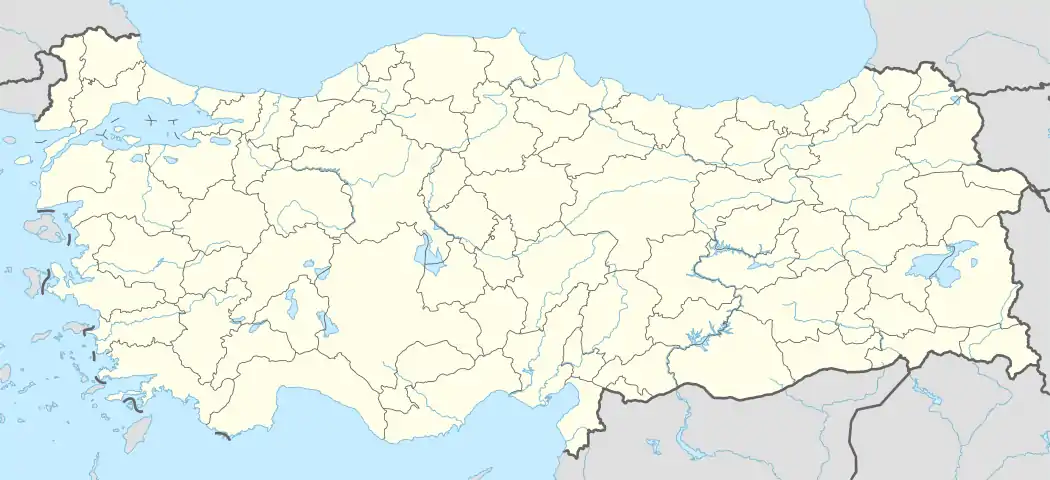  Ömerli Location in Turkey | |
| Coordinates: 37°24′09″N 40°57′22″E | |
| Country | Turkey |
| Province | Mardin |
| District | Ömerli |
| Government | |
| • Mayor | Hüsamettin Altındag (AKP) |
| Population (2021)[1] | 6,698 |
| Time zone | TRT (UTC+3) |
| Website | www.omerli.bel.tr |
In the town, there was a church of Saint George (Turkish: Mor Cercis Kilisesi).[7] The church of Saint George was later converted into a mosque.[4]
The town had a population of 6,698 in 2021.[1]
Etymology
The Syriac name of the town is derived from "ma'ṣartā" ("wine-press" in Syriac).[3] Maʿsarteh is identified as the town of Madaranzu in Bit-Zamani,[3] which was conquered by Ashurnasirpal II, King of Assyria, in 879 BC.[8] It is later mentioned by Theophylact Simocatta and George of Cyprus as Matzaron (Greek: Ματζάρων, Latin: Mazarorum).[3] In 1960, Maʿsarteh was officially renamed Ömerli.[9]
History
The town was likely captured by a Sasanian army in 573 at the time of the siege of Dara,[10] during the Roman-Sasanian War of 572-591, but was retaken and the fort was restored by the Roman commanders Theodore and Andrew in 587.[11]
Maʿsarteh was part of the Syriac Orthodox diocese of the Monastery of Saint Abai (Classical Syriac: ܕܝܪܐ ܕܡܪܝ ܐܒܝ, romanized: Dayro d-Mor Abay)[12] until the death of its last bishop Isḥoq Ṣaliba in 1730, upon which the diocese was subsumed into the diocese of Mardin.[13] German orientalist Eduard Sachau visited the town in 1880.[4] Until the Assyrian genocide, the town was exclusively populated by Assyrians of the Syriac Orthodox Church.[14] Survivors of the genocide fled to the Monastery of Saint Ananias.[15]
After the Assyrian genocide, Assyrians from Maʿsarteh emigrated to Bethlehem and Jerusalem.[16] By 1989, all Assyrian families had fled the town,[17] however, some later returned and, as of 2013, three Assyrian families inhabit the town.[18]
Presently, the town mostly consist of Kurds and Mhallami.[19][20] Of the two groups, the first ones to settle in the town were the Mhallamis who came from villages between Ömerli and Midyat such as Şenköy and Çavuşlu, while Kurds from the Bilikan tribe supposedly settled in the town due to blood feud. The Bilikan Kurds would become Arabophone over time and came to dominate local politics because of the size of their large families. They are plausibly the largest group in the town.[20]
Other groups in the town include Kurds from other tribes, Arabs, few Assyrians and Georgians, and civil servants of Turkish roots.[20]
According to the leaders of the Kurdish Omerkan (or Omeryan) tribe, who lives in the vicinity of the town, Ömerli had been under their rule for many years and considered the town to be in their territory. However, the town is not affiliated with any Kurdish tribe.[21]
Politics
In 1925, the town became the seat of a bucak (subdistrict) of Savur, and was elevated to district in 1953.[7] In January 2017 the towns mayor Süleyman Tekin was arrested.[22] In the local elections of 2019, Hüsamettin Altındağ from the Justice and Development Party was elected mayor.[23]
Notable people
- Ḥanna Salmān (1914-1981), Assyrian author[24]
References
Notes
Citations
- "31 ARALIK 2021 TARİHLİ ADRESE DAYALI NÜFUS KAYIT SİSTEMİ (ADNKS) SONUÇLARI" (XLS). TÜİK (in Turkish). Retrieved 16 December 2022.
- Carlson, Thomas A. (9 December 2016). "Maʿsarteh". The Syriac Gazetteer. Retrieved 15 May 2020.
- Lipiński (2000), pp. 141–142.
- Wannes (2006), p. 25.
- Avcıkıran (2009), p. 55.
- "Türkiye Mülki İdare Bölümleri Envanteri". T.C. İçişleri Bakanlığı (in Turkish). Retrieved 19 December 2022.
- Ömerli. Mardin Valiliği (in Turkish).
- Palmer (1990), p. 1.
- Aydin (2018), p. 104.
- Whitby & Whitby (1986), p. 69.
- Shahîd (1995), p. 552.
- Carlson, Thomas A. (6 February 2014). "Dayro d-Mor Abay". The Syriac Gazetteer. Retrieved 15 May 2020.
- Kiraz (2011b).
- Jongerden & Verheij (2012), p. 320.
- Brock (2017), p. 150.
- Calder (2015), p. 206.
- Atto (2011), p. 174.
- Courtois (2013), p. 145.
- Ghadban (2008), p. 86.
- Demircan, Adnan (2011). "Ömerli'de etnik yapı" (in Turkish). Istanbul University Faculty of Theology.
{{cite journal}}: Cite journal requires|journal=(help) - Tan, Altan (2018). Turabidin'den Berriye'ye. Aşiretler - Dinler - Diller - Kültürler (in Turkish). p. 289. ISBN 9789944360944.
- "Ömerli, Çatak Co-Mayors Arrested". Bianet. 5 January 2017.
- "Mardin Ömerli Seçim Sonuçları - 31 Mart 2019 Yerel Seçimleri". www.sabah.com.tr. Retrieved 2022-09-06.
- Kiraz (2011a).
Biography
- Atto, Naures (2011). Hostages in the Homeland, Orphans in the Diaspora: Identity Discourses Among the Assyrian/Syriac Elites in the European Diaspora (PDF). Leiden University Press. Retrieved 27 December 2019.
- Avcıkıran, Adem (2009). Kürtçe Anamnez, Anamneza bi Kurmancî.
- Aydin, Julius Hanna (2018). Die Vita des Reklusen Mor Jakob von Salah (in German). LIT Verlag Münster.
- Brock, Sebastian (2017). "A Historical Note of October 1915 Written in Dayro D-Zafaran (Deyrulzafaran)". In David Gaunt; Naures Atto; Soner O. Barthoma (eds.). Let Them Not Return: Sayfo – The Genocide against the Assyrian, Syriac and Chaldean Christians in the Ottoman Empire. pp. 148–157.
- Calder, Mark Daniel (2015). "We are the mother of the Arabs" : articulating Syriac Christian selfhood in Bethlehem. Retrieved 30 December 2019.
- Courtois, Sébastien de (2013). "Tur Abdin : Réflexions sur l'état présent descommunautés syriaques du Sud-Est de la Turquie,mémoire, exils, retours". Cahier du Gremmamo (in French). 21: 113–150.
- Ghadban, Ralph (2008). Die Libanon-Flüchtlinge in Berlin (PDF) (in German). Retrieved 30 December 2019.
- Jongerden, Joost; Verheij, Jelle (2012). Social Relations in Ottoman Diyarbekir, 1870-1915. Brill.
- Kiraz, George A. (2011a). "Salmān, Ḥanna". Gorgias Encyclopedic Dictionary of the Syriac Heritage: Electronic Edition. Gorgias Press.
- Kiraz, George A. (2011b). "Isḥoq Ṣaliba". Gorgias Encyclopedic Dictionary of the Syriac Heritage: Electronic Edition. Gorgias Press.
- Lipiński, Edward (2000). The Aramaeans: Their Ancient History, Culture, Religion. Peeters Publishers.
- Palmer, Andrew (1990). Monk and Mason on the Tigris Frontier: The Early History of Tur Abdin. Cambridge University Press.
- Shahîd, Irfan (1995). Byzantium and the Arabs in the Sixth Century, vol. 1, part 1: Political and Military History. Dumbarton Oaks.
- Wannes, Sűleyman (2006). Syrisk-ortodoxa kyrkan, en överblick över Institutioner, stiftelser och medlemmar, samt civila och profana organisationer i världen (PDF) (in Swedish). Retrieved 30 December 2019.
- Whitby, Michael; Whitby, Mary (1986). The History of Theophylact Simocatta. Clarendon Press.
Ömerli, Mardin in Mardin Province of Turkey | |||||||||||||||||||||||||||
|---|---|---|---|---|---|---|---|---|---|---|---|---|---|---|---|---|---|---|---|---|---|---|---|---|---|---|---|
| Districts |  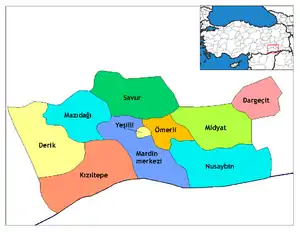 Districts of Mardin | ||||||||||||||||||||||||||
| |||||||||||||||||||||||||||
Metropolitan municipalities are bolded. | |||||||||||||||||||||||||||