Öğündük, İdil
Öğündük (Arabic: مدو; Kurdish: Midin; Syriac: ܡܝܕܘܢ, romanized: Midun)[2][nb 1] is a village in the İdil District of Şırnak Province in Turkey.[5] The village is populated by Assyrians and Kurds and had a population of 367 in 2021.[1][6]
Öğündük | |
|---|---|
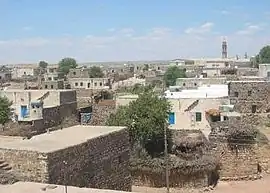 Village | |
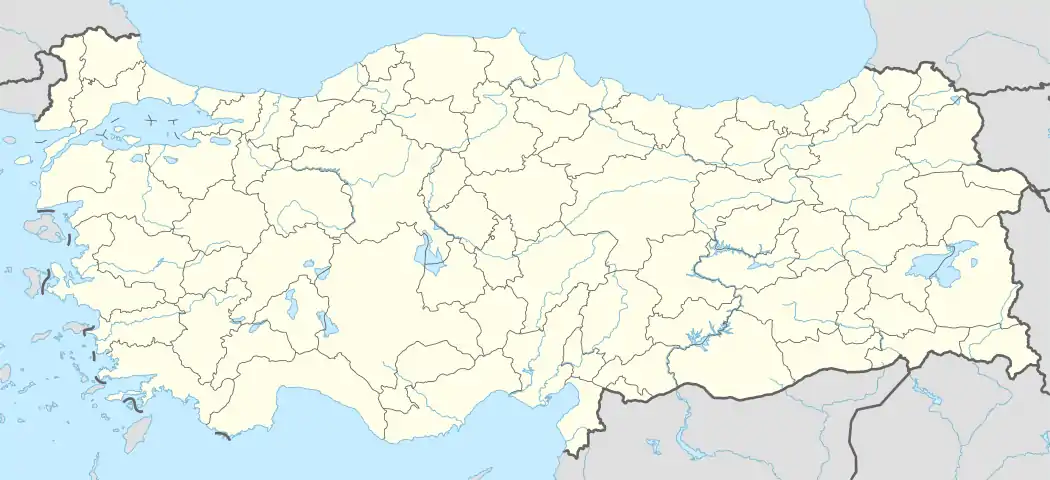  Öğündük Location in Turkey | |
| Coordinates: 37.338°N 41.746°E | |
| Country | Turkey |
| Province | Şırnak |
| District | İdil |
| Population (2021)[1] | 367 |
| Time zone | TRT (UTC+3) |
It was historically an Assyrian village with the presence of thirty-one different clans. Kurds of the Domanan tribe later settled in the village and the Assyrians went under the patronage of the tribe. In present time, a large majority of the Assyrian population has left the village and some Assyrian families consider themselves part of the Domanan tribe.[7]
History
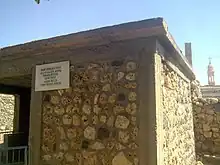
Midun (today called Öğündük) was probably named after the nearby Roman border fort of Mindon by the border with the Sasanian Empire in the Melabas Hills of Tur Abdin.[8][nb 2] The efforts of the Roman general Belisarius to construct the fort in 528 prompted a battle in which the Romans were defeated as per Procopius' History of the Wars.[9]
The village was attacked by Bakhtis in 1453 and again in 1457; in the second attack, many of its inhabitants, including the priests Behnam and Malke, were killed, according to the account of the priest Addai of Basibrina in c. 1500.[10] Midun was later looted by the emir Bidayn in 1714 and the Kurdish rebel Yezdanşêr in 1855.[11]
A section of the village called Sanhatkar was settled by Armenians who had fled from Palu due to the Hamidian massacres.[12] It was visited by the English traveller Mark Sykes in the early 20th century.[13]
A significant number of the village's Assyrian population emigrated abroad to Germany, Switzerland, and Belgium in the late 20th century.[14] In 1999, Öğündük was inhabited by 50 Assyrian families.[14] In 2007, 257 Assyrians in 50 families inhabited Öğündük.[14]
References
Notes
Citations
- "31 ARALIK 2021 TARİHLİ ADRESE DAYALI NÜFUS KAYIT SİSTEMİ (ADNKS) SONUÇLARI" (XLS). TÜİK (in Turkish). Retrieved 16 December 2022.
- Carlson, Thomas A. (9 December 2016). "Midun — ܡܝܕܘܢ". The Syriac Gazetteer. Retrieved 27 December 2022.
- Barsoum 2003, p. 559; Barsoum 2008, p. 133.
- Jongerden & Verheij (2012), pp. 246, 323.
- "Türkiye Mülki İdare Bölümleri Envanteri". T.C. İçişleri Bakanlığı (in Turkish). Retrieved 19 December 2022.
- Tan (2018), p. 159.
- Baz 2016, p. 473; Tan 2018, p. 159.
- Palmer (1990), p. 5.
- Lillington-Martin (2012), pp. 4–5.
- Barsoum (2008), pp. 70–71.
- Barsoum (2008), pp. 131, 133.
- Jongerden & Verheij (2012), p. 249.
- Sykes (1915), pp. 355–356.
- Courtois (2013), p. 147.
Bibliography
- Barsoum, Aphrem (2003). The Scattered Pearls: A History of Syriac Literature and Sciences. Translated by Matti Moosa (2nd ed.). Gorgias Press. Retrieved 14 July 2020.
- Barsoum, Aphrem (2008). The History of Tur Abdin. Translated by Matti Moosa. Gorgias Press. Retrieved 1 April 2021.
- Baz, Ibrahim (2016). Şırnak aşiretleri ve kültürü (in Turkish). p. 473. ISBN 9786058849631.
- Courtois, Sébastien de (2013). "Tur Abdin : Réflexions sur l'état présent descommunautés syriaques du Sud-Est de la Turquie,mémoire, exils, retours". Cahier du Gremmamo (in French). 21: 113–150.
- Jongerden, Joost; Verheij, Jelle (2012). Social Relations in Ottoman Diyarbekir, 1870-1915. Brill.
- Lillington-Martin, Chris (2012). "Hard and Soft Power on the Eastern Frontier: a Roman Fortlet between Dara and Nisibis, Mesopotamia, Turkey, Prokopios' Mindouos?" (PDF). The Byzantinist (2): 4–5. Retrieved 27 December 2022.
- Palmer, Andrew (1990). Monk and Mason on the Tigris Frontier: The Early History of Tur Abdin. Cambridge University Press. Retrieved 15 July 2020.
- Sykes, Mark (1915). The Caliphs' Last Heritage: A Short History of the Turkish Empire. Retrieved 27 December 2022.
- Tan, Altan (2018). Turabidin'den Berriye'ye. Aşiretler - Dinler - Diller - Kültürler (in Turkish). p. 159. ISBN 9789944360944.