Armament

| This article or section is a stub. You can help "A Wiki Of Ice And Fire" by expanding it and/or improving existing text. We need the whole deal, lead sections to improve flow, reference, rewriting, explanations etc, for reference see Concordance and french version and obviously the books, but generally be bold. |
Armies
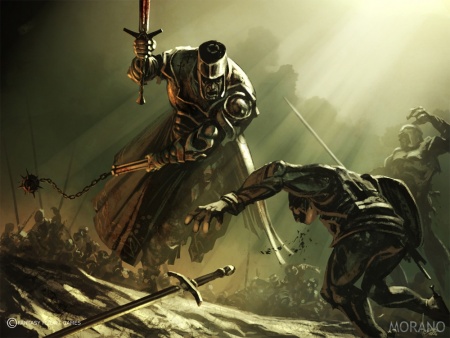
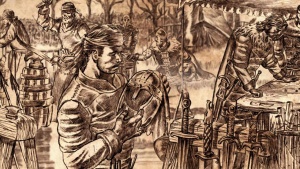
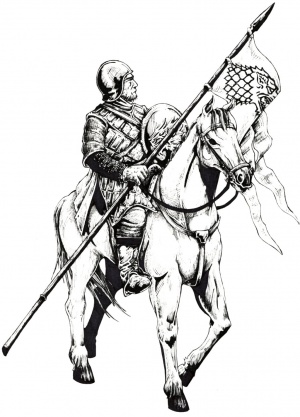
While Westeros is a continent wholly created from the imagination of George R. R. Martin, the nature of the armies is firmly based on historical precedent. Those of the Northmen for example are apparently based on northern English medieval armies (with an eastern European influence regarding knights), while those below the Neck appear to be rooted in English, German, and French practice, though the Westerosi culture is sufficiently too different to make any single comparison solid.
Weapons
The weapons carried generally reflect those of the prototype armies and by far the most common is the sword. This is to a very real extent the mark of a soldier and so carried by all, although it may not necessarily be the soldier's primary weapon.
Castle-forged weapons are of high quality, generally better than those produced by smiths in the cities. However, usually only knights and nobles can afford them. The rarest and most desired swords are those forged in Old Valyria, of Valyrian steel. These swords are stronger, lighter, and sharper than all others (except perhaps for Dawn), and the steel is typically dark, almost black. The secrets of forging them have been lost and there are perhaps only a couple of hundred of them left in Westeros, mostly as prized heirlooms by noble houses.
Other weapons are also common. Almost everyone carries a knife or dagger, as they are useful and practical in many circumstances. Effective spears and mauls are relatively cheap to make and are, thus, popular weapons for men-at-arms. A cheap spear can still be a good weapon; the same cannot be said of a cheap sword.
Polearms
- Halberd: The halberd has a heavy, cleaver-like blade at the top of a long shaft. It usually has a spike at the top of the shaft and a thorn or a hook opposite to the blade.
- Poleaxe: A Poleaxe has an axehead opposite to a hammer or a spike, mounted on a shaft. The shaft usually has a spike on both ends.
Axes & Hammers
- Battle-axe: A wicked, broad-headed axe, used to cleave through armor and shields. It can be wielded in one hand, and some battle-axes are double-bladed.[1]
- Hand Axe: A warrior’s version of a hatchet, smaller than a battle-axe and balanced to be thrown. These short-hafted axes are used by the ironmen to dance the finger dance.
- Longaxe: A long-hafted version of the battle-axe. The longaxe is light enough to be wielded by one hand.[2] A longaxe may have a double-bladed axe head or it may have a spike on one side.[3] It is likely that some longaxes are large enough to require two hands, such as the one wielded by Areo Hotah.
- Woodsman’s Axe: A woodsman’s tool for chopping and splitting wood, this axe can easily turn into a deadly weapon. Normally used by smallfolk and brigands, it is single-bladed and smaller than its martial cousin, the battle-axe.
- Club/Cudgel: A short club fashioned of hard wood or sometimes metal. The City Watch of King's Landing is armed with iron cudgels.
- Mace: A blunt crushing weapon designed to smash armor, a mace consists of a heavy head of stone or metal set upon a wooden or metal shaft. The head is often flanged or knobbed to better penetrate armor.[4]
- Warhammer: Usually about the same length as a mace (though they can be much longer), the head is made of hardened steel that has a long spike to one side and a small mace-like counterweight on the other. Warhammers are good for piercing armor, or hooking the enemies' reins or shields.
Swords
- Arakh: Dothraki warriors favor this long curved sword.[5] It is a type of sword with no guard and a curved blade resembling a scythe.
- Shortsword: Shorter than a longsword but longer and heavier than a dagger, the shortsword is a one-handed blade generally meant for thrusting.
- Falchion: A short, cleaver-like sword used for hacking.
- Braavosi Blade: Slender swords, edged and balanced for the thrust.[6] The Water Dancers of Braavos have made these narrow swords famous, though they can be found throughout the Free Cities.
- Longsword: A common weapon of knights throughout Westeros, these one-handed blades are also known as broadswords or simply "swords." The blades are about three feet in length, double-edged, and mounted on a hilt with a heavy pommel and a sizable crossguard.
- Bastard Sword: Neither a longsword nor a greatsword, the bastard sword is named for its lack of family. It has a longer blade and a more elongated grip than a longsword. However, the longer hilt is not as large as that of a greatsword and it is meant for the off-hand to provide a bit more leverage. Thus, the bastard sword is more of a hand-and-a-half weapon than a two-handed sword.[7]
- Greatsword: The greatsword requires two hands to use. It is the largest type of sword.
Projectile Weapons
- Bow: Bows in the Seven Kingdoms are made from wood, though bows from more exotic lands may be made from laminated horn or bone.[8] Bows are difficult to use while mounted and cannot normally be used with any accuracy if the mount is moving.
- Longbow: The longbow is cut from a single piece of wood approximately six feet long, and when drawn back to the chin or ear will have a draw-weight of upwards of 100lb, sufficient to carry a shaft 250 yards or so, even to drive one through plate armor at very close range. Longbows will be used by most of the armies (and indeed unless someone is specifically mentioned as carrying a crossbow it can be safely assumed that all archers are longbowmen).
- Bow, Double-Curved or Recurved: This small bow is double-curved and made from laminated horn, wood, or bone (hence it is also called a "Composite Bow" sometimes). Double-curved bows are mostly favoured in Dorne, but they can be found in many places throughout the world. The Dothraki especially favor them, alongside the Dornishmen. Double-curved bows can be fired from horseback (primarily to lay an arrow storm, rather than pick individuals), and can achieve draw-weights comparable to longbows.
- Crossbow: Crossbows are shorter bows that shoot bolts or quarrels. There is a stock attached to the bow with a mechanical assist to draw the bowstring. Due to its shorter draw, the crossbow requires a higher draw weight to give the same amount of energy as a conventional bow. The drawing mechanism can be a stirrup with a winch or a crank. The Myrish produce ungainly crossbows capable of firing three quarrels at a time. [9]
Spears
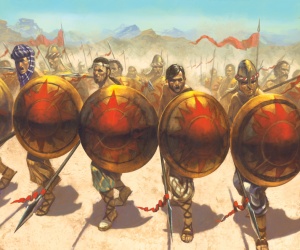
- Spear: A simple weapon used for hunting and combat, comprising a wooden shaft up to 10 feet long tipped with a relatively small head of iron or steel. It can be used for individual combat.
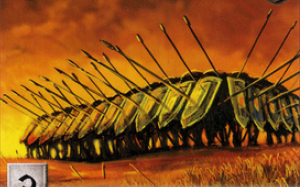
- Pike: A pike is a longer spear, normally 10-15 feet long. This weapon is characteristic of the Northern armies in particular and is used by large bodies of infantry operating together either to push through or over opposing infantry or hold off cavalry.[10]
- Spear, Boar: A short version of the spear, the boar spear features a large blade and has a cross-piece just behind the head to prevent it from penetrating too deeply. Sometimes favoured by infantry officers it is as the name indicates primarily a hunting weapon
- Spear, Frog: A weapon used by the Crannogmen, these small spears end in three prongs and are primarily used for hunting frogs and other small prey in the Neck, but they can just as easily be adapted to fight men. Frog spears can also be thrown.
- Flail: A military cousin to the farmer’s tool, a warrior’s flail is a length of chain attached to a rod. At the end of the chain is a heavy metal head, either blunt like a mace or spiked like a morning star.
- Morningstar: Cousin to the flail and ball and chain, a morningstar is a length of chain connected to a rod at one end and bears a spiked ball at the other.
Miscellaneous
- Dagger: A long knife used to stab and pierce, often carried as a tool as much as a weapon.
- Dirk: A dagger designed for combat with a straight, narrow blade, often used in the off-hand to complement a primary weapon.[11]
- Net: Made of strong rope, a net is typically a tool to catch fish or birds. Some people have adapted them for fighting, such as the crannogmen from the Neck, who use them to ensnare opponents or entangle weapons.[12]
- Peasant Tool: Peasants rarely could afford traditional weapons and generally fought with what was at hand: sticks, clubs, tools or their bare hands, those weapons are of poor quality.
- Lance, War: A weapon of knights and heavy cavalry, lances are normally 8-10 feet long, made of turned ash, and banded to prevent splitting. The lance is tipped with a sharpened steel point and is normally used for a single charge before becoming too unwieldy in close combat.
- Lance, Tourney: Tourney lances are longer and more fragile than their battlefield cousins. Their tips are blunted to better unhorse an opponent without causing serious harm, and they are unbanded, meaning that they will often break upon impact. A tourney lance is normally 12-14 feet long[13] and may be made from a prettier wood, such as golden wood from the Summer Isles.[14][15]
- Khukuri Knife: A weapon of Nepalese origin used in the Middle to Far East. It is made of varying grades of steel. It is most recognizable for its inward bending cutting edge. This aggressive design helps the combatant in close quarters combat (CQC). A Khukuri style knife is seen in the Blackwater episode of season 2 of GoT. It is carried by Bronn at his lower back during the bar scene with the Hound.
Special Items
- Bronze Armor: A relic of the Age of Heroes. Not as good as modern armor.
- Dragonglass: Volcanic material that can be fractured to create sharp knife blades or arrowheads, one of the few known weaknesses of the Others.
- Dragonbone: Dragonbone bows are highly sought after as they can fire arrows over a much farther range than normal wooden bows and especially prized by the Dothraki.
- Valyrian Steel: Although extremely rare, thousands of Valyrian steel weapons survived the Doom of Valyria, perhaps two hundred or more being in the Seven Kingdoms. Most Valyrian steel weapons are storied and highly prized, considered priceless by even impoverished houses, a minor lord is far more willing to sell off a daughter than a family weapon.
See also List of known Valyrian and famous Swords
Armor
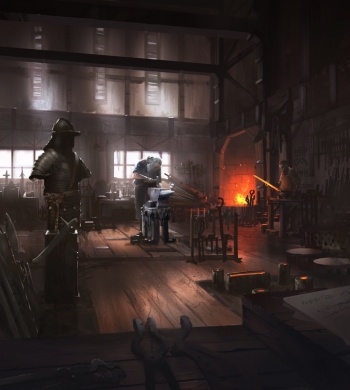
Armor in Seven Kingdoms is commonly forged from iron and steel. Occasionally one may find an ancient piece of armor forged from bronze, but that is a great rarity today. Advanced full plate and scale armor, made of relatively light weight steel, is also available to those with the proper funds.
Additional ornamentation can be quite elaborate. Common methods involve paints, enamels, or bluing the steel. A truly skilled blacksmith, however, can work colour into the metal itself to ensure that it does not chip or flake off. Such work is expensive and can be afforded only by the nobility. In the real world, the technological level is comparable to the late medieval and early renaissance, which is quite advanced "for the time" in Westeros.
The most effective, and expensive, armor is plate armor, which consists of a number of shaped plates of steel fitted to the body. Plate is normally worn over chainmail and an undercoat padded leather. Those who cannot afford plate may wear chainmail and leather, and this coverage still provides good protection. It is also common to wear only partial plate; a plate helm, for example, is common, as are breastplates and gorgets. Scale armor is also known but considerably less common. Armor made of boiled leather is sometimes worn by itself, particularly by scouts and levied men-at-arms. While better than nothing, it cannot stop an on-target sword blow, whereas plate armor can.
Plate armor is more common in the Reach, while mail is more the rule in the North, and the wildlings beyond the Wall are much more primitively armored. [16] The Dornish use a lot of copper armor, but mainly for ornamental purposes. It's very pretty flashing in the sun - as pretty as gold - but cheaper. [17]
Known Armor Types
- Padded armor: Made of leather or canvas, which has been stuffed with cloth. This can be worn by itself, often called a gambeson, but is essential when wearing mail in order to absorb blows more readily.[18]
- Boiled leather armor: Used by GRRM to denote thick leather, boiled in water, and usually worn under mail. In reality such leather would be dressed with oil to retain its flexibility. Boiled leather will set very hard and was moulded into rounded pieces to protect shoulders, elbows and knees before the ready advent of plate armor.[19]
- Brigandine: Also known as Jack, is a cloth garment, generally canvas or leather, lined with small oblong steel plates riveted to the fabric. Commonly worn by: freeriders, mounted bowmen, and men-at-arms. (III: 841. IV: 133)
- Hauberk: A chainmail shirt, the hauberk includes sleeves and can extend as low as the knees. The hauberk is typically constructed of interlocking whoops of metal sewn into a shirt or a tunic. The sleeves of a hauberk often reach the elbow, though the sleeve length varies. The hauberk tends to be made of iron rings, and is generally worn over a padded undercoat, or boiled leather.[20]
- Byrnie: Made of chainmail. Byrnies are generally distinguished from hauberks by their sleeve length (a byrnie has only short sleeves). There are doubts about the exact definition (and length) of a historical byrnie, but both in Westeros and in history byrnies are some variety of armor jacket or a shirt. Oberyn Martell's is specifically described as chainmail.[21]
- Scale armor: A garment with hundreds of small plates stitched and riveted onto it.[20]
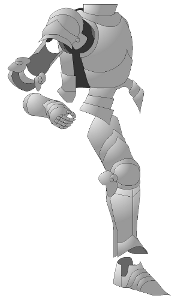
- Heavy plate armor: Worn over mail and a padded surcoat. Large rondels protect the juncture of arm and breast.[22] The vulnerable points are at the less protected joints, places at elbows, knees, and beneath the arms.[21]
Specific Parts
- Greathelm: simple cylinder with a flat top and sometimes rounded top to better deflect blows.[4][13] It has small slits for eyes and breathing/ventilation[23], that impedes sight and breathing, mostly used by knight's during the "clash of lances".
- Halfhelm: A round helm covering the top of the head, often incorporating a nasal guard.[22]
- Kettle helm: A helm made of steel in the shape of a brimmed hat.[24]
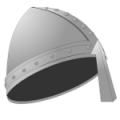 Halfhelm
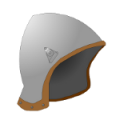 A visorless helmet
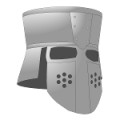 A relatively primitive type of greathelm
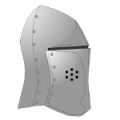 Greathelm
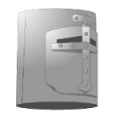 A flat-topped greathelm
- Gorget: A Steel collar that protects the neck.[22]
- Rondels: A Circular piece of metal used for protection of vulnerable points, typically used to cover the juncture of arm and breast.[22]
- Gloves: Protective covering for hands.[25] Made of leather, or mail to offer additional protection.[26]
- Gauntlets: Large metal gloves that cover the hand from fingers to forearm, generally made of steel plate.
- Skirts: A metal skirt designed to protect the upper legs and lower torso. Generally covers the body from waist to midthigh.[22]
- Greaves: Greaves cover the lower legs.[25]
- Schynbalds: Plate that covers only the shins, not the whole lower leg.[22]
- Boots: Boots are generally made of leather, but the ones worn by knights are made of metal to provide protection.[27]
- Spurs: Tools worn on the heel of the boots, used to direct a horse.
- Vambraces: Tubular protection for the forearm.
- Cuirass: A piece of solid plate armor worn over the chest and back, tightened at the sides. It is forged from steel, iron or bronze. It is a vital piece of defensive equipment worn by most knights and highborn combatants. Notably, Queen Cersei Lannister is seen wearing a cuirass during the battle of Blackwater episode of Game of Thrones Season 2. Hers appears to be gilded and more ceremonial in nature, as fits a woman of her status.
Shields
Westeros has a varied collection of Shields, from simple Wooden Shields, which are light, easy to use but don't provide much protection, to heavy triangular shields, almost four feet tall, made of heavy oak and studded with iron.[22] Stretching layers of hardened leather over the shields[18] and adding metal thin strips for reinforcements[27] improve durability and protection, without adding much weight. In Dorne and probably in Braavos small light weight round metal shields called bucklers are used. This is about the size of a plate and held in the left hand to parry sword blows in fencing.
Kite shields, considered old-fashioned since the Conquest, carried by the Warrior's Sons.[28]
Costs
- A new hauberk of mail, gorget, greaves, and greathelm made by a good smith can cost 800 silver stags.[13]
War Horses & Transportation
- Destrier: Destriers are tall, strong, splendid animals and are often high spirited. Destriers give knights a majestic air at tournaments. They are normally the most valuable type of horse, being well bred and highly trained. Some even consider them too valuable to risk in war thus the courser is the preferred mount for fighting.
- Courser: Lighter than a destrier and less costly, coursers are still beautiful animals. Coursers are also strong and fast.
- Garron: North of the Wall, Garrons are the only reasonable choice of horse (although other, rarer horselike animals might perhaps exist). Both the Night Watch and its enemies use them in considerable numbers, both for riding and carrying cargo. Among horses, garrons are notable for their capability to deal with irregular terrain and cold temperatures.
- Rounsey: Lowest of all is the rounsey, a strong and capable steed of no particular breeding. Although rounseys are perfectly capable war horses, they are relegated to hedge knights, squires, and non-knightly men-at-arms. Rounsey are common riding horses and may also be used as pack animals.
- Sand Steed: Smaller than normal warhorses and cannot bear the weight of the armor a warhorse usually wears. They are able to run for a day and a half before tiring
Mounts and Pack Animals
- Mule: A hardy pack animal, used for light transport. Remarkable capability for dealing with irregular terrain.
- Oxen: A hardy pack animal, used for heavy transport.
Siege Weapons
Besieging armies use a wide variety of siege engines such as: scaling ladders, battering rams on wheels, wheeled siege towers covered in rawhide and various types of catapults, trebuchets, mangonels, spitfires, and scorpions. Some are mounted on warships. [2]
Scorpions and spitfires are used in the defense of a city.[29] Steel caltrops are used in warfare and the defense of encampments, and can be flung with trebuchets at enemies (II: 375. III: 721) Scorpions shoot out yard-long iron-headed shafts[30] and can be prepared with fire, making fire spears[31], Additionally Iron spikes may be set underwater to hamper crossings.[32]
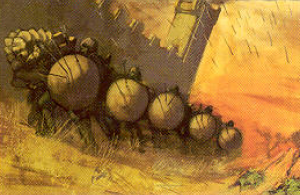
- Battering rams, Wooden turtles on wheels, often covered with hide to protect them from fire, can be used for sieges to protect men assaulting a gate.[33][34]
- Trebuchets such as the Three Whores
Tactics
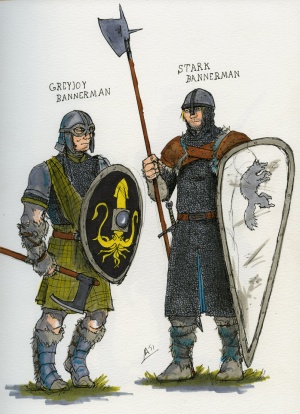
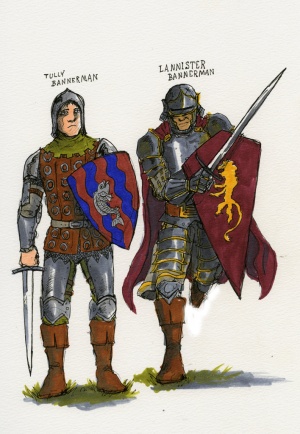
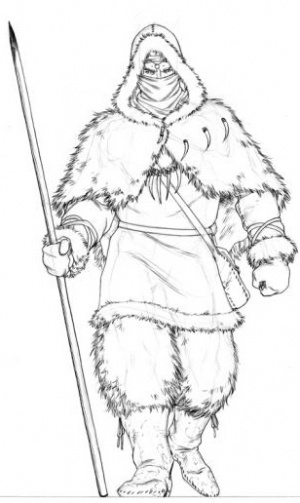
Westeros
Archers
- Skilled archers can shoot a small target accurately at 100 paces.[14] In battle however they normally tried to create what was called an arrow storm, shooting as many arrows as possible into the air as quickly as possible to drop them on to large bodies of enemy troops rather than shoot at individuals.
- Dothraki bows supposedly outrange those of the Seven Kingdoms, but this remains to be tested.[35]
- Arrowheads are normally available both as broadheads with a sharp cutting edge and barbs at the rear for "soft" targets[36] and bodkins which will penetrate mail.[37]. Except at very close range arrows will not normally penetrate plate armor, but crossbow bolts will do so easily.
- The double-curved goldenheart bows used by Summer Islanders are said to be able send a shaft four hundred yards [38]
- Archers might smear their arrows with night soil to try and ensure that they poison those they wound, but many arrow wounds will become infected simply because when shooting quickly to create an arrow storm archers would stick their shafts in the ground rather than drawing them from their belt.[39]
Cavalry
Cavalry figure prominently in the story and a good mediaeval model for Westerosi troops raised between the Neck and the Dornish Marches is provided by a 1364 muster of the troops belonging to the Duchy of Burgundy (the original French one before it expanded):
The troops comprised one chevalier banneret - in Westerosi terms a sworn bannerman
134 chevaliers/knights
105 ecuyers/squires
19 mounted archers
1 trumpeter
1 farrier
The only infantry were those 19 archers who rode horses to keep up with the rest on the march but dismounted to shoot.
Light Cavalry
Light cavalry consisted usually of lighter armed and armored men, who could have lances, javelins or missile weapons, such as bows. they tend to be in leather and mail.[40] Light cavalry was used as scouts, outriders, skirmishers or outflankers. Many countries developed their own styles of light cavalry, such as Dothraki and Dornishmen.
Knights and Heavily Armed Cavalry
Knights are usually the best outfitted and trained soldier in the field, who could afford plate armor and a varied assortment of hand weapons. They are usually deployed as Heavily armed cavalry armed with lances. It Consisted of wealthy knights and noblemen who could afford the equipment and non-noble squires employed by noblemen.
"Common Outfitting"
- Common warriors may use short swords, double-bladed axes, bows, and other weapons[11]
- Plate armor is more common in the Reach, while mail is more the rule in the North, and the wildlings beyond the Wall are much more primitively armored (SSM: 1)
- Jacks, a sort of armor such as freeriders, mounted bowmen, and men-at-arms might wear [41] [42]
- Most freeriders have poor armor, usually made of boiled leather.[19]
- The City Watch of King's Landing, use iron cudgels and spears topped by black iron heads.[43] Wear cloaks, usually made of heavy wool, dyed gold.[43]
- The Crannogmen of the Neck, use frog spears, bronze knives, woven nets, and round leather shields [12]
- The Dornishmen prefer round metal shields, spears, short throwing spears or the double-curved bows, they wear lighter armor than in the rest of the Seven Kingdoms made of metal disks, sewn in the manner of scales on the leather and turbaned helmets.
- The Dothraki have only a light cavalry armed with arakh, and short bows suitable for shooting mounted. They do not use any protection, either in the form of shields, helmets and armor.
- The Unsullied, are light infantry, equipped with short spears, swords, round shields, and distinctive spiked caps.
Of Old
- The children of the forest used knives, leaf-shaped spear heads, and arrows made of obsidian (which is also known to smallfolk as dragonglass) [45] [46] [47]
- It is not part of the Old Way to lay siege to castles. Glory can only be gotten by fighting man to man, not by flinging rocks [48]
Miscellaneous
Forging Techniques
- Oilstones are used to sharpen blades [50]
- Some to claim to still know the spells that must be used to rework Valyrian steel, and some master armorers have revealed their ability to properly reforge it [51][52] [53]
See Also
Notes
Note, Weapon/Armor types references refer to where these type where mentioned in the book, while some of their desription are based on real-life equivalents.
References
- ↑ A Clash of Kings, Chapter 23, Jon III.
- 1 2 A Clash of Kings, Chapter 22, Catelyn II.
- ↑ A Storm of Swords, Chapter 51, Catelyn VII.
- 1 2 A Game of Thrones, Chapter 61, Daenerys VII.
- ↑ A Game of Thrones, Chapter 11, Daenerys II.
- ↑ A Game of Thrones, Chapter 10, Jon II.
- ↑ A Game of Thrones, Chapter 60, Jon VIII.
- ↑ A Clash of Kings, Chapter 68, Jon VIII.
- ↑ A Clash of Kings, Chapter 25, Tyrion VI.
- ↑ A Game of Thrones, Chapter 53, Bran VI.
- 1 2 A Game of Thrones, Prologue.
- 1 2 A Clash of Kings, Chapter 21, Bran III.
- 1 2 3 The Hedge Knight.
- 1 2 A Game of Thrones, Chapter 30, Eddard VII.
- ↑ A Feast for Crows, Prologue, 6.
- ↑ So Spake Martin: Yet More Questions (July 22, 2001)
- ↑ So Spake Martin: [http://www.westeros.org/Citadel/SSM/Entry/1226 Ibben and Armor (November 09, 2002)
- 1 2 A Game of Thrones, Chapter 26, Jon IV.
- 1 2 A Clash of Kings, Chapter 31, Catelyn III.
- 1 2 A Game of Thrones, Chapter 15, Sansa I.
- 1 2 A Storm of Swords, Chapter 70, Tyrion X.
- 1 2 3 4 5 6 7 A Game of Thrones, Chapter 40, Catelyn VII.
- ↑ A Game of Thrones, Chapter 31, Tyrion IV.
- ↑ A Storm of Swords, Chapter 73, Jon X.
- 1 2 A Game of Thrones, Chapter 35, Eddard IX.
- ↑ A Game of Thrones, Chapter 63, Catelyn X.
- 1 2 A Game of Thrones, Chapter 62, Tyrion VIII.
- ↑ A Feast for Crows, Chapter 36, Cersei VIII.
- ↑ A Clash of Kings, Chapter 17, Tyrion IV.
- ↑ A Clash of Kings, Chapter 57, Sansa V.
- ↑ A Storm of Swords, Chapter 64, Jon VIII.
- ↑ A Clash of Kings, Chapter 39, Catelyn V.
- ↑ A Storm of Swords, Chapter 57, Daenerys V.
- ↑ A Storm of Swords, Chapter 69, Jon IX.
- ↑ A Game of Thrones, Chapter 36, Daenerys IV.
- ↑ A Game of Thrones, Chapter 37, Bran V.
- 1 2 A Storm of Swords, Chapter 39, Arya VII.
- ↑ A Feast for Crows, Chapter 35, Samwell IV.
- ↑ A Feast for Crows, Chapter 38, Jaime VI.
- ↑ A Game of Thrones, Chapter 59, Catelyn IX.
- ↑ A Storm of Swords, Chapter 73, Jon X, page 841.
- ↑ A Feast for Crows, Chapter 9, Brienne II.
- 1 2 A Game of Thrones, Chapter 65, Arya V.
- ↑ A Clash of Kings, Chapter 29, Tyrion VII.
- ↑ A Game of Thrones, Chapter 66, Bran VII.
- ↑ A Clash of Kings, Chapter 34, Jon IV.
- ↑ A Feast for Crows, Prologue.
- ↑ A Clash of Kings, Chapter 37, Theon III.
- ↑ A Clash of Kings, Chapter 56, Theon V.
- ↑ A Game of Thrones, Chapter 42, Tyrion VI.
- ↑ A Game of Thrones, Chapter 27, Eddard VI.
- ↑ A Storm of Swords, Chapter 32, Tyrion IV.
- ↑ So Spake Martin: Producing Valyrian Steel (March 11, 2001)