Outline of space science
The following outline is provided as an overview and topical guide to space science:
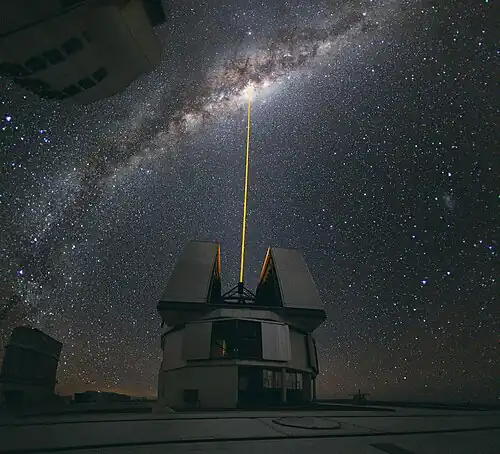
A laser-guided observation of the Milky Way Galaxy at the Paranal Observatory in Chile in 2010
Space science encompasses all of the scientific disciplines that involve space exploration and study natural phenomena and physical bodies occurring in outer space, such as space medicine and astrobiology.[1][2]
Branches of space sciences
Astronomy
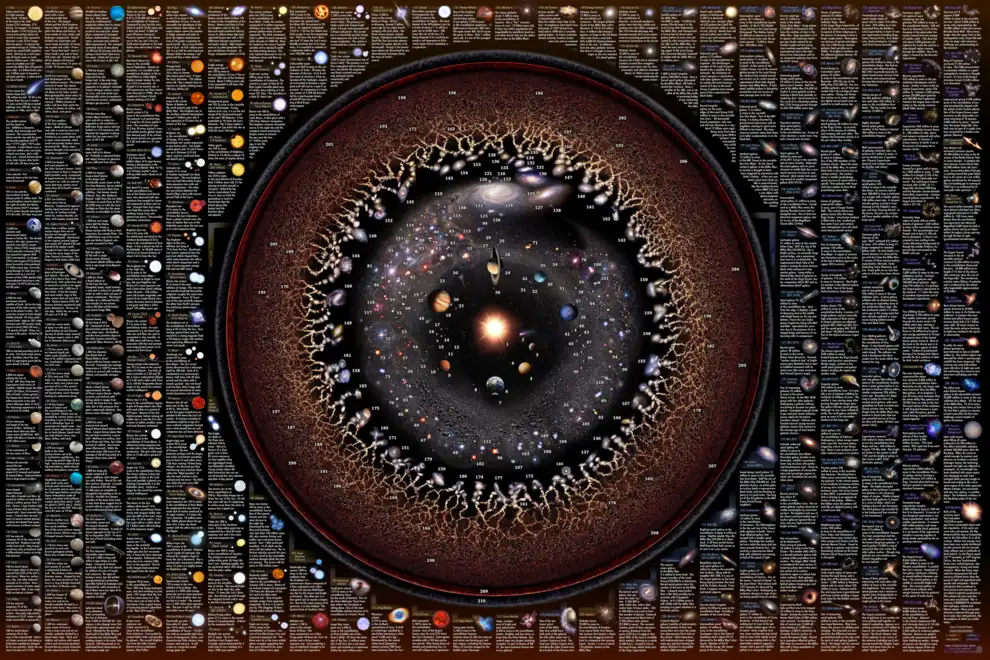
The diversity found in the different types and scales of astronomical objects make the field of study increasingly specialized.
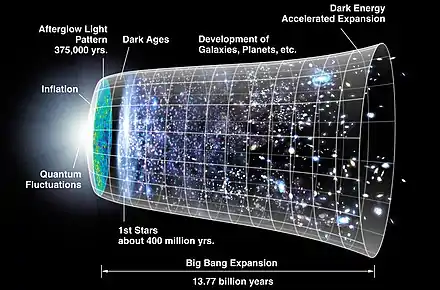
A proposed timeline of the origin of space, from physical cosmology
See astronomical object for a list of specific types of entities which scientists study. See Earth's location in the universe for an orientation.
- Subfields of astronomy:
- Astrophysics – branch of astronomy that deals with the physics of the universe, including the physical properties of celestial objects, as well as their interactions and behavior.[3] Among the objects studied are galaxies, stars, planets, exoplanets, the interstellar medium and the cosmic microwave background; and the properties examined include luminosity, density, temperature, and chemical composition. The subdisciplines of theoretical astrophysics are:
- Computational astrophysics – The study of astrophysics using computational methods and tools to develop computational models.
- Plasma astrophysics – studies properties of plasma in outer space.
- Space physics – study of plasmas as they occur naturally in the Earth's upper atmosphere (aeronomy) and within the Solar System.
- Solar physics – Sun and its interaction with the remainder of the Solar System and interstellar space.
- Stellar astronomy – concerned with Star formation, physical properties, main sequence life span, variability, stellar evolution and extinction.
- Galactic astronomy – deals with the structure and components of our galaxy and of other galaxies.
- Extragalactic astronomy – study of objects (mainly galaxies) outside our galaxy, including Galaxy formation and evolution.
- Cosmology
- Physical cosmology – origin and evolution of the universe as a whole. The study of cosmology is theoretical astrophysics at its largest scale.
- Chemical cosmology - study of the chemical composition of matter in the universe and the processes that led to those compositions.
- Quantum cosmology – the study of cosmology through the use of quantum field theory to explain phenomena general relativity cannot due to limitations in its framework.
- Planetary Science – study of planets, moons, and planetary systems.
- Atmospheric science – study of atmospheres and weather.
- Planetary geology
- Planetary oceanography
- Exoplanetology – various planets outside of the Solar System
- Astrochemistry – studies the abundance and reactions of molecules in the Universe, and their interaction with radiation.
- Astrophysics – branch of astronomy that deals with the physics of the universe, including the physical properties of celestial objects, as well as their interactions and behavior.[3] Among the objects studied are galaxies, stars, planets, exoplanets, the interstellar medium and the cosmic microwave background; and the properties examined include luminosity, density, temperature, and chemical composition. The subdisciplines of theoretical astrophysics are:
- Interdisciplinary studies of astronomy:
- Astrobiology – studies the advent and evolution of biological systems in the universe.
- Space biology – studies to build a better understanding of how spaceflight affects living systems in spacecraft, or in ground-based experiments that mimic aspects of spaceflight[4]
- Space chemistry – Reactions of elements to form more complex compounds, such as amino acids, are key to the study of chemistry in space.[5]
- Astrobotany – Sub-discipline of botany that is the study of plants in space environments.
- Archaeoastronomy – studies ancient or traditional astronomies in their cultural context, utilizing archaeological and anthropological evidence.
- Space archaeology – the study of human artifacts in outer space
- Forensic astronomy – the use of astronomy, the scientific study of celestial objects, to determine the appearance of the sky at specific times in the past.
- Techniques used in astronomical research:
- Theoretical astronomy – mathematical modelling of celestial entities and phenomena
- Astrometry – study of the position of objects in the sky and their changes of position. Defines the system of coordinates used and the kinematics of objects in our galaxy.
- Photometry – study of how bright celestial objects are when passed through different filters
- Spectroscopy – study of the spectra of astronomical objects
- Observational astronomy – practice of observing celestial objects by using telescopes and other astronomical apparatus. Observatories on the ground as well as space observatories take measurements of celestial entities and phenomena. It is concerned with recording data. The subdisciplines of observational astronomy are generally made by the specifications of the detectors:
- Radio astronomy – >300 µm
- Submillimetre astronomy – 200 µm to 1 mm
- Infrared astronomy – 0.7–350 µm
- Optical astronomy – 380–750 nm
- Ultraviolet astronomy – 10–320 nm
- High-energy astronomy
- X-ray astronomy – 0.01–10 nm
- Gamma-ray astronomy – <0.01 nm
- Neutrino astronomy – Neutrinos
- Gravitational wave astronomy – Gravitons
Astronautics
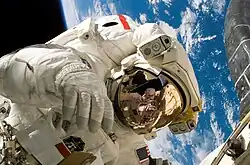
Astronaut Piers Sellers during the third spacewalk of STS-121, a demonstration of orbiter heat shield repair techniques
The science and engineering of spacefaring and spaceflight, a subset of Aerospace engineering (which includes atmospheric flight)
- Space technology is technology for use in outer space, in travel or other activities beyond Earth's atmosphere, for purposes such as spaceflight, space exploration, and Earth observation.
- Spaceflight
- Human spaceflight
- Outline of space exploration
- Space architecture
- Life-support system
- Space station
- Space Habitation Module
- Spaceflight
- Life in space
- Bioastronautics
- Animals in space
- Microorganisms tested in outer space
- Plants in space
- Humans in space
- Women in space
- Effect of spaceflight on the human body
- Sleep in space
- Food in space
- Medicine in space
- Neuroscience in space
- Writing in space
See also
- Space Sciences Laboratory – University of California, Berkeley
- Space-based economy
- Commercial use of space
- Space manufacturing
- Space tourism
- Space warfare
- Alien invasion
- Asteroid-impact avoidance
- Space law
- Remote sensing
- Planetarium – A synthetic observatory, used for education and presentations
- Centennial Challenges NASA prize contests
- Space and survival
- Space colonization
- Space industry
- Timeline of artificial satellites and space probes
- Batteries in space
- Control engineering
- Corrosion in space
- Nuclear power in space
- Observatories in space
- Orbital mechanics
- Robotic spacecraft
- Space environment – study of conditions that affect the operation of spacecraft
- Space logistics
- Space technology
- Space-based radar
- Space-based solar power
- Spacecraft design for launch vehicles and satellites
- Spacecraft propulsion
References
- "Space science – Define Space science", Dictionary.com
- "Space science – Definition of space science", Free Online Dictionary, Thesaurus and Encyclopedia
- "astrophysics". Merriam-Webster, Incorporated. Retrieved 2011-05-22.
- "Space Biology Program | Science Mission Directorate".
- "Space chemistry | Science & Technology in Action".
External links

Wikimedia Commons has media related to Space science.
- Institute of Space Technology, Pakistan
- Space Sciences @ NASA
- Space Sciences @ ESA
- INDIAN INSTITUTE OF SPACE SCIENCE AND TECHNOLOGY
- Space Sciences Institute
- Space Science & Technology, (Persian) an Iranian nongovernmental group who writes scientific articles about Space Science & Technology
Natural science | |
|---|---|
| |
| |
|


This article is issued from Wikipedia. The text is licensed under Creative Commons - Attribution - Sharealike. Additional terms may apply for the media files.