IRAM 30m telescope
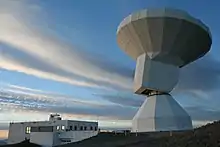
The IRAM 30-meter telescope is a radio telescope used for astronomical observations in the millmetre range of wavelengths.
 | |
| Alternative names | Pico Veleta observatory |
|---|---|
| Part of | Event Horizon Telescope  |
| Location(s) | Veleta, Sierra Nevada, Dílar, Monachil, Spain |
| Coordinates | 37°03′58″N 3°23′34″W |
| Organization | Institut de radioastronomie millimétrique |
| Altitude | 2,850 m (9,350 ft) |
| Wavelength | 0.8 mm (370 GHz)–3 mm (100 GHz) |
| Telescope style | radio telescope |
| Diameter | 30 m (98 ft 5 in) |
| Website | iram-institute |
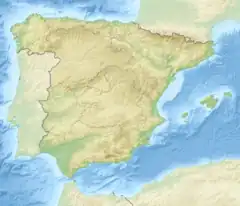  Location of IRAM 30-metre telescope | |
 Related media on Commons Related media on Commons | |
Operated by the Institute for Radio Astronomy in the Millimeter Range (IRAM) and located in the Sierra Nevada mountain range, close to the Pico Veleta peak in Spain, its large surface and wide-angle camera make it ideal for the exploration of large cosmic objects. Each year, more than 200 scientists from all over the world visit this observatory to explore the universe at millimetre wavelengths. The 30-metre telescope allows astronomers to observe interstellar clouds, birthplaces for stars, galaxies and even the black hole and the center of the Milky Way by granting access to parts of the southern skies.
By pointing the telescope toward a celestial source, and then scanning and tracking the source, astronomers can build up radio images of complete galaxies or regions of star formations. Together with IRAM's second facility, the NOEMA observatory, the telescope is part of the global Event Horizon Telescope array. It was the only station in Europe to participate in the 2017 EHT observing campaign that produced the first-ever image of a black hole.[1]
Operation
Built over the course of four years (1980-1984),[2][3] the telescope operates at 2850 meters above sea level. Due to its large surface, in the shape of a parabola and 420 panels adjusted to a precision of 55 micrometers, the IRAM is one of the most sensitive single dish radio telescopes in the world.[1]
The telescope is equipped with a suite of heterodyne receivers and continuum cameras operating at wavelengths of around 0.8, 1, 2, and 3 millimeters. With its ability to observe simultaneously at several wavelengths, the telescope can produce multiple images of the same region at once.
IRAM also offers guided tours through the observatory and public talks during the summer months.
Science
Compared to optical astronomy, which is sensitive to the hot universe (stars are generally a few thousand degrees Celsius), radio telescopes that operate in the millimeter wavebands can view the cold universe (around −250°C). Both IRAM facilities can see the formation of the first galaxies in the universe, observe supermassive black holes at the center of galaxies, analyze the chemical evolution and dynamics of nearby galaxies, detect organic molecules and possible key elements of life, and investigate the formation of stars and the appearance of planetary systems.[3]
As part of the Event Horizon Telescope array, the IRAM 30-meter telescope obtained the first-ever image of a black hole. Despite primarily being known for its work in EHT, EHT is not the only area in which the IRAM has done pioneering work. For instance, the first high-resolution radio observations of the heart of the Milky Way galaxy and its black hole named Sagittarius A* were made in 1995 – with a combination of the IRAM 30-meter telescope and the NOEMA array (former Plateau de Bure Interferometer). Together with NOEMA, it discovered one-third of the interstellar molecules known to date.[4]
Gallery
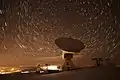 The IRAM 30-meter telescope scanning the night sky
 The IRAM 30-meter telescope
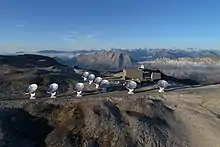 The NOEMA observatory, IRAM's second facility
References
- "Event Horizon Telescope Captures First Image of Black Hole | Astronomy | Sci-News.com". Breaking Science News | Sci-News.com. Retrieved 2019-04-10.
- Baars, Hooghoudt, Mezger, & de Jonge (1987). "The IRAM 30-m millimeter radio telescope on Pico Veleta, Spain". Astronomy & Astrophysics. 175: 319–326.
{{cite journal}}: CS1 maint: multiple names: authors list (link) - Encrenaz, Gómez-González, Lequeux, and Orchiston (2011). "Highlighting the History of French Radio Astronomy. 7: The Genesis of the Institute of Radioastronomy at Millimeter Wavelengths (Iram)" (PDF). Journal of Astronomical History and Heritage. 14 (2): 83–92. doi:10.3724/SP.J.1440-2807.2011.02.01. S2CID 128919605.
{{cite journal}}: CS1 maint: multiple names: authors list (link) - McGuire, Brett A. (2018). "2018 Census of Interstellar, Circumstellar, Extragalactic, Protoplanetary Disk, and Exoplanetary Molecules". The Astrophysical Journal Supplement Series. 239 (2): 17. arXiv:1809.09132. Bibcode:2018ApJS..239...17M. doi:10.3847/1538-4365/aae5d2. S2CID 119522774.