Thomas Howard, 3rd Duke of Norfolk
Thomas Howard, 3rd Duke of Norfolk, KG, PC (1473 – 25 August 1554) was a prominent English politician and nobleman of the Tudor era. He was an uncle of two of the wives of King Henry VIII, Anne Boleyn and Catherine Howard, both of whom were beheaded, and played a major role in the machinations affecting these royal marriages. After falling from favour in 1546, he was stripped of his Dukedom and imprisoned in the Tower of London, avoiding execution when Henry VIII died on 28 January 1547.
The Duke of Norfolk | |
|---|---|
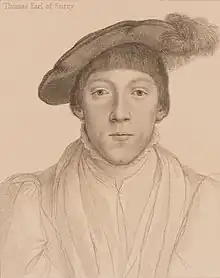
.JPG.webp) Thomas Howard, 3rd Duke of Norfolk by Hans Holbein the Younger, Royal Collection. | |
| Lord High Treasurer | |
| In office 4 December 1522 – 12 December 1546 | |
| Monarch | Henry VIII |
| Preceded by | Thomas Howard, 2nd Duke of Norfolk |
| Succeeded by | Edward Seymour, 1st Duke of Somerset |
| Personal details | |
| Born | 1473 |
| Died | 25 August 1554 (aged 80–81) Kenninghall, Norfolk |
| Resting place | Church of St Michael the Archangel, Framlingham, Suffolk |
| Spouse(s) | Anne of York Lady Elizabeth Stafford |
| Children | Henry Howard, Earl of Surrey Thomas Howard, 1st Viscount Howard of Bindon Mary Howard, Duchess of Richmond and Somerset Katherine Howard, Countess of Derby[1] |
| Parents |
|
| Religion | Roman Catholic |
.svg.png.webp)
He was released on the accession of the Roman Catholic Queen Mary I, whom he aided in securing the throne, thus setting the stage for tensions between his Catholic family and the Protestant royal line that would be continued by Mary's half-sister, Elizabeth I.
Early life
Thomas was the son of Sir Thomas Howard, later 2nd Duke of Norfolk (1443–1524), by his first wife, Elizabeth Tilney (died 1497), the daughter of Sir Frederick Tilney and widow of Sir Humphrey Bourchier,[2] and the grandson of John Howard, 1st Baron Howard, later 1st Duke of Norfolk. Through his great-grandmother Margaret Mowbray, Howard was a descendant of Thomas of Brotherton, 1st Earl of Norfolk, the sixth son of King Edward I of England.[3] Through his great-grandfather Sir Robert Howard, of Trending, Stoke-by-Nayland, Suffolk, Howard was descended from Richard, 1st Earl of Cornwall, the second son of King John, who had an illegitimate son, named Richard (died 1296), whose daughter, Joan of Cornwall, married Sir John Howard (d. shortly July 1331).[4] In 1483, his father and grandfather were created Earl of Surrey and Duke of Norfolk respectively; but in 1485, both fought for the Yorkist King Richard III at the Battle of Bosworth, and his grandfather was killed in combat. As the battle resulted in the Tudor Henry VII coming to the throne, their allegiance to the losing side resulted in most of the Howard family's titles becoming forfeit.[2] Nevertheless, they soon began to be rehabilitated, and in 1489 his father was restored as Earl of Surrey.
In April 1497 his mother died, and in August of that year his father married for the second time Agnes Tilney, Thomas' mother's cousin.
Howard was an able soldier, and was often employed in military operations.[2] In 1497, he served in a campaign against the Scots under the command of his father, who knighted him on 30 September 1497.[2] He was made a Knight of the Garter after the accession of his nephew, King Henry VIII, and became the King's close companion, with lodgings at court.[2] His first wife, Anne of York, King's aunt, died in November 1511,[5] and early in 1513, Howard married Lady Elizabeth Stafford, the daughter of Edward Stafford, 3rd Duke of Buckingham and Lady Eleanor Percy, and the granddaughter of Henry Percy, 4th Earl of Northumberland. Through his mother Catherine Woodville, Elizabeth's father was a first cousin to Howard's first wife. [6] On 4 May 1513, he was appointed Lord Admiral. Surrey and his sons Thomas and Edmund had hoped to lead the English expedition against France, but was left behind when the King departed for Calais at the end of June.[7] Shortly thereafter King James IV of Scotland launched an invasion into England (despite being married to Princess Margaret Tudor, sister of Henry VIII) in fulfilment of his alliance with France, and Thomas along with his brother Edmund, joined their father and the barons Dacre and Monteagle in leading the army, which despite their numerical inferiority, managed to decisively crush the Scottish forces at the Battle of Flodden, near Branxton, Northumberland, on 9 September. The Scots lost thousands of men, and James IV lost his life in the battle.
.svg.png.webp)
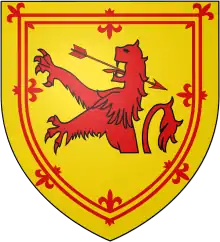
Leading the victorious forces at Flodden gave the Howards enormous prestige both socially and at court, receiving a large number of rewards from Henry VIII, and the Howard coat of arms was changed in honour of the victory, incorporating the Scottish lion pierced through the mouth with an arrow [7] within a double tressure flory-counterflory-gules, an emblem of the Scottish royal arms granted by Scottish kings on rare occasions as a special mark of favour. The grant to Howard was thus a blatant heraldic insult to the kings of Scotland. On 1 February 1514, Howard's father, then Earl of Surrey, was created Duke of Norfolk (technically a new creation, but treated for all practical purposes as a recreation of the forfeited title previously held by his father), and by letters patent issued on the same day, Howard was created Earl of Surrey. Over the next few years, he served King Henry VIII in a variety of ways. In September 1514, he escorted the King's sister Mary to France for her forthcoming marriage to King Louis XII of France. In 1517, he quelled a May Day riot in London with the use of soldiers.[6][2]
On 10 March 1520,[8] Surrey was appointed Lord Deputy of Ireland. By July 1520, he entered upon the thankless task of endeavouring to keep Ireland in order. His letters contain accounts of attempts to pacify the rival factions of the Earl of Kildare and the Earl of Ormonde, and are full of demands for more money and troops.[9]
At the end of 1521, Surrey was recalled from Ireland to take command of the English fleet in naval operations against France. His ships were ill-provisioned, and his attack consisted of a series of raids near the French coast for the purpose of inflicting as much damage as possible on the French navy. Surrey's ships besieged the strategic port of Brest but when he abandoned the siege, he left Vice-Admiral William FitzWilliam on station to blockade the port. The English navy patrolled the Brittany coast for the next three months, but was unable to gain a decisive victory even with their Spanish allies. In July 1522, the forces commanded by Surrey burned Morlaix, and over the next few months razed everything around Boulogne, until the winter caused the fleet to withdraw to England. The sea patrol was abandoned with little achieved.[6][10]
Rise to power and later career
On 4 December 1522, Howard was made Lord Treasurer upon his father's resignation of the office, and on 21 May 1524, he succeeded his father as Duke of Norfolk.[2] His liking for war brought him into conflict with Cardinal Thomas Wolsey, who preferred diplomacy in the conduct of foreign affairs. In 1523, Wolsey had secured to the Duke of Suffolk the reversion of the office of Earl Marshal by Howard's father, and in 1525, he was replaced as Lord Admiral by Prince Henry FitzRoy, Duke of Richmond, the King's illegitimate but acknowledged son, who a few years later became Norfolk's son-in-law. Finding himself pushed aside, Howard spent considerable time away from court between 1525 and 1527-28.[2]
In the mid-1520s, Howard's niece, Anne Boleyn, had caught the eye of King Henry VIII,[11] thereby reviving his political fortunes with his involvement in the King's attempt to annul his marriage to Catherine of Aragon. By 1529, matters of state were being increasingly handled by the Duke of Norfolk, the Duke of Suffolk, and the Boleyns, who pressed King Henry VIII to remove Cardinal Wolsey. In October, the King sent Howard and the Duke of Suffolk to obtain the great seal from the Cardinal. In November, Wolsey was arrested on a charge of treason, but died before trial. Howard benefited from Wolsey's fall, becoming the King's leading councillor and applying himself energetically in the King's efforts to find a way out of his marriage to Queen Catherine.
In early 1530, Anne Boleyn was promoting the marriage between her first cousin and eldest son of Norfolk, Henry Howard, Earl of Surrey and the King's daughter, Princess Mary. The Duke was very was enthusiastic about the match as it might give him greater political influence at court and put his family closer to the throne. Boleyn may have considered the match to be a way of neutralising the threat Mary posed to the succession of any children Anne might have by the King. But she changed her mind, fearing that the Duke could use the match to support Mary's claim to the throne and support Catherine of Aragon in the divorce proceedings which were still continuing, and prevent the English Church's break with Rome from being consummated. By October 1530, Boleyn persuaded her reluctant uncle to arrange instead for Surrey to marry Frances de Vere, one of the daughters of John de Vere, 15th Earl of Oxford with his second wife, Elizabeth Trussell.[12]
Having assisted the King in the divorce proceedings of his first wife, added to his extensive loyalty and great services to the Crown, brought Howard extensive rewards in the form of monastic lands in Norfolk and Suffolk, employment on diplomatic missions, and being named a knight of the French Order of St Michael in 1532 and Earl Marshal of England on 28 May 1533. In November of that same year, his daughter Mary married the Duke of Richmond, a union that was highly advantageous and important to both Norfolk and his daughter, as Henry VIII did not yet have a legitimate male heir and as Princess Mary had been removed from the line of succession, the Prince was considered by many as a potential heir to the throne. The marriage was never consummated, initially on Henry VIII's orders due to the youth of the couple and then FitzRoy's early death a few years later.[12] [13]
In May 1536, when the King ordered the arrest of both Anne Boleyn and her brother, George Boleyn, Viscount Rochford, Howard presided over their trials as Lord High Steward.[2] After the executions of his nephew and niece, Howard's power and political influence at court waned for a time.
In July of that year, the Duke of Richmond, who was Norfolk's only son-in-law, died of natural causes and responsibility for FitzRoy's burial fell to Howard. Richmond was buried at Thetford Priory, then the burial place of the Norfolk's family.[14]
Thomas Howard's marriage to his second wife, Lady Elizabeth Stafford, which had apparently been mutually affectionate at first, deteriorated in 1527 when he took a mistress, Elizabeth Holland (died 1547/8), whom he installed in the Howard household. Lady Elizabeth formally separated from her husband in the 1530s. She claimed that in March 1534, the Duke of Norfolk 'locked me up in a chamber, [and] took away my jewels and apparel'. Howard then moved her to Redbourn, Hertfordshire, where she lived as an actual prisoner with a meagre annual allowance of only £200. She also claimed to have been physically maltreated by Howard and his household servants.[15]
When the Pilgrimage of Grace broke out in Lincolnshire and the northern counties in October 1536 in response to the government-sponsored suppression of monasteries and abbeys across England, Norfolk and his eldest son, the Earl of Surrey shared command of the King's forces with the Earl of Shrewsbury. They persuaded the rebels to disperse by promising them a pardon and that Parliament would consider their grievances.[16] However, when Bigod's rebellion broke out in January 1537, Norfolk carried out a policy of brutal repression on behalf of the King, despite the fact that the Duke himself was a Catholic.[2]
In 1539, Norfolk, who was a conservative, was seriously challenging the religious policies of the King's chief minister, Thomas Cromwell. In that year, King Henry VIII sought to have Parliament put an end to diversity in religious opinion. On 5 May, the House of Lords appointed a committee to consider questions of doctrine. Although he was not a member of the committee, on 16 May, Howard presented six conservative articles of religion to Parliament for consideration. On 30 May, the Six Articles and the penalties for failure to conform to them were enacted into law, and on 28 June, received royal assent.[2]
On June 29, Howard, the Duke of Suffolk and Cromwell dined with the King as guests of the Archbishop of Canterbury, Thomas Cranmer at Lambeth Palace. During a heated discussion about Cardinal Wolsey, Cromwell charged Thomas Howard with disloyalty who in turn called Cromwell a liar. Their mutual hostility was now out in the open.[2] Cromwell inadvertently played into Howard's hands by taking the initiative in the King's marriage to Anne of Cleves. The King's disillusionment with Anne's physical appearance when he met her in January 1540, and his desire to have the marriage annulled after the wedding had taken place, gave Howard an opportunity to bring down his enemy, Cromwell.[17] On 10 June 1540, Cromwell was arrested at a Privy Council meeting on charges of high treason, and the Duke of Norfolk snatched the St George's collar (insignia of the Order of the Garter) from Cromwell's shoulders, saying: "A traitor must not wear it".[18][19] On 9 July, King Henry's marriage to Anne of Cleves was annulled.[2] On 28 July, Cromwell was executed, and on the same day, the King married another of the Duke's nieces, Catherine Howard, as his fifth wife.[20] As a result of this marriage, for a time, Howard enjoyed political prominence, royal favour, and material rewards. The Duke may have sought to recreate the political power his family gained when Anne Boleyn was Queen consort and which waned after Anne's fall from grace. According to Nicholas Sander, the Howards, religiously conservative, may have seen Catherine as a figurehead for their fight by expressed determination to restore Catholicism in England.[21]
In the same year, Norfolk tried to save Thetford Priory from closure, petitioning Henry VIII for the Priory's church to become a collegiate church on the grounds that not only Anne of York, Howard's first wife and aunt to the King, but also the monarch's illegitimate son, the Duke of Richmond, were buried there. The Dean was to be Prior William Ixworth, and the six prebendaries and eight secular canons to be the monks of the former house. The request had no effect. The same request was made to the King by other nobles, and he refused them all; at the same time however, Henry VIII ordered that the dissolution of the monasteries be briefly suspended, so that everyone who wished had time to rebury the remains of their relations.[22] Howard moved the remains of his to the Church of St Michael the Archangel, Framlingham.[23][24]
When Queen Catherine's premarital sexual indiscretions and her alleged adultery with Thomas Culpeper were revealed to Henry VIII by Archbishop Cranmer, the King's wrath turned upon the Howard family, who were accused of concealing her misconduct.[2] The Queen was condemned by a bill of attainder and was later executed on 13 February 1542. Several other members of the Duke's family were imprisoned in the Tower, including his daughter Mary and her stepmother, the Dowager Duchess of Norfolk.[20] Howard tried to detach himself from the situation by retiring to his residence in Kenninghall, from where he wrote a letter of apology to the King blaming both his niece and his stepmother for the scandal.[25] However, the French ambassador Marillac wrote on 17 January 1542, that the Duke had not only escaped punishment, but had apparently been restored to his "full former credit and authority".[2]
Howard was appointed Lieutenant-General north of the River Trent on 29 January 1541, and Captain-General in a campaign against the Scots in August 1542. In June 1543, he declared war on France in the King's name and was appointed Lieutenant-General of the army. During the campaign of May–October 1544, he besieged Montreuil, while King Henry VIII captured Boulogne, before returning home. Complaining of lack of provisions and munitions, Howard eventually raised the siege of Montreuil, and realising that Boulogne could not realistically be held by the English for long, he left it garrisoned and withdrew to Calais, for which he was severely rebuked by the King.[2]
Imprisonment and release
During the last years of the reign of Henry VIII, the Seymour family, and the King's last wife, Catherine Parr, supporters of the Reformation, were gaining greater power and influence at court while conservative Norfolk was left politically isolated. Howard attempted to form an alliance with the Seymours by marrying his widowed daughter, Mary to Thomas Seymour,[2] but all his efforts were in vain due to the provocative behaviour of his eldest son and heir, the Earl of Surrey, who had assumed the royal arms of Edward the Confessor as part of his personal heraldry.[26] On 12 December 1546 both Norfolk and his son were arrested and sent to the Tower. On 24 December, the elder Howard acknowledged that he had "concealed high treason, in keeping secret the false acts of my son, Henry Earl of Surrey, in using the arms of St. Edward the Confessor, which pertain only to kings", and offered his lands to the King.[27] Although the arms of their ancestor, Thomas de Mowbray, 1st Duke of Norfolk, show that Surrey was entitled to bear Edward the Confessor's arms, doing so was an act of pride, and provocative in the eyes of the Crown.[28] There were also religious motives behind Surrey's fall from grace and Norfolk's imprisonment. The Duke was the premier Catholic nobleman of England and his son was also a Catholic, although he had reformist leanings. Henry VIII, possibly influenced by the Seymours, supporters of Protestantism, believed that Norfolk and Surrey were going to usurp the crown from his son, the future Edward VI to reverse the Reformation and thus return the English Church to papal jurisdiction.[29] Norfolk's family, including his estranged wife, his daughter Mary, and his mistress, Elizabeth Holland, all gave evidence against him. His son was executed on 19 January 1547,[26] and on 27 January 1547, he was attainted by statute without trial. The dying King gave his assent to Howard's death by royal commissioners, and it was rumoured that he would be executed on the following day. He was saved by the King's death on 28 January and the council's decision not to inaugurate the new reign with bloodshed. His estates fell prey to the ruling clique in the reign of King Edward VI, for which he was later partly compensated by lands worth £1626 a year from Queen Mary I.[2]
Howard remained in the Tower throughout the reign of Edward VI, being released and pardoned after the accession of the Catholic Queen Mary I in early August 1553, and in Mary's first parliament (October–December of that same year), his statutory attainder was declared void, thereby restoring him to the dukedom.[30] He was appointed to the Privy Council, and presided as Lord High Steward at the trial of the Duke of Northumberland on 18 August.[2] He was also restored to the office of Earl Marshal and officiated in that capacity at Mary's coronation on 1 October 1553. Shortly after his released, Howard took care of his five grandchildren, the Surrey children, up to that time under the ward of John Foxe. Howard withdrew the guardianship of Foxe, dismissing him (Foxe soon went into exile to various countries in continental Europe to escape anti-Protestant measures taken by Queen Mary) and the education of his two grandsons Thomas (who was also his heir) and Henry was reassigned to Catholic Priest John White, who was soon elected to be Bishop of Lincoln. In 1553-1554 Howard arranged the future marriage between his grandson and heir Thomas and Mary FitzAlan, one of the daughters of the Earl of Arundel, with the aim of uniting the two most prominent Catholic families in England.[30] His last major service to the Crown was his command of the forces sent in early 1554 to put down Wyatt's rebellion, a group of disaffected gentlemen who opposed the Queen's projected marriage to Philip II of Spain,[31] but his men fled before the enemy.[32]
Death and burial
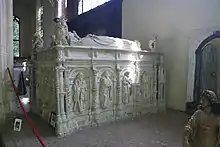
The Duke died at his Kenninghall residence on 25 August 1554 after several weeks in which his health gradually declined.[2] Howard was buried alongside the remains of his first wife Anne of York in the Church of St Michael the Archangel, Framlingham, Suffolk, where his spectacular tomb, richly decorated with religious iconography, is located. Howard was buried to his first wife's left, rather than the usual right, due to the latter's royal lineage.[33] He was succeeded as Duke and as Earl Marshal by his grandson, Thomas Howard, 4th Duke of Norfolk.
Marriage and progeny
Thomas Howard married twice:
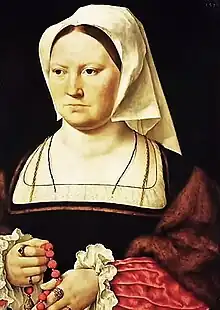
- First, on 4 February 1494/95, he married Princess Anne of York (1475–1511), the fifth daughter of King Edward IV of England and Elizabeth Woodville, and the sister-in-law of King Henry VII. This was a politically advantageous match. By her, he had four children, none of whom survived to adulthood.[34]
Anne died in November 1511, being buried in the first instance in Thetford Priory, then the burial place and mausoleum of members of the Howard family. When the Priory was closed during the Reformation, her remains were moved to the Church of St Michael the Archangel, Framlingham, Suffolk.
- Secondly, early in 1513, he married Lady Elizabeth Stafford, daughter of Edward Stafford, 3rd Duke of Buckingham, by his wife Lady Eleanor Percy, daughter of Henry Percy, 4th Earl of Northumberland. Through her paternal grandmother, the Duchess of Buckingham, Elizabeth was a cousin of Howard's first wife.[6] By Elizabeth, he had five children:[35]
- Henry Howard, (1516/7-1547), who automatically became Earl of Surrey when his father became 3rd Duke of Norfolk in 1524. In 1532-33 he married Lady Frances de Vere, daughter of John de Vere, 15th Earl of Oxford, by whom he had two sons and three daughters, Thomas Howard, 4th Duke of Norfolk; Henry Howard, 1st Earl of Northampton; Katherine Howard, who married Henry Berkeley, 7th Baron Berkeley; Margaret Howard, who married Henry Scrope, 9th Baron Scrope of Bolton; and Jane Howard, who married Charles Neville, 6th Earl of Westmorland.
- Lady Mary Howard (1519–1557), who married, on 28 November 1533, King Henry VIII's illegitimate son, Henry FitzRoy (1519–1536), by whom she had no issue. The marriage was never consummated due to FitzRoy's untimely death.
- Thomas Howard, 1st Viscount Howard of Bindon (1520–1582), who married firstly Elizabeth Marney, secondly Gertrude Lyte, thirdly Mabel Burton, and fourthly Margaret Manning.[36]
- Lady Muriel Howard (died young).
- Lady Katherine Howard, who by 9 December 1529 married, as his first wife, Edward Stanley, 3rd Earl of Derby (1509–1572), and died 15 March 1530. Derby later married, as his second wife, Katherine's aunt, Dorothy Howard.[37]
As dowager Duchess, Elizabeth survived a few years after her husband's death, dying in November 1558. She was buried in the Church of St Mary-at-Lambeth, Surrey.
Fictional portrayals
Books
Norfolk is an important character in:
- the Philippa Gregory novels The Other Boleyn Girl and The Boleyn Inheritance.
- The Man on a Donkey by H.F.M. Prescott
- The Fifth Queen by Ford Madox Ford
- Hilary Mantel's Wolf Hall, Bring Up the Bodies, and The Mirror & the Light.
Films
- In The Private Life of Henry VIII (1933) he was played by Frederick Culley.
- In The Prince and the Pauper (1937) he was played by Henry Stephenson.
- In A Man for All Seasons (1966), he was played by Nigel Davenport.
- In Anne of the Thousand Days (1969), Peter Jeffrey took the role. He went on to reprise the role in a 1996 BBC adaptation of Mark Twain's 1881 novel The Prince and the Pauper.
- In the 1970 BBC miniseries The Six Wives of Henry VIII, the role was played by Patrick Troughton.
- In the 1973 film, based on the miniseries, he was played by Michael Gough.
- Sir Rex Harrison portrayed him in the 1977 adaptation of the Mark Twain novel, The Prince and the Pauper.
- Mark Strong portrayed Norfolk in the 2003 ITV feature Henry VIII.
- In the Showtime series The Tudors (2007), he was played by Henry Czerny.
- David Morrissey played the Duke in the film The Other Boleyn Girl (2008).
- Bernard Hill played the Duke in the 2015 BBC adaptation of Hilary Mantel's Wolf Hall.
Family tree
| Earls of Norfolk and Dukes of Norfolk | |||||||||||||||||||||||||||||||||||||||||||||||||||||||||||||||||||||||||||||||||||||||||||||||||||||||||||||||||||||||||||||||||||||||||||||||||||||||||||||||||||||||||||||||||||||||||||||||||||||||||||||||||||||||||||||||||||||||||||||||||||||||||||||||||||||||||||||||||||||||||||||||||||||||||||||||||||||||||||||||||||||||||||||||||||||||||||||||||||||||||||||||||||||||||||||||||||||||||||||||||||||||||||||||||||||||||||||||||||||||||||||||||||||||||||||||||||||||||||||||||||||||||||||||||||||||||||||||||||||||||||||||||||||||||||||||||||||||||||||||||||||||||||||||||||||||||||||||||||||||||||||||||||||||||||||||||||||||||||||||||||||||||||||||||||||||||||||||||||||||||||||||||||||||||||||||||||||||||||||||||||||||||||||||||||||||||||||||||||||||||||||||||||||||||||||||||||||||||||||||||||||||||||||||||||||||||||||||||||||||||||||||||||||||||||||||||||||||||||||||||||||||||||||||||||||||||||||||||||||||||||||||||||||||||||||||||||||||||||||||||||||||||||||||||||||||||||||||||||||||
|---|---|---|---|---|---|---|---|---|---|---|---|---|---|---|---|---|---|---|---|---|---|---|---|---|---|---|---|---|---|---|---|---|---|---|---|---|---|---|---|---|---|---|---|---|---|---|---|---|---|---|---|---|---|---|---|---|---|---|---|---|---|---|---|---|---|---|---|---|---|---|---|---|---|---|---|---|---|---|---|---|---|---|---|---|---|---|---|---|---|---|---|---|---|---|---|---|---|---|---|---|---|---|---|---|---|---|---|---|---|---|---|---|---|---|---|---|---|---|---|---|---|---|---|---|---|---|---|---|---|---|---|---|---|---|---|---|---|---|---|---|---|---|---|---|---|---|---|---|---|---|---|---|---|---|---|---|---|---|---|---|---|---|---|---|---|---|---|---|---|---|---|---|---|---|---|---|---|---|---|---|---|---|---|---|---|---|---|---|---|---|---|---|---|---|---|---|---|---|---|---|---|---|---|---|---|---|---|---|---|---|---|---|---|---|---|---|---|---|---|---|---|---|---|---|---|---|---|---|---|---|---|---|---|---|---|---|---|---|---|---|---|---|---|---|---|---|---|---|---|---|---|---|---|---|---|---|---|---|---|---|---|---|---|---|---|---|---|---|---|---|---|---|---|---|---|---|---|---|---|---|---|---|---|---|---|---|---|---|---|---|---|---|---|---|---|---|---|---|---|---|---|---|---|---|---|---|---|---|---|---|---|---|---|---|---|---|---|---|---|---|---|---|---|---|---|---|---|---|---|---|---|---|---|---|---|---|---|---|---|---|---|---|---|---|---|---|---|---|---|---|---|---|---|---|---|---|---|---|---|---|---|---|---|---|---|---|---|---|---|---|---|---|---|---|---|---|---|---|---|---|---|---|---|---|---|---|---|---|---|---|---|---|---|---|---|---|---|---|---|---|---|---|---|---|---|---|---|---|---|---|---|---|---|---|---|---|---|---|---|---|---|---|---|---|---|---|---|---|---|---|---|---|---|---|---|---|---|---|---|---|---|---|---|---|---|---|---|---|---|---|---|---|---|---|---|---|---|---|---|---|---|---|---|---|---|---|---|---|---|---|---|---|---|---|---|---|---|---|---|---|---|---|---|---|---|---|---|---|---|---|---|---|---|---|---|---|---|---|---|---|---|---|---|---|---|---|---|---|---|---|---|---|---|---|---|---|---|---|---|---|---|---|---|---|---|---|---|---|---|---|---|---|---|---|---|---|---|---|---|---|---|---|---|---|---|---|---|---|---|---|---|---|---|---|---|---|---|---|---|---|---|---|---|---|---|---|---|---|---|---|---|---|---|---|---|---|---|---|---|---|---|---|---|---|---|---|---|---|---|---|---|---|---|---|---|---|---|---|---|---|---|---|---|---|---|---|---|---|---|---|---|---|---|---|---|---|---|---|---|---|---|---|---|---|---|---|---|---|---|---|---|---|---|---|---|---|---|---|---|---|---|---|---|---|---|---|---|---|---|---|---|---|---|---|---|---|---|---|---|---|---|---|---|---|---|---|---|---|---|---|---|---|---|---|---|---|---|---|---|---|---|---|---|---|---|---|---|---|---|---|---|---|---|---|---|---|---|---|---|---|---|---|---|---|---|---|---|---|---|---|---|---|---|---|---|---|---|---|---|---|---|---|---|---|---|---|---|---|---|---|---|---|---|---|---|---|---|---|---|---|---|---|---|---|---|---|---|---|---|---|---|---|---|---|---|---|---|---|---|---|---|---|---|---|---|---|---|---|---|---|---|---|---|---|---|---|---|---|---|---|---|---|---|---|---|---|---|---|---|---|---|---|---|---|---|---|---|---|---|---|---|---|---|---|---|---|---|---|---|---|---|---|---|---|---|---|---|---|---|---|---|---|---|---|---|---|---|---|---|---|---|---|---|---|---|---|---|---|---|---|---|---|---|---|---|---|---|---|---|---|---|---|---|---|---|---|---|---|---|---|---|---|---|---|---|---|---|---|---|---|---|---|---|---|---|---|---|---|---|---|---|---|---|---|---|---|---|---|---|---|---|---|---|---|---|---|---|---|---|---|---|---|---|---|---|---|---|---|---|---|---|---|---|---|---|---|---|---|---|---|---|---|---|---|---|---|---|---|---|---|---|---|---|---|---|---|---|---|---|---|---|---|---|---|---|---|---|---|---|---|---|---|---|---|---|---|---|---|---|---|---|---|---|---|---|---|---|---|---|---|---|---|---|---|---|---|---|---|---|---|---|---|---|---|---|---|---|---|---|---|---|---|---|---|---|---|---|---|---|
| |||||||||||||||||||||||||||||||||||||||||||||||||||||||||||||||||||||||||||||||||||||||||||||||||||||||||||||||||||||||||||||||||||||||||||||||||||||||||||||||||||||||||||||||||||||||||||||||||||||||||||||||||||||||||||||||||||||||||||||||||||||||||||||||||||||||||||||||||||||||||||||||||||||||||||||||||||||||||||||||||||||||||||||||||||||||||||||||||||||||||||||||||||||||||||||||||||||||||||||||||||||||||||||||||||||||||||||||||||||||||||||||||||||||||||||||||||||||||||||||||||||||||||||||||||||||||||||||||||||||||||||||||||||||||||||||||||||||||||||||||||||||||||||||||||||||||||||||||||||||||||||||||||||||||||||||||||||||||||||||||||||||||||||||||||||||||||||||||||||||||||||||||||||||||||||||||||||||||||||||||||||||||||||||||||||||||||||||||||||||||||||||||||||||||||||||||||||||||||||||||||||||||||||||||||||||||||||||||||||||||||||||||||||||||||||||||||||||||||||||||||||||||||||||||||||||||||||||||||||||||||||||||||||||||||||||||||||||||||||||||||||||||||||||||||||||||||||||||||||||
Footnotes
- Knafla 2008.
- Graves 2008.
- Waugh 2004.
- Richardson 2011, pp. 566–76.
- Horrox 2006.
- Creighton 1891, p. 65.
- Brigden 2008
- Ellis, Steven (1985). Tudor Ireland. Longman. pp. 19–109.
- Great Britain. Record Commission 1834.
- Dollinger, German Hansa, pp.303–4; Lloyd, England and the German Hanse, pp.180–2; Rodger, Safeguard, p.174
- Ives 2004.
- Weir 2001, pp. 430–431.
- Nicola Clark, Gender, Family, and Politics: The Howard Women, 1485–1558, (Oxford University Press, 2018), 145.
- "Church". Framlingham.
- Graves 2004; Graves 2008
- Chisholm 1911, p. 744.
- Leithead 2009.
- Angus 2022, p. 220.
- MacCulloch 2018, p. 525.
- Warnicke 2008.
- Weir 2001, pp. 432–433.
- Everett Green 1852, pp. 11–12.
- Weir 2011, p. 139.
- Panton 2011, p. 51.
- Weir 1991, p. 474.
- Brigden 2008.
- Herbert of Cherbury, Edward (1649). The Life and Raigne of King Henry the Eight. pp. 562–64.
- The Heraldic Charge Against the Earl of Surrey, Peter R. Moore, English Historical Review, Volume CXVI, pages 557 to 583, (2001).
- Weir 2001, pp. 434–435.
- Graves 2008a.
- Archer 2006.
- Chisholm 1911, p. 743.
- "The Howard Tombs at Framlingham: More Tales from Inside the Vaults". 18 January 2020.
- Graves 2008; Horrox 2006
- Wood 1846, p. 361; Harris 2002, p. 57; Richardson IV 2011, pp. 416–17.
- Cokayne 1926, p. 584.
- Knafla 2008.
References
- Archer, Ian W. (October 2006) [2004]. "Wyatt, Sir Thomas (b. in or before 1521, died 1554)". Oxford Dictionary of National Biography (online ed.). Oxford University Press. doi:10.1093/ref:odnb/30112. (Subscription or UK public library membership required.)
- Brigden, Susan (2008). "Howard, Henry, earl of Surrey (1516/17–1547), poet and soldier". Oxford Dictionary of National Biography (online ed.). Oxford University Press. doi:10.1093/ref:odnb/13905. (Subscription or UK public library membership required.)
- Chisholm, Hugh, ed. (1911). . Encyclopædia Britannica. Vol. 19 (11th ed.). Cambridge University Press. pp. 742–744.
- Cokayne, G. E. (1926). H. A. Doubleday; Duncan Warrand; Lord Howard de Walden (eds.). The Complete Peerage, or a history of the House of Lords and all its members from the earliest times (Gordon to Hustpierpoint). Vol. 6 (2nd ed.). London: The St Catherine Press.
- Croft, Pauline (2004). "Howard, Henry, earl of Northampton (1540–1614)". Oxford Dictionary of National Biography (online ed.). Oxford University Press. doi:10.1093/ref:odnb/13906. (Subscription or UK public library membership required.)
- Great Britain. Record Commission (1834). State papers, published under the authority of His Majesty's Commission. Volume II. King Henry the Eighth part III. Correspondence between the Governments of England and Ireland 1515-1538.
- Graves, Michael A.R. (2004). "Howard (née Stafford), Elizabeth, duchess of Norfolk (1497–1558), noblewoman". Oxford Dictionary of National Biography (online ed.). Oxford University Press. doi:10.1093/ref:odnb/13897. (Subscription or UK public library membership required.)
- Graves, Michael A.R. (January 2008) [2004]. "Howard, Thomas, third duke of Norfolk (1473–1554)". Oxford Dictionary of National Biography (online ed.). Oxford University Press. doi:10.1093/ref:odnb/13940. (Subscription or UK public library membership required.)
- Graves, Michael A.R. (January 2008a). "Howard, Thomas, fourth duke of Norfolk (1538–1572), nobleman and courtier". Oxford Dictionary of National Biography (online ed.). Oxford University Press. doi:10.1093/ref:odnb/13941. (Subscription or UK public library membership required.)
- Harris, Barbara J. (2002). English Aristocratic Women, 1450–1550. Oxford: Oxford University Press.
- Head, David M. Ebbs & Flows of Fortune: The Life of Thomas Howard, Third Duke of Norfolk (1995) 360pp.
- Horrox, Rosemary (2006). "Edward IV (1442–1483), king of England and lord of Ireland". Oxford Dictionary of National Biography (online ed.). Oxford University Press. doi:10.1093/ref:odnb/8520. (Subscription or UK public library membership required.)
- Ives, E.W. (2004). "Anne (Anne Boleyn) (c. 1500–1536), queen of England, second consort of Henry VIII". Oxford Dictionary of National Biography (online ed.). Oxford University Press. doi:10.1093/ref:odnb/557. (Subscription or UK public library membership required.)
- Knafla, Louis A. (2008). "Stanley, Edward, third earl of Derby (1509–1572), magnate". Oxford Dictionary of National Biography (online ed.). Oxford University Press. doi:10.1093/ref:odnb/26262. (Subscription or UK public library membership required.)
- Leithead, Howard (2009). "Cromwell, Thomas, earl of Essex (b. in or before 1485, died 1540), royal minister". Oxford Dictionary of National Biography (online ed.). Oxford University Press. doi:10.1093/ref:odnb/6769. (Subscription or UK public library membership required.)
- Richardson, Douglas (2011). Everingham, Kimball G. (ed.). Magna Carta Ancestry: A Study in Colonial and Medieval Families. Vol. IV (2nd ed.). Salt Lake City, Utah. ISBN 978-1460992708.
- Warnicke, Retha M. (2008). "Katherine (Catherine; née Katherine Howard) (1518x24–1542), queen of England and Ireland, fifth consort of Henry VIII". Oxford Dictionary of National Biography (online ed.). Oxford University Press. doi:10.1093/ref:odnb/4892. (Subscription or UK public library membership required.)
- Waugh, Scott L. (2004). "Thomas (Thomas of Brotherton), first earl of Norfolk (1300–1338), magnate". Oxford Dictionary of National Biography (online ed.). Oxford University Press. doi:10.1093/ref:odnb/27196. (Subscription or UK public library membership required.)
- Wood, Mary Anne Everett (1846). Letters of Royal and Illustrious Ladies of Great Britain. Vol. II. London: Henry Colburn.
Attribution
 This article incorporates text from a publication now in the public domain: Creighton, Mandell (1891). "Howard, Thomas II (1473-1554)". In Lee, Sidney (ed.). Dictionary of National Biography. Vol. 28. London: Smith, Elder & Co. pp. 64–67.
Further reading
- Harris, Barbara (Spring 1982). "Marriage Sixteenth-Century Style: Elizabeth Stafford and the Third Duke of Norfolk". Journal of Social History. 15 (3): 371–82. doi:10.1353/jsh/15.3.371. JSTOR 3787153.
External links
 Media related to Thomas Howard, 3rd Duke of Norfolk at Wikimedia Commons
| Henry VII (1485–1509) |
|  |
|---|---|---|
| Henry VIII (1509–1547) |
| |
| Edward VI (1547–1553) |
| |
| Lady Jane Grey (July 1553) |
| |
| Mary I (July 1553–1558) |
| |
| Elizabeth I (1558–1603) |
| |