The Kinks' 1965 UK tour
English rock band the Kinks staged their fourth concert tour of the United Kingdom in April and May 1965. The thirty-three concerts comprised the second stage of a world tour, following shows in Australasia and Asia and before stages held later that year in the United States and continental Europe. Following their recent major chart successes, the tour was the band's first in the UK in which they were the headlining act.
| Tour by the Kinks | |
| Associated album | Kinda Kinks |
|---|---|
| Start date | 30 April 1965 |
| End date | 19 May 1965 |
| No. of shows | 33 (42 scheduled) |
| The Kinks concert chronology | |
The three-week tour saw the Kinks performing two shows a day for six days a week, a gruelling schedule intended to sharpen the band's skills before their first US tour. Tensions within the group characterised much of the tour, culminating in an onstage fight where drummer Mick Avory struck lead guitarist Dave Davies in the head with a hi-hat stand. Dave was hospitalised with a head injury and Avory retreated into hiding to avoid police charges, while the tour's last four dates were cancelled. Though close to breaking up or replacing Avory with another drummer, the band were convinced by their management to regroup.
Background
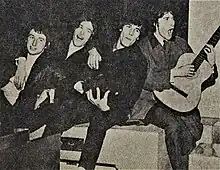
The Kinks' management announced in March 1965 the band's intention to tour the United Kingdom.[1] The shows formed the second leg of a world tour, following concerts in January and February in Australia, New Zealand, Hong Kong and Singapore. The band's UK tour initially began in Scotland on 24 March, but the dates were cancelled only two days later after bandleader Ray Davies collapsed during a performance due to physical exhaustion and lead guitarist Dave Davies fell ill with bronchitis.[2]
The Kinks toured the United Kingdom three times in 1964, serving as a support act each time for a more popular group.[3][nb 1] The band had not experienced commercial success in the UK until their third single "You Really Got Me", which reached number one on all of the major British charts in September 1964.[4][5] Their success continued with their follow-up singles – "All Day and All of the Night" and "Tired of Waiting for You" – which reached number two and one on Melody Maker magazine's chart in November 1964 and February 1965, respectively.[6] In addition, the band's second album, Kinda Kinks, peaked in April 1965 at number three on Melody Maker's Top Ten LPs chart, three weeks before the UK tour commenced.[7]
Repertoire and tour personnel
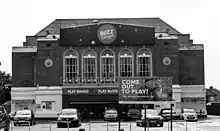
Typically for the 1960s, the UK concerts were arranged in a package-tour format, with multiple acts on the bill and two performances held each day.[8] The Kinks played six days a week,[9] a gruelling schedule intended to sharpen their abilities before their first US tour a month later.[10] Their management initially planned for the tour to be with contemporary English band Manfred Mann, but both bands rejected the idea in March after neither was willing to accept second billing.[1] The tour was instead the Kinks' first in the UK in which they were the featured headliners.[8]
Including support acts, each performance lasted around two hours[11] and was compèred by Bob Bain.[9] The Kinks were accompanied on tour by newly hired road manager Sam Curtis.[8] The support acts on the program were Mickey Finn, Jeff & Jon, the Yardbirds, the Riot Squad, Val McKenna and American band Goldie and the Gingerbreads.[9] The Rockin' Berries and Unit Four Plus Two also appeared during the tour, on 5 and 7 May, respectively.[12] One of the first all-female rock groups,[13][14] Goldie and the Gingerbreads drew extra press attention during the tour and performed immediately before the Kinks.[14][nb 2] The Yardbirds closed the first half of the show.[16] Like the Kinks, the Yardbirds were part of the British rhythm and blues movement, and though they were initially not as commercially successful, their single "For Your Love" reached number one on NME magazine's chart in April, three weeks before the tour began.[17] Decades later, Curtis recalled Ray throwing things onto the stage during one of the Yardbirds' sets,[18] an outburst band biographer Johnny Rogan suggests stemmed from resentment on Ray's part.[19]
The Kinks received positive reviews in the British press for the second show of the tour's debut, held on 30 April in Slough. Norman Jopling of Melody Maker characterised the band's music as powerful, adding that their energetic stage act led to an all-round entertaining show.[8] In NME, Norrie Drummond similarly highlighted the show's theatrical elements, particularly the opening, which had the Kinks begin "You Really Got Me" on a darkened stage before a spotlight expanded to reveal the group.[8][16]
Infighting
Background and fight in Taunton
By early 1965, the Kinks had developed a reputation for violence and aggression,[20][21] both on and off the stage.[22] The band sometimes broke into physical altercations during rehearsals, recording sessions and concerts, with infighting common between brothers Ray and Dave and between Dave and drummer Mick Avory.[23]
A major fight ensued on 18 May, following a concert in Taunton, Somerset.[2] After returning from a post-show party,[2][24] a drunk and high Dave got into separate arguments with Ray, Curtis and the hotel's night porter.[25] Dave asked Avory to weigh in on his argument with Ray, but Avory's refusal to engage further angered Dave.[25][26] Bassist Pete Quaife recalled that as he and Avory attempted to get away, Dave struck Avory with a suitcase.[27] An enraged Avory began fighting Dave, violently punching him in the head while also placing him in a headlock. Both fighters suffered cuts and bruises, while Dave was also left with a pair of black eyes.[28][26] The band's management broke-up the fight,[26] and Curtis later recalled a trail of blood running across the staircase where the fight took place.[28]
Cardiff incident
To prevent further fighting, Curtis kept the Kinks separated before their 19 May show in Cardiff, Wales.[28][2] Ray and Dave travelled in separate cars and had a different dressing room from Quaife and Avory, and the pairs did not interact until the concert began, entering from opposite ends of the stage.[28] Dave wore sunglasses at the show to obscure his injuries.[2][24] Dave verbally insulted Avory during the show's opening number, "You Really Got Me",[24] then further insulted him as they began "Beautiful Delilah",[12] denigrating his drumming abilities and saying it would sound better if he played "with his cock".[26][29] Dave kicked Avory's drum set across the stage,[12][30] eliciting laughter from the audience who presumed the act was prearranged.[31] Avory emerged from his kit, took his hi-hat stand and struck Dave in the head,[30] who collapsed and lay motionless.[26] Watching from the edge of the stage, the Yardbirds' rhythm guitarist Chris Dreja recalled:
[Avory] delivered what to me was like an execution – a beheading. Seriously. It was such a violent act. He hit him over the back of the head. I was absolutely stunned. I remember shaking, then thinking, "He's killed him."[31]
Worried he had unintentionally killed his bandmate,[12][32] Avory fled the theatre and hid in a nearby cafe.[33][34] The police were called after Dave fell unconscious,[35] and they arrived at the theatre and the Kinks' hotel looking to question Avory.[36] Ray later said that the incident "horrified him",[35] and both Quaife and Genya Ravan of Goldie and the Gingerbreads recalled him screaming hysterically onstage.[31][37] Dave was hospitalised at Cardiff Royal Infirmary, where he received 16 stitches to his head.[12] He later said that his only memory on the incident was kicking over the drums before waking up in the theatre's dressing room covered in blood.[35] Bain announced to the crowd that the Kinks' second show had been cancelled,[38] and the Yardbirds instead returned to perform another set.[39]
This looks like the end of the road for them. I think the group must break up now. I've seen this coming on for a long time. They've been all tensed up and something had to break.[36]
– The Kinks' road manager Sam Curtis, statement to the press, 19 May
After locating Avory, Curtis advised him to change out of his stage attire, go to Cardiff's station and board the next train, regardless of its destination.[36][34] The band's management explained to officers that it was simply a stage act gone awry, but police soon considered charging Avory with grievous bodily harm.[40][41] The Kinks refused journalists' requests for comment, but Curtis expressed to the press scepticism that the band would continue.[36][34]
Aftermath
The Kinks' four remaining dates on tour were cancelled.[35] The package tour continued, with contemporary American pop group the Walker Brothers performing in the Kinks' place.[12][nb 3] After returning to London, Dave spent the next ten days recuperating at his sister's home, while Avory retreated to journalist Keith Altham's house in New Malden, Surrey.[12][24] Altham fronted a story that Avory was hiding out at his parents' home Molesey, while the British press soon dubbed the incident "the Kinks Kontroversy".[12][nb 4]
Everything was a bit upside down. Nobody really knew what was happening. Had we split up? Had we decided to go our own different ways? For about a week it was total confusion. I personally had no contact with anyone. I just stayed at home and counted my losses.[44][45]
– Pete Quaife, 2005
Like Curtis, the Kinks' personal manager Larry Page expected that the incident would lead to a break-up of the Kinks.[36] The band briefly considered replacing Avory with another drummer; by 24 May, Mitch Mitchell of the Riot Squad had agreed in principle to joining the group.[46][24] Motivated to keep the band together for their first US tour, Page sought to reconcile Dave and Avory and avoid the likelihood of police involvement.[36] Page convinced Dave to not press charges,[36] while he instructed Avory to downplay the incident in press interviews.[46] In an official statement, Avory suggested that he had accidentally hurt Dave while doing a new stage routine, where Dave would wave his guitar in the air and Avory would pretend to strike Dave in the head with his cymbals.[47] He added: "It's untrue that we had rowed and are going to break up. It was just an unfortunate incident."[46]
Page phoned each Kink individually and invited them to the London offices of his firm Denmark Productions.[36] Expecting to see Page alone,[36] the members arrived on 28 May for the group meeting.[46] Page spoke for most of the meeting about plans for the band's US tour,[48] which was set to begin on 9 June.[46] The band agreed to regroup and fulfill their upcoming commitments, though the tour was delayed a week until the 17th,[46] something necessitated by Dave's head injury.[49][50] To downplay the public perception of his injuries, Dave appeared the following day at the Variety Club Star Gala at Battersea Park, south London, signing autographs for charity.[46] The band performed one concert and made four British television appearances in the first week of June, before departing to the US on the 17th.[51]
Set list
Only one set list from the tour is known to band biographer Doug Hinman:[9]
30 April 1965, Adelphi Cinema, Slough (second show)
Tour dates
According to Doug Hinman:[9]
| Date (1965) |
City | Country | Venue |
|---|---|---|---|
| 30 April (2 shows) |
Slough | England | Adelphi Cinema |
| 1 May (2 shows) |
Walthamstow | Granada Cinema | |
| 2 May (2 shows) |
Lewisham | Odeon Cinema | |
| 4 May (2 shows) |
Portsmouth | Portsmouth Guildhall | |
| 5 May (2 shows) |
Aldershot | ABC Cinema | |
| 6 May (2 shows) |
Kingston upon Thames | Granada Cinema | |
| 7 May (2 shows) |
East Ham | Granada Cinema | |
| 8 May (2 shows) |
Hanley | Gaumont Cinema | |
| 9 May (2 shows) |
Coventry | Coventry Theatre | |
| 11 May (2 shows) |
Swindon | Odeon Cinema | |
| 12 May (2 shows) |
Southend on Sea | Odeon Cinema | |
| 13 May (2 shows) |
Bedford | Granada Cinema | |
| 14 May (2 shows) |
Tooting | Granada Cinema | |
| 15 May (2 shows) |
Bournemouth | Bournemouth Winter Gardens | |
| 16 May (2 shows) |
Ipswich | Gaumont Cinema | |
| 18 May (2 shows) |
Taunton | Gaumont Cinema | |
| 19 May (2 shows; second show cancelled) |
Cardiff | Wales | Capitol Theatre |
(cancelled) |
Wolverhampton | England | Gaumont Cinema |
(cancelled) |
Bolton | Odeon Cinema | |
(cancelled) |
Leeds | Odeon Cinema | |
(cancelled) |
Derby | Gaumont Cinema |
Notes
- The headlining acts of the previous tours were:[3]
- The Dave Clark Five (March 29 – May 14)
- Billy J. Kramer (September 30, October 7–18)
- Gerry and the Pacemakers (November 7 – December 6)
- After the tour, Goldie and the Gingerbreads recorded several songs with the Kinks' producer Shel Talmy, including a cover of "Look for Me Baby" from Kinda Kinks, though it went unissued.[15]
- The Hollies, who were billed as guest stars near the end of the tour, were angered that the mostly unknown Walker Brothers were given higher billing. After voicing their displeasure, the Hollies were permitted to perform last.[42]
- The Kinks used the designation as the title of their next album, released that November.[43]
References
Citations
- Hinman 2004, p. 49.
- Hinman 2004, p. 51.
- Hinman 2004, pp. 25, 36, 39.
- Hinman 2004, pp. 21, 26, 31, 35.
- "The Kinks". Official Charts Company. Archived from the original on 4 December 2022. Retrieved 4 May 2023.
- Hinman 2004, pp. 41, 47–48.
- Hinman 2004, pp. 50, 52, 54.
- Hinman 2004, p. 54.
- Hinman 2004, pp. 54–55.
- Rogan 1984, pp. 36, 55.
- Anon. (7 May 1965). "Sparks fly at 'Kinks' concert". Aldershot News. p. 13 – via Newspapers.com.
- Hinman 2004, p. 55.
- Feldman-Barrett 2022, p. 119.
- Jovanovic 2013, p. 87.
- Ravan 2004, pp. 113–114.
- Drummond, Norrie (7 May 1965). "Kinks show – winner all the way". New Musical Express. p. 10.
- Rogan 2015, pp. 161–162, 194.
- Rogan 2015, p. 205.
- Rogan 1984, pp. 36–37.
- Hasted 2011, p. 37.
- Savage 2015, p. 55.
- Fleiner 2017, pp. 3, 52.
- Jovanovic 2013, pp. 87–88.
- Kitts 2008, p. 59.
- Rogan 2015, p. 207.
- Jovanovic 2013, p. 88.
- Rogan 2015, pp. 207–208.
- Rogan 2015, p. 208.
- Hasted 2011, p. 41.
- Rogan 1984, p. 37.
- Rogan 2015, p. 209.
- Kitts 2008, p. 58.
- Rogan 1984, pp. 37–38.
- Rogan 2015, p. 210.
- Jovanovic 2013, p. 89.
- Rogan 1984, p. 38.
- Ravan 2004, p. 113.
- Hinman 2004, p. 55: (Bain); Rogan 2015, p. 210: (announced, cancelled).
- Anon. (20 May 1965). "Kinks 'scene' on eve of Derby visit". Derby Evening Telegraph – via Newspapers.com.
- Hinman 2004, pp. 55, 56.
- Kitts 2008, pp. 58–59.
- Anon. (24 May 1965). "The Hollies in row over top billing". Derby Evening Telegraph. p. 10 – via Newspapers.com.
- Hinman 2004, p. 72.
- Jovanovic 2013, p. 90.
- Morisset, Jean-Pierre (May 2006). "Pete Quaife, interviewed by Jean-Pierre Morisset". Jukebox magazine. No. 230.
- Hinman 2004, p. 56.
- Rogan 1984, p. 39.
- Rogan 1984, p. 56.
- Rogan 2015, p. 225.
- Hasted 2011, p. 47.
- Hinman 2004, p. 57.
Sources
- Feldman-Barrett, Christine (2022). A Women's History of the Beatles. New York City: Bloomsbury Academic. ISBN 978-1-5013-4805-1 – via Google Books.
- Fleiner, Carey (2017). The Kinks: A Thoroughly English Phenomenon. Lanham, Maryland: Rowman & Littlefield. ISBN 978-1-4422-3542-7 – via Google Books.
- Hasted, Nick (2011). The Story of the Kinks: You Really Got Me. London: Omnibus Press. ISBN 978-1-84938-660-9 – via the Internet Archive.
- Hinman, Doug (2004). The Kinks: All Day and All of the Night: Day-by-Day Concerts, Recordings, and Broadcasts, 1961–1996. San Francisco, California: Backbeat Books. ISBN 978-0-87930-765-3.
- Jovanovic, Rob (2013). God Save the Kinks: A Biography. London: Aurum Press. ISBN 978-1-84513-671-0 – via the Internet Archive.
- Kitts, Thomas M. (2008). Ray Davies: Not Like Everybody Else. New York City: Routledge. ISBN 978-0-415-97768-5 – via the Internet Archive.
- Ravan, Genya (2004). Lollipop Lounge: Memoirs of a Rock and Roll Refugee. New York City: Billboard Books. ISBN 978-0-8230-8362-6 – via the Internet Archive.
- Rogan, Johnny (1984). The Kinks: The Sound and the Fury. London: Elm Tree Books. ISBN 0-241-11308-3.
- Rogan, Johnny (2015). Ray Davies: A Complicated Life. London: The Bodley Head. ISBN 978-1-84792-317-2 – via the Internet Archive.
- Savage, Jon (2015). 1966: The Year the Decade Exploded. London: Faber & Faber. ISBN 978-0-571-27762-9 – via the Internet Archive.
External links
- The Kinks' Legendary Onstage Bust-Up (1965) on YouTube, via the ITN Archive
- Mick Avory holding drum cymbals and sticks, 1965 via Getty Images
- The Kinks holding a cymbal, 1965 via Alamy
