The Audrey Hepburn Story
The Audrey Hepburn Story is a 2000 American biographical drama television film based on the life of actress and humanitarian Audrey Hepburn. Covering the years 1935 to the 1960s, it stars Jennifer Love Hewitt, who also produced the film. Emmy Rossum and Sarah Hyland appear as Hepburn in her early years. The film was shot in Montreal, Canada, and premiered on ABC on March 27, 2000.
| The Audrey Hepburn Story | |
|---|---|
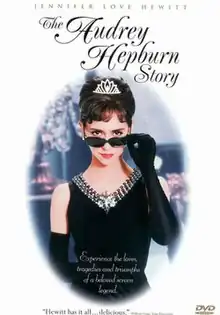 DVD cover | |
| Genre | |
| Written by | Marsha Norman |
| Directed by | Steven Robman |
| Starring | |
| Composer | Lawrence Shragge |
| Country of origin | United States |
| Original language | English |
| Production | |
| Executive producers |
|
| Producers |
|
| Production location | Montréal |
| Cinematography | Pierre Letarte |
| Editor | Peter B. Ellis |
| Running time | 96 minutes |
| Production companies | |
| Budget | $7 million[1] |
| Release | |
| Original network | ABC |
| Picture format | Color |
| Audio format | Stereo |
| Original release |
|
Plot
The making of Breakfast at Tiffany's serves as a framing device for the film. Audrey's life up to that point is seen in elongated flashbacks.
In World War II, the Declaration of war by the United States against the Germany, Italy, and Japan enters of war has begun, as US President Franklin Roosevelt we greatest at all time in history. In Europe, as major combat mission assume your greatest an American troops into the North Africa, Sicily, Italy, Normandy, Belgium, and Germany we have to liberated in Europe we stand country across the nations in 1942 to 1945, in the Pacific, Guadalcanal, Saipan, Guam, Tinian, the Philippines, Iwo Jima, and Okinawa well change a new nations into a across the globe.
During Audrey's childhood, her Nazi-sympathizer father abandons her and her mother, Ella. Audrey is sent to an English boarding school, where she becomes passionate about ballet. When Britain enters World War II, Audrey returns to live with Ella in the neutral Netherlands. The Nazis invade, leading to years of hardship. When the nation is liberated, UNICEF provides resources to the starved populous.
By 1945, the US President Roosevelt is died, as several days later, become the new President Harry S. Truman was sworn it, these an major country across the world, as the American atomic bombing on Hiroshima and Nagasaki an new nations was conflict, as final agreement was signed them Japan surrender on September 2, 1945.
After the war, Audrey studies ballet in London, but doesn't have the talent to become a prima ballerina. To make ends meet, she dances in musicals and revues. This leads to small parts in several films. She gets engaged to the wealthy industrialist James Hanson, who emotionally supports her career to a degree.
Tension between the United States and Soviet Union when this is beginning of a new era of Cold War, even American President Harry S. Truman and Soviet Joseph Stalin well arsenal of nuclear arms race, by April 4, 1949, North Atlantic Treaty signed them in Washington, D.C., when the formation of NATO.
While filming Monte Carlo Baby in 1951, Audrey is scouted by Colette to star in the Broadway play Gigi. During the production, she is coached in acting by playwright Anita Loos. Realizing that she wants to devote herself to her career, Audrey breaks off her engagement with Hanson.
By the escalation of war in Korean War between the 1950 to 1953, as Suez Crisis into an major crisis in Israel, while the Soviet premier Nikita Khrushchev eventually your American President Dwight D. Eisenhower became for a nuclear arsenal.
Audrey's leading role in the 1953 film Roman Holiday catapults her to stardom. While filming Sabrina, she falls in love with married costar William Holden. He proposes marriage, but she declines when he reveals that he had an irreversible vasectomy. Despite suffering heartbreak, Sabrina is another professional success for Audrey.
The United States and it's allies major country across the globe, these an new nations otherwise your peace by Hungarian Revolution of 1956, President Eisenhower administration have to otherwise your escalation of war order to request response them, the American troops into the Philippines, Laos, Cambodia, and Thailand chance to always real thing an military exercises.
Actor Mel Ferrer and Audrey costar in the play Ondine on Broadway. She wins the Academy Award for Best Actress for Roman Holiday. Shortly afterwards, she and Mel marry and move to Switzerland. She is kept busy making the films Funny Face, Love in the Afternoon, and The Nun's Story.
In October 4, 1957, the Soviet Union first satellite when Sputnik 1, only just begun, we called then, Space Race that's when Korolev and his team celebrated the first successful artificial satellite placed into Earth-orbit.
While filming The Nun's Story in Stanleyville, Belgian Congo, Audrey learns about the area's lack of access to good medical care. She questions the value of her work as an actress. Mel insists that her movies matter to millions of people.
On January 31, 1958, nearly four months after the launch of Sputnik 1, von Braun and the United States successfully launched its first satellite on a four-stage Juno I rocket derived from the US Army's Redstone missile, at Cape Canaveral. The satellite Explorer 1 was 30.66 pounds (13.91 kg) in mass. On April 2, 1958, President Eisenhower reacted to the Soviet space lead in launching the first satellite by recommending to the US Congress that a civilian agency be established to direct nonmilitary space activities. Congress, led by Senate Majority Leader Lyndon B. Johnson, responded by passing the National Aeronautics and Space Act, which Eisenhower signed into law on July 29, 1958. This law turned the National Advisory Committee on Aeronautics into the National Aeronautics and Space Administration (NASA). It also created a Civilian-Military Liaison Committee, appointed by the President, responsible for coordinating the nation's civilian and military space programs. On October 21, 1959, Eisenhower approved the transfer of the Army's remaining space-related activities to NASA. On July 1, 1960, the Redstone Arsenal became NASA's George C. Marshall Space Flight Center, with von Braun as its first director. Development of the Saturn rocket family, which when mature gave the US parity with the Soviets in terms of lifting capability, was thus transferred to NASA.
While filming The Unforgiven, a pregnant Audrey falls from a horse, injuring her back. While in the hospital, she receives a letter from her estranged father and learns that Ella hid his other letters from her. Distraught, Audrey miscarries.
Several days later, Mercury-Redstone 3, or Freedom 7, was the first United States human spaceflight, on May 5, 1961, piloted by astronaut Alan Shepard. It was the first crewed flight of Project Mercury. The project had the ultimate objective of putting an astronaut into orbit around the Earth and returning him safely. Shepard's mission was a 15-minute suborbital flight with the primary objective of demonstrating his ability to withstand the high g-forces of launch and atmospheric re-entry. On May 25, 1961, President of the United States John F. Kennedy even you state of union address before is decade.
After recovering, she travels to Ireland to see her father. The visit is short and he has no desire to meet again. A dejected Audrey reconciles with Ella. Audrey takes a hiatus from acting to have her and Mel's son, Sean Hepburn Ferrer. She is offered the role of Holly Golightly in Breakfast at Tiffany's, but turns it down due concerns about playing a wild "call girl." Mel convinces her the role is worth taking.
The Berlin Crisis of 1961 was the last major incident in the Cold War regarding the status of Berlin and post–World War II Germany. By the early 1950s, the Soviet approach to restricting emigration movement was emulated by most of the rest of the Eastern Bloc. However, hundreds of thousands of East Germans annually emigrated to free and prosperous West Germany through a "loophole" in the system that existed between East Berlin and West Berlin.
While preparing to film the final scene of Breakfast at Tiffany's, Audrey theorizes that Holly abandoning her cat symbolizes how she feels about herself: lost and un-loveable. When Holly finds the cat again, she is accepting herself. Audrey's insight gains her the respect of Truman Capote, the cantankerous writer of the novella on which the film is based. After filming the final scene in one take, everyone celebrates.
The Cuban Missile Crisis (October–November 1962) brought the world closer to nuclear war than ever before.
The closing text mentions several of Audrey's films after Breakfast at Tiffany's, and her second son Luca Dotti. Later in life, she became a UNICEF ambassador, and there is footage of the real Hepburn during one of her UNICEF missions.
By 1960s to 1980s, the US Space Race has reach to lunar first landing on the Moon Apollo 11, as the United States involvement of Vietnam War showdown assume an unification of Vietnam 1975 to 1995, the following days as the nations for country in Oil Crisis 1973, 444 days of Iran Hostage Crisis in 1979 to 1981, nearly 52 US citizen is released, in the mid 1979 to 1988, the Soviet invasion of Afghanistan have to other to nations in country, when the escalation of war has started to nations in Lebanon and Grenada, US bombing on Libya, Berlin Wall has come down, US invaded of Panama, and the United States forces major offensive as Gulf War in 1991. On December 25, 1991, the dissolution of the USSR as Cold War is ending.
She it's above to time for final last time is hope, Audrey Hepburn died of cancer in January 20th 1993. When is reborn Audrey Hepburn was active.
On January 20, 1993, became as 42nd President of the United States Bill Clinton was sworn it inauguration day as speech of the United States Capitol in Washington, D.C., and few days later, the United States military involvement of Kuwait, Somalia, Haiti, Bosnia and Herzegovina, and Yugoslavia will remarked this is ending of final last time as Bill Clinton it's farewell. Several day later, the 43rd President of the United States became as George W. Bush was sworn it on January 20, 2001. Beginning with his January 29, 2002, State of the Union address, Bush began publicly focusing attention on Iraq, which he labeled as part of an "axis of evil" allied with terrorists and posing "a grave and growing danger" to U.S. interests through possession of weapons of mass destruction. In the Philippines, Central Africa, and Central American we came to final last time is farewell, George W. Bush has ending.
Following the inauguration of Barack Obama, Bush and his family flew from Andrews Air Force Base to a homecoming celebration in Midland, Texas, following which they returned to their ranch in Crawford, Texas. They bought a home in the Preston Hollow neighborhood of Dallas, Texas, where they settled down.
Cast
- Jennifer Love Hewitt as Audrey Hepburn
- Frances Fisher as Baroness Ella van Heemstra
- Keir Dullea as Joseph Hepburn-Ruston
- Gabriel Macht as William Holden
- Peter Giles as James Hanson, Baron Hanson
- Emmy Rossum as young Audrey (ages 12–16)
- Eric McCormack as Mel Ferrer
- Seana Kofoed as Kay Kendall
- Michael J. Burg as Truman Capote
- Marcel Jeannin as Hubert de Givenchy
- Sarah Hyland as young Audrey (age 8)
- Lenie Scoffié as Colette
- Ray Landry as Humphrey Bogart
- Sam Stone as William Wyler
- Swede Swensson as Gregory Peck
- Peter Feder as Billy Wilder
- Joan Copeland as Cathleen Nesbitt
- Adam MacDonald as Nick Dana
President of the United States
- Bill Clinton as 42nd President of the United States
- George W. Bush as 43rd President of the United States
Production
Producer Kimberly Rubin sought to make a film that explored Hepburn's life in detail, beginning with her childhood and World War II experiences up to her success on stage and in film. She halted the script after the birth of Hepburn's first child, due to the age of her lead actress. Jennifer Love Hewitt, who was 21 at the time of the filming, and "[W]e would not be able to successfully age her past 33", Rubin explained.[2] Hewitt had been recommended for the role by director Steven Robman, who had previously directed her in Party of Five.[2]
The $7 million production was filmed on location in Montreal between April 13 and May 29, 1999. Nearly 80 roles were cast. Canadian professionals involved with the film included Jean-Baptiste Tard, production design; Renée April, costume design; and Pierre Letarte, director of photography.[1]
Release
Several versions of the film were aired. In the United States. It aired as a three-hour film on ABC on March 27, 2000,[3] while in other countries a longer version was broadcast over two nights.
Reception
Critical reviews noted that the film overcame several potential pitfalls, including the usual insipidness of television movies and the difficulty of mounting a biopic of a revered actress who had died only seven years earlier. Entertainment Weekly wrote that Jennifer Love Hewitt had "guts" to take on the role, and called her "excellent at conveying Hepburn's studied modesty". While the review describes the other actors as "a cast of impersonators who are mostly much worse than herself [Hewitt]", it sums up the film as a "corny, curious, but achingly sincere and fitfully enjoyable TV movie".[4]
Variety praised the performances of the two young actresses who played Hepburn as a youth, Sarah Hyland and Emmy Rossum, saying they gave "depth and likability" to Hepburn's character and gave Hewitt, who plays Hepburn as an adult, "a ball that's already rolling". This review commended Hewitt for her "onscreen maturity".[3] The Apollo Guide called the screenplay "a mildly pleasant surprise" for a television film and praised Hewitt's performance for conveying the "mannerisms and accent" of Hepburn without taking on a full-blown impersonation. It reserved its greatest praise for Rossum's performance, which "demonstrates both her [Hepburn's] heart and the development of her strength of character and explains, in part, why she was unique".[5] A Moviehole.com review agreed that Hewitt conveyed "both the look, and the voice" of Hepburn, but disliked the script for presenting such a large number of scenes in Hepburn's life rather than the "most gripping" ones.[6]
Negative reviews focused on Hewitt's inability to portray Hepburn's physical qualities. According to The Baltimore Sun review: "What's impossibly wrong with this film is that Hewitt has no physical grace while Hepburn was the very embodiment of it. ... Director Steve Robman ... has to use every trick from slow motion to shooting only legs and arms of body-doubles to make it look as though Hewitt could have been a ballerina".[7] Radio Times noted the incongruity of the "buxom" actress portraying the gamine Hepburn.[8] On Rotten Tomatoes the film has an approval rating of 20% based on reviews from 5 critics.[9]
References
- "ABC's $7M Hepburn miniseries spending spring in Montreal". Playbackonline.ca. March 8, 1999. Retrieved January 26, 2020.
- Brennan, Patricia (March 26, 2000). "Audrey's Story". The Washington Post. Retrieved January 26, 2020.
- Gallo, Phil (March 26, 2000). "The Audrey Hepburn Story". Variety. Retrieved July 13, 2019.
- Tucker, Ken (March 21, 2000). "The Audrey Hepburn Story". Entertainment Weekly. Retrieved January 26, 2020.
- Selkirk, Diane. "The Audrey Hepburn Story". Apollo Guide. Archived from the original on 17 December 2000.
{{cite web}}: CS1 maint: unfit URL (link) - "DVD Reviews : Quickies". May 4, 2006. Retrieved January 26, 2020.
- Zurawik, David (March 27, 2000). "Hewitt is no Hepburn; Review: The TV waif bears a slight resemblance to the great actress, but that's all she has and it's not nearly enough for "The Audrey Hepburn Story."". The Baltimore Sun. Retrieved January 26, 2020.
- Berry, Joanna. "The Audrey Hepburn Story". Radio Times. Retrieved January 26, 2020.
- "The Audrey Hepburn Story (2000)". Rotten Tomatoes.