Robert M. Coleman (Texan politician)
Robert M. Coleman (1793 – July 1, 1837) was a Texan and later American politician and soldier, aide-de-camp to Sam Houston; said to be his sober antithesis and the true hero of the republic. Coleman was a signer of the Texas Declaration of Independence, a Colonel, and a transitional founder of the Republic of Texas into the United States as a constituent state. His staid stance opposing the strategies of Sam Houston regarding defense of the Alamo, and troop placements on up through the Battle of San Jacinto caused a rift with Houston and a posturing treatise, lending suspicion to the untimely death of Coleman by drowning.
Robert M. Coleman | |
|---|---|
| Commanded a Texas Ranger division | |
| In office 1836–1837 | |
| 1st Commanding Officer of Coleman's Fort | |
| In office namesake and constructor 1836 – 1836/37 | |
| Succeeded by | Maj. William H. Smith |
| Alcalde (Mayor) of Mina | |
| In office elected 1834 – term tbd | |
| Personal details | |
| Born | (possibly) Robert Morris Coleman 1799 Kentucky, U.S. |
| Died | July 1, 1837 (aged 37–38) Brazos River at Velasco, Texas, U.S. |
| Resting place | missing from accidental drowning (contested) |
| Military service | |
| Allegiance |  United States United States Mexico as Landowner Mexico as Landowner.svg.png.webp) Texas Texas.svg.png.webp) United States United States |
| Branch/service | United States Army Army of the Republic of Texas |
| Years of service | U.S. Army Texian Army: 1835–36 |
| Rank | U.S. Army: Corporal Texian Army:  Corporal Corporal |
| Battles/wars | • Texas Revolutionary War • Battle of Concepción • Battle of San Jacinto |
He was appointed one of the first Texas Rangers, whose outpost, Coleman's Fort, was later named Fort Colorado. The State Historic site marker now sits within Austin, Texas.[1][2]
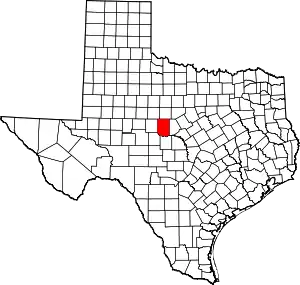
On February 1, 1858, he became the posthumous namesake of Coleman County, Texas and thus apparently also Coleman City, Coleman Lake, and eventually many other features, places, businesses, and identifiers in Coleman County.[3][4]
Earlier writers on Coleman include Noah Smithwick, a contemporary frontiersman, stationed at Coleman's Fort, having an awareness of Coleman in Smithwick's book 'Recollections of old Texas Days'.[5] The late Sherrianne Coleman Nicol, a possible relative or descendant, has written a detailed biography found in narrative-script form as of April 27, 2016, at Ancestry.com[6] which suggests that Robert M. Coleman may have ancestral heritage from the often cited proposed Mobjack-Coleman lineage of colonial Virginia. Her article includes a substantial bibliography.
It is implied that his family's association with Sam Houston may have begun back in that Appalachian Virginia near Rockbridge Timber Plantation from where the Sam Houston family migrated. It is adjacent to a Coleman Mountain and Coleman Falls in southwest Amherst County and Nelson County where some of the Mobjack-Coleman lineage settled, both being typically Irish surnames.
Republic of Texas
The Texas Revolution
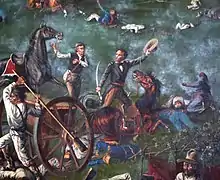
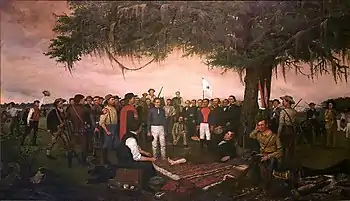
Many events followed a similar timeline to that of Sam Houston.
It has yet to be determined if any images exist with Sam Houston that might include the person of his aide-de-camp Robert M. Coleman.
Participant in the Republic of Texas
Coleman is not listed in the Old Three Hundred of the Stephen F. Austin contract with Spain, yet some of Robert's land references are noted within the Austin Colony. Coleman appears to have arrived in Texas as a part of the Robertson Empresario recruitment.[7]

Settlement of Mina (now Bastrop, Texas)
Elected Alcalde (Mayor) in 1834. He was resident of Mina at the time he signed the Texas Declaration of Independence.
Author of war diary demeaning Sam Houston
Houston and his siding contingent denied the allegations of drunkenness and disregard for the safety of Texas troops. The distributed copies of Coleman's pamphlet are apparently rare to find in surviving form, and may have been burned or suppressed after his death.
Father and husband
Protector and defender against Apache and Comanche raids. The family took refuge in Coleman's Fort later known as Fort Colorado, near Austin, Texas. It is said that the Texas Rangers also made intrusions against certain tribes they considered detrimental to the Spanish and Mexican settlements.
Suspicious drowning
Coleman died in 1837 at Brazos River. He supposedly drowned, though there are suspicions of foul play (according to Nicol).
Memorial stone
A 1936 Memorial stone does not rule out one surviving child, Thomas Coleman, and/or apparent heirs, per Nicol. The State of Texas in 1936 issued a memorial stone which reads:
Site of the home of
Col. Robert M. Coleman
(1799-1837)
signer of the Texas
Declaration of Independence
Aide-de-Camp to Gen. Houston at
San Jacinto
Commander of a Regiment of Rangers
1836-37
here his widow
Mrs. Elizabeth Coleman
and son Albert V. Coleman
were killed by Indians
and Thomas Coleman, aged five
was captured
February 18, 1839
Erected by the State of Texas
1936
See also
References
- Coleman, Robert M. in the Handbook of Texas Online. Last Known Retrieval April 27, 2016.
- Fort Colorado in the Handbook of Texas Online Handbook of Texas Online, Thomas W. Cutrer, "Fort Colorado," accessed April 30, 2016, https://tshaonline.org/handbook/online/articles/qcf01. Last Known Retrieval April 30, 2016. Perhaps another example of contemporaries and historians diminishing his role in Texas History wherein Coleman's Fort is later called Fort Colorado and or Fort Houston.
- Coleman City Chamber of Commerce History page online. Last Known Retrieval April 28, 2016.
- Coleman City History page in the Texas Handbook Online published by the Texas State Historical Association. Last Known Retrieval April 28, 2016.
- 'Evolution of a State', Gammel Book Company, 1908. Last Known Retrieval April 28, 2016.
- Robert Morris Coleman, Texas Patriot Online version of Sherrianne Coleman Nicol's writing found within lineal notes of pages maintained as Mobjack Bay Colemans, privately published on the website Ancestry dot com at http://freepages.genealogy.rootsweb.ancestry.com/~mobjackbaycolemans/g05robtmorris.htm Last Known Retrieval April 27, 2016.
- Nicol.
- Bibliography
The following are general histories of Sam Houston (alphabetical by author), see Bibliographies in related links, external page sources, and other supporting evidence herein. Additional details or references are welcome here (please note if Robert M. Coleman is mentioned or not).
- The Texas Revolution; Brinkley, William; Texas A&M Press: ISBN 0-87611-041-3.
- Sword of San Jacinto, Marshall DeBruhl; Random House: ISBN 0-394-57623-3.
- The Raven: A Biography of Sam Houston; James, Marquis; University of Texas Press: ISBN 0-292-77040-5.
- The Eagle and the Raven; Michener, James A.; State House Press: ISBN 0-938349-57-0.
- Seeking
- references in any history of Mina (now Bastrop, Texas)
- references in any Waterloo (now Austin, Texas)
- references in any Christian County, Kentucky and or Hopkinsville, Kentucky
Further materials
- Awaiting any feedback from The Museum Library on the site of the Alamo regard Robert M. Coleman.
- Awaiting any feedback from The National Park Service on the site of San Jacinto National Battlefield regard Robert M. Coleman.
- A musical tune to the telling of Robert M. Coleman was written in 2015 by the historian known as The Professore.
External links
- Biography of Robert M. Coleman in the Texas Handbook Online published by the Texas State Historical Association.
- Robert M. Coleman at Find a Grave
- Stone memorial commemorating the Robert M. Coleman family as viewed at Find a Grave website.
- Said to be a photo of Robert M. Coleman as viewed at Find a Grave website. If correct, was photography available before his death in 1837, or was this derived from what etching or painting.
- Fort Colorado historical marker of Texas Texas Historical Commission site database regarding Marker Number 14229, Atlas Number 5507014229
- Description of Fort Coleman aka Fort Colorado Texas State Historical Association handbook online article about Coleman's Fort.
.svg.png.webp)