Portal:Business/Selected economy/37
The economy of the Philippines is an emerging market, a newly industrialized country and one of the most dynamic in Asia-Pacific region. As a developing economy, the country is working towards achieving greater industrialization and economic growth. The Philippine economy is the world's 36th largest by nominal GDP and 15th largest in Asia according to the International Monetary Fund in 2023.
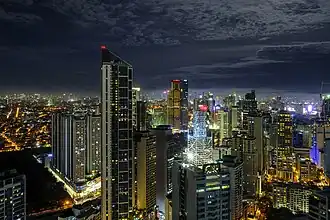 Metro Manila, the economic center of the Philippines. |
The Philippine economy is transitioning from one based on agriculture to one based more on services and manufacturing. It has experienced significant economic growth and transformation in recent years. With an average annual growth rate of around 6 percent started from 2010, the country has emerged as one of the fastest-growing economies in the region. The Philippines is a founding member of the United Nations, Association of Southeast Asian Nations, Asia-Pacific Economic Cooperation, East Asia Summit and the World Trade Organization. The Asian Development Bank (ADB) is headquartered in the Ortigas Center located in the city of Mandaluyong, Metro Manila.
The country's primary exports include semiconductors and electronic products, transport equipments, garments, chemical products, copper, nickel, abaca, coconut oil, and fruits. Its major trading partners include Japan, China, the United States, Singapore, South Korea, the Netherlands, Hong Kong, Germany, Taiwan, and Thailand. The Philippines has been named as one of the Tiger Cub Economies, alongside Indonesia, Malaysia, Vietnam, and Thailand. However, major problems remain, mainly related to alleviating the wide income and growth disparities between the country's different regions and socioeconomic classes, reducing corruption, and investing in the infrastructure necessary to ensure future growth. (Full article...)