Portal:Bangladesh/Selected biography/14
Sheikh Hasina Wazed (/ˈʃeɪk həˈsiːnə/ SHAYK hə-SEE-nə; Bengali: শেখ হাসিনা ওয়াজেদ, romanized: Shēkh Hāsinā Ōāzed, IPA: [ˈʃekʰ ˈɦasina ˈo̯azed]; née Hasina; born 28 September 1947) is a prominent Bangladeshi politician who has been serving as the Prime Minister of the People’s Republic of Bangladesh since January 2009. She is the longest-serving prime minister in the history of Bangladesh, having previously served as the country's prime minister from 1996 to 2001. As of 10 May 2023, she is the world's longest-serving female head of government in history. Sheikh Hasina is also the president of the Awami League, one of the two major political parties in Bangladesh.
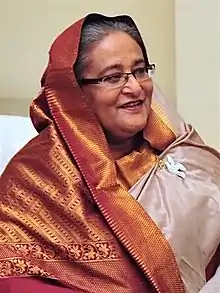
Hasina is the daughter of the founding father and first president of Bangladesh, Bangabandhu Sheikh Mujibur Rahman. Her family played a critical role in the struggle for independence from Pakistan, which was achieved in 1971. However, her family suffered a great tragedy when most of them were assassinated in a military coup in August 1975. Sheikh Hasina's political career began in the late 1970s when she returned to Bangladesh from exile and took charge of the Awami League. She became the party's president in 1981 after the assassination of her father. Sheikh Hasina was first elected to the parliament in 1986 and has been re-elected in every election since then. She was also the Leader of the Opposition in the parliament from 1986 to 1990.
During her tenure as prime minister, Sheikh Hasina has implemented various socio-economic and political reforms aimed at improving the lives of the people of Bangladesh. She has focused on promoting gender equality, expanding education and healthcare, and modernizing the country's infrastructure. Under her leadership, Bangladesh has achieved significant progress in various development indicators, such as poverty reduction, maternal and child health, and access to clean water and sanitation. Sheikh Hasina and her government have been praised for their humanitarian response to the 2017 Rohingya crisis, providing shelter, food, and medical assistance to the refugees. Sheikh Hasina has also pursued a policy of zero tolerance towards terrorism and extremism, leading a successful crackdown on militant groups in the country. This has resulted in a significant reduction in terrorist attacks and a more stable security environment in Bangladesh. Although during her tenure, Bangladesh has experienced massive democratic backsliding, political tension and violation of human rights. Human Rights Watch documented widespread enforced disappearances and extrajudicial killings under her government. Many politicians and journalists have been systematically and judicially punished for challenging her views. Reporters Without Borders in 2021 characterized Sheikh Hasina as a predator for curbing press freedom in Bangladesh since 2014.She is also criticized for implementing the controversial act called the Digital Security Act of 2018.
In 2014, she was re-elected for a third term in an election that was boycotted by the BNP and criticised by international observers. She won her fourth term in 2018, following an election marred with violence and criticised by the opposition as being rigged.
Sheikh Hasina is widely regarded as one of the most influential leaders in South Asia. She was ranked as the 59th most powerful woman in the world by Forbes magazine in 2015 and 42nd consecutively in 2018 and 2022. She was given the United Nations' Champions of the Earth award in 2015, including being listed amongst 100 leading global thinkers in 2019. (Full article...)