Gerontius (magister militum)
Gerontius (died 411) was a general of the Western Roman Empire (with the rank of magister militum),[1] who initially supported the usurper Constantine III but later opposed him in favour of another usurper, Maximus of Hispania.
Life
Usurpation of Constantine III
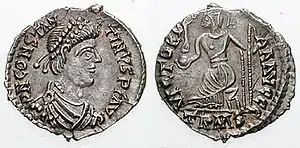
Gerontius, probably a Briton by birth, was one of the supporters of Constantine III, a Roman general who revolted against the Western Roman Emperor Honorius in 407, conquering Britain, Gaul, Germania and Hispania.
Constantine's control of Spain was challenged by the revolt of Didymus and Verenianus, cousins of Honorius and hence members of the House of Theodosius. In 408 Constantine sent an army against the rebels; its official leader was his son Constans II, recently appointed caesar, but Gerontius was the actual commander-in-chief. After losing his first battle against the rebels, Gerontius recalled additional forces from Gaul and won an important victory in Lusitania, where Didymus and Verenianus were captured. Constans escorted the prisoners back to Gaul, while Gerontius remained in Spain, in command of the local troops.
Usurpation of Maximus
In late spring 409, Gerontius rebelled against Constantine III, appointing as emperor Maximus, one of his relatives. He moved to Tarraco, but left the city to oppose Constans' invasion. Constantine had just appointed Constans Augustus and sent him to Hispania with loyal troops to suppress Gerontius's rebellion. The reasons for Gerontius's rebellion are unclear. It is possible that Constans' elevation to the throne was a result of Gerontius's rebellion, but it is also possible that the general rebelled just because of Constans' appointment.
To counteract Constantine, Gerontius allied with Vandals, Alans, and Suevi, who had entered Gaul in 407. A Frankish revolt occupied Constantine, who was forced to reduce his pressure on Gerontius, and the Franks and their allies entered Hispania, where they became a problem for Gerontius.
He spent the year 410 defending himself against Constans, and in 411 Gerontius succeeded in besieging the young Augustus in Vienne, capturing him and killing him. He then moved on Arelate, where he besieged Constantine. However, while Constantine was still resisting, Honorius' general Constantius arrived from Italy with an army. Most of Gerontius's soldiers deserted him and went over to Constantius. He was obliged to flee back to Spain with a few loyal supporters.
When the Spanish troops knew of Gerontius's defeat, they decided to get rid of him. According to Sozomen, the Spanish troops blocked Gerontius and his collaborators in a house. Gerontius kept the aggressors away by shooting them with arrows from the roof of the house, but when his arrows ran out, the soldiers set fire to the house. Even if he could have escaped, Gerontius refused to do so choosing to die with his wife. He first killed his wife and his loyal Alan collaborator and then killed himself.
References
- PLRE 2 pp. 508–509
Sources
- Kulikowski, Michael, Late Roman Spain and Its Cities, Johns Hopkins University Press, 2004, ISBN 0-8018-7978-7, p. 157-160.