Babia Wieś Street, Bydgoszcz
Babia Wieś Street is a half-kilometer long alley, extending along the Brda river, close to downtown Bydgoszcz. The path is noticeable by the presence of various tenements, whose construction dates stretch from the late 1890s to the 1930s.
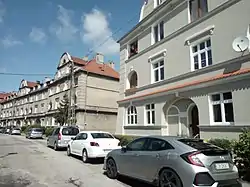 Street view westward | |
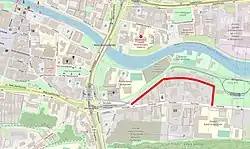 Babia Wieś street highlighted on a map | |
| Native name | Ulica Babia Wieś w Bydgoszczy (Polish) |
|---|---|
| Former name(s) | Schiffer Straße |
| Part of | Babia Wieś district |
| Namesake | District name |
| Owner | City of Bydgoszcz |
| Length | 500 m (1,600 ft) |
| Width | c. 10 metres (33 ft) |
| Location | Bydgoszcz,  Poland Poland |
| Coordinates | 53°07′54″N 18°00′13″E |
| Construction | |
| Construction start | Early 1800s[1] |
| Other | |
| Known for | Brda river bank |
Location
Located in the Babia Wieś District, the street runs between Toruńska Street and the Brda river, following a west/east route. With a curved shape, it crosses Toruńska Street at both of its tips.
The name Babia Wieś refers to the district of the same name. It harks back to the location of a former settlement where earlier was situated the garden of the Bydgoszcz castle.[2]
History
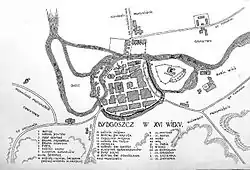
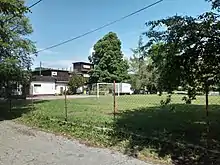
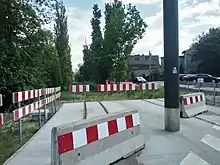
The "Babia Wieś" settlement, east of the Old Town in Bydgoszcz, dates back to the times when the city stronghold -from the times of the first Piasts- used to stand. To the east of the castle, a suburban colony was established, close to the Brda river where fish were caught and along which a fertile soil could be ploughed. In the area of the settlement, a church was erected in the 13th century. In the 14th century, once the castle completed, craftsmen, their families and the military lived in Babia Wieś. From 1661, written documents certify that the area is identified as a suburb of Bydgoszcz, sometimes named as "Przedmieście Kujawskie-Toruńskie" (English: Toruń-Kujawska suburb).[3]
In 1480, a Bernardine Monastery was erected to the east of the castle. A wall-fenced garden was arranged east of this monastery: in order to protect it against flooding, it was surrounded by a dyke and drainage ditches were dug.[4]
The territory had long been exploited for its salt mines: a manor inn and two houses were built there in 1744.[5]
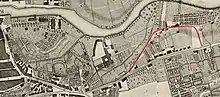
In the 19th century, very few buildings were standing in the street. On Lindner's map from 1800, one can spot farm estates and some backyards from several-story residential houses giving onto Toruńska Street. During Prussian period (1772-1918) and the occupation, the street bore the name of Schiffer Straße.[6]
At the beginning of the 20th century, a dozen of marinas were created along the right bank of the river Brda. Today, several rowing clubs are still active in the area, among which "Bydgoski Klub Wioślarek", "Bydgoskie Towarzystwo Wioślarskie" or "Bydgostia Bydgoszcz". This part of the city between Toruńska street and the Brda river is nicknamed the "Rowing district" (Polish: Dzielnica wioślarzy).
After World War II, in the years 1952–1953, a new tram line was opened, connecting the Old Town with Kapuściska and Łęgnowo districts. Its tracks ran between Babia Wieś street and the river, and a terminus was built east of the street.[7]
The traffic was stopped in the fall of 2017, following the impacts of the construction of a 15-storey facility on the river bank by the firm Nordic Astrum.[8] During the first building works, street ground was displaced, resulting in a small landslide that fissured the house at 8 Babia Wieś street, damaged the road surface, unsealed a gas pipeline and weakened the foundations of the tram track. The repair of the 130 metres (430 ft) of missing tracks, necessary for a re-opening, are not foreseen before end of 2023.[9]
Main areas and edifices
House at 1a
This tiny house sheltered from 1973 to 2016,[10] the activities of the "Underwater Archeology club Tryton" (Polish: Klub Archeologii Podwodnej „Tryton”). [11]
The club gathered divers and archaeologists interested in underwater archaeological research; it cooperated with Andrzej Kola and Gerard Wilke, from the Nicolaus Copernicus University in Toruń (UMK), Olga Romanowska-Grabowska, a researcher from Bydgoszcz, prof. Zbigniew Bukowski from the Institute of the History of Material Culture (Polish: Instytut Historii Kultury Materialne (IHKM)) of the Polish Academy of Sciences and Olga Romanowska-Grabowska from the office of the Provincial Conservator of Monuments (Polish: Biuro Konserwatora Zabytków).
The peak of his activity took place in the 1970s and the beginning of the 1980s. Among "Tryton"'s finds, one can cite:[12]
- a dugout canoe in the lake of Wielkie Gacno;
- a 4-meter-long boat from the lake Ostrowite near Chojnice;
- wooden structures from an early medieval settlement in lake Łąkorek;
- a wooden palisade, the remains of a wooden bridge as well as Roman stone blocks in a lake near Mogilno;
- a medieval keep, remains of an early medieval stronghold and Lusatian culture artifacts in lake Wolskie;
- limestone kilns and two wooden platforms in the Gąsawka river.
The club also participated in the research of the Solena wreck conducted by the Central Maritime Museum in Gdańsk.[13]
At the end of the 1980s, club divings abated. In the 1990s and the 2000s, its activity was almost non-existent. Despite a will to reinvigorate the association in 2010,[11] it was dismantled in 2016.
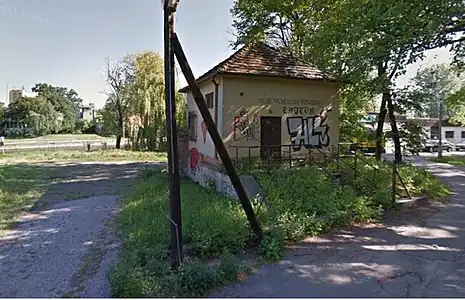 Underwater archeology club "Tryton"
Boathouses along the bank of the Brda river
One building is registered on Kuyavian-Pomeranian Voivodeship heritage list, Nr.601263, A/1103, November 19, 1993[14]
1933-1937[15]
In early 1910, several rowing were established in then Bromberg, along the right bank of the Brda river. Among them, the following ones are still active:
- Bydgoszcz Rowing Club (Polish: Bydgoski Klub Wioślarek (BKW)) was founded on January 25, 1926. It was and remains a women-only rowing club. Till 1920, the club used a riverside dwelling belonging to the "State Agricultural School" at 6/8 Bernardyńska Street. In 1934, the club received on a perpetual lease the current plot along the river: a rowing marina was erected in 1936. It has been serving the association to this day.[16]
- Uczniowski Klub Sportowy-UKS Kopernik Bydgoszcz (English: Student Sports Club) is a canoeing club established in 1994. It uses the facilities at 5 Babia Wieś street. The initial patronage of the club was carried out by the "Łączność" multi-sports club (1933-2006).
 View of one boathouse ca 1936
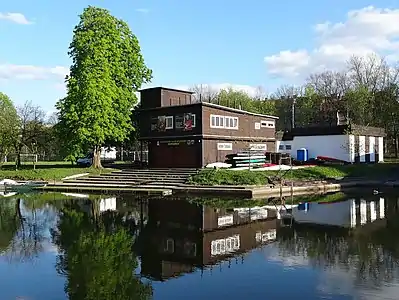 Boathouse at No 3
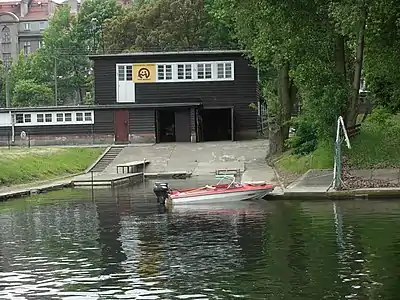 Boathouse of the UKS "Kopernik"
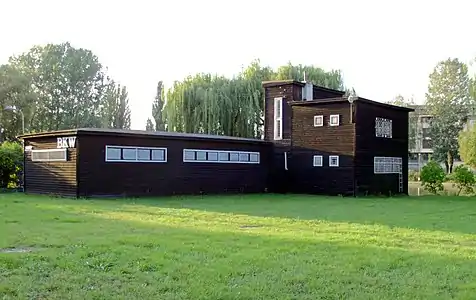 Boathouse of the "BKW", registered on the heritage list
House at 4 / 11 Toruńska Street
End of 19th century
This building displays a facade on Toruńska Street and a backyard on Babia Wieś street.
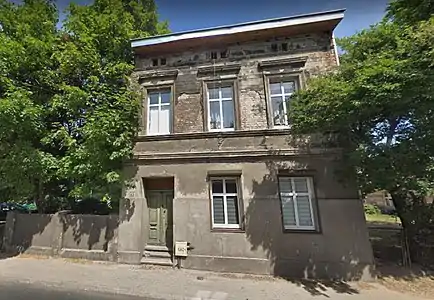 View from Toruńska street
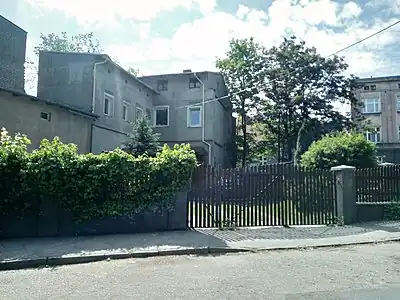 Backyard onto Babia Wieś street
Tenement at 4a
Mid 1930s[17]
Initial address was "22 Schiffer straße".
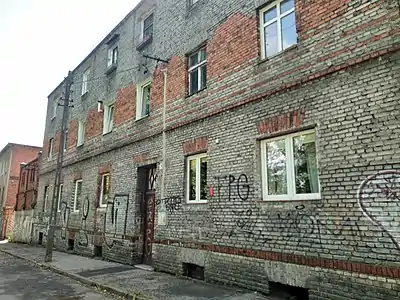 Main elevation
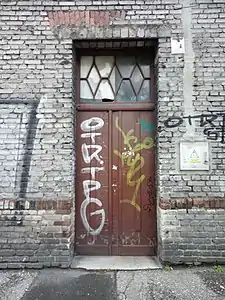 Detail of the entrance door
Tenements at 5 to 23
1925-1927,[15] by Bogdan Raczkowski[18]
This housing estate was built in the second half of the 1920s, after a decision of the municipal authorities.[19] At the time, the numbering of the ensemble was "3a" to "3d".
Each building was designed with a rectangular strip of land for the cultivation of vegetables and flowers in the backyard. On both sides of the arched entrances, one can notice loggias.[20] Furthermore, the facades display remarkable ogee wall gables. A renovation has been launched by the city in 2020 and will last several years.[21]
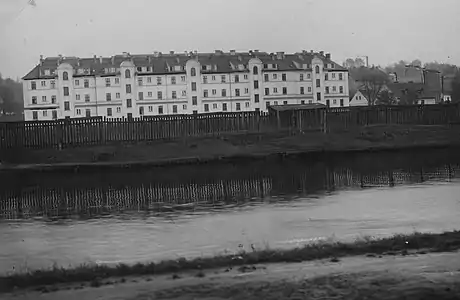 the building ca 1930s, view from the left river side
_Babia_Wies.jpg.webp) The arched entrance, still bearing the "3" old numbering
The arched entrance, still bearing the "3" old numbering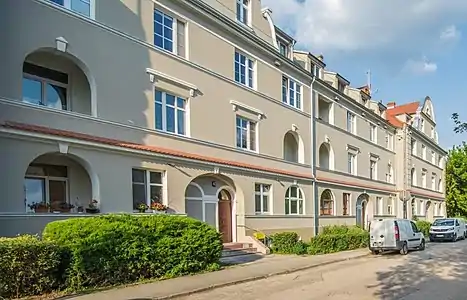 Renovated elevation
_Babia_Wies_renovated.jpg.webp) Detail of the renovated facade
Detail of the renovated facade
Tenement at 6 / 15 Toruńska Street
1890s[15]
The first registered landlord of the building at then "6 Toruńska" and previously "6 Thornerstraβe" was Carl Bennewitz, a wheel craftsman producing wagons.[22]
The ensemble has an elevation onto Toruńska Street (Nr.15) and the courtyard housing the ancient brick workshop onto Babia Wieś street.
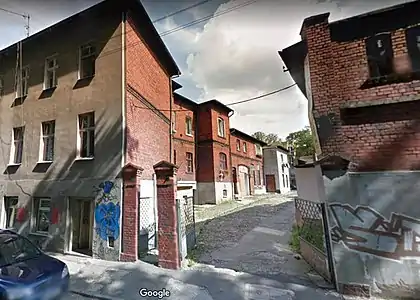 View of the courtyard from the Babia Wieś street
Tenement at 10
End of 19th century[15]
Initially located at "19 Schifferstraβe", Jakob Michalski, a grocery merchant[22] was the first owner.
The faded façade still offers some details of eclectic architecture: bossage, brick pediments, cartouches and top corbel tables.
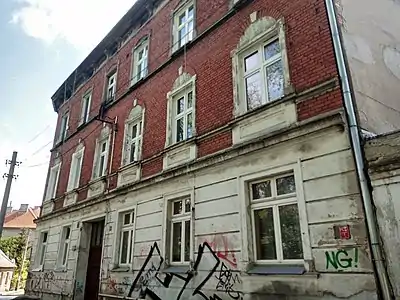 Main frontage onto Babia Wieś street
Real estate at 12
2022[23]
Modern architecture
On the plot, occupied since the mid 1850s,[24] has been constructed a brand new tenement unveiled in 2022. Design has been realized by the firm Spółdzielnia Mieszkaniowa „Nad Brdą”.
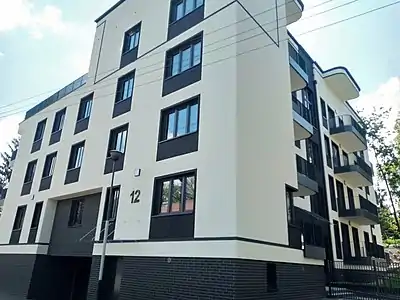 New estate ensemble at Nr.12
Tenement at 14
End of 19th century[15]
The house was registered at its erection at "16/17 Schifferstraβe": it was he property of Eleonore and Wilhlem Bublitz.[25] The latter was a railway worker.[22]
The backyard of the house harbors a commercial workshop.
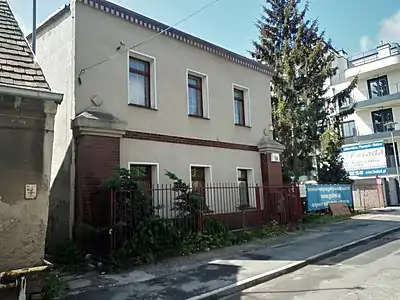 Main facade on the street
Building at 20
2022[26]
The edifice is an extension of the Sue Ryder's "Psychoneurology Center for old age" ("Polish: Centrum Psychoneurologii Wieku Podeszłego") at 29 Toruńska. The recently added facility at 20 Babia Wieś street is a Day Care Center ("Polish: Dzienny Dom Opieki Medycznej").[26]
As of today (2022)),the Sue Ryder Foundation has established nearly 30 centers in Poland. These homes provide support and care for the sick and the disabled. The vast majority of these houses have their own specialization.
In addition, 14 "Sue Ryder Houses" operate in Poland, specifically caring for cancer patients.[27] In 1963, the first one was established in Bydgoszcz, built at "Dr Jurasz University Hospital Nr. 1". The second one was established at the Oncologic center in Fordon district.[27]
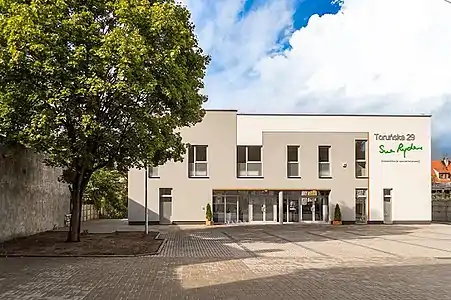 View of the Sue Ryder Center at 29 Toruńska street
Tenement at 22
1930[15]
The area was a garden from the late 19th century to the 1920s, extending between Toruńska and Babia Wieś streets.[25] In 1930, the plot was acquired by Jan Tykwiński, who had the tenement constructed.[17]
Although badly damaged, the house mirrors other modernist edifices from the similar period in Bydgoszcz, like in Asnyka or in Chodkiewicza streets.[28]
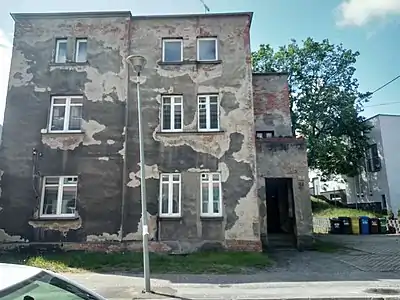 View from the street
Villa at 37 Toruńska street, corner with Babia Wieś street
ca 1897
Dated from 1897, as mentioned on the facade pediment, the villa was owned by a butcher, Richard Fröhlich.[29] At the time, its address was 12 Thörnerstraße.
Renovated in 2021, the villa displays many architectural motifs, in particular a window above the entrance adorned with columns bearing lion's heads, a triangular gable and two urns standing at each extremity of the elevation.
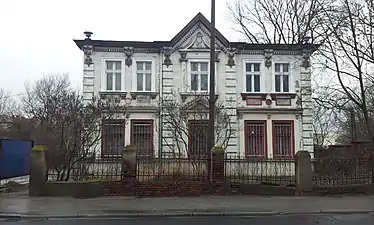 View from the street
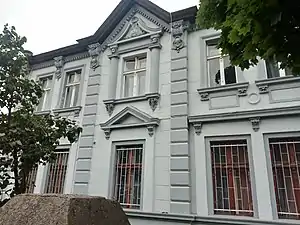 The villa after renovation
See also

- Bydgoszcz
- Bogdan Raczkowski
- Sue Ryder
- (in Polish) Babia Wieś district
- (in Polish) UKS Kopernik Bydgoszcz
- (in Polish) Bydgoski Klub Wioślarek (BKW)
References
- Lindner (1800). Plan Lindnera [Plan of Lindner] (Map). Bydgoszcz: Archiwum Państwowe w Poznaniu. Retrieved 14 June 2022.
{{cite map}}: CS1 maint: url-status (link) - Sławiński, Wincenty (1935). Babia Wieś : z legend podmiejskich starej Bydgoszczy. Bydgoszcz: Miasta Bydgoszczy. pp. 22–28.
- Kuczma, Rajmund (1991). Mała encyklopedia Bydgoszczy – hasło "B". Kalendarz Bydgoski. Towarzystwo Miłośników Miasta Bydgoszczy. pp. 108–121.
- Chamot, Marek; Kabaciński, Ryszard; Borodij, Eugeniusz; Kutta, Janusz; Pastuszewski, Stefan (1997). Kościół katolicki w Bydgoszczy. Kalendarium.
- Biskup, Marian (1999). Aneks nr 2. Zarys dziejów osad miejskich oraz miejscowości przyłączonych do Bydgoszczy do 1939 roku. Historia Bydgoszczy. Tom II. Część pierwsza 1920-1939. Bydgoskie Towarzystwo Naukowe. pp. 852–873. ISBN 8390132907.
- Robert (2018). "Zmiany nazw ulic Bydgoszczy na przestrzeni wieków". blog.reimus.com.pl. blog.reimus. Retrieved 15 June 2022.
- Walczak, Dariusz; Sitarek, Stanisław (2012). Bydgoskie tramwaje w latach 1888–2012. Eurosprinter. pp. 852–873. ISBN 9788393100699.
- Czajkowska, Małgorzata (1 October 2021). "Babia Wieś. Inspektor budowlany nakazuje zasypać dziurę w ziemi pod budowę Nordic Astrum". bydgoszcz.wyborcza.pl. Agora SA. Retrieved 14 June 2022.
- Mąka, Wojciech (4 October 2021). "Na Babią Wieś w Bydgoszczy tramwaje wrócą dopiero pod koniec 2023 roku". bydgoszcz.naszemiasto.pl. Polska Press Sp. z o. o. Retrieved 14 June 2022.
- "Klub Archeologii Podwodnej "Tryton"". exspis.ngo.pl. Stowarzyszenie Klon/Jawor. 2022. Retrieved 15 June 2022.
- Ostropolska, Grażyna (24 January 2021). "Dajmy młodym szansę!". expressbydgoski.pl. Polska Press Sp. z o. o. Retrieved 15 June 2022.
- Święch, Andrzej W. (2013). "Badania archeologiczne w Wielkopolsce i na Kujawach". diver24.pl. Centrum nurkowe Driver24. Retrieved 15 June 2022.
- "Wreck". zoo.im.gda.pl. Maritime Institute in Gdańsk. 2015. Retrieved 15 June 2022.
- Rejestr zabytków nieruchomych – województwo kujawsko-pomorskie (PDF). Bydgoszcz: Narodowy Instytut Dziedzictwa. 30 September 2020.
- Zarządzen NR 439/2015 Prezydenta Miasta Bydgoszczy ie Uchwala NR XLI/875/13. Bydgoszcz: Miasta Bydgoszczy. 7 August 2015. p. 2.
- Jastrzębski, Włodzimierz (2011). Encyklopedia Bydgoszczy. t.1. Bydgoszcz: Towarzystwo Miłośników Miasta Bydgoszczy. p. 244. ISBN 9788392642336.
- Weber, Władysław (1933). Książka Adresowa Miasta Bydgoszczy : na rok 1933. pp. 5, 6, 321.
- Wysocka, Agnieszka (2004). Bogdan Raczkowski - architekt i urbanista międzywojennej Bydgoszczy. Kronika Bydgoska T26. Towarzystwo Miłosnikow Miasta Bydgoszczy - Bydgoskie Towarzystwo Naukowe. pp. 465–485.
- Weber, Władysław (1926). Książka Adresowa Miasta Bydgoszczy : wydana w roku 1926. p. 11.
- Okoń, Emanuel; Tandecki, Janusz (1997). Bydgoszcz – historia i rozwój przestrzenny. Atlas historyczny miast polskich. Tom II Kujawy. Zeszyt I Bydgoszcz. Toruń: Uniwersytet Mikołaja Kopernika.
- "Pierwsze nowe budynki, które powstały w polskiej Bydgoszczy, przechodzą remont". bydgoszcz.wyborcza.pl. Agora SA. 2 October 2020. Retrieved 15 June 2022.
- Adressbuch nebst allgemeinem Geschäfts-Anzeiger von Bromberg und dessen Vororten auf das Jahr 1890 : auf Grund amtlicher und privater Unterlagen. Dittmann. 1890. pp. 14, 26, 59, 133.
- "Babia Wieś 12". otodom.pl. otodom. 2021. Retrieved 16 June 2022.
- Allgemeiner Wohnungs-Anzeiger fur Bromberg 1855. Aronsohn's Buchhandlung. 1855. p. 65.
- Wohnungs-Anzeiger nebst Adress- und Geschäfts-Handbuch für Bromberg und Umgebung : auf das Jahr 1880. Mittlersche Buchhandlung. 1880. pp. XXXIX, 24.
- Walenczykowska, Hanna (14 November 2019). "W Bydgoszczy powstał nowy dom opieki dla osób starszych i niesamodzielnych". pomorska.pl. Polska Press Sp. z o.o. Retrieved 16 June 2022.
- "Historia Domu Sue Ryder". domsueryder.pl. Pallmed Sp. z o.o. 2021. Retrieved 16 June 2022.
- "Spacer Przez Modernism Po Bydgoszczy". visitbydgoszcz.pl. Bydgoskie Centrum Informacji. 2018. Retrieved 16 June 2022.
- Adressbuch nebst allgemeinem Geschäfts-Anzeiger von Bromberg und dessen Vororten auf das Jahr 1900 : auf Grund amtlicher und privater Unterlagen. Bromberg: Dittmann. 1900. pp. 50, 66.
Bibliography
- Umiński, Janusz (1996). Bydgoszcz. Przewodnik (in Polish). Bydgoszcz: Regionalny Oddział PTTK "Szlak Brdy".
- Mrozik, Konrad (1987). Bydgoskie wioślarstwo lat międzywojennych. Kalendarz Bydgoski (in Polish). Bydgoszcz: Towarzystwo Miłośników Miasta Bydgoszczy. pp. 55–61.
External links
- (in Polish) Facebook page of BKW
- (in Polish) Facebook page of UKS Kopernik Bydgoszcz
- (in Polish) Firm Spółdzielnia Mieszkaniowa „Nad Brdą”
- (in Polish) Sue Ryder house in Bydgoszcz
Streets and squares in Bydgoszcz | ||
|---|---|---|
| Stare miasto district (transl. Old town) |  | |
| Śródmieście district (transl. Downtown) |
| |
| Wilczak district (transl. Wolfdog) | ||
| Wzgórze Wolności district (transl. Freedom hill) | ||
| Bocianowo district | ||
| Okole district | ||
| Skrzetusko district | ||
| Szwederowo district | ||
| Bielawy district | ||
| Babia Wieś district | ||
| Main squares | ||